NYT Pips Solver
Rebuild any Pips-style domino puzzle — paint the colored regions, set each region’s condition, enter your dominoes — and get a valid placement drawn on the board. The backtracking solver runs entirely in your browser and works on any board you enter, from the daily Easy to hand-made monsters up to 8×8.
Select a region color, then click cells on the board to paint them. Clicking a painted cell with its own color (or the eraser) clears it.
2 dominoes cover 4 cells · board has 0 painted cells
What Is Pips?
Pips is a daily domino logic puzzle from The New York Times, launched in August 2025. You get a board of cells grouped into colored regions and a tray of dominoes. Every cell must be covered by exactly one domino half, and every region’s condition must hold: a number means the pips (the dots on the domino halves) in that region sum to exactly that value; “=” means all pips in the region are equal; “≠” means all different; “<” and “>” bound the region’s sum. A domino may span two regions — each half counts toward its own region — and touching dominoes do not need matching ends. Each day has an Easy, Medium and Hard board.
How to Use the Pips Solver
- Set the grid size to fit the puzzle, then paint the board: select a region color, choose its condition, and click cells. Cells you leave unpainted are not part of the board — irregular shapes are fine.
- Enter every domino from the tray as a two-value chip (0–6 pips per half). The count readout tells you when cells and dominoes match up.
- Click Solve. A valid placement is drawn directly on the board — outlined pairs are dominoes, numbers are pips.
- Compare with your game — or use the Example button first to see how a finished setup looks.
How the Solver Works
The solver runs a classic backtracking search with constraint pruning. It scans for the first uncovered cell (row by row), tries pairing it with the free cell to its right or below, and attempts each unused domino in both orientations. Before committing a pip value to a cell, it checks the cell’s region: a sum region is pruned the moment its partial total exceeds the target (or can no longer reach it, since each remaining cell adds at most 6); an equals region rejects any second value; a ≠ region rejects duplicates; < and > regions are bounded the same way. Because bad branches die early, even 8×8 boards with a dozen dominoes solve in milliseconds.
Worked Example
Click Example to load a 2×3 board. The purple region (left column) demands all pips equal — only the 3-3 double can fill it. The amber single cell must sum to 1, so the 5-1 domino must end there with its 1; that forces its 5 into the blue region. Blue needs a total of 11, and 5 leaves 6 for the 2-4 domino: 2 + 4 = 6. Every real Pips board unwinds the same way — one forced region at a time.
Solving Order Strategy
- Start with “=” regions. They usually need doubles or matching halves — the scarcest resources in the tray.
- Then tight sums. A 3-cell region that must sum to 2 or 3, or a single-cell region with an exact number, admits very few pip combinations.
- Count your extremes. Zeros and sixes are limited; regions with very low or very high targets tell you exactly where they go.
- Watch the geometry. An odd-shaped corner cell often has only one neighbor, forcing a domino’s direction before you think about pips at all.
- Leave “no condition” regions for last — they absorb whatever dominoes remain.
Frequently Asked Questions
What do the Pips region symbols mean?
A number is an exact sum for the pips in the region. “=” means all pips in the region are the same value. “≠” means all values differ. “<N” and “>N” mean the region’s sum stays below or above N. Regions without a symbol have no restriction.
Can a domino cross two regions?
Yes — each half counts toward the region its own cell belongs to. And unlike traditional domino games, adjacent dominoes don’t need matching pip counts.
Does the solver fetch today’s NYT board?
No. It solves only boards you enter by hand. That keeps it useful for any Pips-style puzzle, including ones you design yourself.
Why does it say my board is unsolvable?
Usually a data-entry slip: the painted cell count must be exactly twice the domino count, and one wrong pip or condition value can kill every placement. Re-check the board against the puzzle.
What board sizes are supported?
Up to 8×8, with any subset of cells active — real Pips boards are irregular, and unpainted cells are simply ignored.
Can I use this to build my own Pips-style puzzles?
Yes. Design a board and dominoes, hit Solve to confirm a solution exists, then tighten conditions until the solution feels unique. It’s a quick way to prototype domino logic puzzles for classrooms or puzzle books.
Is it free and private?
Yes. No account, no server calls — the backtracking search runs in your browser and your board never leaves your device.
Not affiliated with The New York Times. Pips is an NYT game and a trademark of The New York Times Company. This is an independent helper that solves only boards you enter — it has no access to, and publishes no feed of, daily NYT puzzles or answers.
From our own shelf
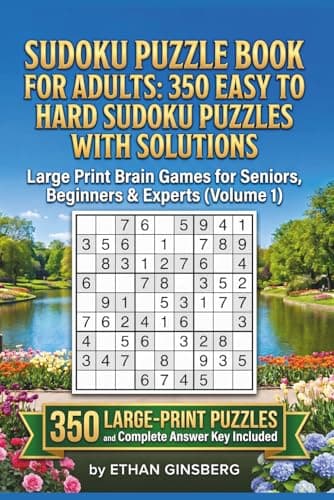
Every title- Sudoku Puzzle Book for Adults350 Easy to Hard Sudoku Puzzles with Solutions — Large Print (Volume 1)
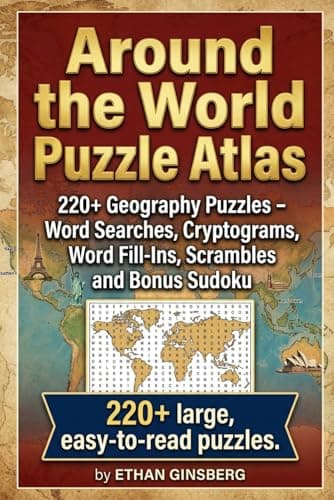
- Around the World Puzzle Atlas220+ Geography Puzzles — Word Searches, Cryptograms, Fill-Ins, Scrambles & Bonus Sudoku
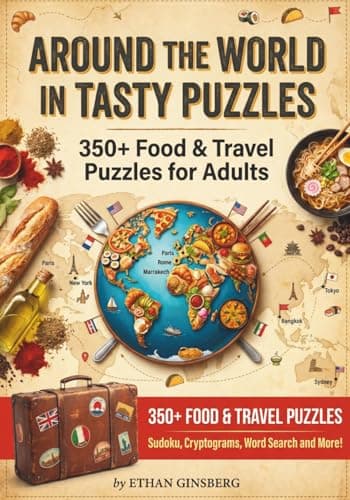
- Around the World in Tasty Puzzles330+ Food & Travel Puzzles — Sudoku, Cryptograms, Word Searches & More
These are Amazon links, and we earn a small commission if you buy through them — at no extra cost to you. They are our own books.
Every free PuzzlePage tool
All free, no signup, and they run in your browser.
Word Solvers & Finders
Daily Game Solvers & Helpers
Logic Puzzle Solvers
Cipher Tools & Decoders
Translators & Converters
Word Lists & Dictionary