Letter Boxed Solver
Enter the 12 letters from your Letter Boxed puzzle — three per side — and get every one-word and two-word solution, ranked shortest first, plus three-word chains and the full list of playable words. Some boards genuinely have no two-word answer, so the solver always has a three-word backup ready. Everything runs in your browser against the 168,000-word public-domain ENABLE list. Prefer a nudge over an answer? Flip on hint mode to see only first letters.
• Words use only the 12 letters and must be 3+ letters long.
• Consecutive letters must come from different sides.
• Each new word starts with the previous word’s last letter.
• Use all 12 letters in as few words as possible — two is the classic target.
Enter your 12 letters and click Solve, or try the example box.
Teaching with it, or recommending it to readers? Link it— it's free either way, and no attribution beyond the link is required.
Link (HTML)
<a href="https://www.puzzlepage.app/letter-boxed-solver">Letter Boxed Solver — PuzzlePage</a>What Is Letter Boxed?
Letter Boxed is a daily word puzzle from The New York Times. Twelve letters sit around a square, three per side. You spell words by drawing lines between letters, but with a twist: consecutive letters in a word must come from different sidesof the box, so you can never use two letters from the same side back to back. Each new word must start with the last letter of the previous word, chaining your solution together. The goal is to use all 12 letters in as few words as possible — the puzzle suggests a par (“try to solve it in 5 words”), and expert players aim for two.
How to Use the Letter Boxed Solver
- Type the 12 letters into the square — three per side, matching your puzzle’s layout. (Side order doesn’t change the answers; only which letters share a side matters.)
- Click Solve. The dictionary downloads once (about 1.7 MB), then solving takes well under a second.
- Read the two-word tab first — pairs are ranked by total letters, shortest first, and the second word always starts with the first word’s last letter.
- No two-word answer? Open the 3 words tab. It opens automatically when the box has no pair solution, and lists chained three-word answers shortest first.
- Want a nudge, not a spoiler? Turn on hint mode to see only each word’s first letter and length.
How the Solver Works
The solver first filters the ENABLE word list down to words playable on your box: every letter must be one of your 12, and no two consecutive letters may share a side. That typically leaves 1,000–2,000 playable words. Each word is then encoded as a 12-bit mask — one bit per letter of the box — so “does this pair of words cover all 12 letters?” becomes a single bitwise OR.
One-word solutions are words whose mask is already complete. For two-word solutions, words are indexed by first letter; for each candidate first word, the solver scans only the words starting with its last letter and keeps every pair whose combined mask covers the box. The search is exhaustive — every valid pair is found — and still runs in tens of milliseconds on a 168,000-word dictionary because the bitmask check is a single CPU instruction per pair.
Three-word chains are a much bigger search, so they get extra pruning. For every starting letter the solver precomputes a table answering “can any word starting with this letter supply this exact set of missing letters?” in one lookup, so most half-finished chains are thrown out immediately. Middle words that add no new letters are treated as bridges and only the shortest bridge to each letter is kept, and every word list is sorted shortest first so the search can stop as soon as a chain can no longer beat the answers already found. The result is the 200 shortest three-word chains in well under a second.
Worked Example
Load the example box (top A U R, right B C S, bottom E W H, left O T Y) and click Solve. The best answer is cubes → seaworthy — 14 letters total. CUBES ends in S, SEAWORTHY starts with S, and between them they touch all 12 letters. Notice how SEAWORTHY does the heavy lifting: long words that zigzag across all four sides are the backbone of most two-word solutions.
Strategy: Finding Two-Word Solutions Yourself
- Start with the awkward consonants. Letters like J, Q, X, Z and V appear in few words — find a word that covers them first, then fill in the rest.
- Hunt for a long “coverage” word. A single 8–10 letter word that touches 8+ of the 12 letters leaves an easy cleanup word.
- Mind the pivot letter. Your first word’s last letter is your second word’s first letter. Words ending in S, R, T or E give you the most options to chain into.
- Repeated letters are free. You only need to use each letter once, but you may reuse letters as often as you like within and across words.
- Can’t find two? Three short words beat one forced, obscure pair — and some boards have no two-word solution at all. The 3 words tab lists those chains for you, and the all-words list is great for building your own.
Frequently Asked Questions
How does the Letter Boxed solver work?
It filters a 168,000-word dictionary to words playable on your box, encodes each as a 12-bit letter mask, then exhaustively checks every chained pair of words for full coverage. All of it runs locally in your browser.
Why are two-word solutions the target?
The NYT suggests a par of several words, and nearly every daily box has at least one two-word solution. Finishing in two beats par almost every day, so that’s what strong players hunt for.
What if there is no two-word solution?
It happens more often than people expect. Some daily boards genuinely have no two-word answer with any reasonable dictionary — the letters simply do not pair up. When the two-word tab comes back empty, the 3 words tab opens automatically with chained three-word answers, shortest total length first, so you always have something to play.
How many three-word solutions are shown?
Up to the 200 shortest chains. Most boxes have thousands of valid three-word answers, and the shortest ones use the most common words, so the top of the list is almost always the easiest to spot on the board yourself.
Are one-word solutions real?
They exist but are rare — a single word must use all 12 letters while alternating sides on every step. Most days the one-word tab will be empty, and that’s expected.
Does this show today’s NYT answer automatically?
No. The solver has no feed of daily puzzles — it only solves the letters you type in. If you enter today’s letters, you’ll get valid solutions, which may or may not match the NYT’s featured answer.
A word the solver suggested wasn’t accepted in the game. Why?
The NYT curates its own dictionary; we use the public-domain ENABLE list. They overlap heavily but not perfectly. If one suggestion is rejected, the next-shortest pair almost always works.
Can I get a hint without spoiling the answer?
Yes — switch on hint mode. Solutions display as a first letter plus dots for the remaining letters (with the word length), so you can nudge yourself toward the answer.
Is it free? Does my puzzle leave my browser?
Free, no account. The dictionary is a static file; solving happens entirely on your device and your letters are never sent to a server.
Not affiliated with The New York Times. Letter Boxed is an NYT game and a trademark of The New York Times Company. This is an independent solver that works only on letters you enter — it has no access to, and publishes no feed of, daily NYT puzzles or answers.
From our own shelf
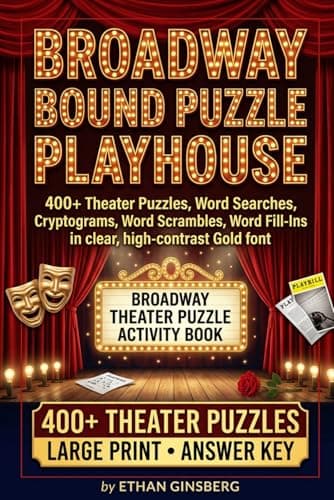
Every title- Broadway Bound Puzzle Playhouse400+ Theater Puzzles, Word Searches, Cryptograms, Word Scrambles & Word Fill-Ins
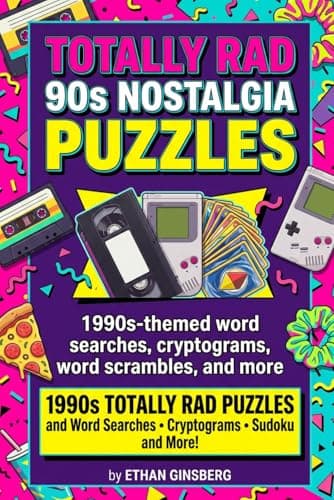
- Totally Rad 90s Nostalgia Puzzles1990s-Themed Word Searches, Cryptograms, Word Scrambles & More
- Around the World Puzzle Atlas220+ Geography Puzzles — Word Searches, Cryptograms, Fill-Ins, Scrambles & Bonus Sudoku
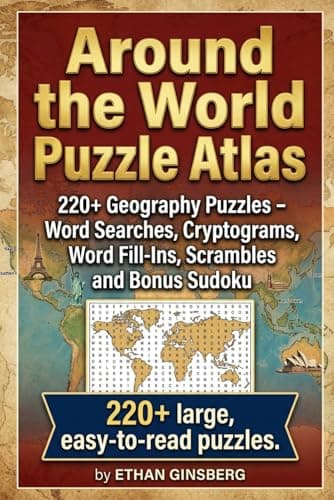
These are Amazon links, and we earn a small commission if you buy through them — at no extra cost to you. They are our own books.
Every free PuzzlePage tool
All free, no signup, and they run in your browser.
Word Solvers & Finders
Daily Game Solvers & Helpers
Logic Puzzle Solvers
Cipher Tools & Decoders
Translators & Converters
Word Lists & Dictionary