Cryptogram Solver — Interactive Substitution Cipher Helper
Paste any cryptogram and solve it with power tools: an editable letter mapping under every cipher letter, live letter-frequency comparison against English, dictionary pattern-match suggestions for any word you click, and an auto-fill for words with only one possible answer. An assistive solver — you make the calls, it does the bookkeeping.
Teaching with it, or recommending it to readers? Link it— it's free either way, and no attribution beyond the link is required.
Link (HTML)
<a href="https://www.puzzlepage.app/cryptogram-solver">Cryptogram Solver — PuzzlePage</a>What Is a Cryptogram?
A cryptogram is a short piece of text — usually a quotation — encrypted with a monoalphabetic substitution cipher: each letter of the alphabet is consistently replaced by a different letter, and (by newspaper convention) no letter stands for itself. Word breaks and punctuation are kept, which is exactly what makes cryptograms solvable by hand: the shape of each word survives encryption. Cryptograms have run in American newspapers for over a century as “cryptoquotes” and remain a staple of puzzle books, escape rooms, and classroom logic exercises.
How This Solver Works
This is an assistivesolver: it doesn’t hand you the answer, it removes the drudgery while you reason. Three engines run under the hood. First, frequency analysis: the panel counts every cipher letter and ranks them so you can compare against English’s ETAOIN order. Second, pattern matching: every word has a repetition pattern (THAT is ABCA, LETTER is ABCCBD); click a cipher word and the solver scans the 168,000-word public-domain ENABLE word list (the Words With Friends base list) for words with the identical pattern that also agree with every letter you’ve already mapped — and whose unmapped letters don’t collide with plain letters already in use. Third, constraint propagation: the auto-fill button applies any word with exactly one surviving candidate, which often unlocks new single-candidate words, and repeats until nothing more is forced (capped at 50 passes). One-letter words are left to you, since A and I are both common.
A Solving Walkthrough
- Scan the structure. One-letter words are A or I. The most common three-letter word in English is THE — if a three-letter cipher word appears several times, try it.
- Use the frequency panel. The top cipher letter is a strong candidate for E or T; if it also ends many words, E gets likelier.
- Exploit patterns. A word shaped ABCCBD with your E mapped in the right slots might have only a handful of candidates — click it and look.
- Apply and propagate. Applying a suggestion fills those letters everywhere. Run auto-fill; watch the preview turn green.
- Back out of conflicts. Red cells mean two cipher letters claim the same plain letter — one guess is wrong. Clear one and try the alternative.
Why Cryptograms Are Solvable at All
A substitution alphabet has 26! ≈ 4 × 10²⁾ possible keys — far too many to brute-force by hand. But English is massively redundant: letter frequencies are lopsided, word patterns are distinctive, and short function words (THE, AND, OF, TO) dominate any real sentence. Each mapped letter constrains dozens of others through shared words, so information cascades — which is exactly what the suggestion filter and auto-fill automate. The same redundancy is why the cipher identifier can tell a substitution cipher from random noise using the index of coincidence.
Frequently Asked Questions
Is this an automatic solver?
It’s assistive: you choose the mappings while it computes frequencies, filters dictionary candidates by pattern and consistency, flags conflicts, and auto-fills words with a single possible answer.
How do pattern suggestions work?
The cipher word’s repetition pattern (THAT = ABCA) is matched against the ENABLE word list, keeping only words that agree with your current mapping and don’t reuse plain letters already assigned elsewhere.
What does Auto-fill obvious do?
Repeatedly applies any cipher word with exactly one consistent dictionary candidate until a fixpoint (max 50 passes). It skips one-letter words on purpose.
What are the best first moves?
Single-letter words (A or I), repeated three-letter words (THE, AND), apostrophe patterns (’T, ’S), and double letters (LL, EE, SS, OO are the most common).
Why did a word show no suggestions?
Either a mapped letter in it is wrong, or the word isn’t in the dictionary — proper nouns and archaic spellings in quotes are the usual culprits.
What do the red cells mean?
Two cipher letters are mapped to the same plain letter. Standard cryptograms are one-to-one, so one of those guesses must change.
What dictionary is used?
The public-domain ENABLE word list (the Words With Friends base list), about 168,000 words, downloaded once and searched locally.
Does my puzzle leave my browser?
No — parsing, matching, and auto-fill all run client-side.
Want to Make a Cryptogram Instead?
This page solves cryptograms. To create one — for a classroom, a party, or a puzzle book — use the free cryptogram maker: paste any quote and download a printable puzzle with its answer key.
From our own shelf
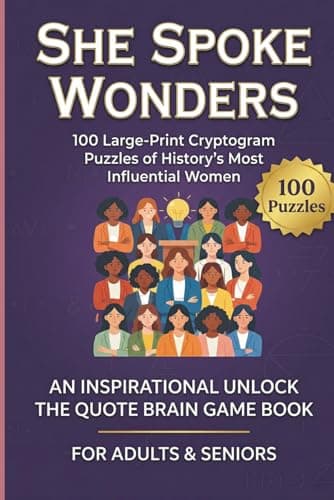
Every title- She Spoke WondersLarge Print Inspirational Cryptograms for Women
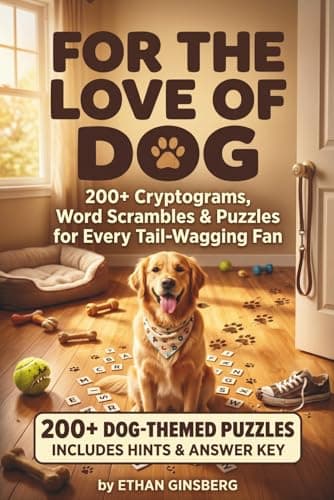
- For the Love of Dog200+ Cryptograms, Word Scrambles & Puzzles for Every Tail-Wagging Fan
- Last Lesson PlanCryptograms for Aggressively Dedicated Teachers
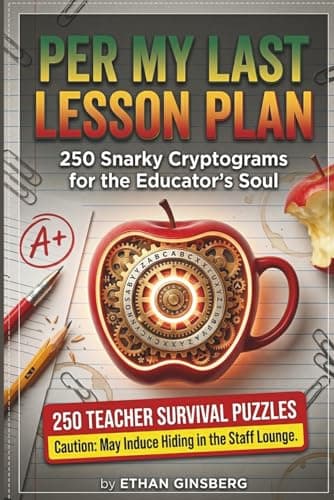
These are Amazon links, and we earn a small commission if you buy through them — at no extra cost to you. They are our own books.
Every free PuzzlePage tool
All free, no signup, and they run in your browser.
Word Solvers & Finders
Daily Game Solvers & Helpers
Logic Puzzle Solvers
Cipher Tools & Decoders
Translators & Converters
Word Lists & Dictionary