Extreme Connections: The Finance Vocabulary Game for Teams
Extreme Connections is a 32 or 64-tile word-grouping puzzle that teaches finance vocabulary. Free to play, plus a 32-puzzle library built for teams.
On this site: Try the Extreme Connections maker·Browse 100+ free printables·Play today's puzzles
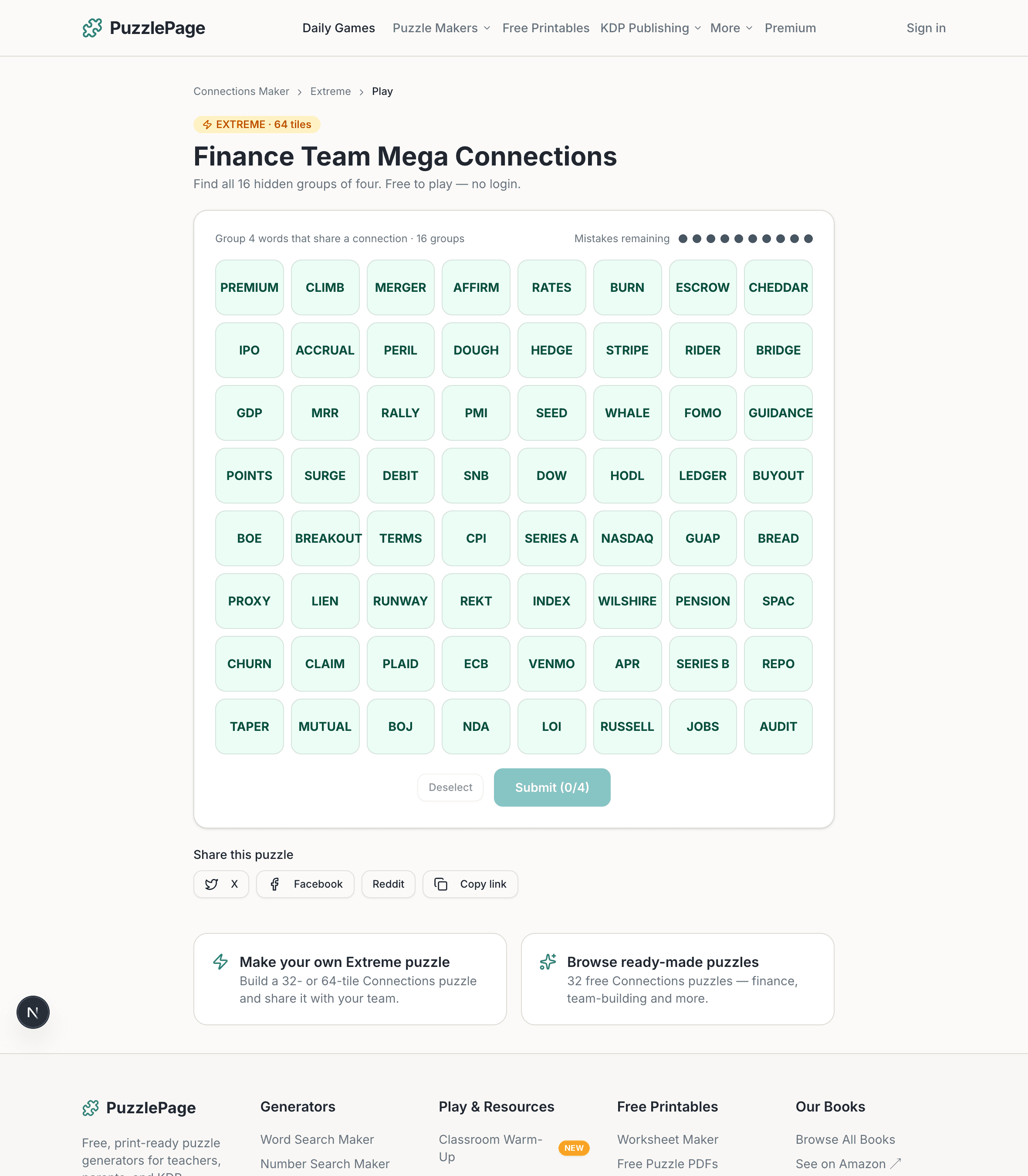
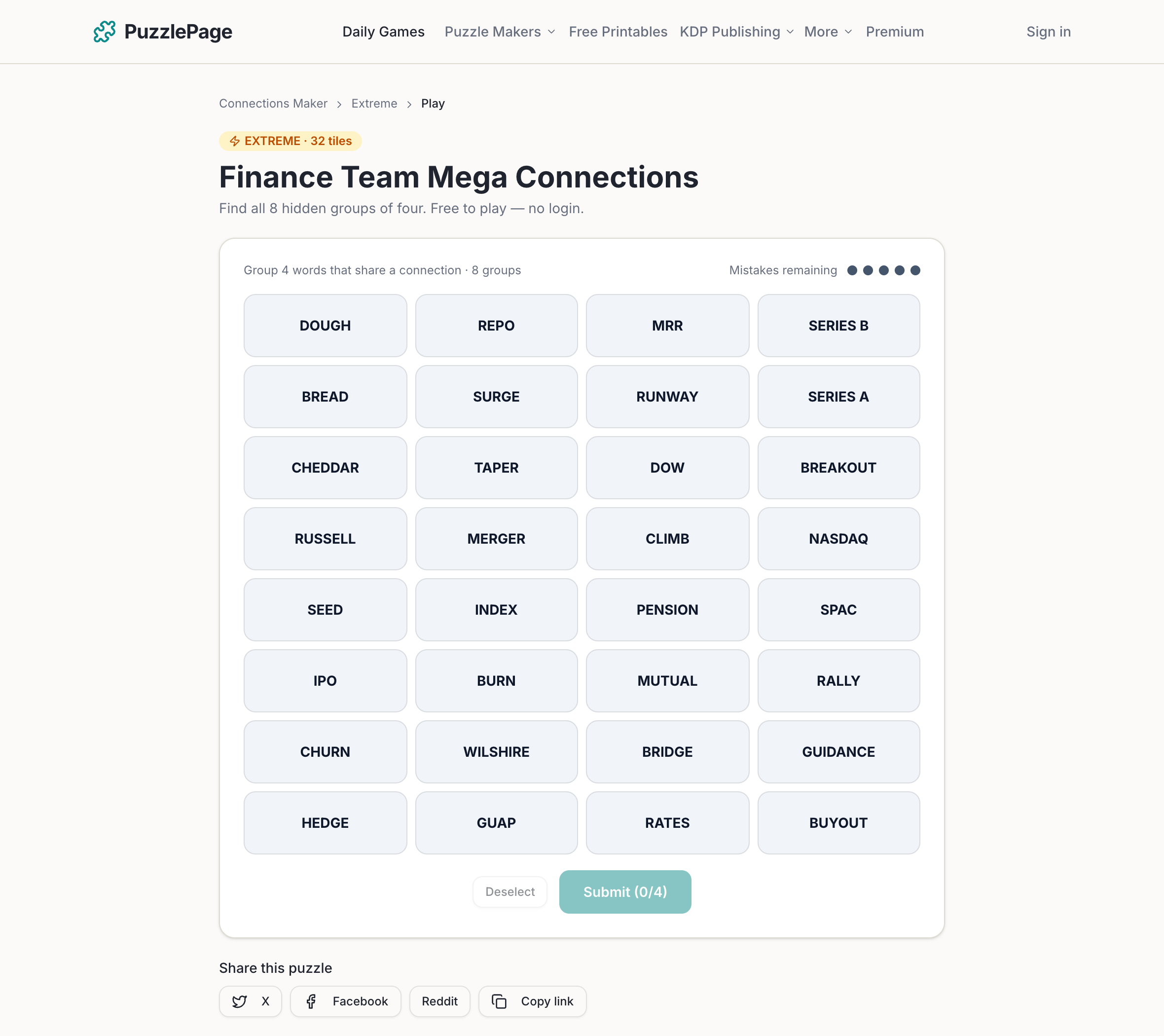
Extreme Connections is a word-grouping puzzle where you sort 32 tiles into 8 hidden groups, or 64 tiles into 16 groups, instead of the usual 16 tiles in 4 groups. It is free to play any shared puzzle with no login, and it doubles as a genuinely effective way to teach and reinforce finance vocabulary with a team, a class, or a study group.
Our connections puzzle maker already ranks number one on Google for "connections puzzle maker," and one group has quietly adopted it more than any other: finance teams. They build a board, share a live link, and watch a trading desk or a client workshop argue happily over which four terms really belong together.
So we built the version they kept asking for. Today we are launching Extreme Connections, and this post is both the announcement and a practical guide to using word-grouping as a finance education tool.
Key takeaways
- Extreme Connections adds an 8-group (32-tile) and a 16-group (64-tile) board to the connections maker.
- Playing any shared puzzle is free and needs no account; creating Extreme puzzles is a Premium feature.
- A ready-made library of 32 puzzles ships with it, heavy on finance and team themes.
- Sorting terms into hidden groups is retrieval practice, which makes finance vocabulary stick far better than a glossary.
- New decorative themes (including a money theme), a live board preview, and printable PDF export round out the release.
 0:55
0:55What is Extreme Connections?
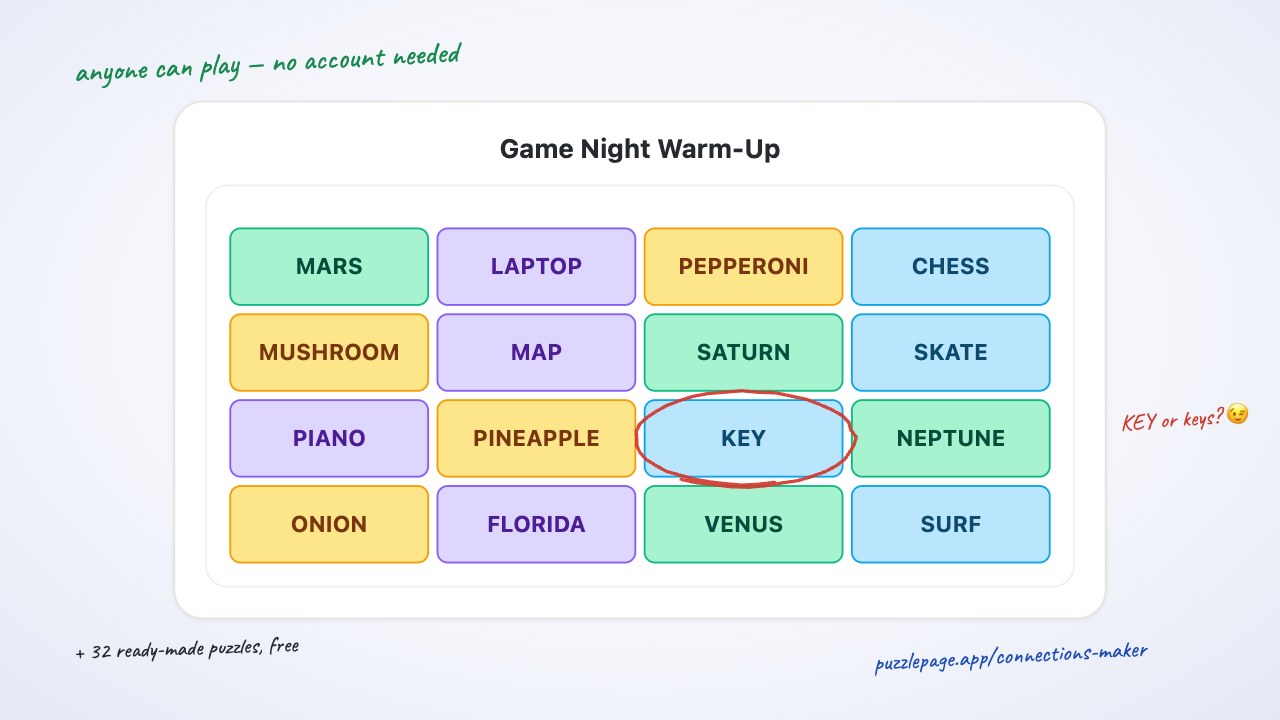
A classic Connections puzzle gives you 16 words and asks you to find 4 hidden groups of 4. The challenge is that the puzzle deliberately plants words that look like they fit more than one group.
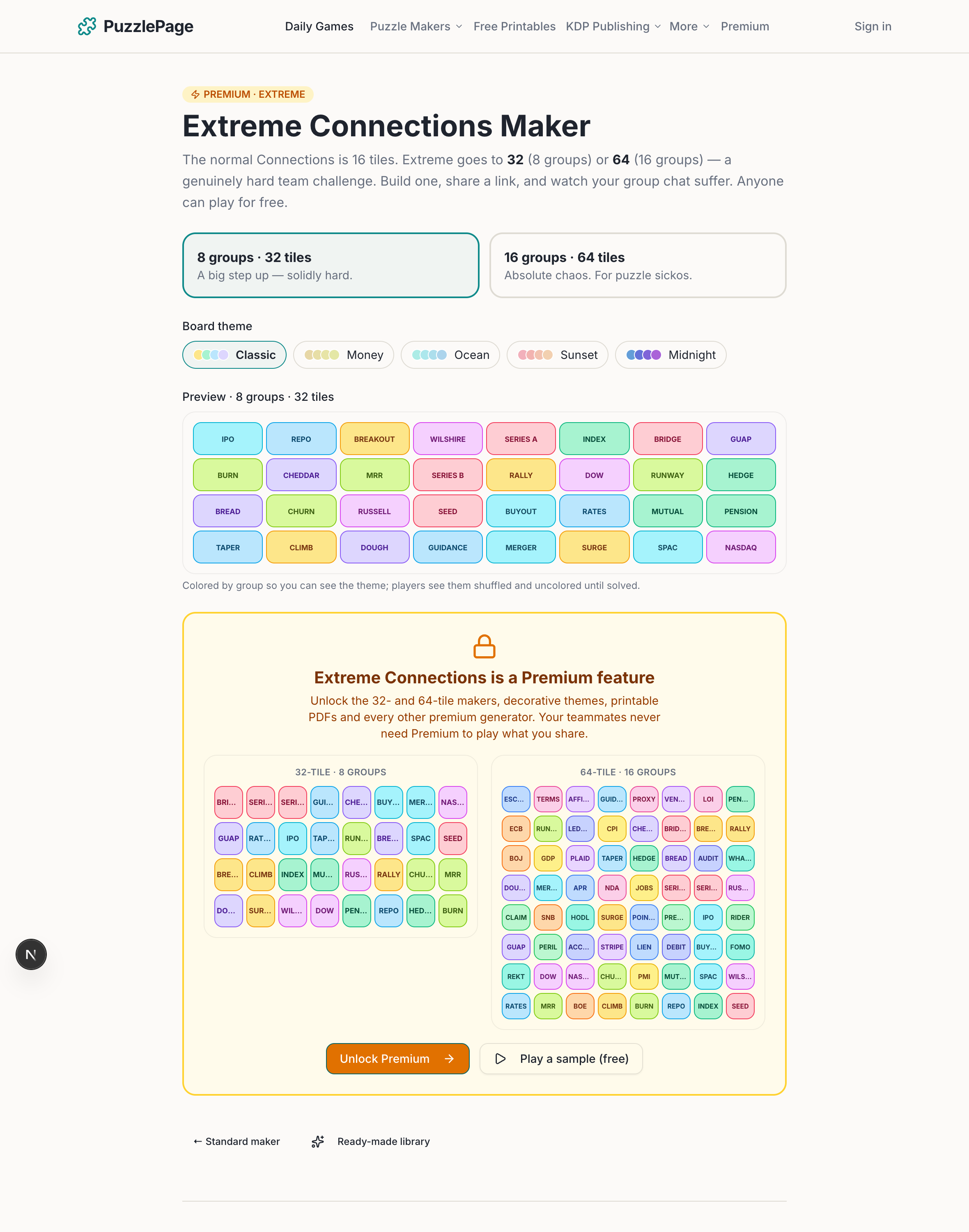
Extreme Connections keeps that mechanic and scales it up. The 32-tile board hides 8 groups of 4, and the 64-tile board hides 16 groups of 4. More groups means more overlap, more decoys, and a much longer stretch where every tile feels like it could belong in three places at once.
That difficulty is the point. Four groups is a coffee-break puzzle, while sixteen groups is a real team challenge that can hold a room for twenty minutes and generate the kind of debate that actually teaches something.
Like this? We send 10 of these every month.
Free printable puzzles, answer keys included — same quality as the ones in this post.
One email. Unsubscribe anytime.
Why word-grouping puzzles teach finance so well
The reason is a well-studied learning principle called retrieval practice. Pulling an answer out of your own memory strengthens it far more than re-reading the same definition, an effect documented by cognitive scientists at the Retrieval Practice project.
A grouping puzzle is retrieval practice in disguise. To place "hedge," "mutual," "index," and "pension" together as fund types, you cannot skim; you have to actively recall what each term means and what family it belongs to.
Compare that to handing a new analyst a two-page glossary. The glossary is passive, forgettable, and nobody argues about it. A puzzle makes the same vocabulary active, social, and slightly competitive, which is exactly the combination that gets terms to stick.
There is a second benefit that finance trainers notice quickly. A puzzle surfaces what people do not know without putting anyone on the spot, because the group is solving it together rather than one person being quizzed.
Pro tip: build a puzzle from the exact vocabulary in this week's training deck. When the same terms show up on the board that afternoon, you get spaced repetition for free, and retention climbs without adding a single slide.
The tricky-overlap mechanic mirrors real finance nuance
Finance is full of terms that mean different things depending on context, and that is precisely where learners stumble. A good Connections puzzle weaponizes that confusion on purpose.
Take the word "market." It is an order type (a market order), a measure of company size (market cap), a broad direction (a bull market), and a short-term instrument family (money market). A puzzle can drop "market" on the board and let it tug at four different groups at once.
The solver has to resolve the ambiguity the same way a working professional does, by asking which meaning the surrounding evidence supports. That is not trivia. That is the core skill of reading a term in context.
Here are a few overlaps that make excellent decoys, because they are the real confusions students and new hires actually have.
Order types versus everything else
Group four order types together: Market, Limit, Stop, and Fill. Then plant "market" so it also flirts with a "kinds of cap" group (Market cap, Small cap, Large cap, Mid cap). A learner who really understands the vocabulary can tell which "market" the puzzle wants.
Fund types that sound alike
Group Hedge, Mutual, Index, and Pension as fund types. Then add "index" pressure from a separate group of things that track a benchmark, or "hedge" pressure from a group of risk-management verbs. The near-miss is the lesson.
Startup funding stages with a decoy
Group Seed, Angel, Bridge, and Series-A as early funding concepts. "Bridge" is the trap, because it also reads as a generic connector and can be pulled toward an unrelated group. Solvers learn that a bridge round is a specific financing, not just a metaphor.
A closer look at the 64-tile mega board
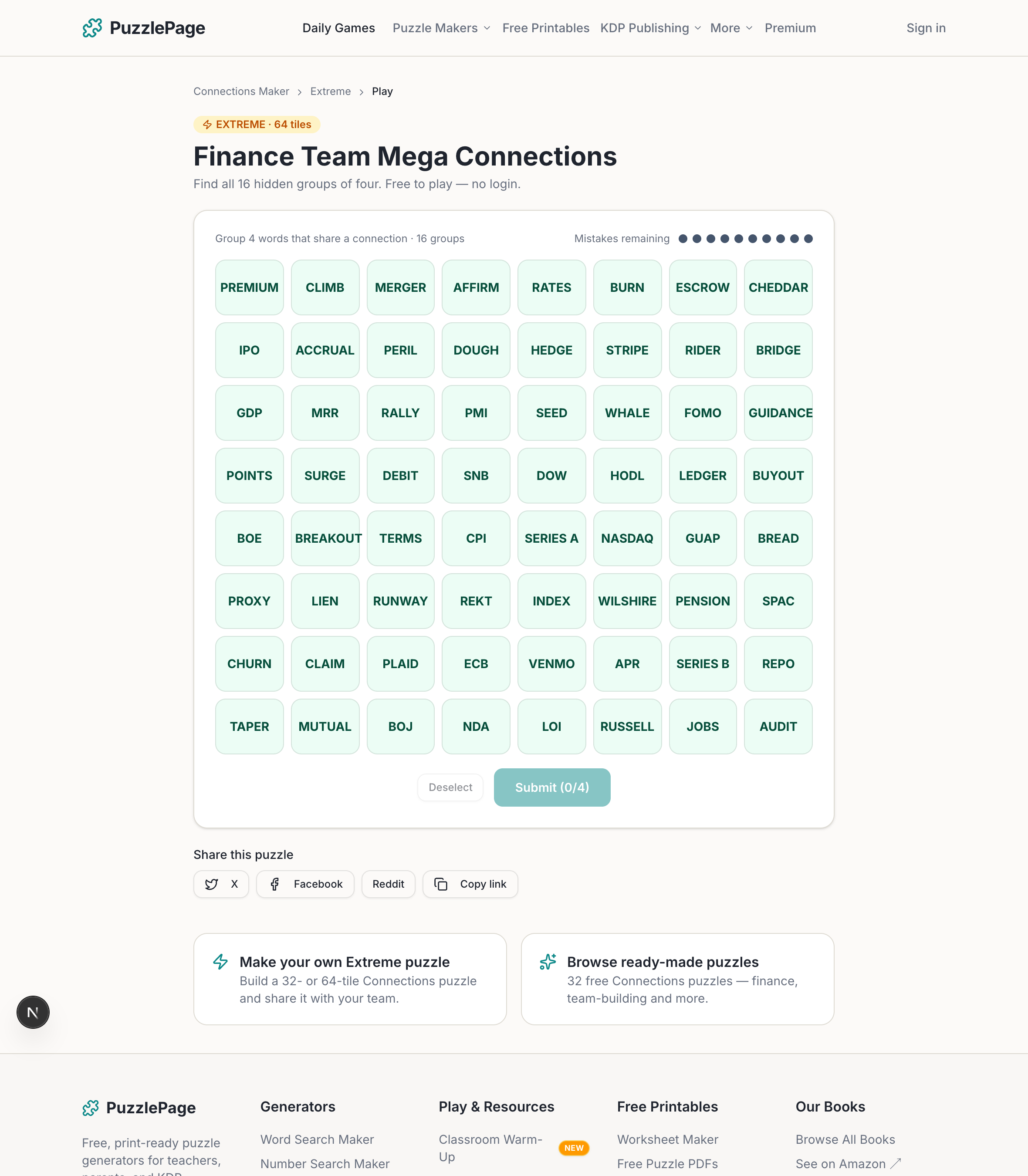
The 64-tile board is where Extreme Connections earns its name. Sixteen groups of four is a serious cognitive load, and it changes how a team works.
With four groups, one person can often solve the whole thing alone. With sixteen groups, the board rewards divide-and-conquer, note-taking, and someone willing to say "let us lock the three we are sure of and come back." Those are the same habits that make a good analyst.
It also makes a strong pre-exam review. A single 64-tile board can cover an entire unit of finance vocabulary in one sitting, which is why we think of it as a "mega review" format for CFA and CFP study groups.
The 32-puzzle library, built for finance and teams
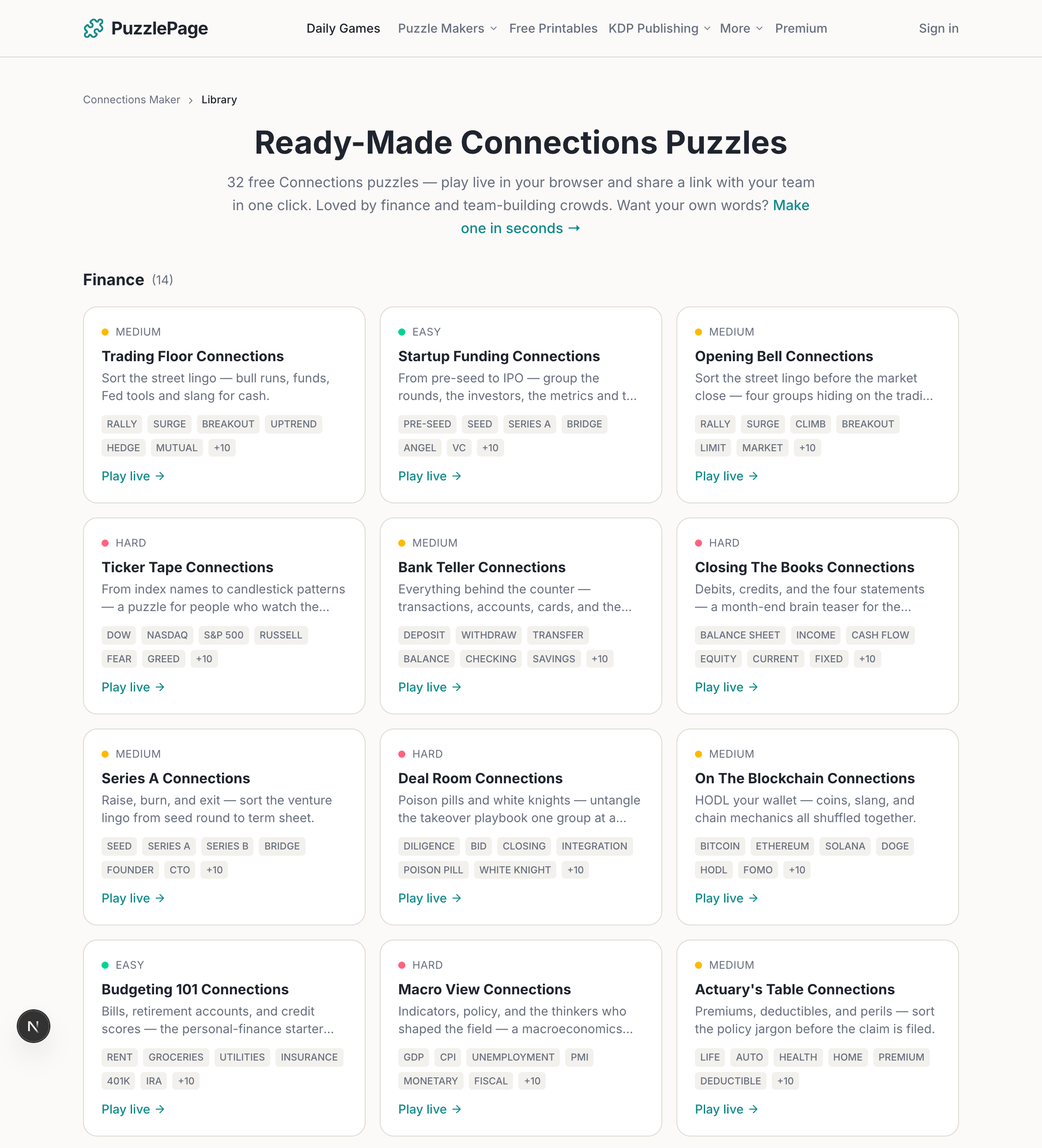
You do not have to write a single word to get started. Extreme Connections ships with a library of 32 ready-made puzzles, and many of them lean directly into finance and team culture.
A few of the titles waiting in the library:
- Trading Floor for desk vocabulary and order mechanics.
- Series A for startup funding and venture terms.
- Deal Room for M&A and diligence language.
- On The Blockchain for crypto and distributed-ledger concepts.
- Closing The Books for accounting and month-end vocabulary.
- Macro View for central banks, indicators, and policy terms.
- Quarterly Kickoff for planning and reporting language.
- Corporate Buzzwords for the phrases every all-hands secretly runs on.
Playing any of these is free, so the fastest way to understand the format is to open one and try it before you build your own. The library is the on-ramp; the maker is where it gets personal.
How to build your own Extreme Connections puzzle
Creating a custom board is a Premium feature, and it is designed to take a few minutes rather than an afternoon. The workflow is deliberately simple.
- Open the Extreme Connections maker and choose the 32-tile or 64-tile board.
- Name each hidden group, for example "Fund Types" or "Month-End Verbs."
- Enter four terms per group, and add a decoy term that overlaps with another group on purpose.
- Pick a decorative theme, including the money theme if you want a finance look.
- Watch the live board preview update as you type so you can feel the difficulty.
- Share the live link with your team, or export a printable PDF for the room.
The single most important design choice is the decoy. A puzzle with no overlap is a sorting exercise; a puzzle with one well-placed overlap per group is a teaching tool.
Pro tip: aim for one "obvious but wrong" tile in each group. If your team locks a group in five seconds, the vocabulary is not being tested. If they debate it for a minute, you built it right.
Ways finance teams and educators actually use it
The same board flexes across very different rooms. Here are the settings where a grouping puzzle earns its place.
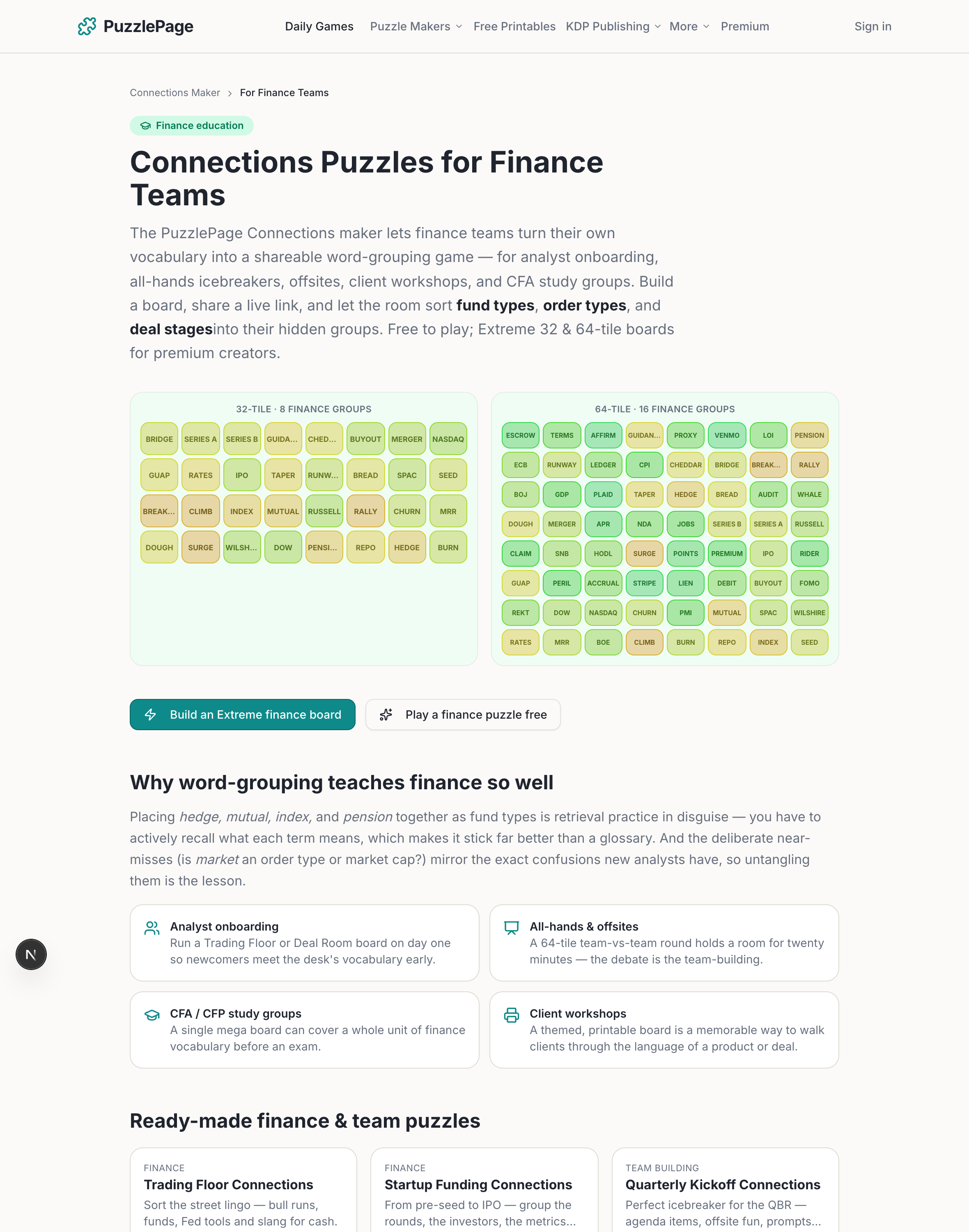
- New-analyst onboarding. Run a Trading Floor or Deal Room board on day one so newcomers meet the desk's vocabulary before they meet the desk.
- All-hands icebreakers. A Corporate Buzzwords board is a low-stakes laugh that also warms up a room before the numbers come out.
- Offsites and team-versus-team. Split into tables, share the same 64-tile link, and race. The debate is the team-building.
- Client workshops. A themed board is a memorable way to walk a client through the language of a product or a deal.
- Finance-classroom warm-ups. A five-minute board at the start of a lecture primes recall of last week's terms.
- Study-group review. A CFA or CFP cohort can build boards for each other and quiz the whole syllabus by category.
Because any shared puzzle plays free with no login, the friction to run one of these is close to zero. You send a link, people click, and the room is engaged.
Concrete lesson ideas you can steal
If you want ready-to-run structure, here are four formats that work.
The weekly vocabulary board
At the end of each training week, build a 32-tile board from that week's eight most important groups of terms. Run it the following Monday as a five-minute recall warm-up. You have just added spaced repetition to your program with almost no effort.
The 64-tile mega review
Before an exam or a certification checkpoint, assemble a single 64-tile board covering the whole unit. Solving it forces learners to recall and categorize sixteen clusters of vocabulary in one sitting, which is far more active than re-reading notes.
Team versus team
At an offsite, give two tables the same board and a timer. The winning table is not the one that knows the most trivia, it is the one that communicates and locks its confident groups first. That is a leadership lesson wearing a puzzle costume.
Build-it-yourself as the assignment
Ask each study-group member to build a board for the others. Writing a good decoy requires understanding a term well enough to know what it is often confused with, so the author learns as much as the solver.
More example groupings to seed your boards
Good boards start from good groups. Here are believable clusters across the finance stack that you can drop into a maker session.
- Bond anatomy: Coupon, Yield, Maturity, Par.
- Option Greeks: Delta, Gamma, Theta, Vega.
- Central banks: Fed, ECB, BOJ, BOE.
- Macro indicators: CPI, GDP, PMI, PPI.
- Month-end verbs: Accrue, Reconcile, Defer, Amortize.
- On-chain nouns: Wallet, Node, Token, Ledger.
- Valuation shorthand: P/E, ROE, EBITDA, Beta.
- Buzzword bingo: Synergy, Bandwidth, Runway, Circle-back.
Notice the built-in traps. "Delta" is an option Greek but also a plain change in math, "runway" is startup cash but also a plane's strip, and "ledger" is an accounting record but also a blockchain concept. Those are the overlaps that turn a sorting task into a lesson.
Themes, live preview, and printable PDF export
Extreme Connections ships with three creator upgrades that make a board feel finished rather than functional.
The new decorative themes are color schemes that set a tone, and yes, there is a finance-flavored money theme for desk and client boards. A Trading Floor puzzle simply lands better when it does not look like a spreadsheet.
The live board preview updates as you type, so you can feel the difficulty and spot a lopsided group before you share it. And printable PDF export means you can take a board off the screen entirely, which is ideal for offsites, classroom handouts, and study groups.
Free to play, Premium to create
The rule is simple and generous. Anyone can play any shared Extreme Connections puzzle for free, in the browser, with no account.
Creating your own Extreme puzzles is where Premium comes in, and it bundles the 32 and 64-tile makers, the decorative themes, the live preview, and printable PDF export together. If your team is going to run these regularly, one person with Premium can supply boards for everyone else to play free.
Teams that want a running start can browse the finance-teams landing page, which collects the most useful examples and templates in one place.
Where this fits with the rest of PuzzlePage
Word-grouping is one tool in a kit. If your goal is vocabulary reinforcement, a few other generators pair naturally with Extreme Connections.
A printable word search is a gentler recall warm-up for a large group, and a cryptogram code-breaking puzzle works well as a change of pace when you want a decode-the-message challenge instead of a sorting one. Rotating formats keeps a training program from feeling like the same drill every week.
The common thread is active recall. Whichever format you choose, the learning comes from making people pull answers out of memory rather than handing the answers over.
How to write a fair decoy
A decoy is the tile that looks like it belongs in one group but actually belongs in another. It is the difference between a sorting chore and a puzzle worth arguing over.
The rule of a fair decoy is that the overlap must be real. "Market" genuinely reads as an order type and as a size measure, so pulling it between those two groups teaches something. A cheap trick, by contrast, relies on a term nobody would reasonably file two ways, which just frustrates solvers without testing knowledge.
Aim for one "obvious but wrong" tile per group. The tile should have a tempting first-glance home and a correct second-glance home, so a solver who knows the vocabulary can tell them apart while a solver who is guessing cannot.
Here is how to think about the difference in practice.
- Fair overlap: "Ledger" tugs between an accounting group and an on-chain group, because both meanings are standard finance usage.
- Fair overlap: "Delta" tugs between the option Greeks and a plain "change" idea, which is a real ambiguity traders live with.
- Cheap trick: a rare acronym only one person would recognize, which rewards trivia rather than understanding.
- Cheap trick: a term that fits two groups only because of a pun, with no genuine finance meaning behind it.
On a 32-tile board, three to four well-placed decoys is plenty. On a 64-tile board you can run one soft decoy per group, but resist stacking two hard overlaps into the same cluster, because that tips difficulty into guesswork.
Use the live board preview to tune it. If a group locks in a few seconds while you are building, the vocabulary is not being tested and you should swap in a stronger overlap. If you cannot solve your own board without checking your notes, ease off one decoy before you share it.
Pro tip: write the decoy last. Build clean, correct groups first, then go back and ask "which single tile in this group could a smart person misfile, and where would they put it?" That question produces better traps than trying to be clever from the start.
A 64-tile board for a full finance vocabulary map
The 64-tile board covers sixteen groups, which is enough to map an entire introductory finance syllabus in one sitting. Below is a worked example built as a CFA-Level-I-style review, with the sixteen group names you would use.
- Bond Anatomy (Coupon, Yield, Maturity, Par)
- Option Greeks (Delta, Gamma, Theta, Vega)
- Central Banks (Fed, ECB, BOJ, BOE)
- Macro Indicators (CPI, GDP, PMI, PPI)
- Valuation Ratios (P/E, ROE, EBITDA, Beta)
- Financial Statements (Balance, Income, Cash-flow, Equity)
- Fund Types (Hedge, Mutual, Index, Pension)
- Order Types (Market, Limit, Stop, Fill)
- Funding Rounds (Seed, Angel, Bridge, Series-A)
- Derivatives (Future, Forward, Swap, Option)
- Fixed Income Terms (Duration, Convexity, Spread, Callable)
- Risk Measures (VaR, Sharpe, Volatility, Drawdown)
- Market Structure (Bid, Ask, Spread, Depth)
- Accounting Verbs (Accrue, Reconcile, Defer, Amortize)
- Ethics and Standards (Diligence, Disclosure, Fairness, Loyalty)
- Portfolio Concepts (Alpha, Correlation, Rebalance, Diversify)
The built-in decoys are what make this board a review rather than a checklist. "Spread" appears in both Fixed Income Terms and Market Structure, so a solver has to decide which sense the surrounding tiles support.
"Beta" tugs between Valuation Ratios and Portfolio Concepts, and "Option" pulls between Order Types and Derivatives. Those three overlaps alone will generate more discussion than a whole page of notes, because each one forces the group to say out loud why a term lives where it does.
Pro tip: when you build this for a study group, hand each member two of the sixteen groups to author. Writing the Ethics and Standards or Risk Measures cluster well requires knowing the terms cold, so the authors get the deepest review of all.
Running Extreme Connections remotely versus in a room
The same board plays very differently on a video call and around a table, so it helps to match your setup to the setting.
For a remote team, avoid one person screen-sharing while everyone else watches. That turns sixteen people into an audience and one person into a typist.
Instead, share the live link so each participant, or each breakout group, plays on their own screen. Then bring everyone back to compare which groups they locked first and where they got stuck, which is where the teaching happens.
A few logistics keep remote sessions sharp.
- Set a timer. Ten minutes for a 32-tile board and twenty for a 64-tile board keeps energy up and prevents one group from stalling.
- Use breakout rooms as tables. Three or four people per room debate better than a silent group of twelve.
- Debrief the decoys. Ask each room which overlap fooled them, because naming the trap is what cements the vocabulary.
In a room, the printable PDF export changes the whole dynamic. Print two copies per table and one spare, because someone always spills coffee on theirs, and let each table solve on paper before you reveal the answers on a shared screen.
Paper also removes the temptation to search a term mid-solve, which makes the recall more honest. For an offsite, a printed 64-tile board plus a timer plus a small prize is a complete team-building activity that costs nothing but a few minutes to build.
Pro tip: whether remote or in person, keep the reveal social. Do not just show the solution; walk group by group and ask "who put a different tile here, and why?" The wrong answers are the most useful part of the whole exercise.
Getting started in five minutes
You do not need a plan or a budget to try this today.
- Open the Extreme Connections library and play one finance puzzle to feel the format.
- Note which overlaps tripped you up, because those are the teaching moments.
- If you have Premium, open the maker and build a 32-tile board from this week's vocabulary.
- Share the live link with your team, or export a PDF for the room.
Start with the library, then make it yours. The best finance board is the one built from the exact terms your team needs this quarter.
Frequently Asked Questions
What is Extreme Connections?
Extreme Connections is a harder version of the classic word-grouping puzzle. Instead of 16 tiles in 4 groups, you solve 32 tiles in 8 groups, or 64 tiles in 16 groups. Every shared puzzle is free to play in the browser.
How is it different from a normal Connections puzzle?
A standard Connections board has 16 words and 4 hidden groups. Extreme doubles or quadruples that to 8 or 16 groups, which forces you to hold more categories in mind at once and makes the decoy overlaps far harder to untangle.
Is Extreme Connections free?
Playing any shared Extreme Connections puzzle is completely free to play. Creating your own Extreme puzzles is a Premium feature, which also unlocks decorative themes, the live board preview, and printable PDF export.
Why is a word game good for teaching finance?
Sorting terms into hidden categories forces active recall of finance vocabulary, which sticks far better than reading a glossary. The near-miss overlaps in a good puzzle mirror the exact confusions learners have, such as whether "market" is an order type or a measure of company size.
Can I use Extreme Connections for analyst onboarding or a finance class?
Yes. It works as a new-analyst onboarding warm-up, an all-hands icebreaker, an offsite team-versus-team round, a university finance-course starter, or a CFA and CFP study-group review before an exam.
How many ready-made puzzles are in the library?
The Extreme Connections library ships with 32 pre-built puzzles, many of them finance and team themed. Titles include Trading Floor, Series A, Deal Room, On The Blockchain, Closing The Books, Macro View, Quarterly Kickoff, and Corporate Buzzwords.
Can I print an Extreme Connections puzzle?
Yes. Premium creators can export any board to a printable PDF, which is useful for offsites, classroom handouts, and study groups where you do not want everyone staring at a screen.
Where do I start?
Play a puzzle from the library first to feel the format, then open the maker to build your own from this week's vocabulary. Finance teams can start from the dedicated finance-teams landing page for ready examples and templates.
More you can make here
One puzzle is the start. Here is the rest of the kit.
 New
NewWorksheet Builder
Put a word search, a cryptogram and a scramble on one page, or build a whole themed packet. Prints with answer keys.
Build a worksheet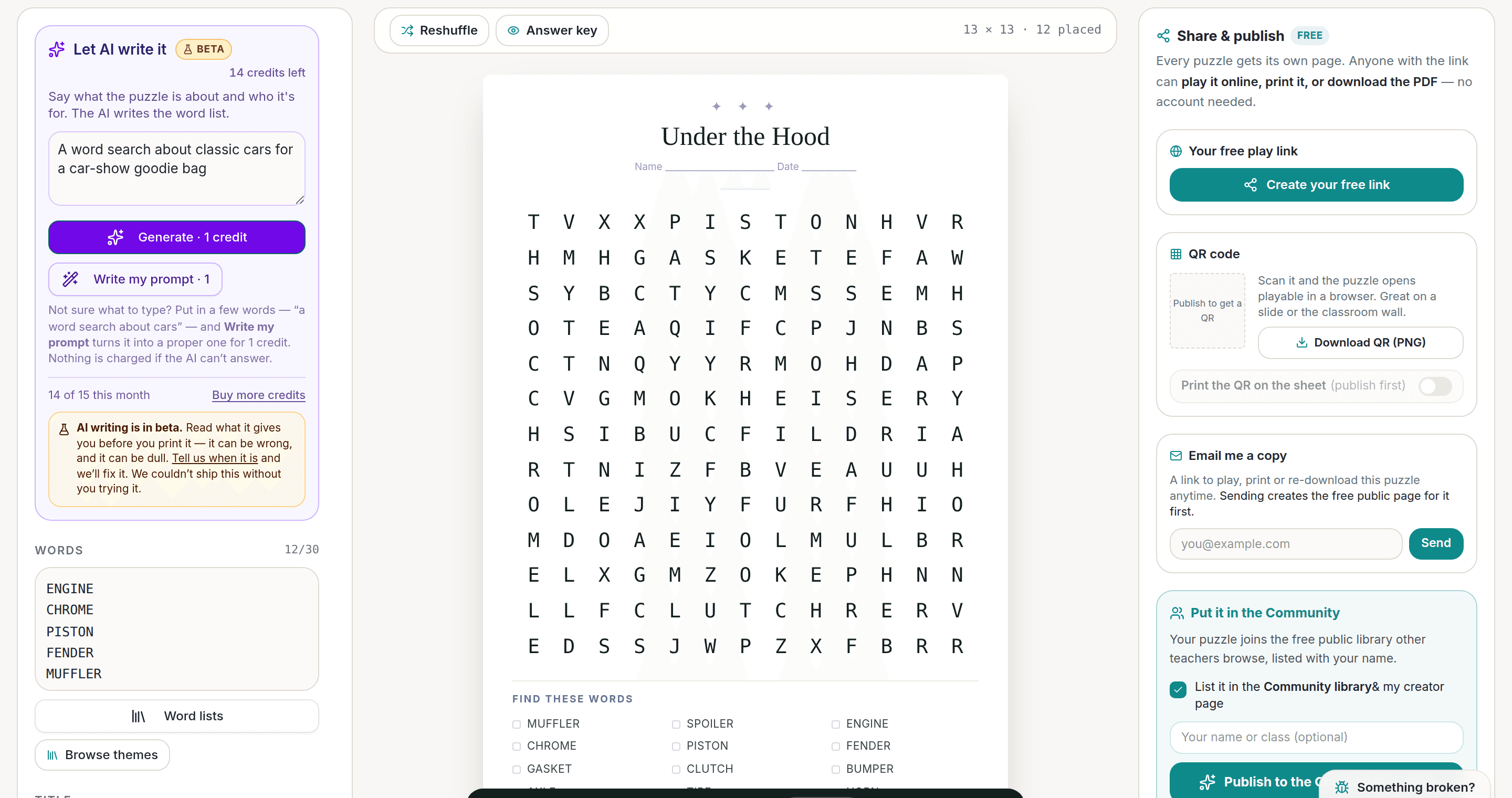
AI Puzzle Generator
Type a topic, get a themed word list and a finished puzzle. Premium also removes the footer credit and adds Word export.
Try the AI generator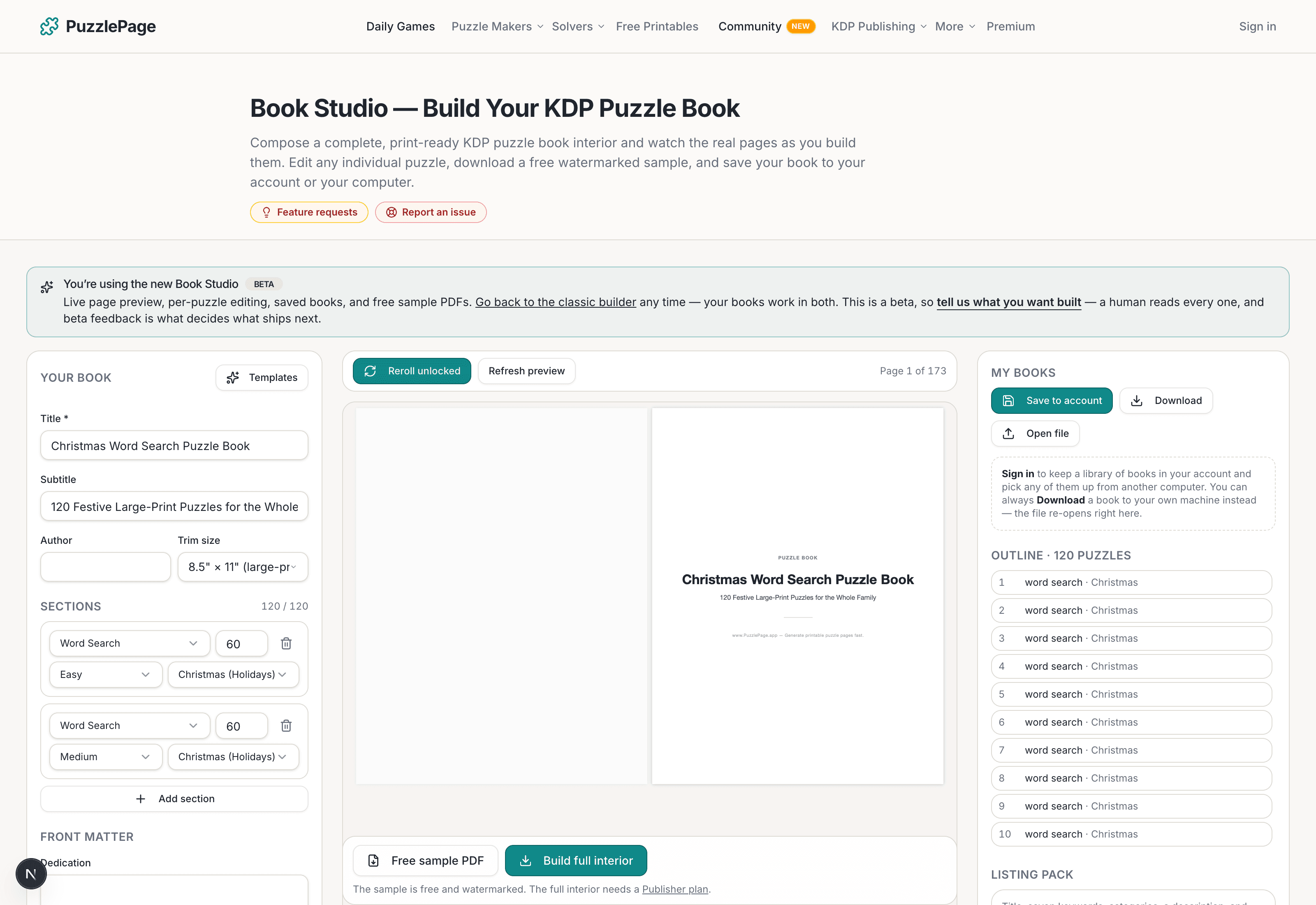
KDP Book Studio
Lay out a full puzzle book for Amazon KDP: templates, trim sizes, page checks and a cover designer.
Start a puzzle book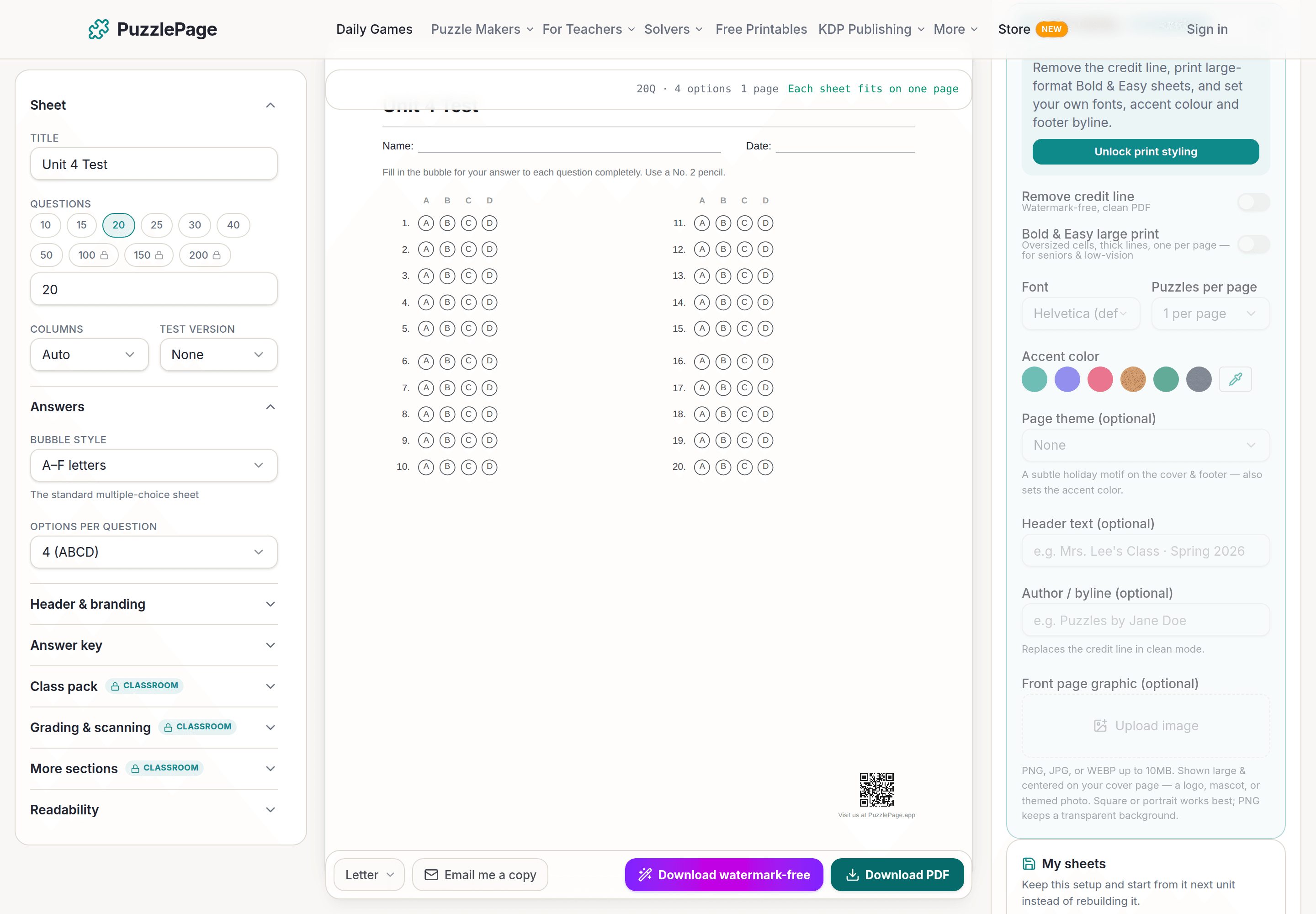
Bubble Sheet Studio
Answer sheets for any test length, with sections, versions, student ID grids and a matching answer key.
Make a bubble sheetPremium removes the footer credit, adds Word export and custom styling across every maker.
See plans →Free daily games
Need a two-minute break? Today's puzzles are live.
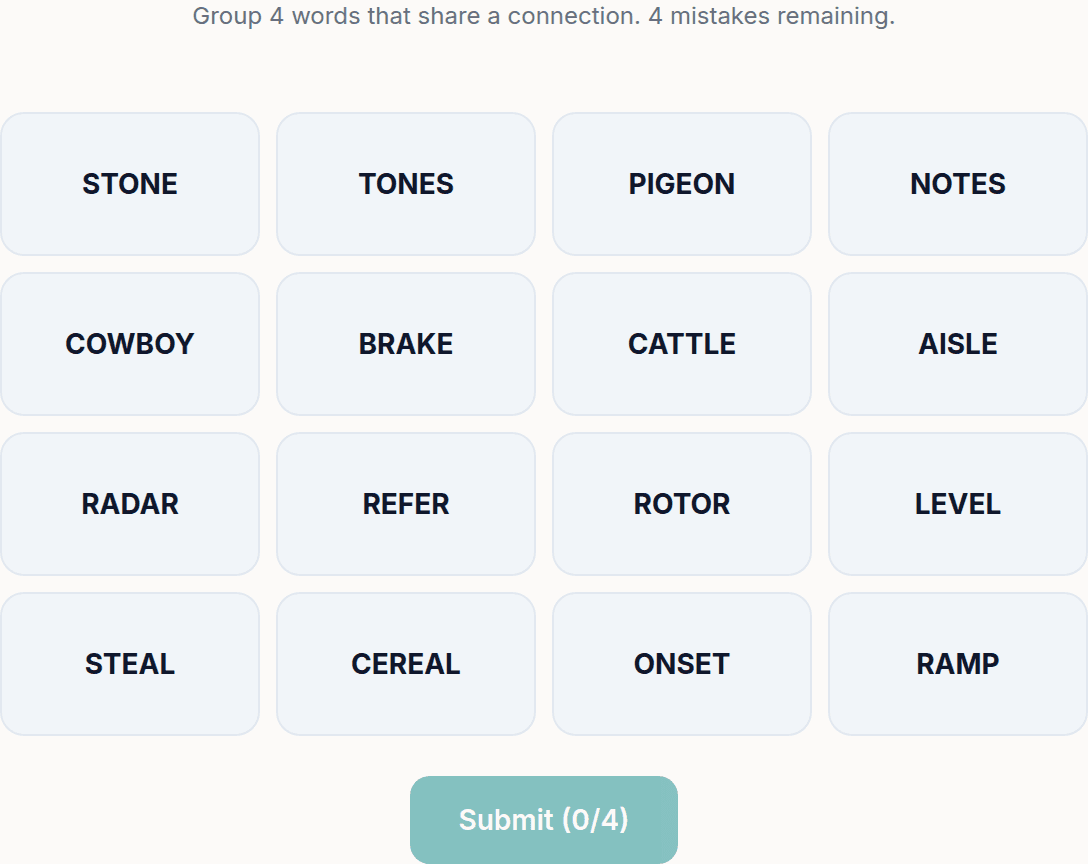
A new Sudoku and a new Connections board every day. No download, no account.


Keep reading
Get 10 free puzzles
Get the free 10-puzzle pack
Enter your email and we'll send you 10 print-ready puzzles with answer keys, plus a heads-up when we publish new generators and seasonal puzzle packs. Same quality as the ones on this page.
Roughly two emails a month. No spam, unsubscribe anytime.
Enjoyed this? Share the puzzle on X
Like puzzles like this? Follow on Pinterest for a new one every day.