Bee Word Search Printables for World Honey Bee Day
Free printable bee word search for World Honey Bee Day: pollination vocabulary, a hexagon honeycomb grid, and classroom station ideas for K-5 science.

Find these words
- BEESWAX
- BUZZING
- CLOVER
- COLONY
- DRONE
- FLOWERS
- GARDEN
- HIVE
- HONEYCOMB
- NECTAR
- POLLEN
- POLLINATOR
- QUEEN
- WORKER
Drag across the grid to trace each hidden word.
Busy Bees Word Search
Honey bee life and pollination vocabulary for World Honey Bee Day
Word List
- POLLINATOR
- HONEYCOMB
- BUZZING
- FLOWERS
- BEESWAX
- POLLEN
- NECTAR
- WORKER
- COLONY
- GARDEN
- CLOVER
- QUEEN
- DRONE
- HIVE
Free companion PDF
Busy Bees Word Search
Honey bee life and pollination vocabulary for World Honey Bee Day. Grab the PDF now and we'll send 10 more printable puzzles, plus a heads-up when new generators or seasonal packs go live. Roughly two emails a month — unsubscribe anytime.
No payment · Letter-size · Answer key included
Prefer to play online? There's a new puzzle every day.
Free daily word games — play instantly. Come back tomorrow for a fresh one.
On this site: Create your own free word search puzzle·Browse 100+ free printables·Play today's puzzles
World Honey Bee Day lands on Saturday, August 15, 2026, right as teachers are planning early-fall science. A bee word search slots neatly into a pollinator unit: it reinforces lifecycle vocabulary, runs as a self-checking station, and prints in minutes.
This guide covers the word list, the honeycomb-shaped grid, a honey-tasting station plan, and a garden observation pairing that turns one puzzle worksheet into a full lesson block.
📌 Key Takeaways
- World Honey Bee Day falls on Saturday, August 15, 2026, and pairs naturally with early-fall pollinator units.
- Hunting hidden words gives science vocabulary five or six extra exposures before a quiz.
- The hexagon grid shape turns an ordinary find-a-word into a honeycomb cell.
- Stations run best as a taste, observe, puzzle rotation of 10 to 12 minutes each.
- Differentiate by grade band: 8 to 10 words for K-2, up to 15 words including POLLINATOR for grades 3-5.
 1:02
1:02Why Does a Bee Word Search Work in a Pollinator Unit?
A bee word search works because it makes students slow down and stare at the exact spelling of science vocabulary like NECTAR, POLLEN, and COLONY. Scanning a letter grid for hidden words gives each term several extra exposures, and that repetition sticks better than a read-aloud alone.
The subject earns the attention. The USDA estimates that about one third of the food we eat depends on pollinators, honey bees chief among them, and the USDA pollinator resources make a strong read-aloud companion for grades 3 and up.
A single hive can hold 20,000 to 60,000 worker bees during peak summer months, a range beekeeping educators cite often, and that number gives students a concrete anchor for words like COLONY and WORKER. Pair the statistic with the word search and ask students to guess how many of those workers are out foraging at any given moment.
This kind of printable word puzzle is also the rare vocabulary activity that runs itself. Students self-check against the word list, which frees the teacher to float between stations instead of anchoring one.
A find-a-word format also travels well across ability levels in the same room. A student reading below grade level can hunt HIVE and QUEEN while a partner two seats over tackles POLLINATOR and BEESWAX, and both finish the same worksheet at roughly the same time.
Free Word Search PDF — Busy Bees Word Search
Print-ready · answer key included · unsubscribe anytime
Bee Vocabulary Worth Teaching
Build the word list from the science you actually teach: hive roles, hive products, and pollination terms. Common, spellable words beat obscure ones in a K-5 classroom game.
| Grade band | Focus | Sample words | Grid size |
|---|---|---|---|
| K-2 | Hive basics | HIVE, QUEEN, POLLEN, FLOWERS | 8 to 10 words, large letters |
| Grades 3-5 | Roles and lifecycle | WORKER, DRONE, COLONY, BEESWAX | 12 to 15 words |
| Enrichment | Pollination science | NECTAR, POLLINATOR, CLOVER | 15 words plus a writing prompt |
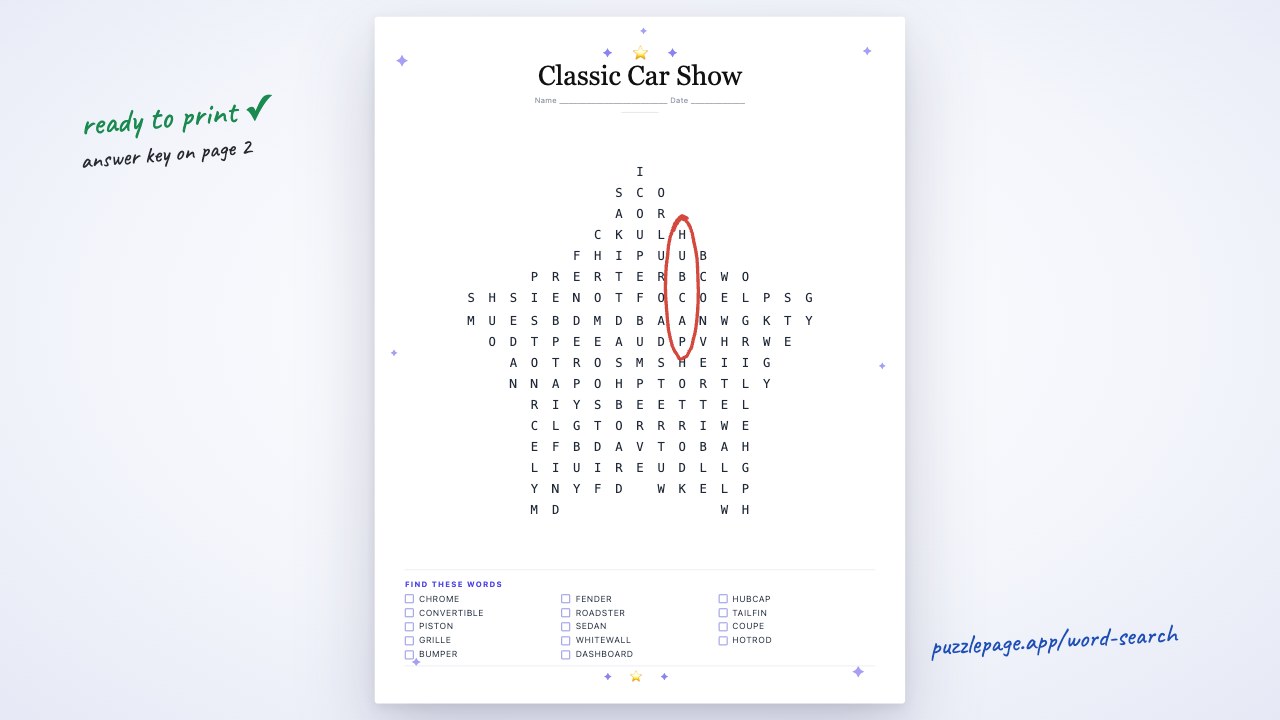
The screenshot below shows the live word search tool with the bee list loaded. Choose the hexagon shape option and the whole grid becomes a honeycomb cell, which sells the theme before anyone finds a single word.


How Do You Run a Honey Tasting Puzzle Station?
Run three rotations: taste, observe, puzzle. Students sample two honey varieties on craft sticks, record one describing word, then move to the puzzle station while the next group tastes.
- Set out two honey varieties (clover and wildflower work well) with craft sticks and a describing-words card.
- Stock the observe table with magnifying glasses and real honeycomb photos.
- Stock the puzzle station with hexagon grids, pencils, and a sand timer.
- Rotate groups every 10 to 12 minutes.
- Close by charting the class favorite honey and the trickiest hidden word.
When we ran this rotation during a second grade pollinator week, 21 of 26 students finished the honeycomb grid before the timer went off, and BUZZING was the word most students circled first. The describing-word cards came back with SWEET, FLOWERY, and one memorable STICKY-YUMMY.
Pro Tip
Tape the answer key underneath the station bin. Early finishers flip the bin to self-check, and the line for teacher help disappears.
Garden Observation Pairing
Take the vocabulary outside. A single worker bee visits roughly 50 to 100 flowers on one foraging trip, a figure beekeeping educators love to cite, and a ten-minute flower count in the school garden makes that number real.
- Give pairs a clipboard tally sheet with three columns: flower, visitor, count.
- Watch one flower patch quietly for five minutes and tally every visit.
- Back inside, circle GARDEN, CLOVER, and FLOWERS in the puzzle and connect each word to something the pair observed.
Early finishers can keep working the same word list in new formats. A bee word scramble with jumbled letters to unscramble doubles as spelling practice, and older students can decode a bee fact with the free cryptogram maker as a code-breaking challenge.
Pro Tip
Reuse one word list across all three puzzle types during the unit. Students meet the same vocabulary in a fresh format each day without worksheet fatigue.
Where Else Does a Bee Word Search Fit in the School Year?
A bee word search is not a one-day worksheet. Once the word list exists, the same puzzle worksheet slots into several other spots on the calendar with almost no extra prep.
Early finisher bin
Keep a stack in the fast-finisher folder so students who wrap up math early have a quiet, on-theme option instead of free time.
Substitute teacher folder
Print a set ahead of time and leave it with sub plans. A self-checking classroom game needs no special instructions to run.
Take-home science night
Send the puzzle worksheet home alongside a short pollinator fact sheet so families can work through the vocabulary together.
Rainy-day recess
Swap the usual indoor recess packet for a themed hidden words game when the garden observation gets rained out.
Spring pollinator week encore
Bring the same word list back in April or May when pollinator week overlaps with garden planting, and compare notes with the August session.
None of these uses require new prep beyond the original word list, which is part of why teachers tend to build one bee word search and reuse it across the year.
Try It Yourself
The whole build takes about five minutes with the free teacher resource below.
- Open the free word search generator and title the puzzle Busy Bees.
- Enter the core list: POLLEN, NECTAR, HIVE, QUEEN, HONEYCOMB, COLONY, BEESWAX, and CLOVER.
- Add two or three harder role words for grades 3 to 5.
- Choose the hexagon shape and medium difficulty.
- Print the puzzle and the answer key, one set per station bin.
Make your free bee word search printable before World Honey Bee Day, and the station plans above are ready to go.
Frequently Asked Questions
Where can I find a bee word search free printable?
The free word search generator at PuzzlePage builds one from any word list you enter and prints a clean PDF with an answer key. You can pick a hexagon honeycomb shape and adjust the difficulty by grade.
What words should a bees word search puzzle include?
Start with POLLEN, NECTAR, HIVE, QUEEN, WORKER, and HONEYCOMB, then add COLONY, BEESWAX, and CLOVER for older students. Keep every word tied to vocabulary the class has actually met in the unit.
How do you get good at word searches?
Scan the grid one row at a time for the first letter of your target word, and hunt uncommon letters first, like the Q in QUEEN or the Z in BUZZING. Crossing off found words keeps the word list manageable.
Can I make a beekeeping word search for older students?
Yes. Swap in beekeeping terms like BEESWAX, DRONE, COLONY, and HONEYCOMB, raise the difficulty so words run backward and diagonally, and hide the word bank for a real challenge.
Live demo
Make your own word search right here
Swap in your own words (a spelling list, residents' names, a unit's vocabulary) and press Generate. The full maker adds answer keys, size options and PDF export.
More you can make here
One puzzle is the start. Here is the rest of the kit.
 New
NewWorksheet Builder
Put a word search, a cryptogram and a scramble on one page, or build a whole themed packet. Prints with answer keys.
Build a worksheet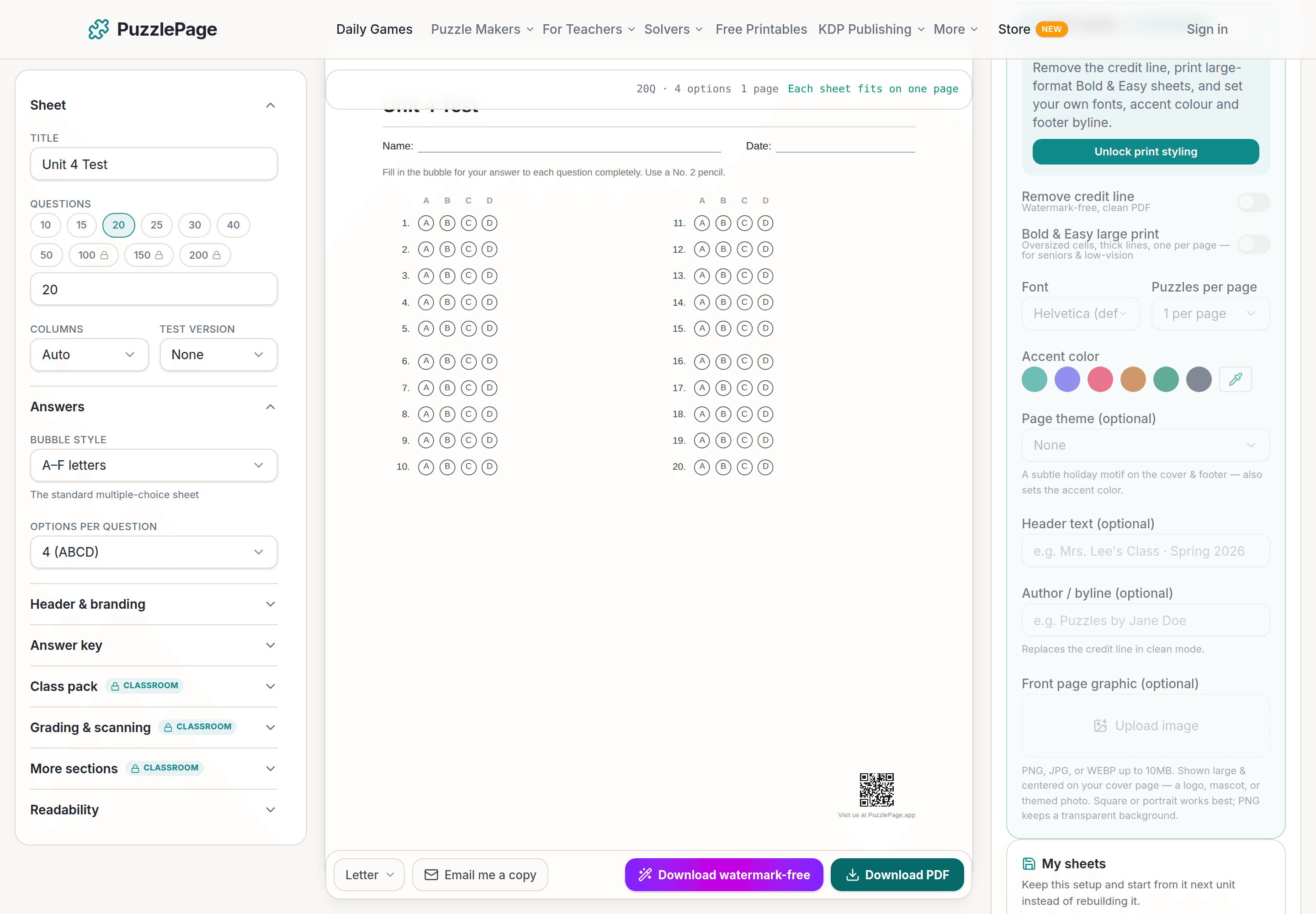
Bubble Sheet Studio
Answer sheets for any test length, with sections, versions, student ID grids and a matching answer key.
Make a bubble sheet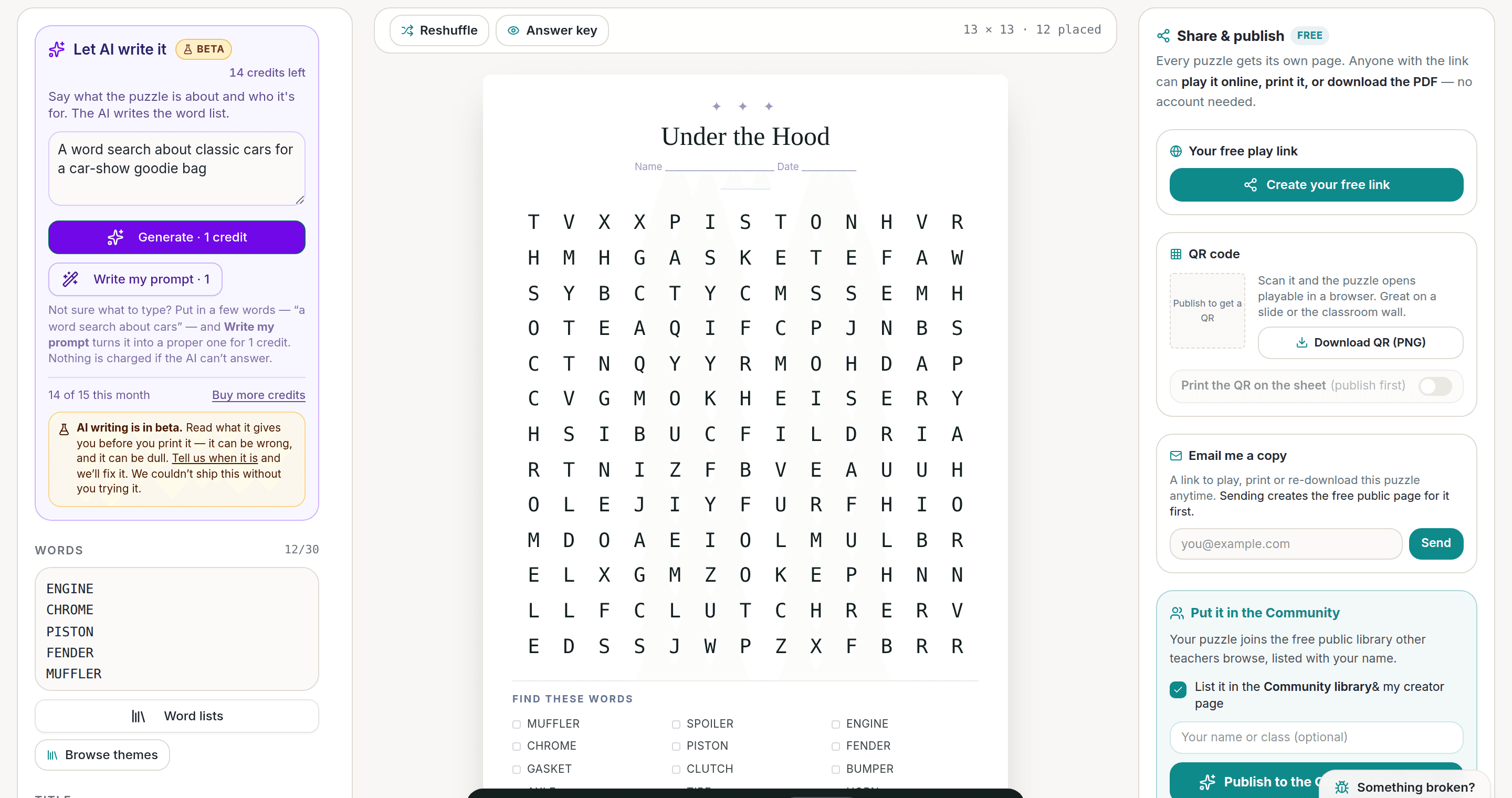
AI Puzzle Generator
Type a topic, get a themed word list and a finished puzzle. Premium also removes the footer credit and adds Word export.
Try the AI generator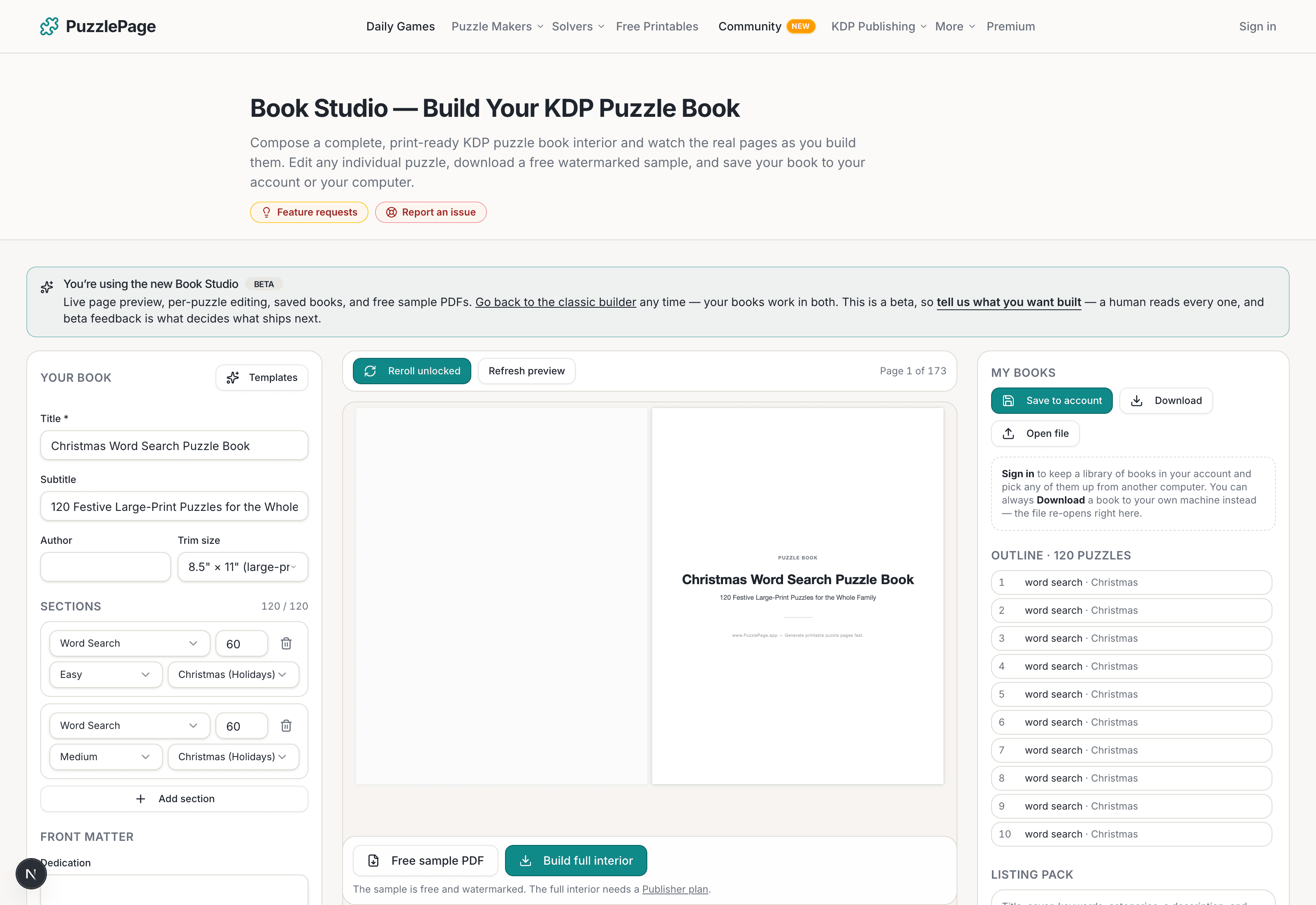
KDP Book Studio
Lay out a full puzzle book for Amazon KDP: templates, trim sizes, page checks and a cover designer.
Start a puzzle bookPremium removes the footer credit, adds Word export and custom styling across every maker.
See plans →Free daily games
Need a two-minute break? Today's puzzles are live.
A new Sudoku and a new Connections board every day. No download, no account.


Keep reading
Take the puzzle with you
Free Word Search PDF — Busy Bees Word Search
Print-ready · answer key included · unsubscribe anytime
Enjoyed this? Share the puzzle on X
Like puzzles like this? Follow on Pinterest for a new one every day.