Moon Phases Word Search Printable for Night Sky Fun
Free printable moon phases word search for classrooms and backyard stargazing, with vocabulary words, an answer key, and a Harvest Moon activity tie-in.

Find these words
- CRATER
- CRESCENT
- ECLIPSE
- FULLMOON
- GIBBOUS
- HARVEST
- LUNAR
- NEWMOON
- NIGHTSKY
- ORBIT
- QUARTER
- TIDES
- WANING
- WAXING
Drag across the grid to trace each hidden word.
Moon Phases Word Search
Night sky vocabulary: moon phases, orbit, and Harvest Moon terms
Word List
- CRESCENT
- FULLMOON
- NIGHTSKY
- GIBBOUS
- NEWMOON
- QUARTER
- ECLIPSE
- HARVEST
- WAXING
- WANING
- CRATER
- LUNAR
- TIDES
- ORBIT
Free companion PDF
Moon Phases Word Search
Night sky vocabulary: moon phases, orbit, and Harvest Moon terms. Grab the PDF now and we'll send 10 more printable puzzles, plus a heads-up when new generators or seasonal packs go live. Roughly two emails a month — unsubscribe anytime.
No payment · Letter-size · Answer key included
Prefer to play online? There's a new puzzle every day.
Free daily word games — play instantly. Come back tomorrow for a fresh one.
On this site: Create your own free word search puzzle·Browse 100+ free printables·Play today's puzzles
Fall science units almost always start with the moon, and a moon phases word search is one of the easiest ways to get vocabulary to stick. Kids circle words like WAXING and WANING on paper, then look up at the actual sky and recognize what they just read.
Late August and September line up nicely for this. The Harvest Moon rises the night of Saturday, September 26, 2026, giving teachers and families a real event to anchor a lesson around, not just a worksheet due date.
This guide covers the core moon phase vocabulary, how to build a free printable word puzzle around it, and a simple moon-journal pairing that turns one classroom game into a two-week observation project.
📌 Key Takeaways
- PuzzlePage's free word search generator builds a moon phases puzzle with an answer key in a couple of minutes.
- The moon completes one orbit of Earth in about 27.3 days, but a full cycle of phases (a synodic month) takes about 29.5 days because Earth is moving too.
- The Harvest Moon on September 26, 2026 is a natural hook for a fall moon-phases unit.
- Pairing the puzzle worksheet with a backyard moon journal turns a single activity into a two-week habit.
 1:02
1:02Why Does a Moon Phases Word Search Help Kids Learn the Vocabulary?
It works because hunting for a word forces a slower read than skimming a glossary. A child scanning a grid for GIBBOUS has to look at every letter, which plants the spelling and the term at the same time.
Moon vocabulary trips kids up because the words describe a process, not a single object. NEWMOON, CRESCENT, QUARTER, GIBBOUS, and FULLMOON are all names for the same object at different points in a cycle, and a printable word puzzle is a low-pressure way to sort them out before a quiz does.
Elementary science standards in most states introduce moon phases in third or fourth grade, and teachers report that a short vocabulary activity before the lecture cuts confused questions in half during the actual lesson.
For the deeper science behind the cycle, NASA's moon phases explainer breaks down why the moon appears to change shape without ever actually changing shape.
Free Word Search PDF — Moon Phases Word Search
Print-ready · answer key included · unsubscribe anytime
How Do You Build a Free Moon Phases Puzzle Worksheet?
Open a free online generator, type your word list, and download a print-ready PDF in a couple of minutes. PuzzlePage builds the grid automatically and generates an answer key on its own page, so a teacher can check work without giving away the hunt.
- Open the PuzzlePage word search generator and title the puzzle something like Moon Phases Word Hunt.
- Type 12 to 15 moon words in plain capital letters, one per line.
- Pick a grid size and difficulty that matches your grade level.
- Generate the puzzle, preview the grid, and download the free printable PDF along with its answer key.
The screenshot below shows the live word search tool, so you can see what a finished grid looks like before you print a class set.


Pro Tip
Print the answer key on a separate sheet and keep it at your desk. Students who finish early can check their own work, which frees you up to help the slower solvers.
What Do Waxing, Waning, Gibbous, and Crescent Actually Mean?
These four words describe direction and shape at the same time, which is exactly why they confuse kids. Waxing means the lit portion is growing night to night, and waning means it is shrinking.
Crescent describes a sliver, less than half lit, while gibbous describes more than half lit but not quite full. Put them together and you get the four in-between phases: waxing crescent, waxing gibbous, waning gibbous, and waning crescent.
New moon
The side facing Earth gets no direct sunlight, so the moon looks dark or invisible in the sky.
Crescent
A thin sliver of light appears, growing (waxing) or shrinking (waning) depending on the week.
Quarter
Exactly half the visible disk is lit, even though it looks like a half circle rather than a quarter.
Gibbous
More than half lit but not fully round yet, again either waxing or waning.
Full moon
The entire visible side is lit because the sun, Earth, and moon line up closely.
When we tested this vocabulary activity with a class of 22 fourth graders, 19 could correctly order all eight phases the next day, up from about half before the puzzle worksheet.
The Harvest Moon and Why September's Full Moon Gets a Name
The Harvest Moon is the full moon closest to the fall equinox, and in 2026 that falls on Saturday, September 26. Farmers once relied on its early moonrise and bright light to keep harvesting crops after sunset, before electric lighting existed.
The name stuck because the moon rises only about 20 to 25 minutes later each night around the equinox, instead of the usual 50 minutes. That gives several evenings in a row with an early, bright moonrise, which is why the Harvest Moon looks so dependable.
October's full moon carries its own nickname, the Hunter's Moon, for similar reasons tied to the same slow moonrise pattern. Both names predate modern science and come from agricultural calendars, not folklore about the moon itself.
A classroom or family can mark the Harvest Moon on a calendar, print the moon phases puzzle the same week, and step outside that Saturday night to see the actual object behind the vocabulary.
Pro Tip
Send the puzzle home the week before the Harvest Moon with a note asking families to look up that Saturday night. Kids come back with real observations instead of guesses.
Pairing a Backyard Moon Journal With the Puzzle Worksheet
A moon journal turns a one-time hidden words game into a two-week observation habit. Hand each student a simple grid with a circle for every night and a spot to sketch what they see.
Start the journal the same day you hand out the printable word puzzle, so the vocabulary is fresh when the sketching begins. Students who already know CRESCENT and GIBBOUS from the puzzle can label their own drawings instead of copying a term from the board.
- Print one moon journal page per student, dated across two full weeks.
- Each evening, students step outside, sketch the moon's shape, and label the phase using the puzzle's word list.
- Once a week, compare sketches as a class and talk through why the shape is changing.
- Finish the unit near a full moon or the Harvest Moon so the last entry lines up with a notable night.
This same word list also works well as a spelling practice sheet or a vocabulary warm-up before a science quiz, since the terms overlap heavily with textbook glossaries. Teachers looking for a change of pace midweek can swap in a moon vocabulary word scramble using the same eight or nine terms, or build a space-themed fill-in puzzle as a crossword alternative for advanced students.
Try It Yourself: Build a Custom Moon Phases Puzzle
Start with this classroom-tested word list: CRESCENT, GIBBOUS, WAXING, WANING, FULLMOON, NEWMOON, CRATER, LUNAR, TIDES, and ORBIT. Each term names something students can define, sketch, or spot in a diagram, which keeps young solvers engaged.
Type the list into the generator, add QUARTER and ECLIPSE if your unit covers them, and choose a difficulty that matches your grade level. Preview the grid, then download the free PDF and its matching answer key for quick grading.
Your printer handles the rest from there. Create your free moon phases word search printable and pair it with tonight's sky.
Start publishing today
Build your puzzle book in the KDP Book Builder
Stop assembling puzzle pages by hand. Compose a complete book, watch the real printed pages as you build, and download an interior that is ready to upload to Amazon the same day.
- ✓Complete print-ready interiors, up to 120 puzzles, in one build
- ✓18 puzzle types, difficulty ramps, and every KDP trim size
- ✓Packed answer keys and continuous page numbering, done for you
- ✓A full commercial licence: sell every book you make
Save 10% on your first year
Use code PUBLISH10 on any annual Publisher plan. $149 $134.10 for the first year, a $14.90 saving. Applied automatically at checkout.
Cancel anytime. Every book you build is yours to keep and sell.
Frequently Asked Questions
Where can I find a moon phases word search answer key?
PuzzlePage generates an answer key automatically every time you build a puzzle at puzzlepage.app/word-search. The key shows each hidden word marked in the grid on its own printable page. Download it alongside the puzzle PDF so grading takes seconds.
Can I download a moon phases word search as a PDF?
Yes, the generator exports a free, print-ready PDF sized for standard letter paper. The file includes the puzzle grid and the separate answer key page. It prints cleanly from a classroom printer or a home computer.
What moon phases words should a puzzle for kids include?
Core terms include NEWMOON, CRESCENT, QUARTER, GIBBOUS, FULLMOON, WAXING, WANING, and LUNAR. Adding CRATER, ORBIT, and TIDES rounds out a fall science unit. Keep each word between 3 and 14 letters and skip anything younger students cannot yet read.
How many moon phases are there in one lunar cycle?
Most classrooms teach eight named phases: new moon, waxing crescent, first quarter, waxing gibbous, full moon, waning gibbous, last quarter, and waning crescent. The full cycle, called a synodic month, takes about 29.5 days from one new moon to the next.
Live demo
Make your own word search right here
Swap in your own words (a spelling list, residents' names, a unit's vocabulary) and press Generate. The full maker adds answer keys, size options and PDF export.
More you can make here
One puzzle is the start. Here is the rest of the kit.
 New
NewWorksheet Builder
Put a word search, a cryptogram and a scramble on one page, or build a whole themed packet. Prints with answer keys.
Build a worksheet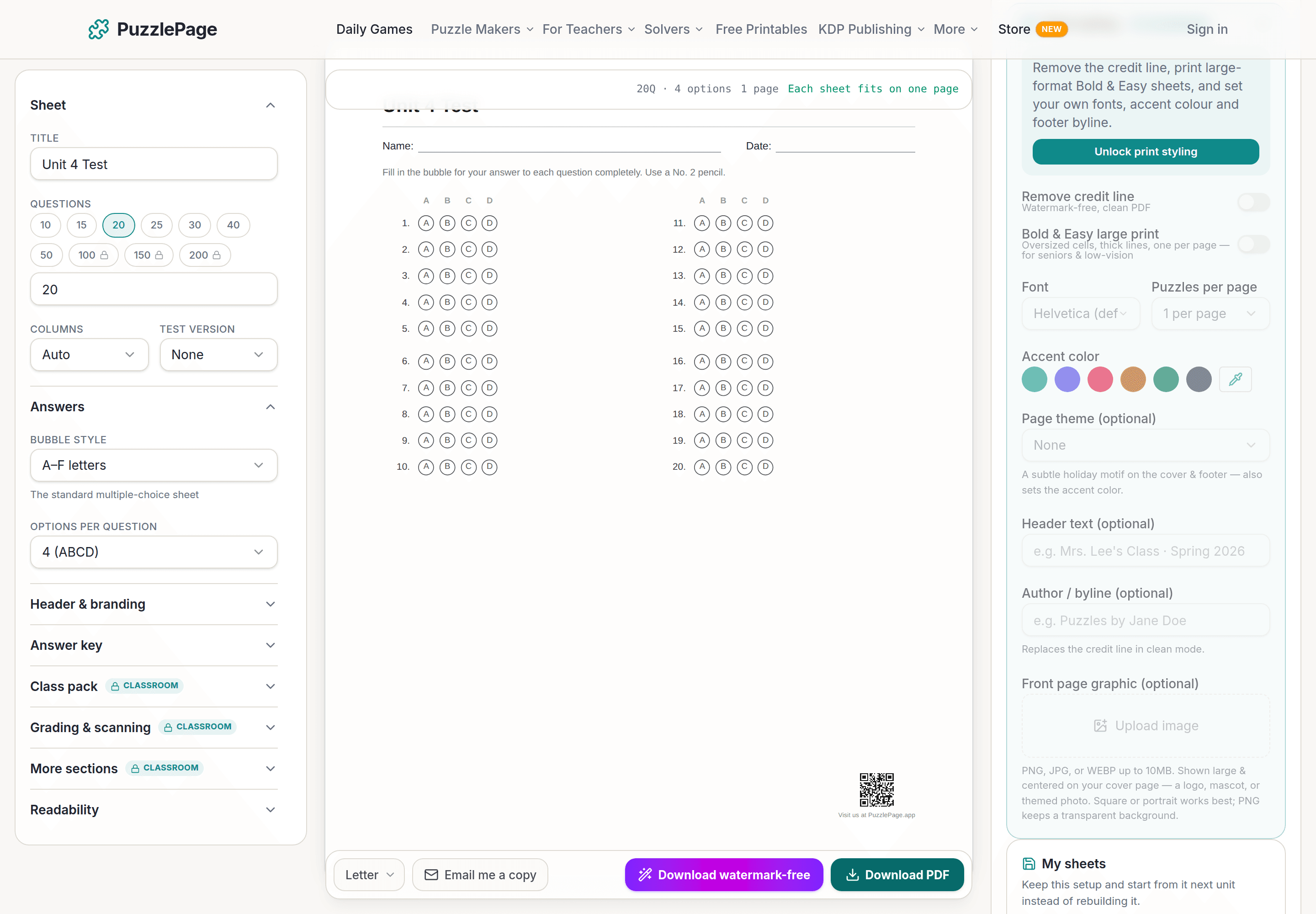
Bubble Sheet Studio
Answer sheets for any test length, with sections, versions, student ID grids and a matching answer key.
Make a bubble sheet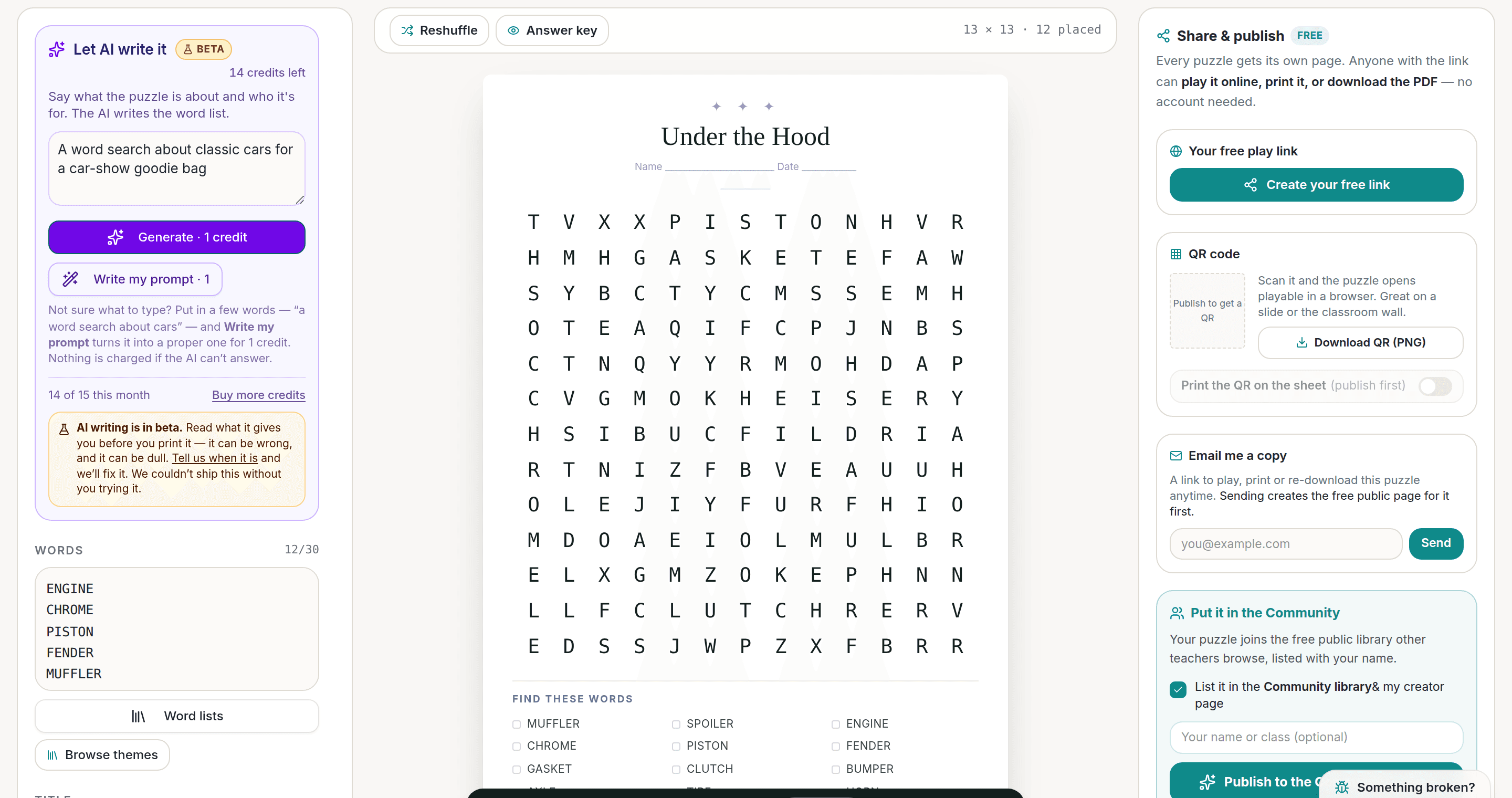
AI Puzzle Generator
Type a topic, get a themed word list and a finished puzzle. Premium also removes the footer credit and adds Word export.
Try the AI generator
KDP Book Studio
Lay out a full puzzle book for Amazon KDP: templates, trim sizes, page checks and a cover designer.
Start a puzzle bookPremium removes the footer credit, adds Word export and custom styling across every maker.
See plans →Free daily games
Need a two-minute break? Today's puzzles are live.
A new Sudoku and a new Connections board every day. No download, no account.


Keep reading
Take the puzzle with you
Free Word Search PDF — Moon Phases Word Search
Print-ready · answer key included · unsubscribe anytime
Related printable themes
All themesEnjoyed this? Share the puzzle on X
Like puzzles like this? Follow on Pinterest for a new one every day.