King Tut Activities for Kids: Crack the Pharaoh's Code
King Tut activities for kids built around November 4, 1922: a printable secret-code puzzle, a hieroglyph-style cipher twist and Egypt facts for class.

Hints
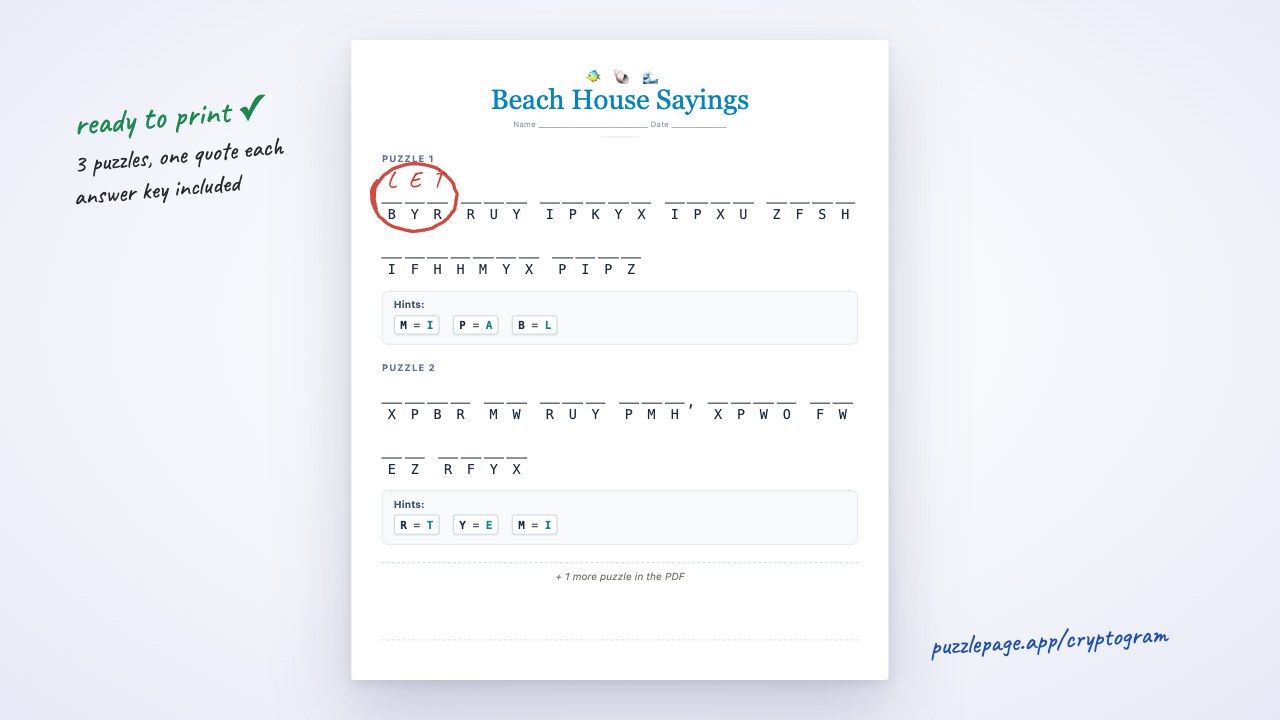
Crack the Pharaoh's Code
The 1922 discovery of King Tutankhamun's tomb and life in ancient Egypt
Phrase 1
Hint: J = P
Phrase 2
Hint: O = E
+ 3 more phrases in the PDF
Free companion PDF
Crack the Pharaoh's Code
The 1922 discovery of King Tutankhamun's tomb and life in ancient Egypt. Grab the PDF now and we'll send 10 more printable puzzles, plus a heads-up when new generators or seasonal packs go live. Roughly two emails a month — unsubscribe anytime.
No payment · Letter-size · Answer key included
Prefer to play online? There's a new puzzle every day.
Free daily word games — play instantly. Come back tomorrow for a fresh one.
On this site: Create your own free cryptogram puzzle·Browse 100+ free printables·Play today's puzzles
Your Egypt unit is on the calendar, and a room of eight-year-olds has already asked whether pharaohs had pets. King Tut activities for kids work best when students get to do what the archaeologists did: find clues, test guesses and uncover something hidden.
November 4 marks the day in 1922 when Howard Carter's team uncovered the first step down to Tutankhamun's tomb. This lesson turns that story into a secret-code puzzle, and the playable version sits at the top of this page.
📌 Key Takeaways
- The first step of Tutankhamun's tomb was found on November 4, 1922, in the Valley of the Kings near Luxor.
- A cryptogram swaps every letter for another letter; students crack the code using short words and letter patterns.
- The companion puzzle hides five real facts, including Carter's famous words, "Yes, wonderful things."
- Easy mode reveals three letters to start, which suits grades 2 to 3. Hard mode gives no hints.
 0:58
What Happened on November 4, 1922?
On November 4, 1922, workers on Howard Carter's excavation in Egypt's Valley of the Kings uncovered a step cut into the rock. It was the top of a staircase that led to the sealed tomb of Tutankhamun, a young king who ruled Egypt more than 3,000 years ago.
Carter's own journal, kept today by the Griffith Institute at the University of Oxford, records the day. The team cleared the stairs, found seals with the king's name, and on November 26 made a small opening in the doorway.
When his sponsor, Lord Carnarvon, asked whether he could see anything, Carter's published account gives his answer as "Yes, wonderful things." (His journal records it a little differently, which makes a nice lesson in how primary sources vary.) Those three words are one of the secret messages in today's puzzle.
| Date | What happened | Kid-friendly takeaway |
|---|---|---|
| Nov 4, 1922 | First step of the staircase found | Patience pays: Carter searched for years |
| Nov 24, 1922 | Stairs cleared; seals with Tutankhamun's name found | Clues confirm the guess |
| Nov 26, 1922 | Small opening made in the sealed doorway | "Wonderful things" inside |
| 1922 to 1930s | Thousands of objects recorded, drawn and photographed | Scientists take careful notes |
Free Cryptogram PDF — Crack the Pharaoh's Code
Print-ready · answer key included · unsubscribe anytime
How Does a Secret-Code Puzzle Teach Kids About Egypt?
A cryptogram asks students to decode a message where each letter stands for a different letter. That is close to what early scholars faced with hieroglyphs: a writing system full of symbols that had to be matched to sounds before anyone could read it.
Kids practise the same habits archaeologists use. They look for patterns, test a guess, and check whether it makes sense across the whole message.
- One-letter words are almost always A or I.
- A three-letter word that repeats is often THE or AND.
- A letter that appears again and again is likely E, T or A.
- Once one word cracks, write those letters everywhere else in the message.
Pro Tip
Put the one-letter-word tip on the board before you hand out sheets. It gets every group their first correct letter in under a minute, and early success keeps the whole room trying.
How Do You Run This King Tut Code-Breaker Lesson?
Run it in four parts: a two-minute story hook, a model decode, group code-breaking, and a share-out. The whole lesson fits 30 to 45 minutes.
- Tell the November 1922 story in two minutes. Stop at the moment Carter looks through the opening.
- Project the puzzle at the top of this page and decode the short message, YES, WONDERFUL THINGS, together.
- Print the same puzzle from the Printable page tab, one per pair.
- Give pairs 15 to 20 minutes to crack the other four facts.
- Have each pair read one decoded fact aloud and explain which clue cracked it.
| Grade | Cryptogram setting | Support | Time |
|---|---|---|---|
| Grades 2 to 3 | Easy (3 letters revealed) | Work in pairs with an alphabet strip | 20 to 25 minutes |
| Grades 4 to 5 | Medium (1 letter revealed) | Pairs, no strip | 15 to 20 minutes |
| Grades 6 to 8 | Hard (no hints) | Solo or pairs, timed | 15 minutes |
Want your own facts in the code? Type them into the cryptogram maker, choose Easy, Medium or Hard, and print a fresh sheet with its answer key.
How Do You Add a Hieroglyph-Style Twist?
Add the twist by replacing letters with simple drawn symbols instead of other letters. Students make a key (A is an eye, B is a foot, and so on), write a short message in symbols, and trade it with a partner to decode.
Be clear with students that this is a pretend alphabet. Real hieroglyphs did not work letter by letter like English; many symbols stood for sounds or whole ideas. The game borrows the feeling of decoding without claiming to teach real Egyptian writing.
Pro Tip
Keep the symbols simple enough to draw in five seconds: a wavy line, a circle with a dot, a bird shape. Complicated symbols turn a decoding game into an art project.
What Other King Tut Activities for Kids Fit the Unit?
Several short printables round out the week. Each one uses the same Egypt vocabulary so students meet the words more than once.
Egypt word search
Put PHARAOH, PYRAMID, PAPYRUS, SCRIBE, NILE and SCARAB into the word search maker for a warm-up or early-finisher sheet.
Vocabulary scramble
A word scramble of the same words checks spelling before a quiz.
Mixed code packet
The Worksheet Builder puts a cryptogram, word search and maze on one page, with answer keys at the end. Building is free; the PDF download is paid.
Daily brain break
The free daily Connections-style game makes a good two-minute class challenge on the board.
For more on the discovery, Smithsonian Magazine's article on how Howard Carter found the tomb is a readable teacher background piece.
Start publishing today
Build your puzzle book in the KDP Book Builder
Stop assembling puzzle pages by hand. Compose a complete book, watch the real printed pages as you build, and download an interior that is ready to upload to Amazon the same day.
- ✓Complete print-ready interiors, up to 120 puzzles, in one build
- ✓18 puzzle types, difficulty ramps, and every KDP trim size
- ✓Packed answer keys and continuous page numbering, done for you
- ✓A full commercial licence: sell every book you make
Save 10% on your first year
Use code PUBLISH10 on any annual Publisher plan. $149 $134.10 for the first year, a $14.90 saving. Applied automatically at checkout.
Cancel anytime. Every book you build is yours to keep and sell.
Frequently Asked Questions
What age are King Tut code-breaking activities good for?
Grades 2 to 8 can all play, with different settings. Younger students use Easy mode with three letters revealed, while middle schoolers can try Hard mode with no hints.
When was King Tut's tomb discovered?
The first step of the staircase was uncovered on November 4, 1922, by Howard Carter's team in the Valley of the Kings. The sealed doorway was opened a little on November 26, 1922.
How do kids solve a cryptogram?
Kids start with one-letter words, which are usually A or I, and repeated three-letter words like THE. Each letter they crack gets filled in everywhere it appears until the message can be read.
Can I make a cryptogram with my own Egypt facts?
Yes. Type your facts into the free cryptogram maker, pick a difficulty, and download a printable sheet with its answer key.
Live demo
Make your own cryptogram right here
Swap in your own words (a spelling list, residents' names, a unit's vocabulary) and press Generate. The full maker adds answer keys, size options and PDF export.
More you can make here
One puzzle is the start. Here is the rest of the kit.
 New
Worksheet Builder
Put a word search, a cryptogram and a scramble on one page, or build a whole themed packet. Prints with answer keys.
Build a worksheet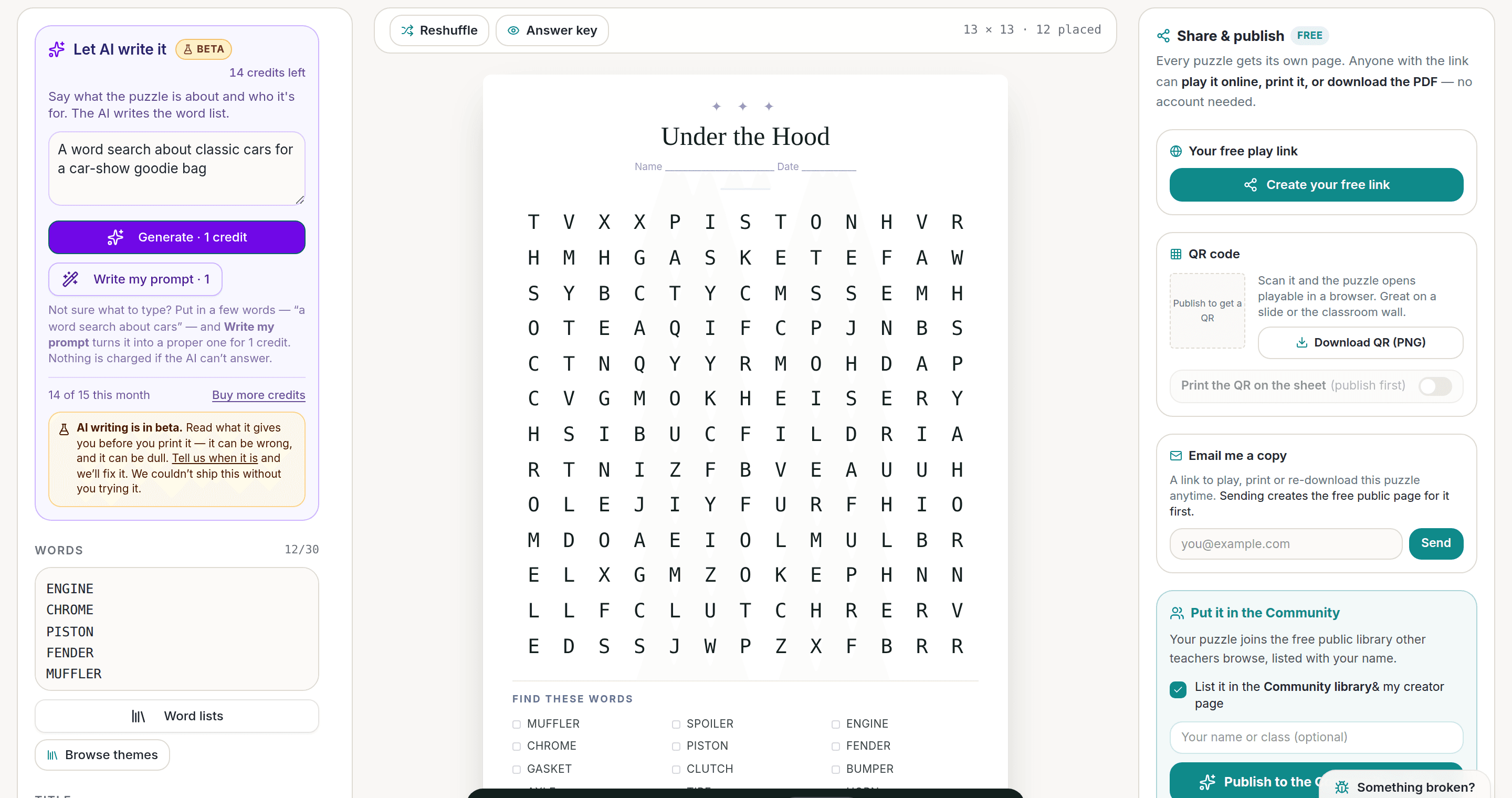
AI Puzzle Generator
Type a topic, get a themed word list and a finished puzzle. Premium also removes the footer credit and adds Word export.
Try the AI generator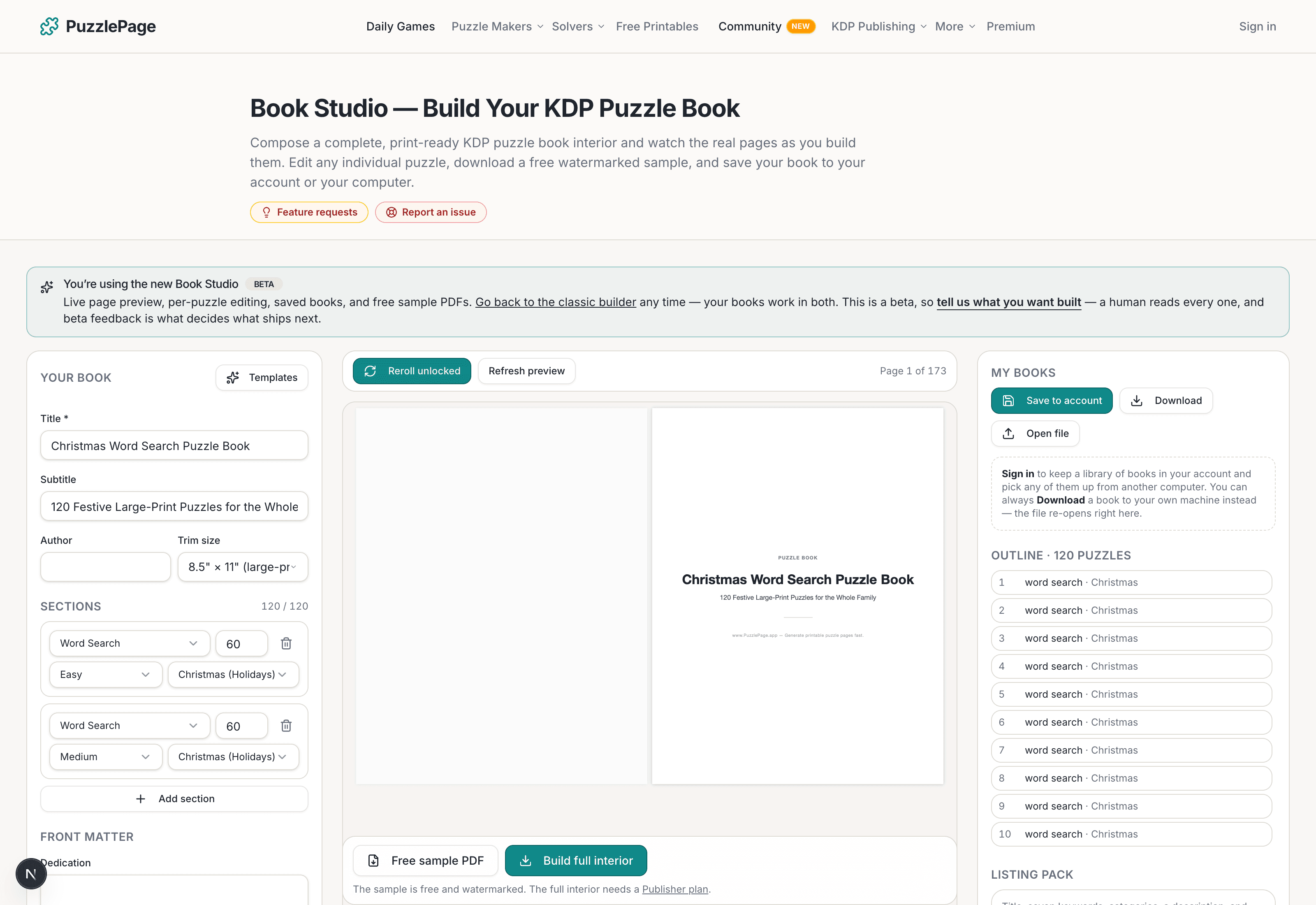
KDP Book Studio
Lay out a full puzzle book for Amazon KDP: templates, trim sizes, page checks and a cover designer.
Start a puzzle book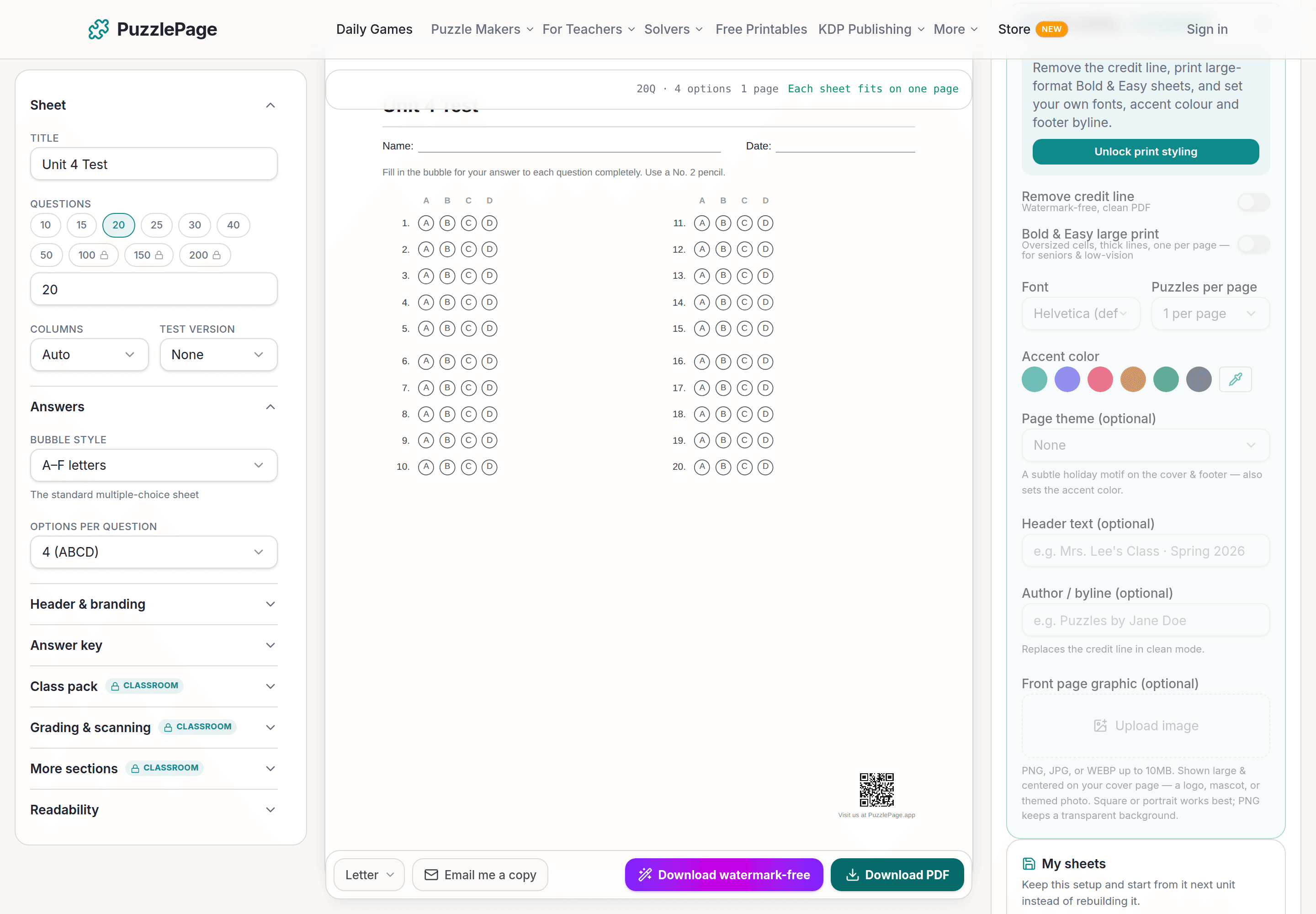
Bubble Sheet Studio
Answer sheets for any test length, with sections, versions, student ID grids and a matching answer key.
Make a bubble sheetPremium removes the footer credit, adds Word export and custom styling across every maker.
See plans →Free daily games
Need a two-minute break? Today's puzzles are live.
A new Sudoku and a new Connections board every day. No download, no account.
Keep reading
Take the puzzle with you
Free Cryptogram PDF — Crack the Pharaoh's Code
Print-ready · answer key included · unsubscribe anytime
Enjoyed this? Share the puzzle on X
Like puzzles like this? Follow on Pinterest for a new one every day.