Fibonacci Day Activities: Free Printable Puzzles for Nov 23
Fibonacci Day activities for November 23, 2026: a free 11-puzzle printable pack, a Fibonacci number search, a graph paper spiral and a 45-minute class plan.
On this site: Print the free Fibonacci Day puzzle pack·Browse 100+ free printables·Play today's puzzles
Quick Answer
The easiest Fibonacci Day activities are a free printable puzzle pack, a Fibonacci number search you make in two minutes, and a spiral drawn on 1 cm graph paper. Fibonacci Day 2026 is Monday, November 23, because 11/23 reads 1, 1, 2, 3, the first numbers of the sequence.
It is the Monday of Thanksgiving week, half the class is already thinking about pie, and you want one math lesson that still feels like a treat. These Fibonacci Day activities fit that day: they are printable, they work from grade 3 up, and every one ends with students finding a pattern on their own.
Below you will find a 45-minute plan, a free 11-puzzle pack with answer keys, a number search you can build from the real sequence, and a hands-on spiral that turns the numbers into a picture.
📌 Key Takeaways
- Fibonacci Day 2026 falls on Monday, November 23, three days before Thanksgiving.
- The rule fits on a sticky note: add the last two numbers to get the next one.
- The free Fibonacci Day pack has 11 puzzles (word searches, scrambles, fill-ins and cryptograms) with answer keys.
- A Fibonacci number search and a graph paper spiral each take about 15 minutes of class time.
When is Fibonacci Day in 2026?
Fibonacci Day 2026 is Monday, November 23. Written as month and day, the date is 11/23, and those digits (1, 1, 2, 3) are the opening numbers of the Fibonacci sequence. It is an unofficial day that math teachers, libraries and museums use as a reason to talk about patterns.
The day is named for Leonardo of Pisa, the Italian mathematician later known as Fibonacci. In his book Liber abaci, written in 1202, he posed a puzzle about rabbits whose answer builds the sequence, and the same book helped spread the Hindu-Arabic numerals we use today across Europe. The Britannica entry on the Fibonacci sequence is a good teacher read before class.
Because the date lands in Thanksgiving week this year, plan for a short, high-energy lesson. Every activity below works in a single period, and the puzzle pack makes a calm early-finisher folder for the rest of the week.
Like this? We send 10 of these every month.
Free printable puzzles, answer keys included — same quality as the ones in this post.
One email. Unsubscribe anytime.
What is the Fibonacci sequence, in kid-friendly words?
The Fibonacci sequence is a list of numbers where each new number is the sum of the two numbers before it. Start with 1 and 1, add them to get 2, add 1 and 2 to get 3, and keep going. Students can build the whole list with nothing but addition.
Here are the first fifteen numbers, which is all a class needs for the activities on this page:
1, 1, 2, 3, 5, 8, 13, 21, 34, 55, 89, 144, 233, 377, 610
Fibonacci's rabbit puzzle asked how many pairs of rabbits there would be after a year if every pair produced a new pair each month, starting from their second month. His answer was 144 pairs, the twelfth number on the list above. Ask students to find 144 on the list before you tell them why it matters.
Older students can try one more trick. Divide any number by the one before it (144 divided by 89, then 233 divided by 144) and the answers creep closer and closer to about 1.618, a number known as the golden ratio.
Pro Tip
Write 1, 1 on the board and let students race to the first number over 1,000. It takes 17 numbers (1,597 is the first), and the race doubles as a fast addition warm-up.
Which Fibonacci Day activities fit a 45-minute class?
Pick two or three of the activities below and you have a full period. Each one is printable or uses paper you already have, and each links to the free tool or puzzle that does the setup for you.
| Activity | Time | Grades | What you need |
|---|---|---|---|
| Build the sequence race | 5 min | 3 to 8 | A whiteboard |
| Fibonacci number search | 15 min | 3 to 6 | One page from the number search maker |
| Graph paper spiral | 15 to 20 min | 4 to 8 | 1 cm graph paper, pencil, compass (optional) |
| Pinecone spiral count | 10 min | 2 to 6 | A few pinecones, two colors of yarn or marker |
| Fibonacci Day puzzle pack | 10 to 30 min | 3 to 8 and adults | The free PDF, printed |
The free Fibonacci Day puzzle pack holds 11 pages: word searches about number patterns, spirals in nature (shaped like a leaf) and math tools, two scrambles, two fill-ins and four short cryptograms, one of which explains why the day falls on November 23. Answer keys are at the back.
For a quieter block, hand out the cryptograms first. Students decode a fact, then check it against the list on the board.
How do you make a Fibonacci number search?
A number search works like a word search, but students hunt for numbers in a grid of digits. Paste Fibonacci numbers into the free number search maker and it hides them for you, so the puzzle practices the sequence itself.
- Open the number search maker and type a title, such as "Fibonacci Day Number Hunt."
- Under Numbers to hide, choose My own list.
- Paste these 15 numbers, one per line: 13, 21, 34, 55, 89, 144, 233, 377, 610, 987, 1597, 2584, 4181, 6765, 10946.
- Keep the Medium (13 by 13) grid, which holds up to 30 numbers, and pick a difficulty: Easy runs numbers across and down, Medium adds diagonals, Hard adds backwards.
- Click Generate Puzzle, toggle Show Answer Key to check it, then download the PDF and print.

Pro Tip
Start the list at 13 rather than 1. Single digits are everywhere in a grid of digits, and even two-digit numbers can turn up more than once by chance, so the longer numbers make a fairer hunt.
Want a bonus round? Leave one number off the list and add a blank line at the bottom. Students who find the pattern can work out the missing number before they search for it. For more ways to use the tool, see our guide to the number search generator.
How do you draw a Fibonacci spiral on graph paper?
A Fibonacci spiral is drawn by stacking squares whose sides are Fibonacci numbers, then sweeping a curve through them. On 1 cm graph paper the squares are easy to count, and the finished picture fits on one sheet.
- Print a sheet from the free graph paper maker with the grid size set to 10 mm (1 cm).
- Near the middle of the page, shade two 1 by 1 squares side by side.
- Draw a 2 by 2 square along the long edge of that pair, then a 3 by 3 square along the new long edge.
- Keep going in the same turning direction with 5 by 5, 8 by 8 and 13 by 13 squares.
- In each square, draw a quarter-circle from one corner to the opposite corner so the arcs join into one spiral.
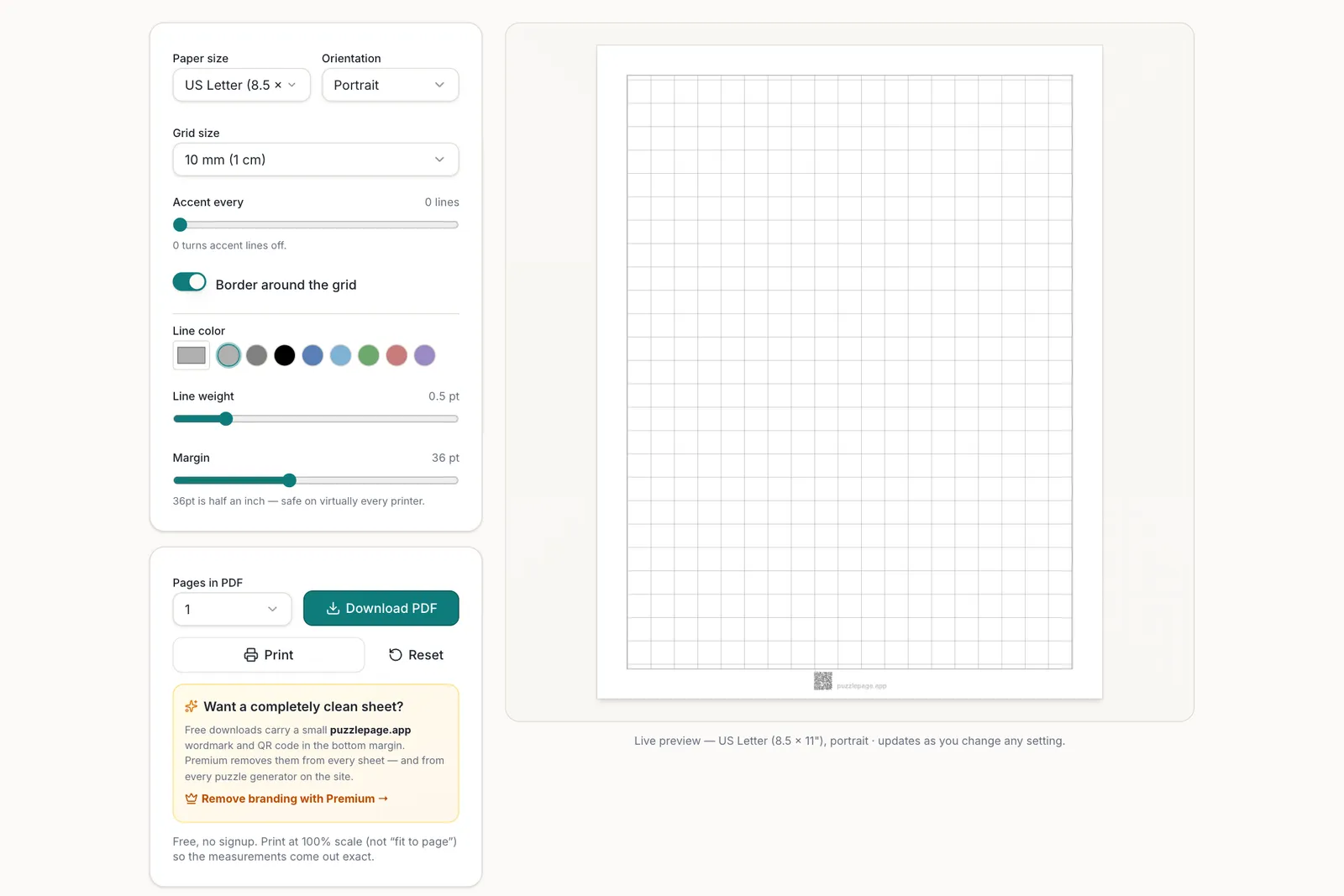
The squares through 13 make a rectangle 13 cm wide and 21 cm long, so turn it with the long side running down the page and it fits on a portrait Letter or A4 sheet. Younger students can stop at 8; a compass helps older students draw cleaner arcs. Our graph paper grid size guide explains which grid suits which grade.
Where can students spot Fibonacci numbers in nature?
Pinecones, sunflower heads and pineapples often grow in two sets of spirals, one turning each way, and the two counts are often neighbors in the Fibonacci sequence. A pinecone commonly shows 8 spirals one way and 13 the other. Large sunflower heads often show 34 and 55.
The word "often" matters here. Counting studies of real sunflowers found many heads with Fibonacci counts and some without, so tell students they are testing a pattern, not checking a rule.
-
Pinecone count
Give each table a pinecone. Students mark one spiral with a dot of marker, count every spiral turning that way, then count the other way and compare the two numbers with the list.
-
Photo hunt
Project a close-up photo of a sunflower head or a pineapple and let pairs trace spirals with a finger on the board.
-
Class tally
Record every table's counts on one chart. Circle the Fibonacci pairs and talk about the ones that are not.
Finish with the "Spirals in Nature" word search from the puzzle pack, or build a vocabulary page of your own with the word search maker. A secret message is easy to make too: type a sentence into the cryptogram maker and print a code-breaking exit ticket. Teachers planning a whole unit can borrow words from our math vocabulary word search lists.
Frequently Asked Questions
When is Fibonacci Day 2026?
Fibonacci Day 2026 is Monday, November 23. The date is chosen because 11/23 reads 1, 1, 2, 3, the first numbers of the Fibonacci sequence.
What are easy Fibonacci Day activities for kids?
Easy Fibonacci Day activities include building the sequence on the board, a Fibonacci number search and counting the spirals on a pinecone. The free Fibonacci Day puzzle pack adds 11 printable puzzles with answer keys for early finishers.
What grade is the Fibonacci sequence taught in?
Any student who can add two-digit numbers can build the sequence, so grade 3 and up works for the basic rule. Middle school students can go further with the graph paper spiral and the ratio that approaches about 1.618.
Is the Fibonacci Day puzzle pack free?
Yes. The pack is a free PDF with an answer key for every page, and you download it with your email address. A Premium plan removes the small PuzzlePage credit line from the pages.
More you can make here
One puzzle is the start. Here is the rest of the kit.
 New
Worksheet Builder
Put a word search, a cryptogram and a scramble on one page, or build a whole themed packet. Prints with answer keys.
Build a worksheet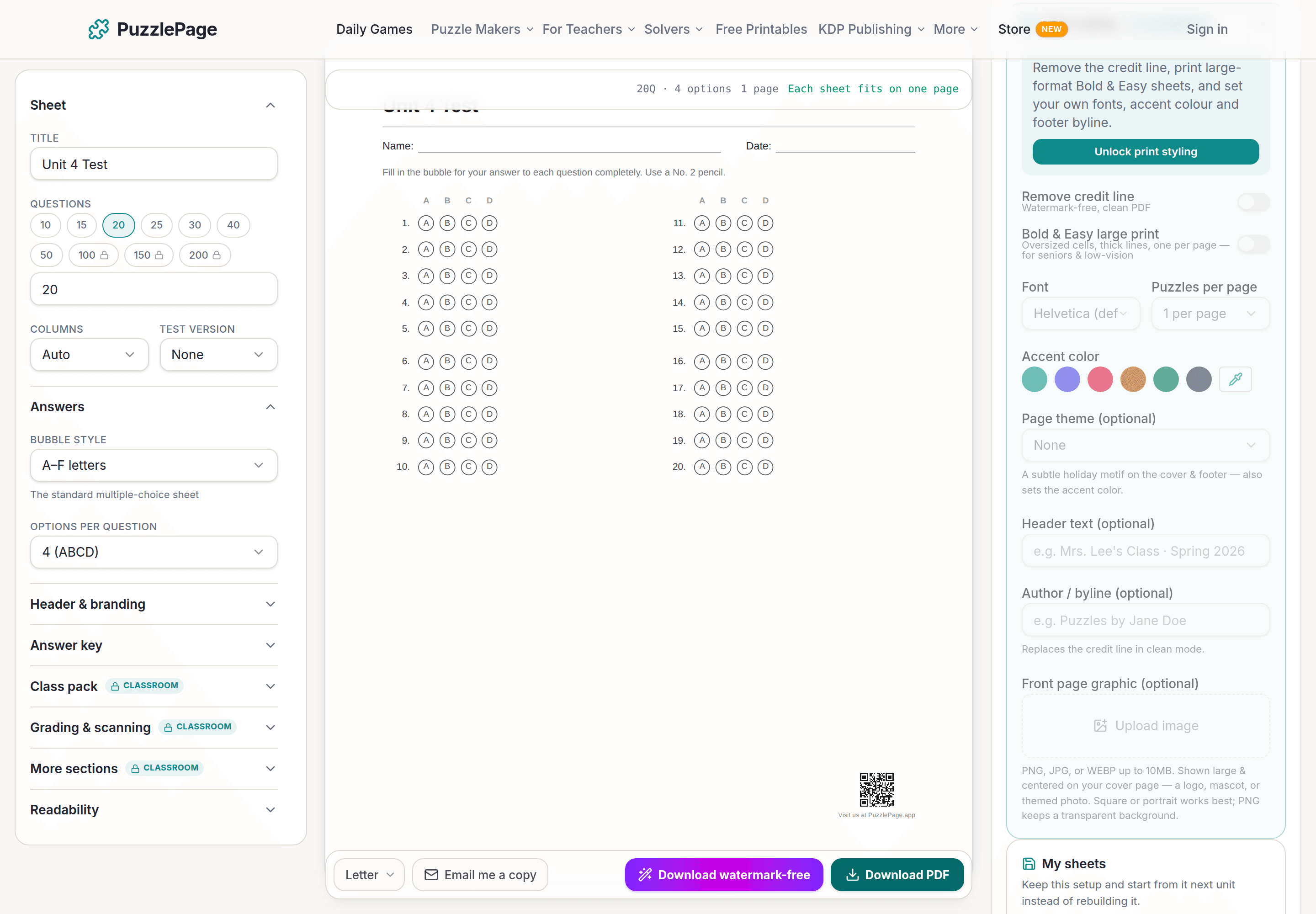
Bubble Sheet Studio
Answer sheets for any test length, with sections, versions, student ID grids and a matching answer key.
Make a bubble sheet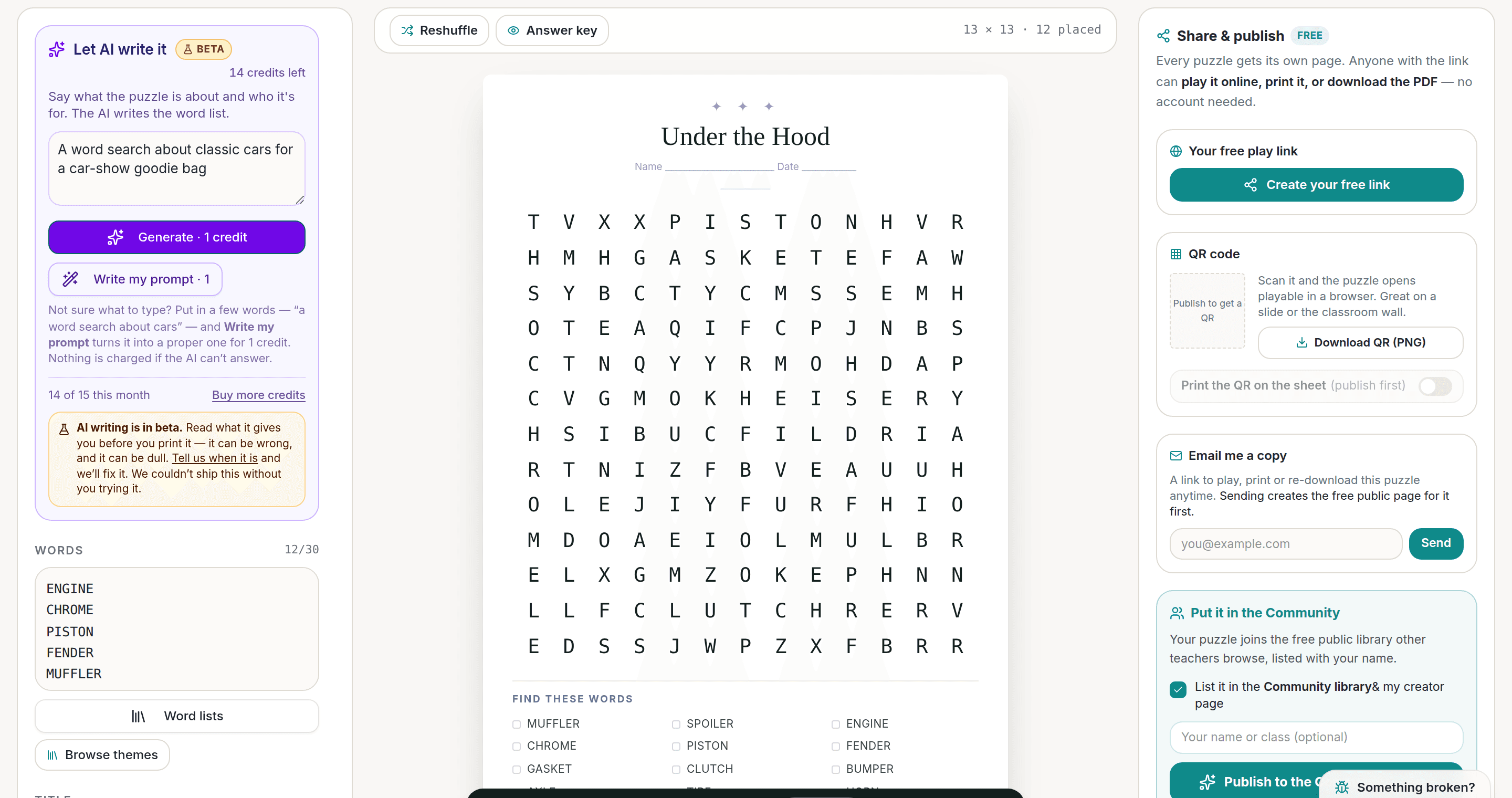
AI Puzzle Generator
Type a topic, get a themed word list and a finished puzzle. Premium also removes the footer credit and adds Word export.
Try the AI generator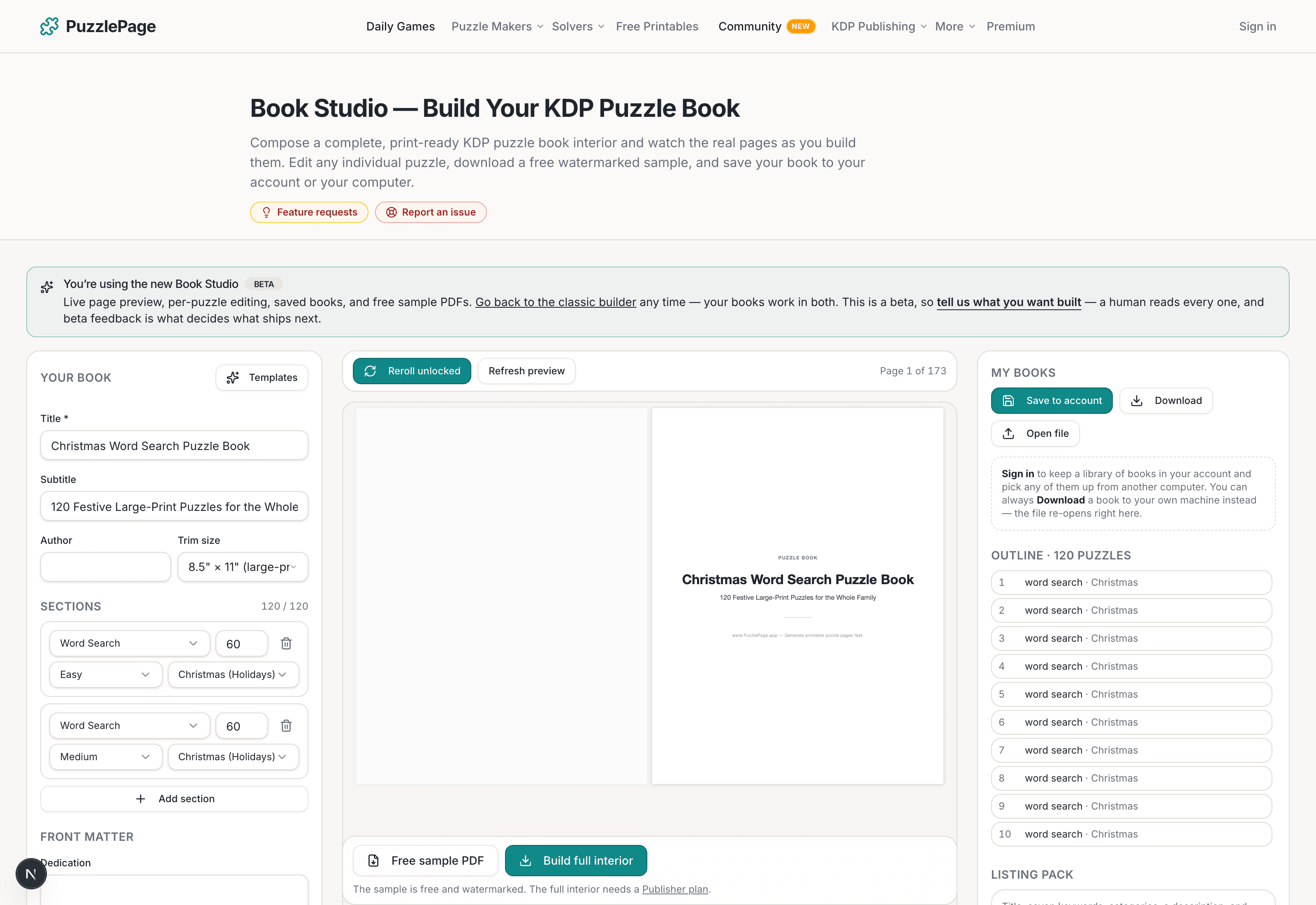
KDP Book Studio
Lay out a full puzzle book for Amazon KDP: templates, trim sizes, page checks and a cover designer.
Start a puzzle bookPremium removes the footer credit, adds Word export and custom styling across every maker.
See plans →Free daily games
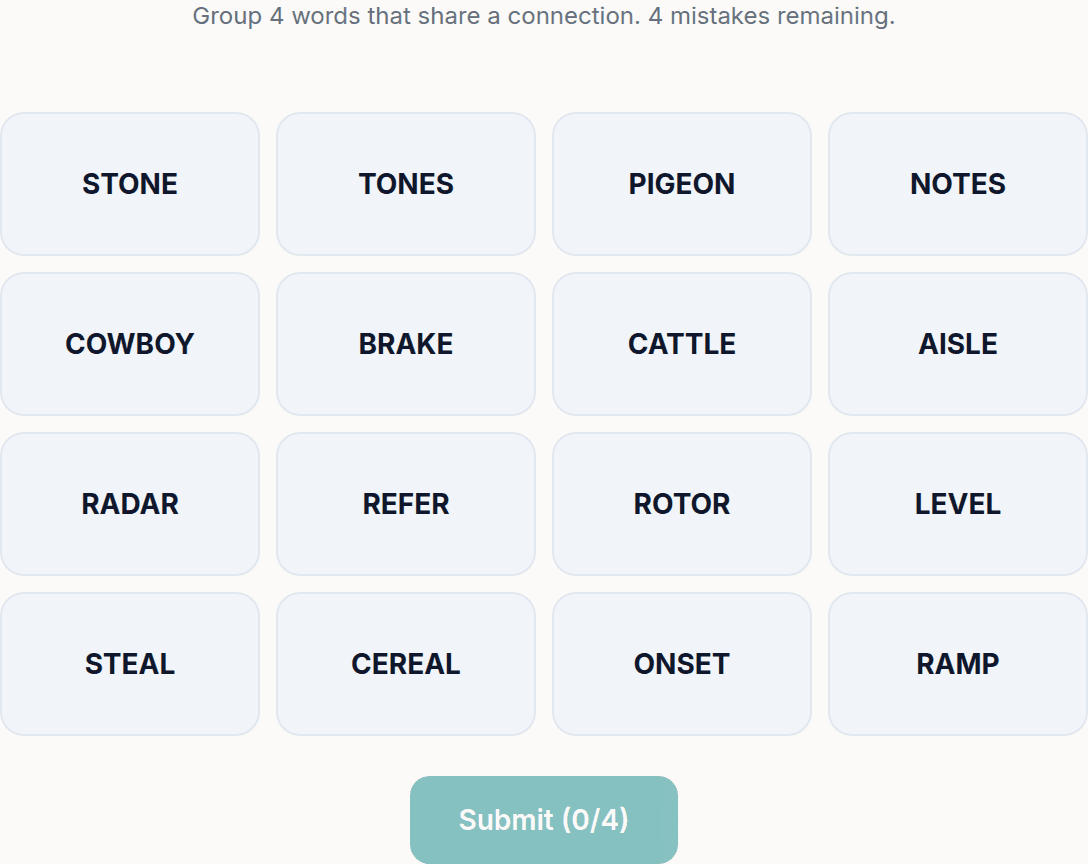
Need a two-minute break? Today's puzzles are live.
A new Sudoku and a new Connections board every day. No download, no account.


Keep reading
Get 10 free puzzles
Get the free 10-puzzle pack
Enter your email and we'll send you 10 print-ready puzzles with answer keys, plus a heads-up when we publish new generators and seasonal puzzle packs. Same quality as the ones on this page.
Roughly two emails a month. No spam, unsubscribe anytime.
Enjoyed this? Share the puzzle on X
Like puzzles like this? Follow on Pinterest for a new one every day.