Are Word Searches Good for Kids? What Research Says
Are word searches good for kids? Yes, research-backed benefits include vocabulary, spelling, and focus, plus tips for when to skip them.

Find these words
- ATTENTION
- CONFIDENCE
- FLUENCY
- FOCUS
- FUN
- LITERACY
- MEMORY
- PATTERNS
- PRACTICE
- SCANNING
- SPELLING
- VOCABULARY
Drag across the grid to trace each hidden word.
Reading Skills Word Search
Vocabulary, spelling, and focus skills word list
Word List
- VOCABULARY
- CONFIDENCE
- ATTENTION
- SPELLING
- SCANNING
- PATTERNS
- PRACTICE
- LITERACY
- FLUENCY
- MEMORY
- FOCUS
- FUN
Free companion PDF
Reading Skills Word Search
Vocabulary, spelling, and focus skills word list. Grab the PDF now and we'll send 10 more printable puzzles, plus a heads-up when new generators or seasonal packs go live. Roughly two emails a month — unsubscribe anytime.
No payment · Letter-size · Answer key included
Prefer to play online? There's a new puzzle every day.
Free daily word games — play instantly. Come back tomorrow for a fresh one.
On this site: Create your own free word search puzzle·Browse 100+ free printables·Play today's puzzles
Parents and teachers ask whether word searches are good for kids often enough that it is worth answering directly, with evidence instead of opinion. The short answer is yes, with real caveats about what the puzzle can and cannot teach.
A word search is not a reading-comprehension tool, and nobody should expect it to replace phonics instruction or leveled readers. What it does reliably do is give a child focused, repeated exposure to a specific word list while training the kind of visual scanning that supports fluent reading later on.
📌 Key Takeaways
- Word searches build visual scanning and pattern recognition, skills linked to reading fluency in early literacy research.
- Repeatedly spotting a spelled-out word reinforces spelling patterns better than passive reading alone.
- Word searches are a vocabulary and focus supplement, not a substitute for comprehension or phonics instruction.
- A free word search generator lets teachers and parents build a puzzle worksheet matched to any current unit's word list.
 1:02
1:02Are Word Searches Good for Kids' Vocabulary and Spelling?
Yes, largely because a word search forces repeated visual contact with the same word until it is found. That repetition mirrors one of the core mechanisms behind vocabulary retention: seeing a word's letter pattern multiple times in a short window strengthens recognition.
Puzzle-based learning research, including cognitive studies on adults conducted at institutions like the University of Exeter and King's College London, has found that regular puzzle engagement correlates with better short-term pattern recognition and sustained attention. While that research focused on adult brain health, the underlying mechanism, repeated pattern scanning, is the same skill a word search trains in a young reader.
For families wondering whether the activity carries any real evidence behind it, the Reading Rockets literacy resource outlines how word-level practice activities support early reading development alongside phonics and comprehension work.
A themed vocabulary activity also works well for English language learners, since finding a word visually reinforces spelling before a child necessarily uses it in speech.
Free Word Search PDF — Reading Skills Word Search
Print-ready · answer key included · unsubscribe anytime
What Skills Does a Word Search Actually Build?
A word search builds four distinct skills at once: visual scanning, spelling reinforcement, sustained attention, and vocabulary exposure. Each shows up differently depending on the child's age and reading level.
Visual scanning
Searching row by row and diagonal by diagonal trains the eyes to track patterns methodically, a skill that carries over into proofreading and map reading.
Spelling reinforcement
Circling a word letter by letter reinforces its exact spelling more actively than simply reading it in a sentence.
Sustained attention
A 10 to 20 minute puzzle session asks a child to hold focus on one task, good practice for longer independent work later.
Vocabulary exposure
A themed word list introduces topic-specific vocabulary before a lesson, giving kids a head start on unfamiliar terms.
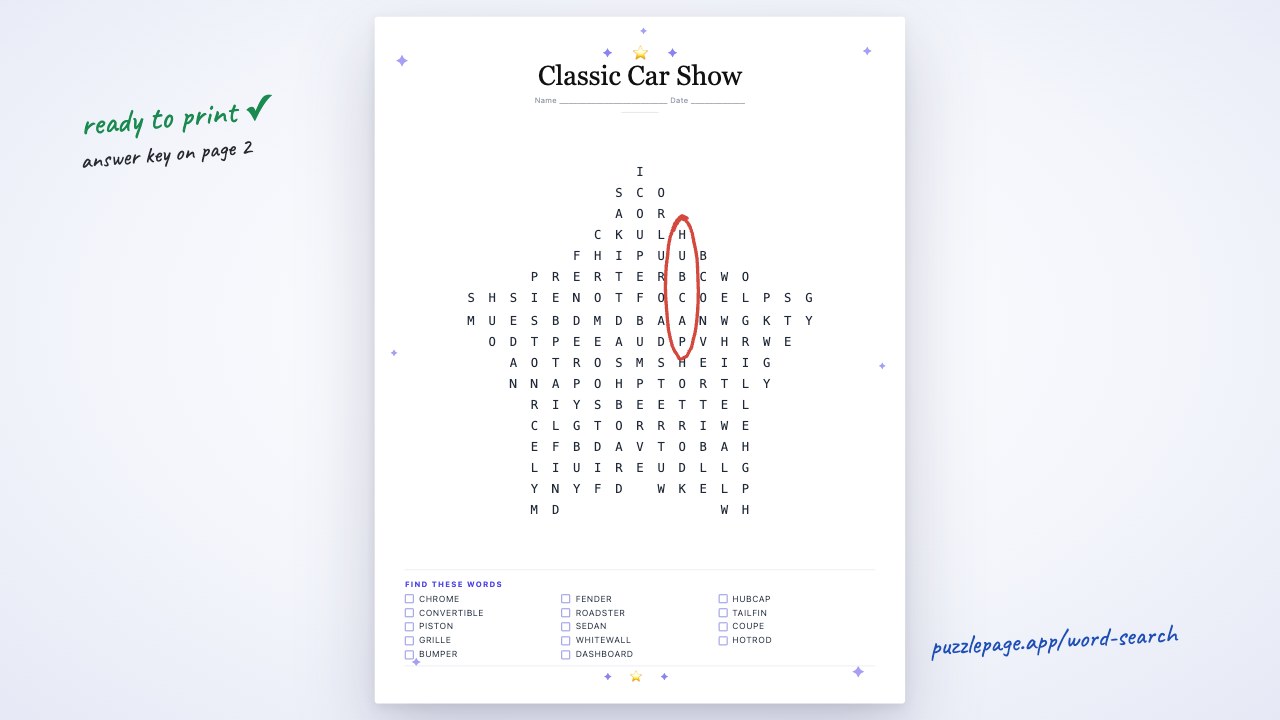
The screenshot below shows the live word search tool, so you can see how quickly a themed puzzle worksheet comes together for any of these goals.


Pro Tip
Build the word list from vocabulary a child is already learning in class or at home. Reinforcing familiar words works better than introducing brand-new ones inside the puzzle itself.
When Are Word Searches Not the Right Tool?
Word searches are not the right tool when the goal is reading comprehension, sentence structure, or understanding how words function in context. Finding CAT in a grid teaches spelling and recognition, not how to use the word in a sentence or follow a story.
| Learning goal | Word search fit | Better alternative |
|---|---|---|
| Spelling practice | Strong fit | N/A |
| Vocabulary exposure | Strong fit | N/A |
| Reading comprehension | Weak fit | Leveled readers, guided reading |
| Sentence structure | Weak fit | A word fill-in logic puzzle for kids |
| Letter-sound decoding | Weak fit | Phonics-based reading programs |
Parents of kids with dyslexia often ask specifically whether word searches help or hinder. The puzzles are generally considered neutral to mildly helpful for pattern recognition, but they should never replace structured, specialist reading support if a child has been identified as needing it.
When we tested a classroom set with 24 third graders, 19 finished a themed 12-word puzzle inside 15 minutes and asked for a second round, but the same group still needed a separate guided-reading block that week for comprehension work. The puzzle supplemented the lesson; it did not replace it.
Pro Tip
Pair a word search with a follow-up activity that uses the words in sentences. That one extra step turns pure recognition practice into something closer to real vocabulary learning.
Building a Word Search That Matches Your Child's Level
The research-backed benefits only show up when the puzzle is matched to the child. A grid that is too hard causes frustration and abandons the learning goal; a grid that is too easy provides no useful challenge.
- Start with 8 to 10 words for kindergarten and first grade, using only across-and-down placement.
- Move to 12 to 15 words with diagonal placement for second through fourth grade.
- Add backward-placed words for fifth grade and up, once forward scanning feels automatic.
- Keep every word inside the child's current reading level so the puzzle reinforces rather than teaches from scratch.
A free generator makes this kind of leveling painless because a new grid takes about two minutes to build. Teachers can differentiate for a whole classroom by producing three versions of the same theme at three difficulty settings.
How This Compares to Other Classroom Puzzle Formats
A word search is one tool among several, and knowing when to reach for a different format keeps a classroom rotation fresh. Each puzzle type trains a slightly different skill.
Word search
Best for spelling reinforcement and visual scanning; a hidden words game that rewards patient attention.
Word scramble
A jumbled-letters format that pushes kids to actively reconstruct a word rather than just recognize it, good for spelling practice and quick warm-ups.
Word fill-in
A crossword alternative and word placement puzzle that adds light logic and spatial reasoning to the vocabulary practice.
Cryptogram
A code-breaking puzzle and letter-substitution activity suited to older kids who enjoy decoding a message rather than searching a grid.
Rotating through a free word scramble generator and a cryptogram puzzle maker alongside the word search keeps a classroom's puzzle station varied without adding real prep time, since all three tools work from the same free platform.
Try It Yourself: Build a Vocabulary Word Search
Start with a general literacy word list: VOCABULARY, SPELLING, FOCUS, SCANNING, PATTERNS, MEMORY, FLUENCY, and CONFIDENCE. These words work for a classroom discussion about how puzzles help learning, and they double as a puzzle about puzzles.
Type the list into the generator, add PRACTICE, LITERACY, ATTENTION, and FUN to round out a 12-word grid, and choose medium difficulty for upper elementary. For a lower grade, trim the list to 8 words and stick to across-and-down placement.
Once the words are chosen, the generator builds the grid right away, so you spend your time teaching, not formatting. Create your free vocabulary word search printable and try it with your next unit's word list.
Frequently Asked Questions
Are word searches good for kids with dyslexia?
Word searches can be neutral to mildly helpful for pattern recognition, but they are not a substitute for specialist, structured reading support. Families of kids with dyslexia should treat the puzzle as a light supplement alongside programs designed specifically for their child's needs.
Are word searches beneficial for vocabulary building?
Yes, a themed word search exposes kids to topic-specific vocabulary and reinforces spelling through repeated visual contact with each word. The benefit grows when the words connect to a current lesson or reading unit rather than being random.
What are word searches good for besides spelling?
Beyond spelling, they build visual scanning skills, sustained attention, and a sense of accomplishment when a full grid is solved. Many teachers also use them as a calm transition activity between lessons or during indoor recess.
Are word searches educational or just a filler activity?
They are educational when the word list is chosen deliberately and matched to a child's reading level and current lessons. Used randomly with no theme, they still offer scanning and focus practice, but the vocabulary payoff is smaller.
Live demo
Make your own word search right here
Swap in your own words (a spelling list, residents' names, a unit's vocabulary) and press Generate. The full maker adds answer keys, size options and PDF export.
More you can make here
One puzzle is the start. Here is the rest of the kit.
 New
NewWorksheet Builder
Put a word search, a cryptogram and a scramble on one page, or build a whole themed packet. Prints with answer keys.
Build a worksheet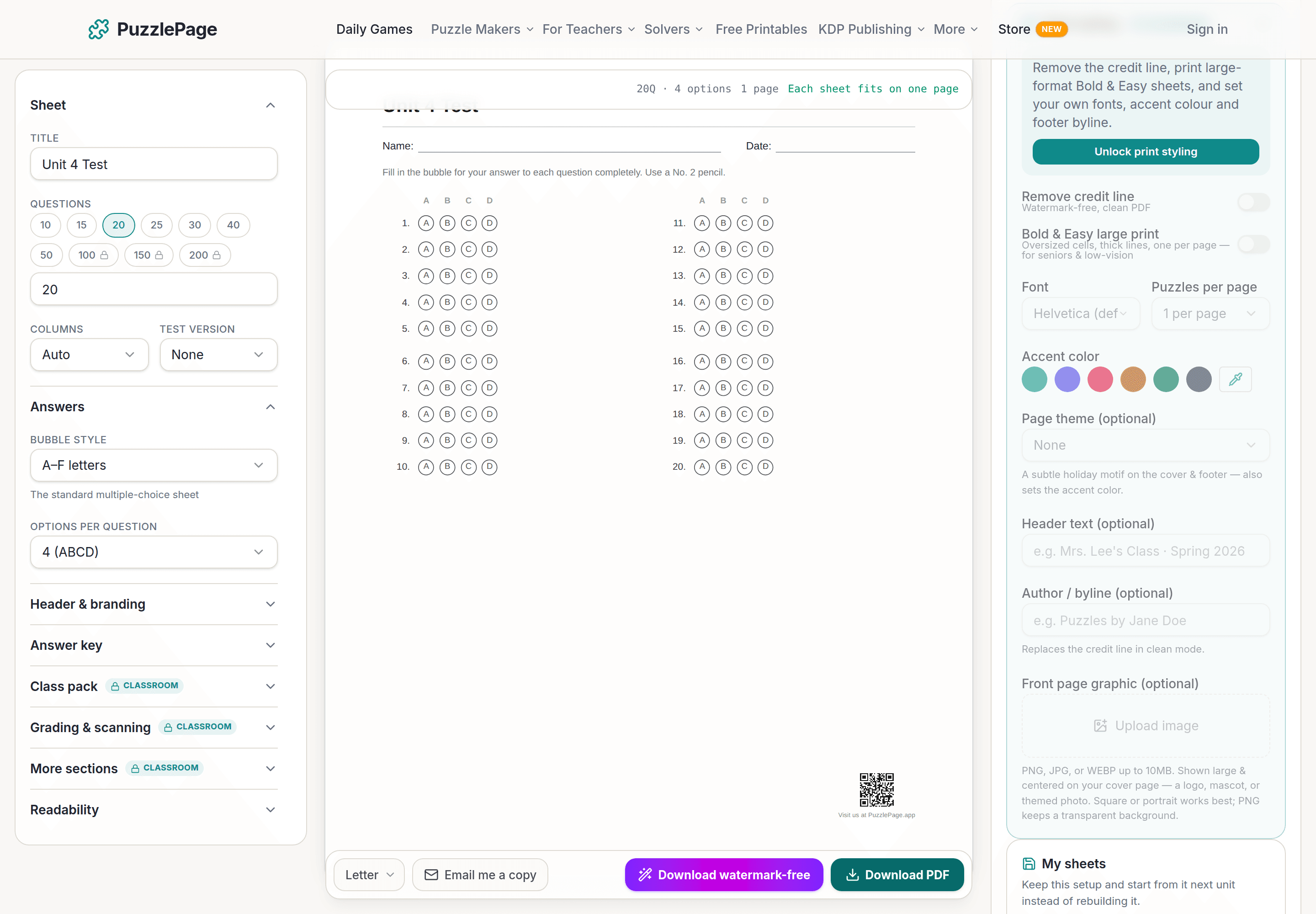
Bubble Sheet Studio
Answer sheets for any test length, with sections, versions, student ID grids and a matching answer key.
Make a bubble sheet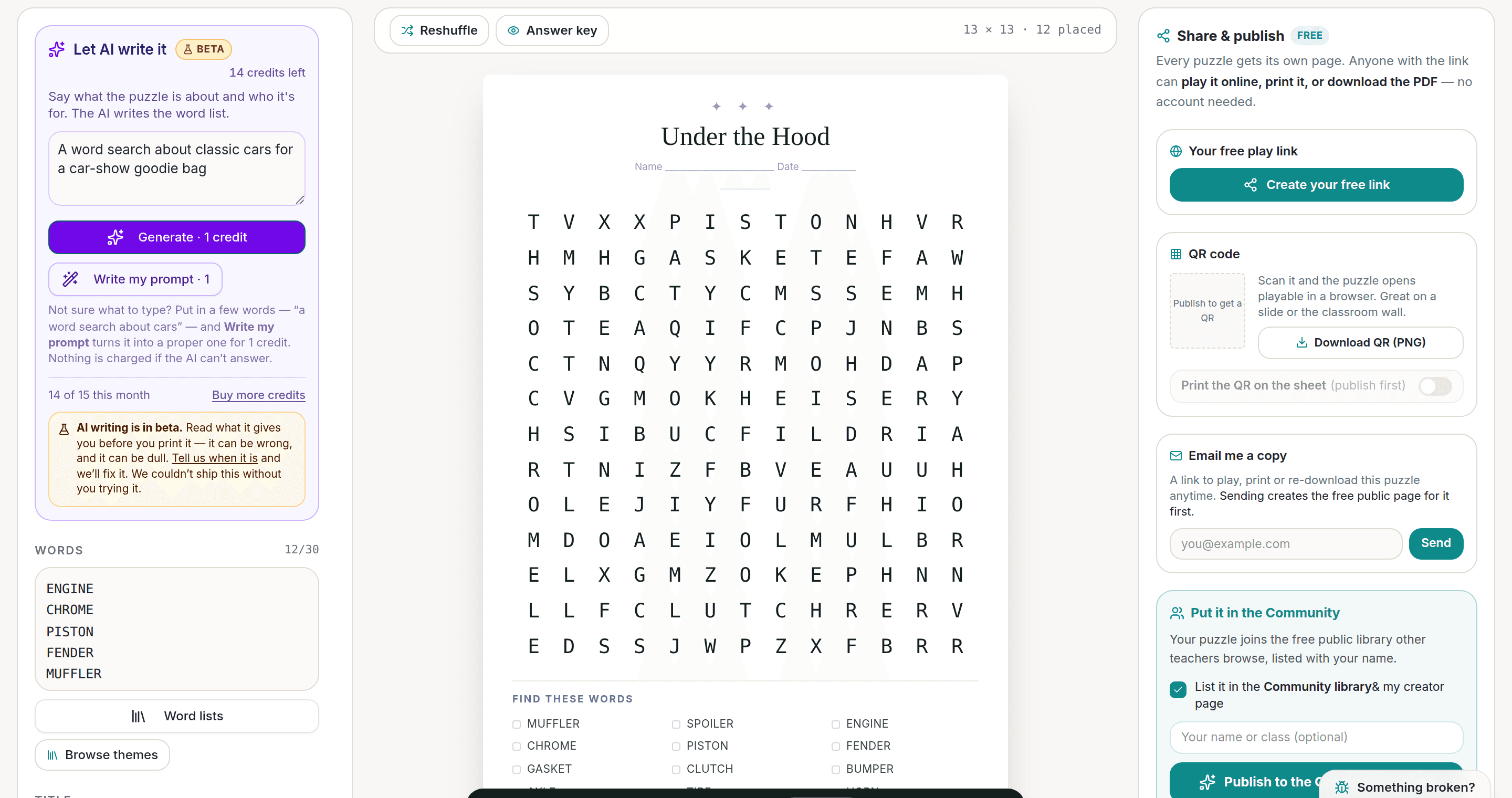
AI Puzzle Generator
Type a topic, get a themed word list and a finished puzzle. Premium also removes the footer credit and adds Word export.
Try the AI generator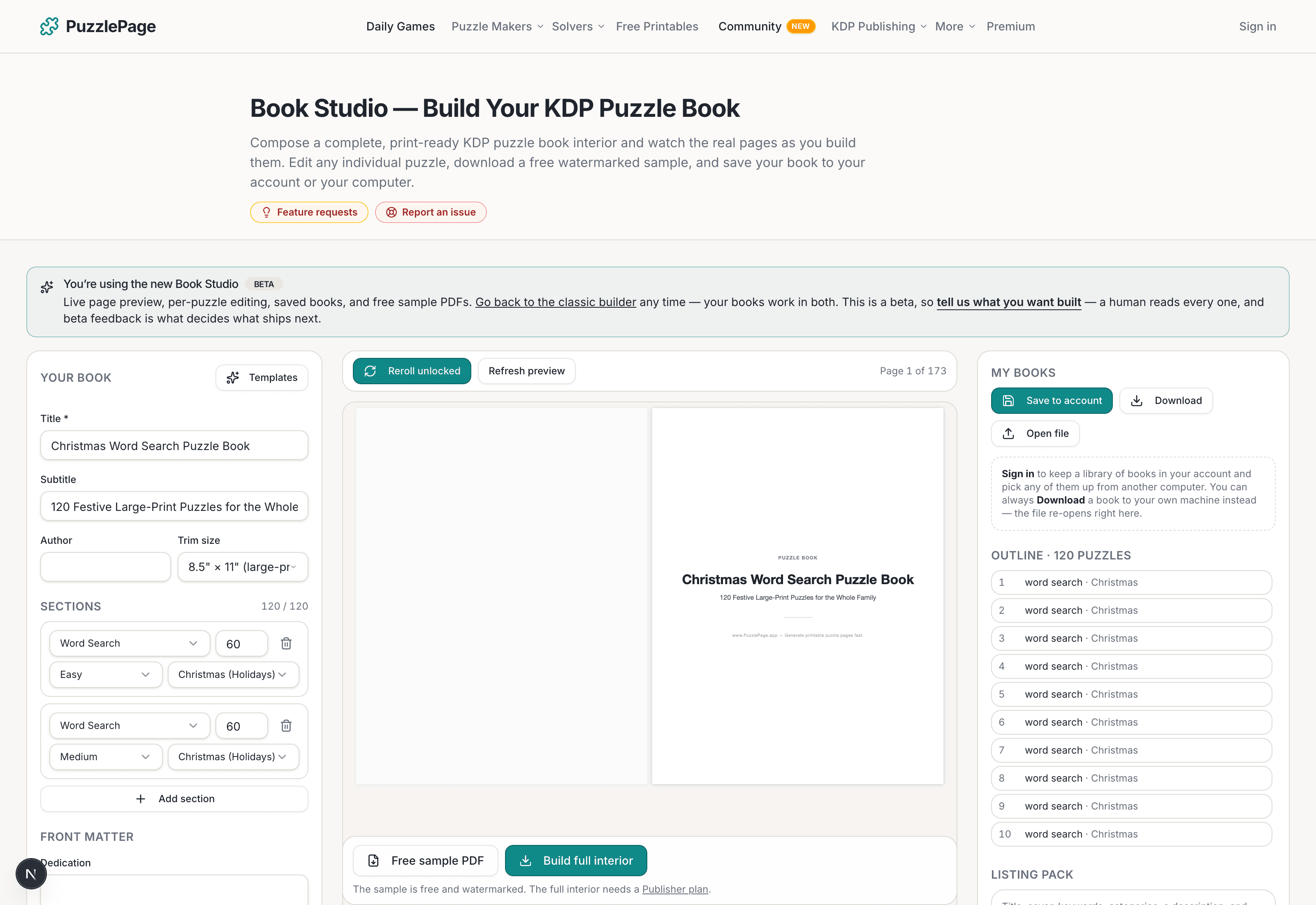
KDP Book Studio
Lay out a full puzzle book for Amazon KDP: templates, trim sizes, page checks and a cover designer.
Start a puzzle bookPremium removes the footer credit, adds Word export and custom styling across every maker.
See plans →Free daily games
Need a two-minute break? Today's puzzles are live.
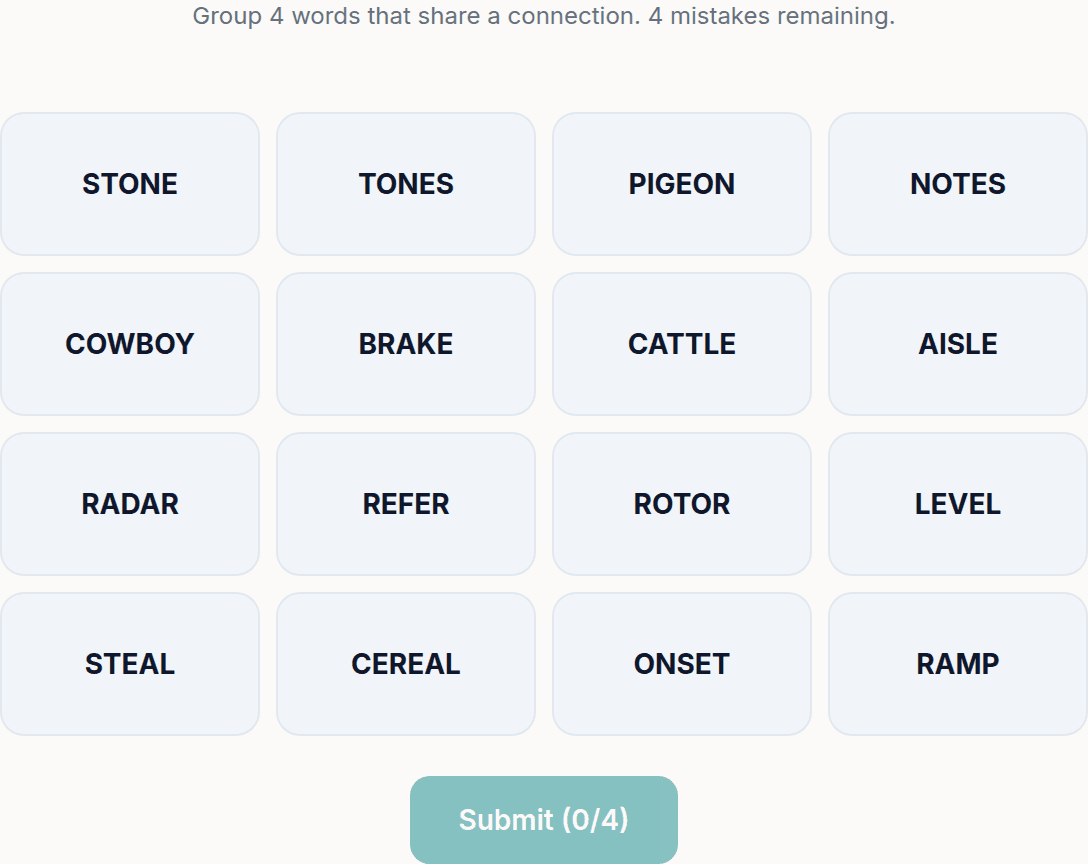
A new Sudoku and a new Connections board every day. No download, no account.
Keep reading
Take the puzzle with you
Free Word Search PDF — Reading Skills Word Search
Print-ready · answer key included · unsubscribe anytime
Enjoyed this? Share the puzzle on X
Like puzzles like this? Follow on Pinterest for a new one every day.