KDP Interior File: 9 Checks to Run Before Upload
Every KDP interior file check that matters: trim size, gutter margins that scale with page count, bleed, embedded fonts, and the spine math that follows.

Free to try
Build this book free in the PuzzlePage Book Studio
18 puzzle types, KDP margins and a full-wrap cover. Download the first 10 pages and the cover free.
Hints
Print-Ready Interior Cryptogram
Short reminders about preparing a print ready book interior
Phrase 1
Hint: G = I
Phrase 2
Hint: N = K
+ 2 more phrases in the PDF
Free companion PDF
Print-Ready Interior Cryptogram
Short reminders about preparing a print ready book interior. Grab the PDF now and we'll send 10 more printable puzzles, plus a heads-up when new generators or seasonal packs go live. Roughly two emails a month — unsubscribe anytime.
No payment · Letter-size · Answer key included
For publishers: Build a book free in the Studio·Ready-made book templates·KDP calculators·Books made here
A rejected kdp interior file almost never comes back with an interesting reason. It comes back because the trim size is not on Amazon's list, the page count sits outside the allowed range, or the inside margin is too narrow for the number of pages being glued into the spine.
The Book Studio runs those checks against the PDF it just built and shows the result before you go anywhere near an upload form.
📌 Key Takeaways
- Nine checks run against the finished PDF, each one a documented KDP requirement rather than a house rule.
- The gutter margin requirement scales with page count, so a margin that passed on a thin book can fail on a thick one.
- Paperbacks must land between 24 and 828 pages; a 120 puzzle word search book measured 173.
- Fonts must be embedded and subset, which is the check that silently fails when a manuscript is assembled in a word processor.
 1:33
1:33What does Amazon check in a KDP interior file?
Nine things, in practice: trim size, page count, inside margin, outside margins, bleed, fonts, file size, trademarks in your metadata, and the content itself. Each one is a hard gate, and each one is mechanical enough to verify before upload.
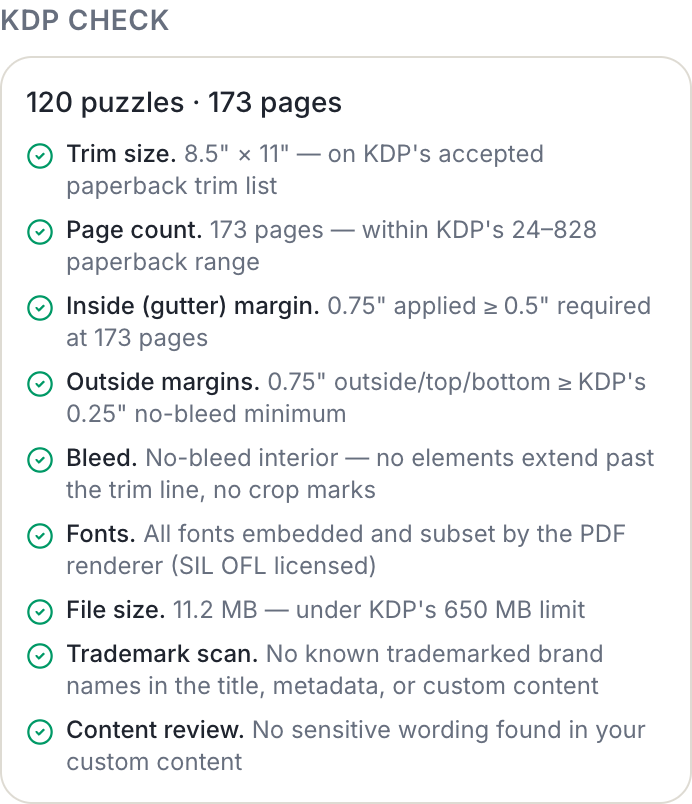
Read the middle three lines carefully. They are where puzzle books fail, because a puzzle grid pushed too close to the spine is unreadable long before Amazon calls it a rejection.
Trim size
Must be one of Amazon's accepted paperback sizes. Puzzle books are usually 8.5 by 11 for large print, 7 by 10 for a middle ground, or 6 by 9 for a pocket collection.
Page count
Black and white paperbacks run from 24 to 828 pages. Below 24 the book cannot be bound, and a very thin book cannot carry spine text either.
Inside margin, also called the gutter
Scales with page count. Thicker books need more, because more paper curves into the spine. The 173 page book above needed at least 0.5 inches and was built with 0.75.
Outside margins
At least 0.25 inches on the outside, top, and bottom for a no-bleed interior. Puzzle grids sitting closer than that get trimmed off in production.
Pro Tip
Set your gutter for the book you will end up with, not the book you are testing. Publishers commonly lay out a 90 page proof, get it approved, then expand to 170 pages and fail on the same margin that passed the first time.
Free Cryptogram PDF — Print-Ready Interior Cryptogram
Print-ready · answer key included · unsubscribe anytime
Why do fonts break a KDP interior file?
Because a PDF that references a font instead of embedding it renders differently on Amazon's machines than on yours. Amazon requires every font embedded, and it is the check that most often fails on manuscripts assembled in a word processor.
An interior generated straight to PDF avoids the problem entirely: fonts are embedded and subset by the renderer, so what you see is what prints. The check above reports it explicitly rather than leaving you to guess.
Pro Tip
Check the file size before you upload rather than after. Amazon's ceiling is 650 MB, and a puzzle interior assembled from image scans can blow past it while a text-rendered one stays small. The 173 page book above is 11.1 MB.
- Embedded and subset fonts, so the file carries the glyphs it uses and nothing else.
- No bleed on a puzzle interior, because nothing runs to the edge of the paper.
- No crop marks, which a print shop expects and Amazon does not.
- File size well under Amazon's 650 MB ceiling; the 173 page book came in at 11.1 MB.
What does a compliant puzzle page actually look like?
One puzzle per page, instructions above the grid, the word list below it, and a page number that runs continuously from the front matter through the answer keys at the back.
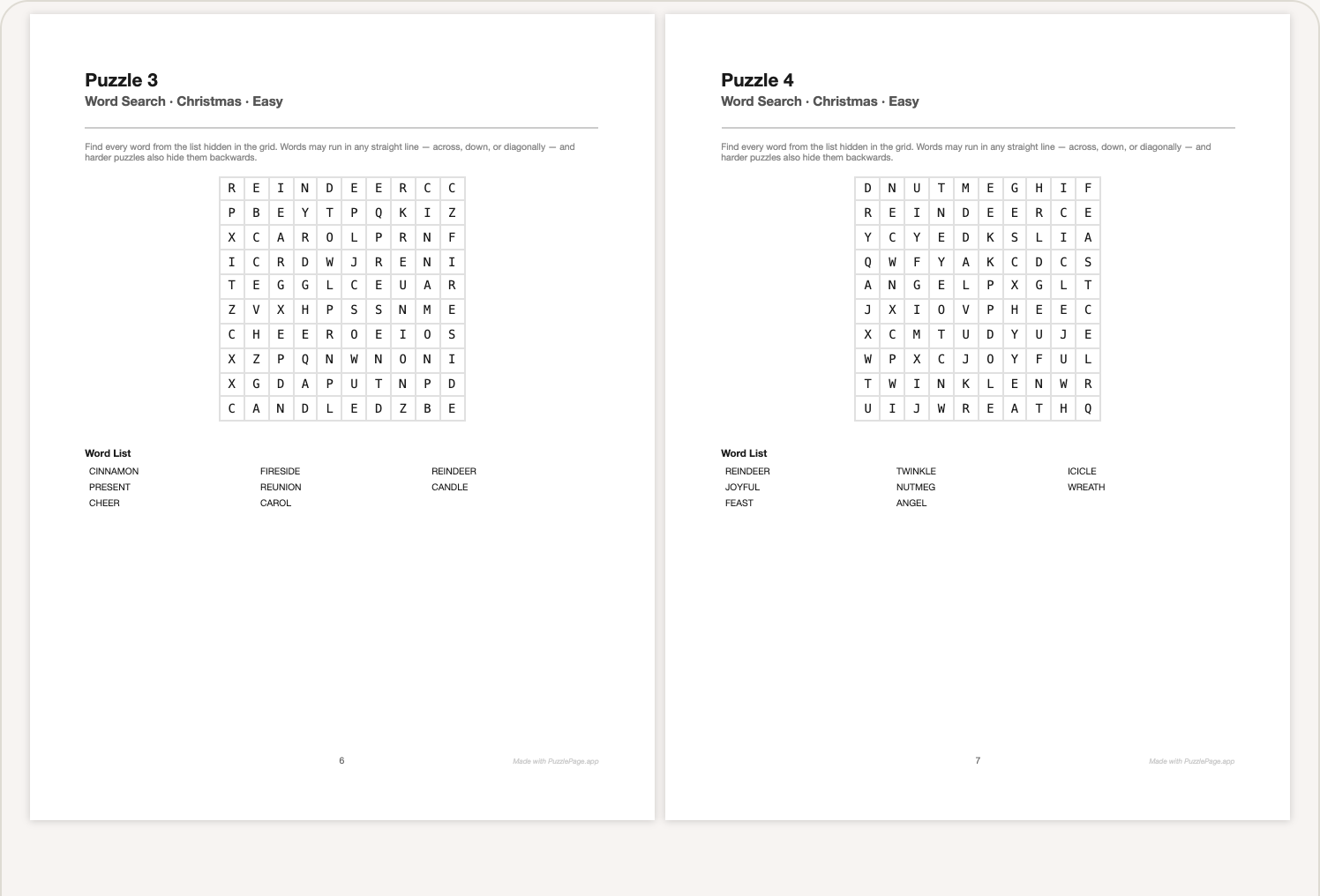
Notice how much white space sits around the grid. That is not wasted paper, it is the margin allowance doing its job, and it is the first thing to disappear when a manuscript is assembled by hand to squeeze in more puzzles.
Heads up
Answer keys are part of the interior, not an optional extra. A puzzle book without solutions attracts one star reviews faster than any other single mistake, and the answer key section is what makes the page count land where it does.
What comes after the interior passes?
The cover, and its spine width comes from the measured page count. Get the page count first, then build the cover to the exact numbers, because a wrong spine is the most common reason a puzzle book cover is rejected.
For the 173 page example the listing pack reported a 0.390 inch spine and a full wrap of 17.640 by 11.250 inches at 300 DPI, bleed included. Those are numbers you can hand straight to a cover designer.
- Build the full interior so the page count is measured rather than estimated.
- Read the spine width and full wrap dimensions from the listing pack.
- Design the cover at exactly those dimensions at 300 DPI.
- Upload the interior first, then the cover, and check Amazon's previewer before you approve.
Amazon's own paperback manuscript requirements are the reference every one of these checks is written against. If you want to test a single page's margins before committing to a book, print one from the word search generator or the word fill-in generator and hold it against a ruler. Our guide on publishing low content puzzle books covers the upload flow itself.
Free to try
Try the Book Studio free: first 10 pages and cover, no card
Build the whole book in your browser, watch the real printed pages as you go, and download the first 10 pages plus the cover to check them before you decide anything.
- ✓18 puzzle types with difficulty ramps and answer keys
- ✓KDP trim sizes and margins checked as you build
- ✓A matching full-wrap cover, spine included
- ✓Download the first 10 pages and the cover free
Build first, decide later. You only pay when you want the full interior.
Frequently Asked Questions
What format does a KDP interior file need to be?
A single PDF containing every page at the final trim size, with fonts embedded and margins already applied. Amazon does not accept a folder of images or separate files per chapter.
How wide should the gutter margin be on a puzzle book?
It depends on page count, because thicker books lose more paper into the spine. A 173 page book requires at least 0.5 inches on the inside edge, and building at 0.75 leaves comfortable headroom.
Does a puzzle book interior need bleed?
No, not unless artwork runs off the edge of the page. Puzzle interiors are normally no-bleed, which means nothing crosses the trim line and no crop marks are included.
How many pages can a KDP paperback have?
Black and white paperbacks run from 24 to 828 pages. Most puzzle books land between 100 and 200, and a 120 puzzle word search collection measured 173 pages at 8.5 by 11.
Live demo
Make your own cryptogram right here
Swap in your own words (a spelling list, residents' names, a unit's vocabulary) and press Generate. The full maker adds answer keys, size options and PDF export.
More you can make here
One puzzle is the start. Here is the rest of the kit.
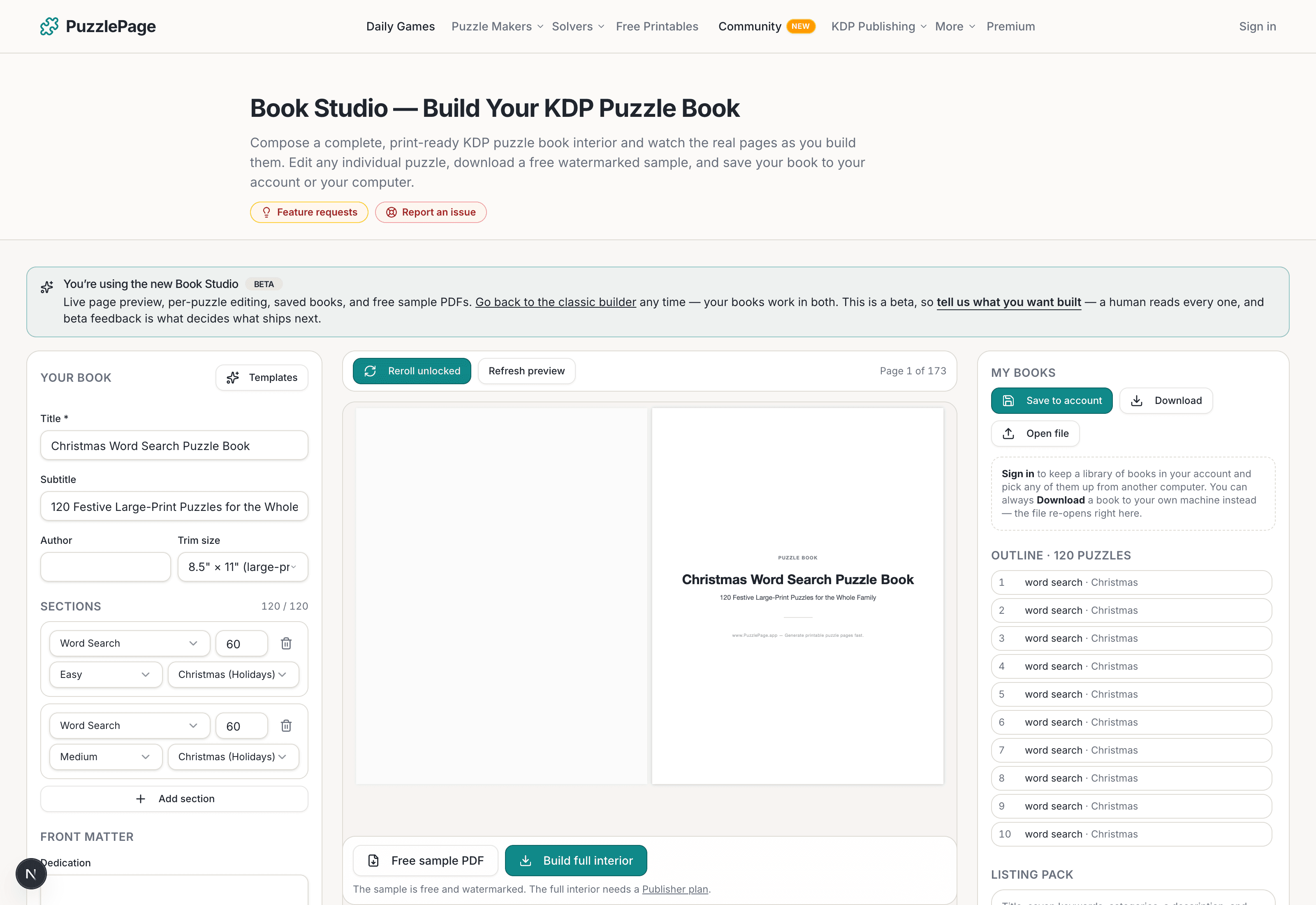
KDP Book Studio
Lay out a full puzzle book for Amazon KDP: templates, trim sizes, page checks and a cover designer.
Start a puzzle book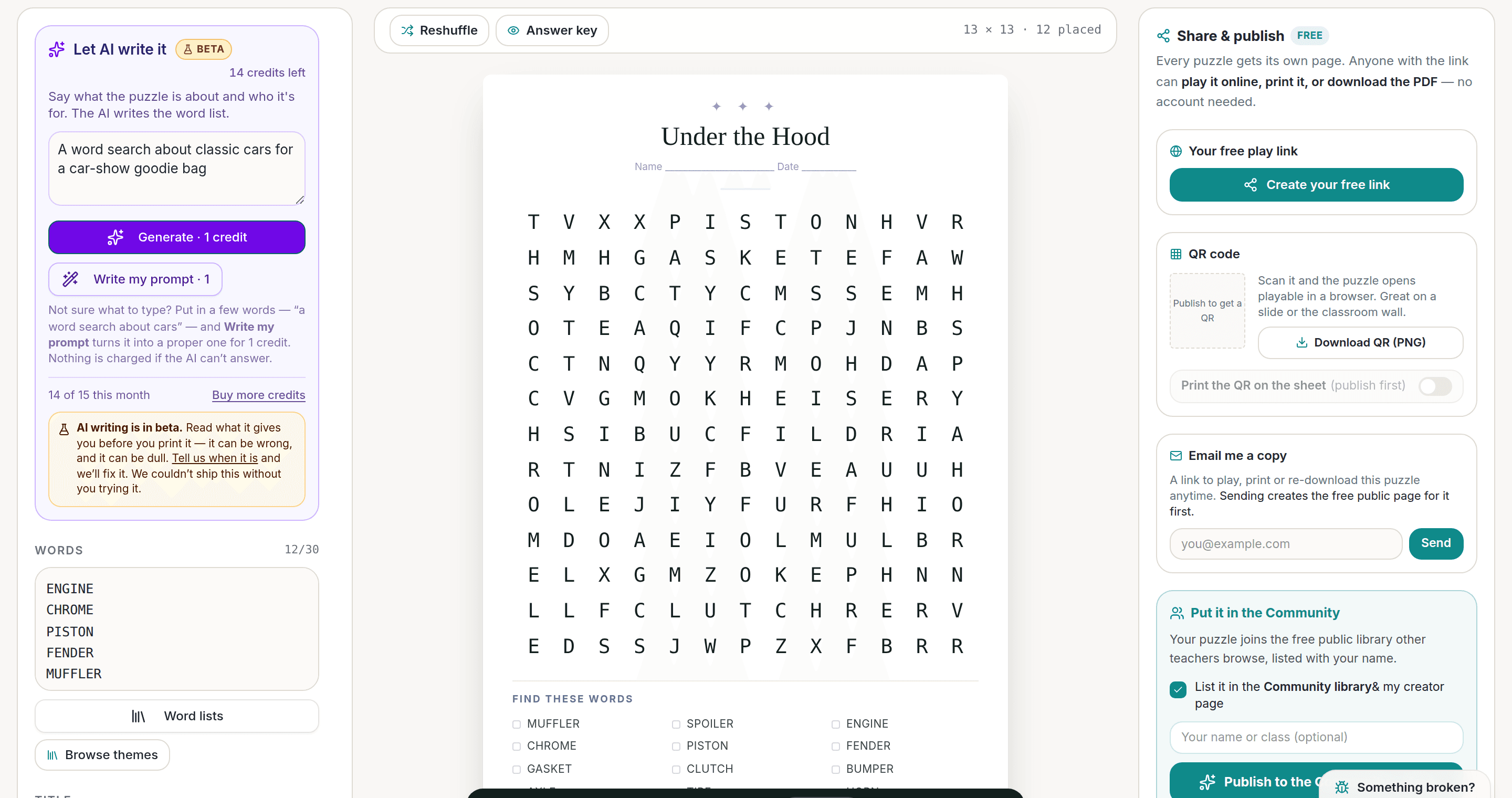
AI Puzzle Generator
Type a topic, get a themed word list and a finished puzzle. Premium also removes the footer credit and adds Word export.
Try the AI generator New
NewWorksheet Builder
Put a word search, a cryptogram and a scramble on one page, or build a whole themed packet. Prints with answer keys.
Build a worksheet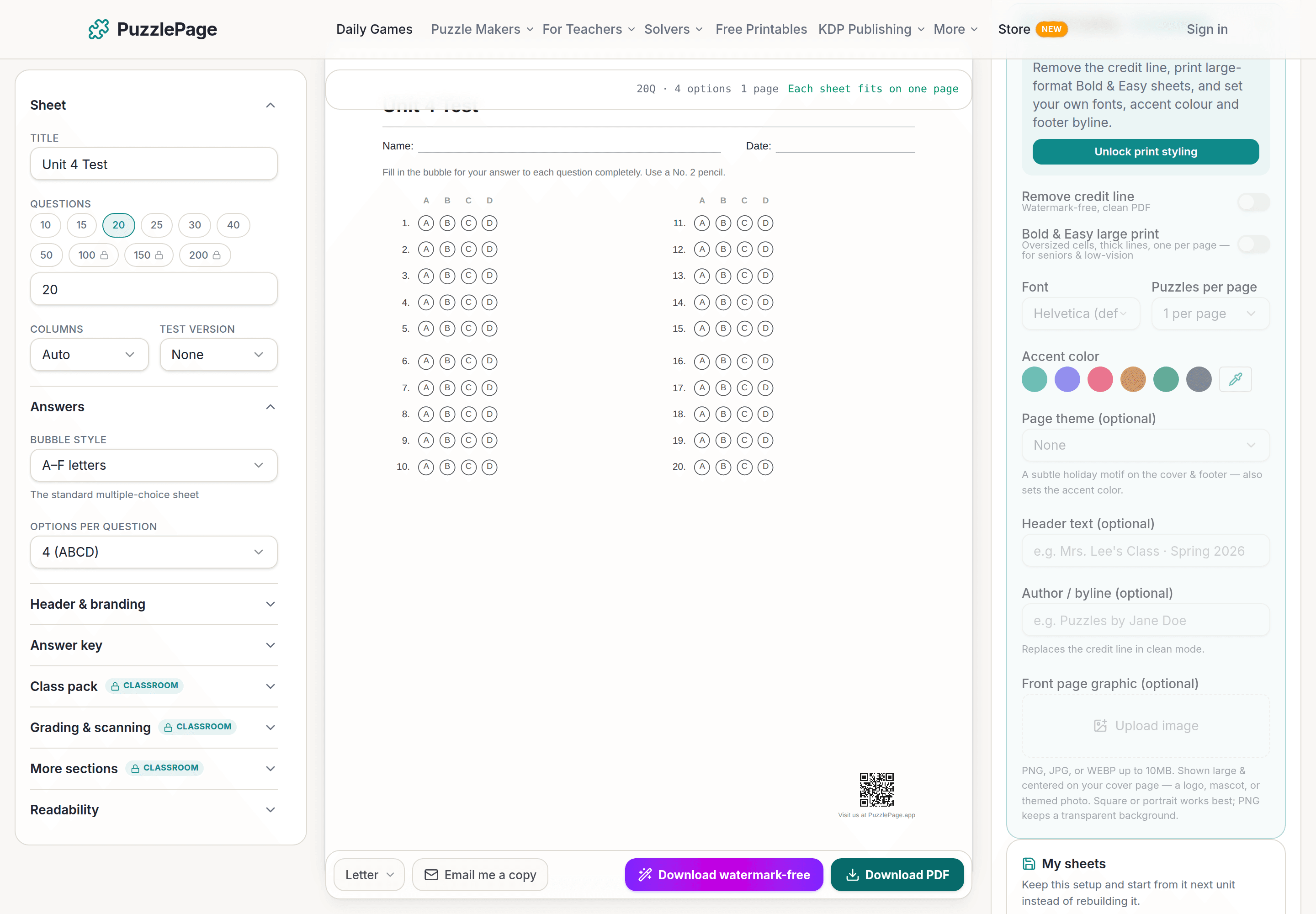
Bubble Sheet Studio
Answer sheets for any test length, with sections, versions, student ID grids and a matching answer key.
Make a bubble sheetPublisher plans unlock full print-ready interiors and covers, with a commercial licence to sell every book.
See plans →Free daily games
Need a two-minute break? Today's puzzles are live.
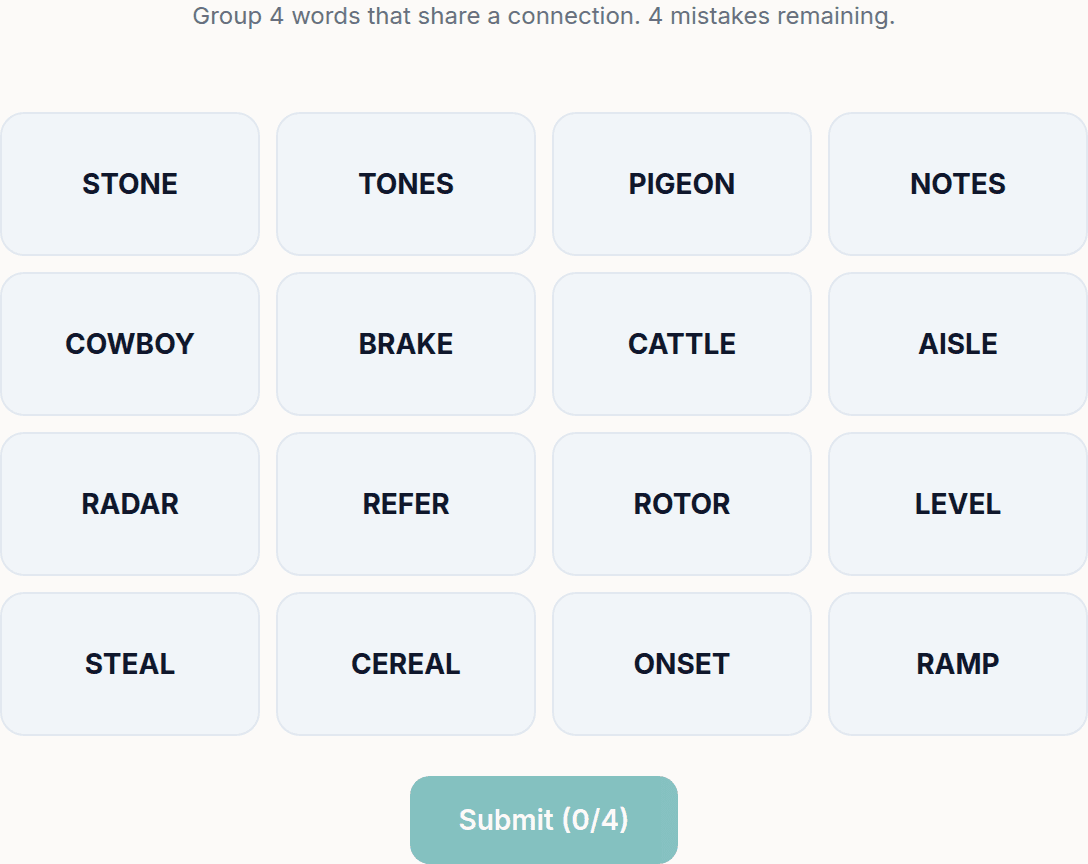
A new Sudoku and a new Connections board every day. No download, no account.
Keep reading
Take the puzzle with you
Free Cryptogram PDF — Print-Ready Interior Cryptogram
Print-ready · answer key included · unsubscribe anytime
Ready to build?
Build this book free in the PuzzlePage Book Studio
18 puzzle types, KDP margins and a full-wrap cover. Download the first 10 pages and the cover free.
Or start from a ready-made book template, or see books other publishers made here.
Enjoyed this? Share the puzzle on X
Like puzzles like this? Follow on Pinterest for a new one every day.