Play Star Battle Online Free: Rules, History & Strategy
Learn how to play Star Battle (Two Not Touch) with beginner rules, champion strategy, its World Puzzle Championship history, and a free online board to solve now.
On this site: Play Star Battle Online Free free·Browse 100+ free printables·Play today's puzzles
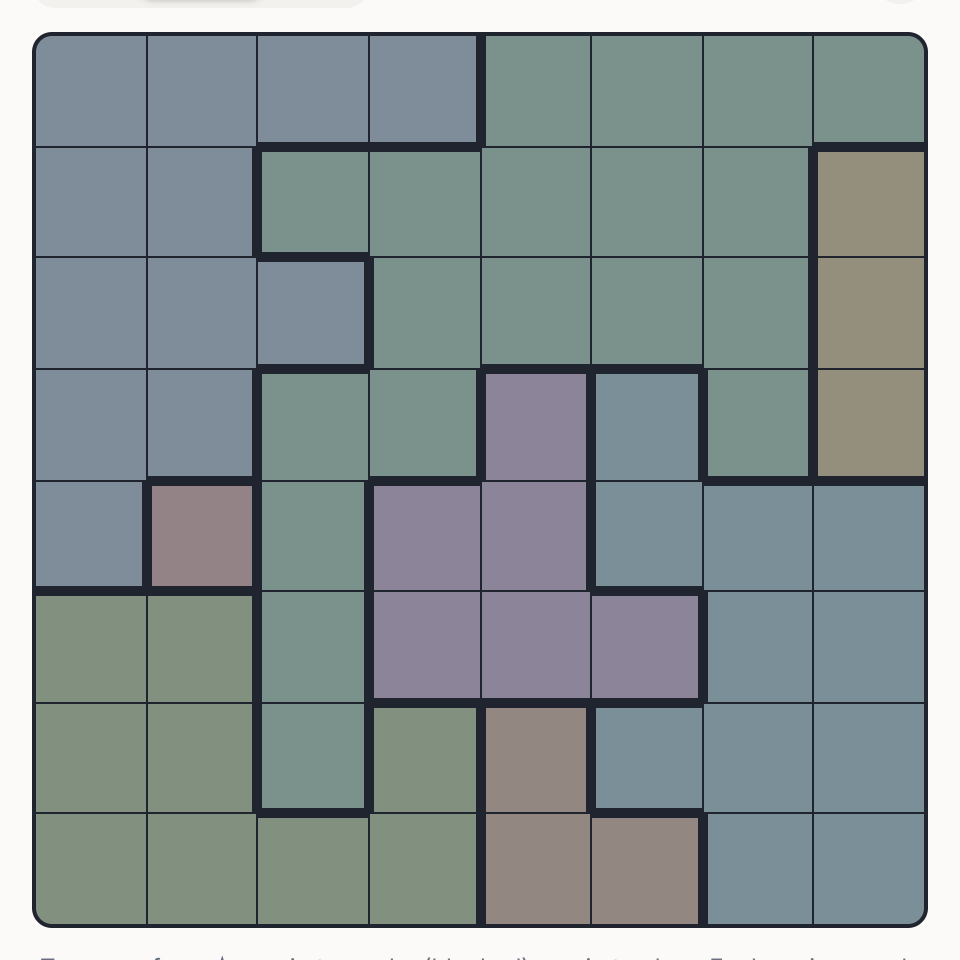
Scatter a handful of stars across a gridded sky, but obey three jealous rules at once: every row needs its share, every column needs its share, and every oddly shaped region needs its share — and no two stars may ever touch, not even at a corner. That last rule turns a simple counting task into a cascade of crisp logical deductions. It is no wonder Star Battle, known to millions of newspaper readers as Two Not Touch, has become one of the most addictive logic puzzles of the modern era.
📌 Key Takeaways
- Star Battle asks you to place a fixed number of stars in every row, every column, and every bold region — most commonly two stars on a 10×10 grid.
- No two stars may touch, even diagonally, so every star clears its eight surrounding cells.
- It was invented by Dutch designer Hans Eendebak for the 2003 World Puzzle Championship and went mainstream as the New York Times' "Two Not Touch."
- Marking cells that cannot hold a star is just as important as marking the stars themselves.
- You can play Star Battle free online right now — no app, no download.
The history of Star Battle
Star Battle was created by Dutch puzzle designer Hans Eendebak for the 2003 World Puzzle Championship, held that year in Arnhem, the Netherlands. Its design descended from an earlier object-placement concept called "Cattle" by Tim Peeters, which already used region and no-touch constraints but relied on outside numeric clues rather than the clean, uniform per-row and per-column star counts we know today (source).
From the championship circuit, the puzzle spread internationally and was championed by dedicated publishers — most notably Grandmaster Puzzles, founded by World Puzzle Champion Thomas Snyder, and Krazydad, run by Jim Bumgardner, whose generators put thousands of free grids online (source, source).
Its leap to a mass audience came when the New York Times began publishing it under the name "Two Not Touch" — a 2-star, 10×10 variant constructed by Krazydad. The puzzle is also sometimes called "Queens," and that 2-star, 10×10 form remains the most common shape in both competitions and consumer books (source).
Like this? We send 10 of these every month.
Free printable puzzles, answer keys included — same quality as the ones in this post.
One email. Unsubscribe anytime.
How to play Star Battle
The rules are short, and you can start a fresh sky on our free Star Battle board in seconds.
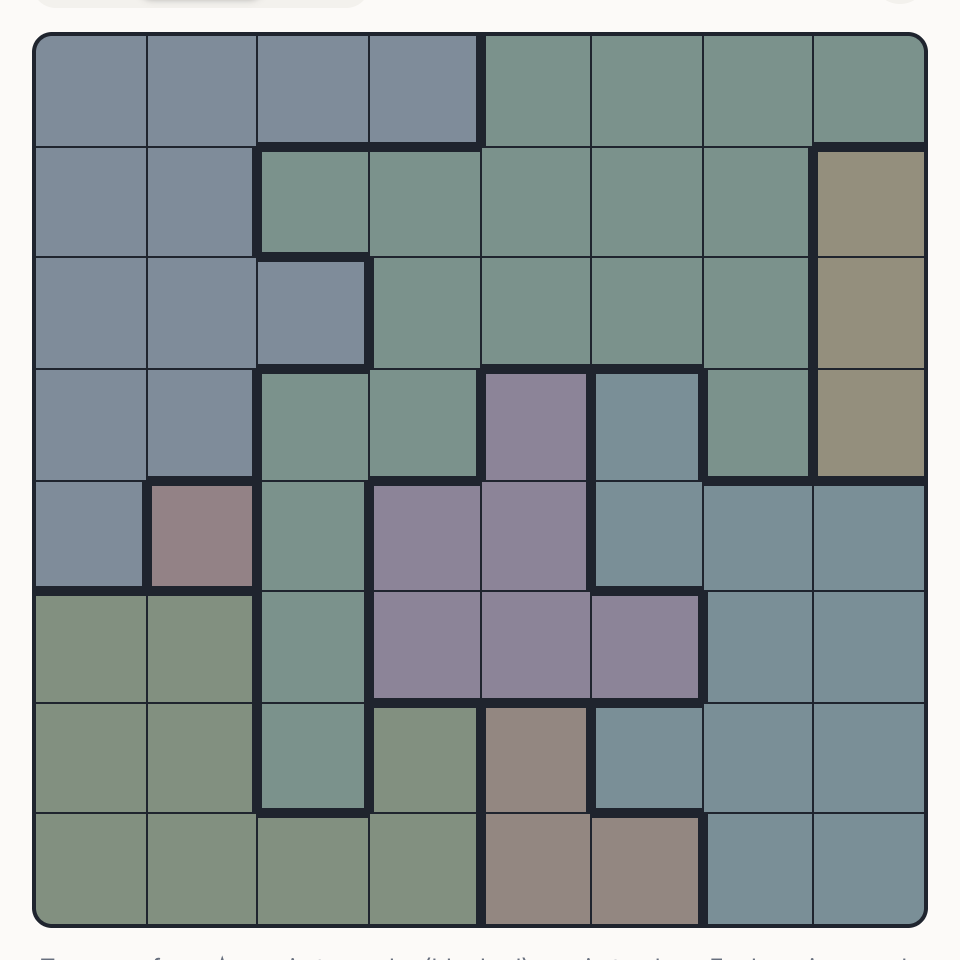
- Read the grid. The board is a square split into bold, irregularly shaped regions. The classic size is 10×10 with two stars per unit.
- Learn the star count. Each row, each column, and each bold region must contain exactly the puzzle's fixed number of stars — usually two.
- Obey the no-touch rule. No two stars may be adjacent in any direction, including diagonally, so every star isolates the cells around it.
- Mark the impossible cells. Whenever a cell clearly cannot hold a star, dot or shade it. These eliminations drive most of your progress.
- Place a star when only one spot remains. If a row, column, or region has just enough open cells left for its stars, those cells must hold them.
- Clear the neighbors. The moment you place a star, mark all eight surrounding cells as empty.
- Repeat until the sky is full. The puzzle is solved when every row, column, and region holds exactly its star count and no two stars touch.
What is the easiest way to start a Star Battle?
The easiest start is to find a row, column, or region whose open cells are already squeezed into a tight corner or single line, because that narrows where its stars can sit and immediately rules out neighboring cells.
Strategy & tips
Once the obvious placements run out, structured technique takes over. These tactics keep a stuck grid moving:
- The 2×2 rule: Any 2×2 block of cells can hold at most one star, because two stars inside it would always touch. Use this everywhere to cap how many stars a cramped area can absorb.
- Confined lines: If the remaining open cells of a region, row, or column all fall on a single line, the stars are forced onto that line — which then clears star possibilities in the crossing units.
- Mark empties first: Dotting cells that cannot hold a star is as valuable as placing the stars themselves; eliminations are what unlock the next deduction.
- Count the overlap: When a region sits mostly inside one or two rows, compare its star quota against those rows' quotas to pin down shared cells.
- Work the edges and corners: Border cells have fewer neighbors, so stars there clear less of the board and are often easier to confirm.
World Puzzle Champion Thomas Snyder — founder of Grandmaster Puzzles and a prolific Star Battle constructor — stresses a foundational deduction: any 2×2 block holds at most one star, and any region, row, or column whose remaining open cells are confined to a single line forces its stars onto that line, eliminating star possibilities elsewhere. He notes that marking cells that cannot hold stars is as important as marking the stars themselves (source). Creator Hans Eendebak describes the puzzle's elegance as a triple overlapping constraint — the same fixed count satisfied across every row, column, and irregular region at once, with the diagonal no-touch rule tying neighbors together so a single placement cascades into eliminations across multiple regions (source).
If you love that deductive feel, you will likely enjoy our other logic grids — try classic Sudoku, the picture-forming logic of Nonograms, or the spacing-and-counting challenge of Ripple Effect.
Do you have to guess in Star Battle?
No — a well-made Star Battle has a single unique solution reachable by logic alone, so if you feel tempted to guess you have almost certainly missed an elimination, usually a 2×2 block or a confined line.
Watch a video tutorial
Seeing the eliminations happen in real time makes the strategy click. A great primer is "Star Battle puzzles introduction, tutorial and strategy, part 1" on YouTube, which walks through the same Two Not Touch grid the New York Times publishes:
Ready for harder deductions? Two more solid walkthroughs are "Two Not Touch Puzzle Advanced Tutorial #1 (in simple terms)" and "2 Star No Touch, Star Battle 10×10 puzzle, intermediate techniques."
Ready to solve?
The best way to learn Star Battle is to place that first star yourself and watch the eliminations ripple outward. Jump into a fresh grid and play Star Battle free online — no download, nothing to install, just you and the logic. Craving more variety afterward? Test yourself with Kakuro or our rotating daily puzzles, and see how far your deduction can take you.
Keep reading
Get 10 free puzzles
Get the free 10-puzzle pack
Enter your email and we'll send you 10 print-ready puzzles with answer keys, plus a heads-up when we publish new generators and seasonal puzzle packs. Same quality as the ones on this page.
Roughly two emails a month. No spam, unsubscribe anytime.
Enjoyed this? Share the puzzle on X
Like puzzles like this? Follow on Pinterest for a new one every day.