Play Ripple Effect Online: Hakyuu History, Rules & Tips
Learn how to play Ripple Effect (Hakyuu) with beginner rules, expert strategy, its Nikoli history, and a free online board. Solve your first puzzle in minutes.
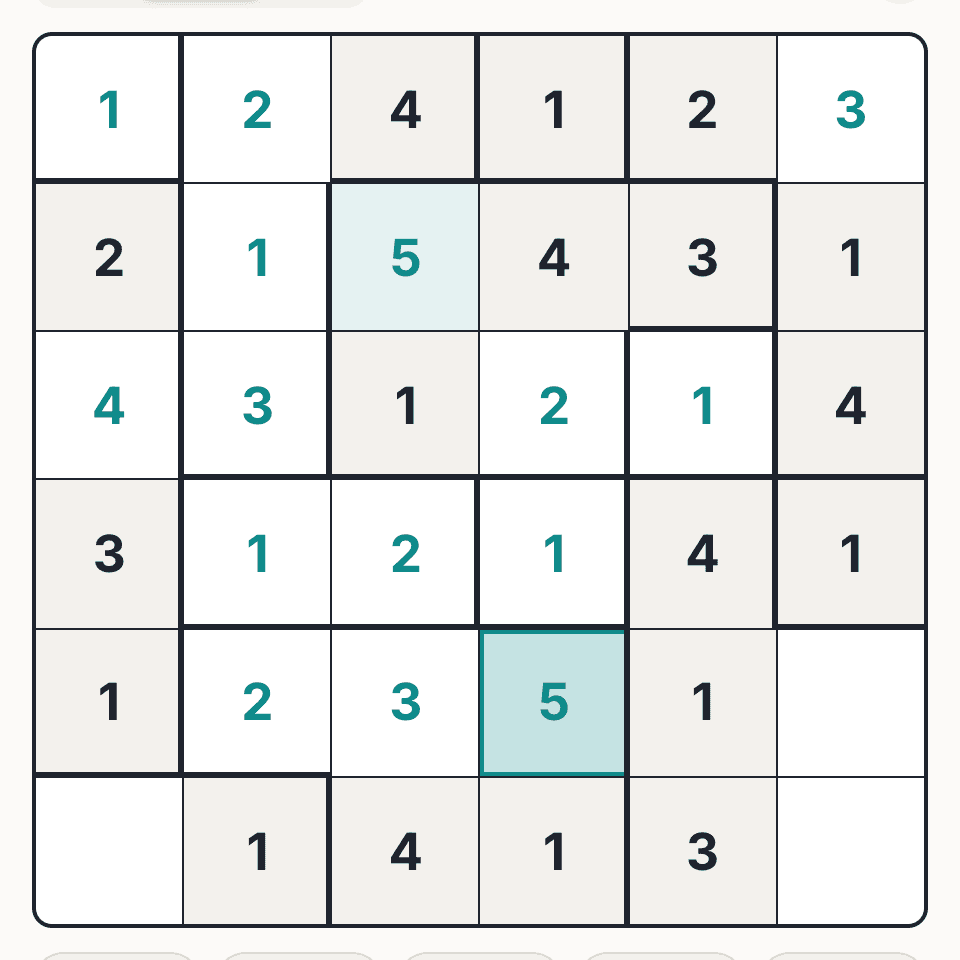
On this site: Play Ripple Effect Online free·Browse 100+ free printables·Play today's puzzles
Picture a grid carved into little tile-shaped regions, each one demanding the numbers 1 up to its own size — and then a second rule that ripples outward: place a number too close to its twin in the same line, and the whole thing collapses. That tension between filling regions and spacing repeats is what makes Ripple Effect (Hakyuu) one of the most quietly addictive logic puzzles Nikoli ever published. No arithmetic, no guessing — just clean deduction.
📌 Key Takeaways
- Ripple Effect fills a grid of polyomino regions so each region holds the consecutive numbers 1 to N (its cell count).
- The signature rule: two equal numbers M in the same row or column must be separated by at least M cells.
- It was created by Japan's Nikoli — the company that popularized Sudoku — and first appeared in 1998.
- The puzzle is also known internationally as Hakyuu, Hakyuu Kouka, or Seismic.
- You can play Ripple Effect free online right now — no app, no download.
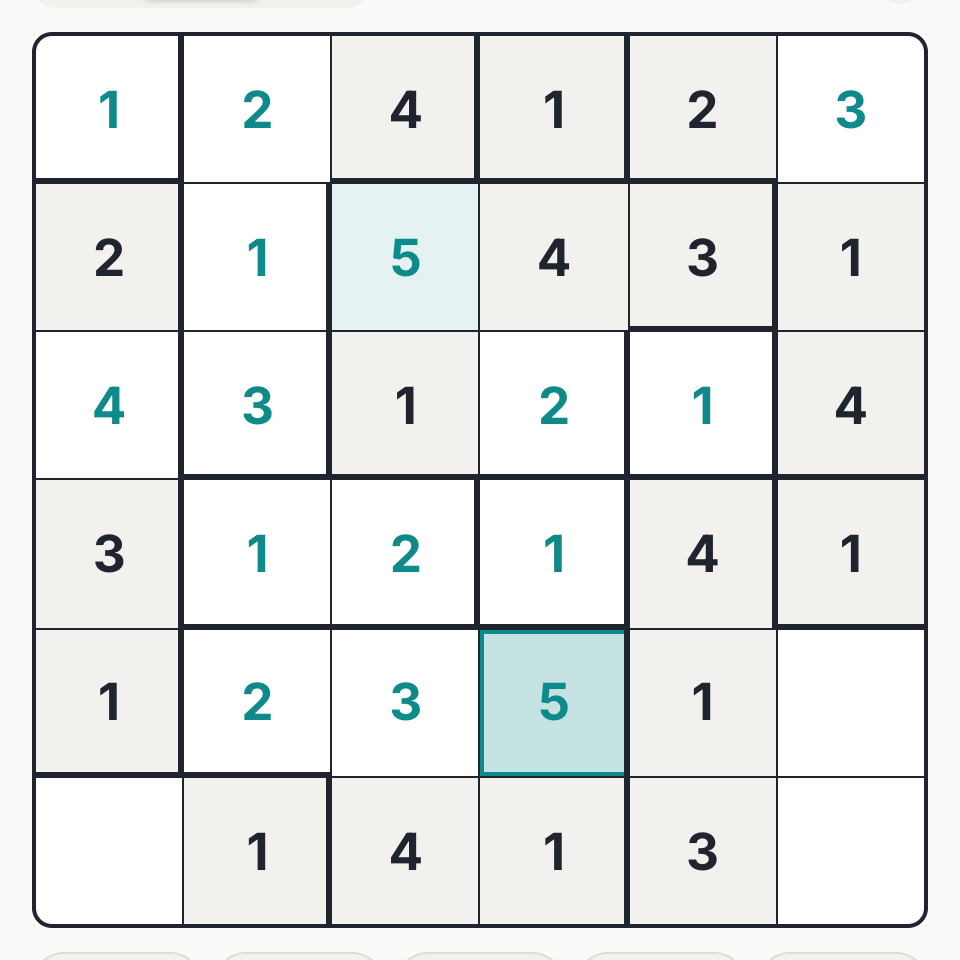
The history of Ripple Effect
Ripple Effect — in Japanese, 波及効果, Hakyuu Kouka, usually shortened to Hakyuu — is an original logic puzzle created and published by Nikoli, the celebrated Japanese puzzle company that also popularized Sudoku for the world. The puzzle made its debut in Puzzle Communication Nikoli #73 in May 1998 (source).
It proved popular enough to earn dedicated volumes: as of 2007, Nikoli had published two books made up entirely of Ripple Effect puzzles, the second arriving on October 4, 2007. Internationally the puzzle travels under several names — you'll see it called Hakyukoka, Hakyuu Kouka, or Seismic depending on the publisher (source).
Like many Nikoli creations, Ripple Effect spread globally through the company's English-language outreach, online puzzle communities, and championship circuits such as the World Puzzle Championship. Today it's widely available through free archives like KrazyDad and a growing shelf of English-language puzzle books, and it remains a favorite of constructors at outlets like The Art of Puzzles.
Like this? We send 10 of these every month.
Free printable puzzles, answer keys included — same quality as the ones in this post.
One email. Unsubscribe anytime.
How to play Ripple Effect
The rules are short, and you can open a fresh grid on our free Ripple Effect board in seconds.
- Understand the grid. The board is a rectangle divided into outlined regions (polyominoes). A few cells already contain numbers as givens.
- Fill each region 1 to N. A region with N cells must contain the consecutive integers from 1 up to N, each exactly once. A 3-cell region holds 1, 2, 3; a 5-cell region holds 1 through 5.
- Learn the separation rule. If the same number M appears twice in a single row or column, there must be at least M cells between them. Two 1s need at least one cell between them; two 3s need at least three.
- Start with the big regions. Large regions force placements — the highest number in a region can only sit where the spacing rule allows it.
- Count along lines. Before placing a candidate, scan its row and column and count the gap to any matching number to confirm the spacing holds.
- Never guess. A proper Ripple Effect has one solution reachable by logic alone. If you're tempted to guess, you've missed a deduction — keep counting.
- Finish and check. The puzzle is solved when every region is complete and no two equal numbers sit too close in any row or column.
What is the one rule that makes Ripple Effect unique?
Its defining rule is the spacing constraint: two identical numbers M in the same row or column must be separated by at least M empty cells, so larger numbers must sit farther apart than smaller ones.
Strategy & tips
Once the obvious givens are placed, technique takes over. These tactics turn a stalled grid back into a flowing one:
- Place the extremes first. A region's largest number is the most constrained, and any 1 is the least — pin down the values that have the fewest legal homes.
- Count distances, don't guess. The spacing rule is really a counting rule. Walk along a row or column and eliminate cells that sit too close to an existing number.
- Use single-cell regions. A region of one cell must be a 1, which immediately blocks the adjacent cells in its row and column from holding another 1.
- Watch where lines cross regions. A long row passing through several regions stacks up constraints fast — combine the 1-to-N rule with spacing to corner a value.
- Warm up small. Start on smaller grids to internalize the patterns before attacking a dense 10×10 cold.
The publisher Nikoli notes that its core rule design drives the key solving technique: because each region must hold 1 to N consecutively, the largest cells force placements, and the separation constraint lets you eliminate candidates by counting distances along lines rather than guessing (source). Constructor Grant Fikes, a puzzlemaster for The Art of Puzzles, frames the same idea from the maker's side: a cell with number M must have at least M cells between it and any other M in the same row or column — and that relationship is the very first thing to scan when narrowing candidates (source).
If you enjoy that count-and-eliminate feel, you'll likely love our other logic grids — try the deduction of Sudoku, the picture-forming logic of Nonograms, or the region-spacing challenge of Star Battle.
Is Ripple Effect harder than Sudoku?
Not necessarily harder, but different — Ripple Effect adds variable-sized regions and a distance rule, so instead of "no repeats" you constantly judge how far apart equal numbers must sit, which many solvers find a refreshing twist on Sudoku logic.
Watch a video tutorial
Seeing the counting technique in motion makes it click. A clear walkthrough is "How to solve a tough Ripple Effect Puzzle?" by Unshackling Sudokus & Puzzles:
For a variant twist, the same channel also covers "How to solve a Ripple Loop puzzle?", and you can browse more Ripple Effect solving tutorials on YouTube.
Ready to solve?
The best way to learn Ripple Effect is to count out that first forced placement yourself. Jump into a fresh grid and play Ripple Effect free online — no download, nothing to install, just you and the logic. Craving more variety afterward? Test yourself with Kakuro or our rotating daily puzzles, and see how far your deduction can take you.
Keep reading
Get 10 free puzzles
Get the free 10-puzzle pack
Enter your email and we'll send you 10 print-ready puzzles with answer keys, plus a heads-up when we publish new generators and seasonal puzzle packs. Same quality as the ones on this page.
Roughly two emails a month. No spam, unsubscribe anytime.
Enjoyed this? Share the puzzle on X
Like puzzles like this? Follow on Pinterest for a new one every day.