Play X-Sudoku Online Free: Rules, History & Strategy
Learn how to play X-Sudoku (Diagonal Sudoku), where both main diagonals also hold 1–9. Beginner rules, expert strategy, history, and a free online board.
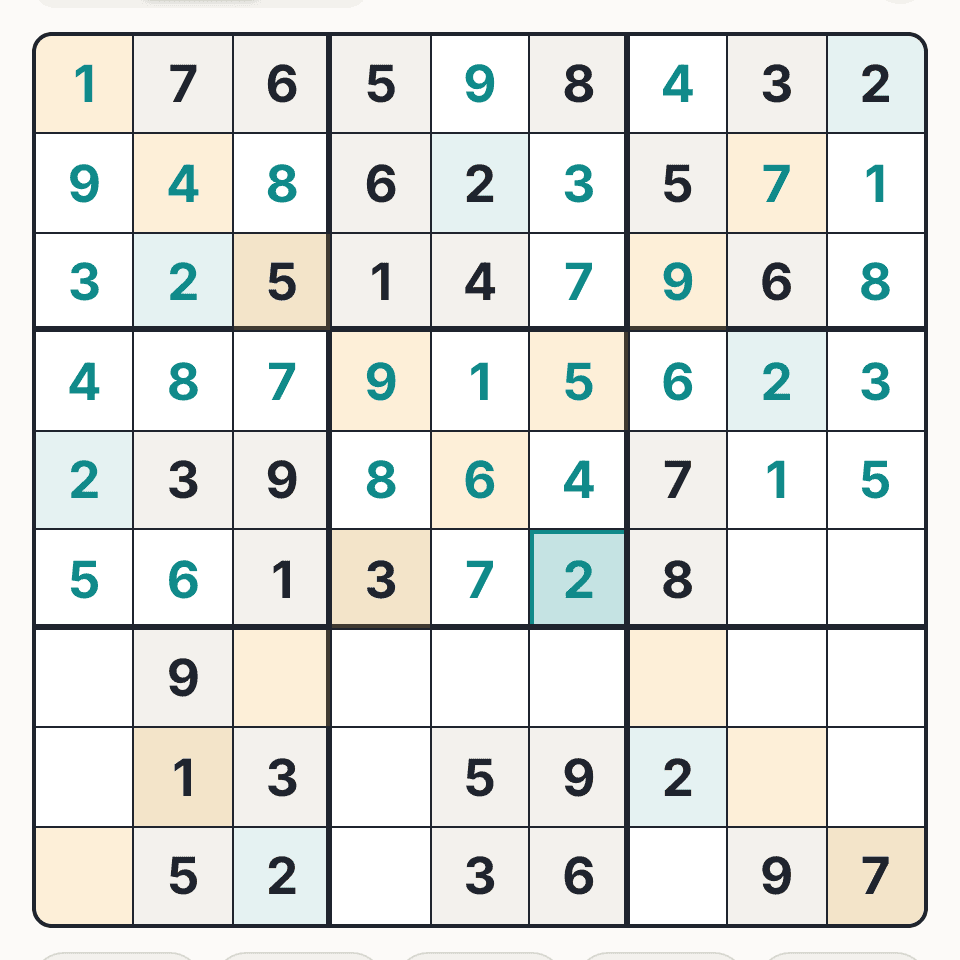
On this site: Play X-Sudoku Online Free free·Browse 100+ free printables·Play today's puzzles
Take everything you love about Sudoku, then draw a giant glowing X across the grid — and make those two diagonals play by the rules too. That single addition turns a familiar puzzle into a fresh logical knot, where the center cell suddenly answers to five masters at once. Welcome to X-Sudoku, the diagonal variant that feels like Sudoku wearing a cape.
📌 Key Takeaways
- X-Sudoku is classic 9×9 Sudoku plus one rule: both main corner-to-corner diagonals must also contain the digits 1–9 exactly once.
- The two highlighted diagonals form an “X,” which is where the name (also Sudoku X or Diagonal Sudoku) comes from.
- The diagonal rule dates to Dell's “Number Place Challenger”; The Daily Mail branded its version “Sudoku X.”
- The center cell (R5C5) sits on both diagonals, making it the single most constrained square on the board.
- You can play X-Sudoku free online right now — no app, no download.
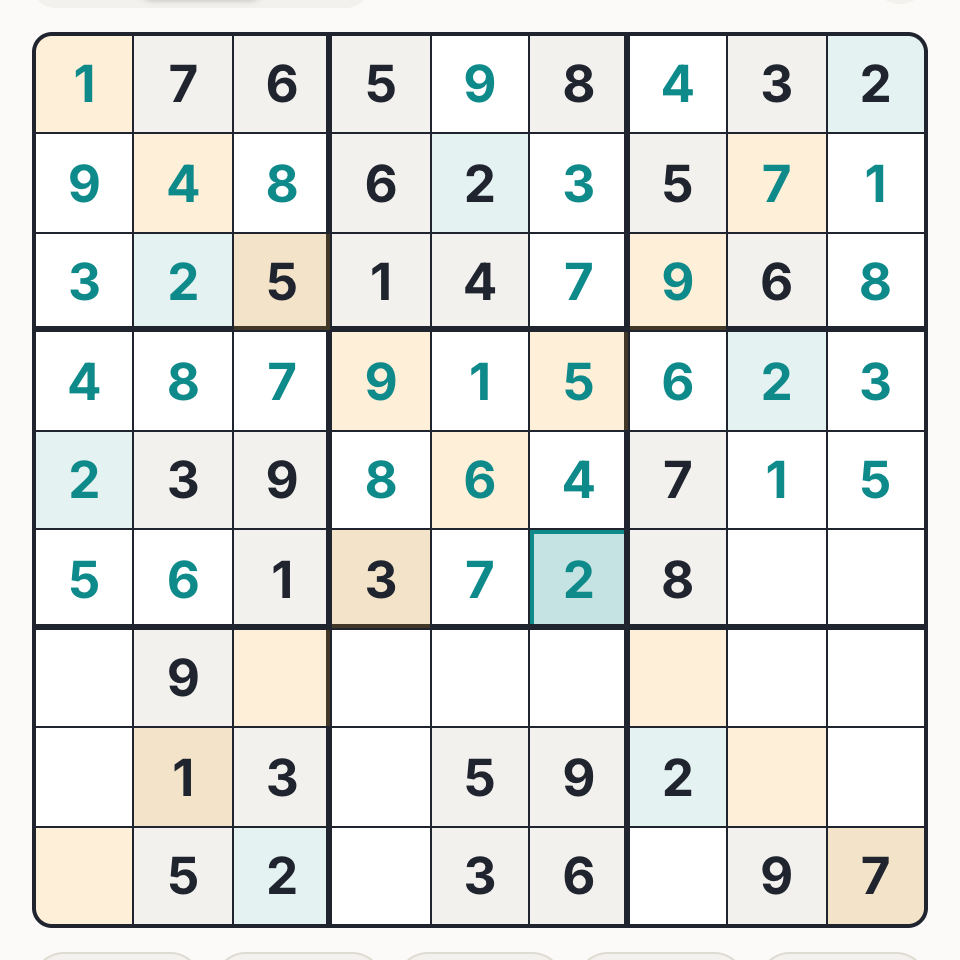
The history of X-Sudoku
X-Sudoku — also called Sudoku X or Diagonal Sudoku — is a variant of standard 9×9 Sudoku that adds two constraints: each of the two main corner-to-corner diagonals must also contain the digits 1 through 9 exactly once. Highlighted on the board, those diagonals form the “X” that gives the puzzle its name.
It builds directly on classic Sudoku, which descends from Howard Garns' “Number Place,” first published anonymously by Dell Magazines in the United States in 1979 and later popularized in Japan by the publisher Nikoli under the name “Sudoku” in the 1980s. The diagonal variant was an early offshoot of that boom: the diagonal-uniqueness rule is the form used by Dell's “Number Place Challenger” puzzles, while “Sudoku X” was the branded name the British newspaper The Daily Mail used for its diagonal puzzles (source).
As Sudoku spread globally after Wayne Gould's puzzles appeared in The Times of London in 2004, variants like Sudoku X were syndicated in newspapers and puzzle books around the world. It remains one of the most common Sudoku variants, supported by major solver sites and publishers (source). No single person is credited with inventing the diagonal form — it emerged naturally as an extra “dimension” added to the base puzzle (source).
Like this? We send 10 of these every month.
Free printable puzzles, answer keys included — same quality as the ones in this post.
One email. Unsubscribe anytime.
How to play X-Sudoku
If you know Sudoku, you're 90% of the way there — the rest is the diagonals. Start a fresh grid on our free X-Sudoku board and follow along.
- Understand the grid. The board is a 9×9 square divided into nine 3×3 boxes, with some cells pre-filled as givens.
- Learn the base rule. Every row, every column, and every 3×3 box must contain each digit from 1 to 9 exactly once, with no repeats.
- Add the X rule. Both main diagonals — top-left to bottom-right, and top-right to bottom-left — must also contain the digits 1 to 9 exactly once. These are usually shaded to mark them.
- Solve the diagonals like extra lines. Treat each diagonal as a ninth and tenth “unit” to track. A digit already on a diagonal can't appear elsewhere on that same diagonal.
- Mind the center. The middle cell sits on both diagonals at once, so it's bound by its row, column, box, and both X-lines — resolve it early when you can.
- Use pencil marks. Note candidate digits in tight cells, then erase them as the rows, columns, boxes, and diagonals rule numbers out.
- Never guess. A proper X-Sudoku has one solution reachable by logic alone. If you're tempted to guess, you've missed a diagonal deduction — keep scanning.
- Finish and check. The puzzle is solved when all 81 cells are filled and no digit repeats in any row, column, box, or diagonal.
What makes X-Sudoku harder than regular Sudoku?
X-Sudoku is harder because the two diagonals act as extra constraint lines, so cells along the “X” obey more rules at once — but those same lines also hand you extra deductions a standard grid can't offer.
Strategy & tips
The diagonals aren't just extra restrictions — they're extra information. Lean on them and the puzzle opens up faster than a plain Sudoku of equal difficulty.
- Treat each diagonal as its own unit. Scan it exactly like a row or column: which of 1–9 are still missing, and where can each one legally land?
- Attack the center first. R5C5 is the busiest cell on the board; pinning it down often cascades into the rest of the grid.
- Cross-reference diagonal and box. A diagonal cell sits inside a 3×3 box too, so a digit forced onto the diagonal is simultaneously removed from the rest of that box.
- Use the “rectangle” elimination. A trick unique to the diagonal, explained below.
- Warm up first. Solve a few easy diagonals to internalize the X-lines before attacking a hard grid cold.
Andrew Stuart, creator of SudokuWiki.org and author of The Logic of Sudoku, documents a deduction that only exists in the diagonal variant: because any two cells on a main diagonal share neither a row nor a column, they sit at opposite corners of a rectangle. So when a candidate is locked to a pair of cells on the diagonal, you can eliminate that same candidate from the other two corners of that rectangle — an elimination standard Sudoku simply doesn't allow (source).
Prolific variant constructor Djape (Dejan Ristanović), author of numerous published Diagonal/X Sudoku books, stresses the power of the middle square: the central cell lies on both diagonals plus its row, column, and box, making it the most constrained cell in the grid. Resolving the diagonals early often forces the center and cascades through the whole puzzle (source).
Love this deductive flavor? You'll feel right at home with our other logic grids — the original Sudoku, the arithmetic-spiced Killer Sudoku, or the math-cage challenge of Calcudoku.
Is X-Sudoku solvable without guessing?
Yes — a well-made X-Sudoku has exactly one solution reachable through logic alone, with the diagonals providing extra clues, so guessing should never be necessary.
Watch a video tutorial
Seeing the diagonal logic in motion makes it click. A clear primer is “Sudoku X — Rules & Strategies”, a logic-puzzle tutorial walkthrough of the diagonal variant:
Want more walkthroughs? Browse a full YouTube search of Diagonal / X Sudoku tutorials to find a teaching style that suits you.
Ready to solve?
The fastest way to learn X-Sudoku is to draw that first number onto a diagonal yourself and watch the logic ripple outward. Jump into a fresh grid and play X-Sudoku free online — no download, nothing to install, just you, the grid, and the glowing X. Want more variety afterward? Test yourself with Nonograms, unwind with a Word Search, or take on our rotating daily puzzles.
Keep reading
Get 10 free puzzles
Get the free 10-puzzle pack
Enter your email and we'll send you 10 print-ready puzzles with answer keys, plus a heads-up when we publish new generators and seasonal puzzle packs. Same quality as the ones on this page.
Roughly two emails a month. No spam, unsubscribe anytime.
Enjoyed this? Share the puzzle on X
Like puzzles like this? Follow on Pinterest for a new one every day.