Play Nonograms Online Free: Rules, History & Strategy
Learn how to play Nonograms (Picross, Hanjie, Griddlers) with beginner rules, expert strategy tips, their Japanese history, and a free online board to solve now.
On this site: Play Nonograms Online Free free·Browse 100+ free printables·Play today's puzzles
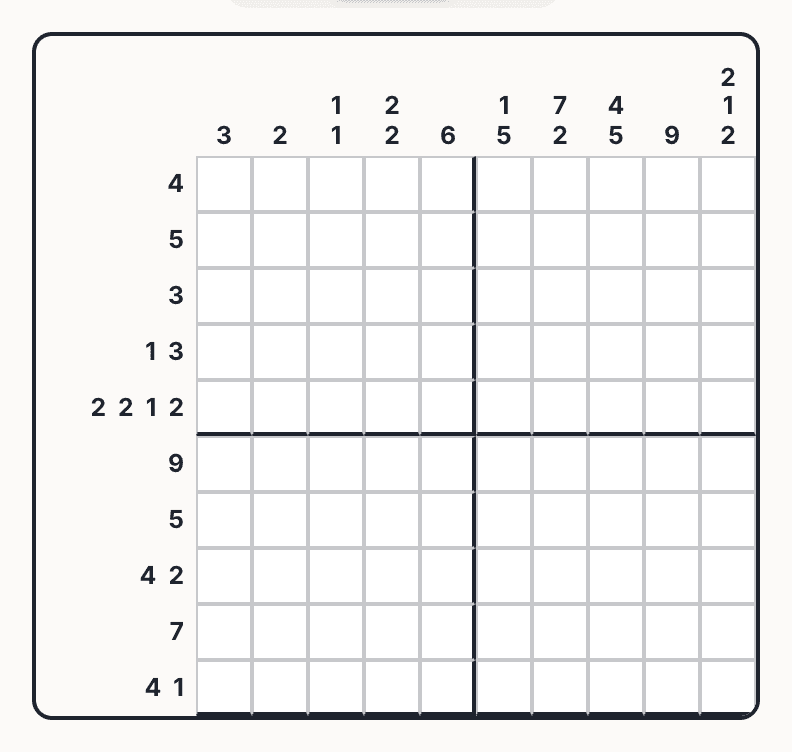
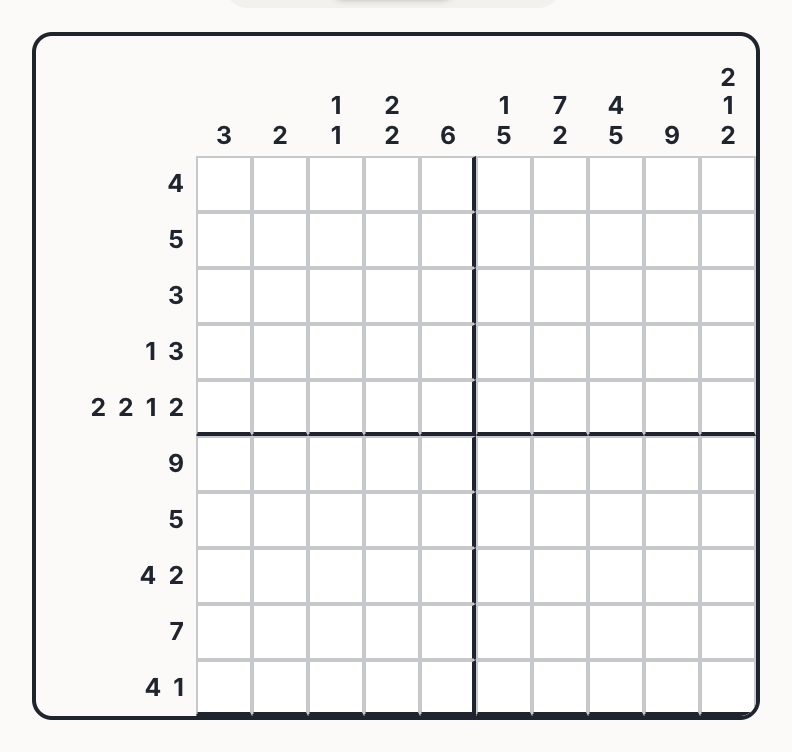
A grid of empty squares, two sets of numbers along the edges, and a hidden picture waiting inside. Fill the right cells and a heart, a cat, or a sailboat slowly emerges from pure logic. Nonograms — also called Picross, Hanjie, or Griddlers — are the rare puzzle that rewards you with art, and once the picture starts appearing it is almost impossible to stop.
📌 Key Takeaways
- Nonograms use number clues on each row and column to tell you which cells to fill, revealing a hidden picture.
- The clue numbers list the lengths of consecutive filled blocks in order, separated by at least one empty cell.
- A genuine nonogram has exactly one solution reachable by logic alone — you never need to guess.
- Invented in Japan around 1987 and later made famous worldwide as Nintendo's Picross.
- You can play Nonograms free online right now — no app, no download.
The history of Nonograms
The puzzle was invented in Japan around 1987, credited to two creators working independently. Non Ishida, a Tokyo graphics editor, won a window-art competition by lighting up squares on skyscrapers to form pictures, while puzzle maker Tetsuya Nishio arrived at the same grid-and-clue idea around the same time. Their two strands merged into the picture-logic puzzle we know today (source).
The puzzle reached the wider world through British collector James Dalgety, who coined the English name "nonogram" — a nod to Non Ishida. The Sunday Telegraph began running them in 1990 and helped popularize the format across the UK, which is why so many regional names exist: Hanjie, Griddlers, Picture Cross, and more (source).
Most players today, though, met nonograms through video games. Nintendo licensed the concept and released it as Picross, with the original Game Boy title Mario's Picross arriving in 1995. The Picross series has thrived for decades since, turning a newspaper puzzle into a beloved hand-held franchise (source).
Like this? We send 10 of these every month.
Free printable puzzles, answer keys included — same quality as the ones in this post.
One email. Unsubscribe anytime.
How to play Nonograms
The rules are quick to learn, and you can open a fresh grid on our free Nonograms board in seconds.
- Read the clues. Numbers sit beside each row and above each column. Each number is the length of an unbroken run of filled cells, listed in the order they appear.
- Mind the gaps. When a clue lists several numbers, like 3 1 2, those blocks appear in that order with at least one empty cell between each.
- Fill what's forced. Find rows or columns where a clue is large enough that some cells must be filled no matter how the blocks slide.
- Mark the empties. When you know a cell cannot be filled, mark it with an X. Eliminated cells are just as valuable as filled ones.
- Cross-reference. A filled or X'd cell from a row instantly constrains its column, and vice versa. Bounce between the two to make progress.
- Never guess. A proper nonogram is solvable by logic alone. If you feel like guessing, there's a deduction you've missed — keep scanning.
- Reveal the picture. The puzzle is solved when every clue is satisfied and the hidden image appears in the filled cells.
What do the numbers in a Nonogram mean?
Each number is the length of a solid block of filled cells in that row or column, and when several numbers are listed they describe those blocks in order, separated by at least one empty cell.
Strategy & tips
Once you understand the clues, a handful of reliable tactics will carry you through almost any grid:
- Start with the biggest clues. A clue that nearly fills its line leaves the least room to slide, so it locks in cells fastest.
- Use the line total. Add up a line's clue numbers plus the mandatory gaps between them. If that total equals the line length, the entire line is forced and can be filled instantly.
- Mark X's aggressively. Once a clue is fully placed, X out the remaining cells in that line. Empty cells often unlock the crossing line.
- Work edges inward. A block touching the wall of the grid has a fixed starting point, which makes it easy to place exactly.
- Re-scan after every move. Each filled cell or X changes the constraints on its crossing line, so loop back and look again.
The single most powerful beginner technique is overlapping. As nonogram author Djape — a computer scientist who has written more than 250 puzzle books — explains, for any clue larger than half the line, the cells that stay filled in every possible placement are guaranteed, so you can fill them with certainty even before you know exactly where the block begins (source). For example, a clue of 8 in a 10-cell row must cover the middle 6 cells no matter how it slides — color them in immediately.
Just as important is trusting the logic. James Dalgety, the collector who introduced nonograms internationally and gave them their name, stresses that a genuine nonogram has one unique solution reachable by pure logic, so you should never need to guess (source). If you hit a wall, the answer is always hiding in a line you haven't fully exploited yet.
Do you ever have to guess in a Nonogram?
No — a properly constructed nonogram has exactly one solution that pure logic can reach, so if you feel tempted to guess, it means there is a deduction somewhere on the board you haven't spotted yet.
If that deductive, no-guessing feel is what you love, you'll enjoy our other logic grids too — try the picture-free number logic of Sudoku, the relaxing hunt of Word Search, or the shaded-cell challenge of Star Battle.
Watch a video tutorial
Watching the overlapping technique in motion makes it click instantly. A great primer is "How to solve Nonogram Puzzles - The Basics" on YouTube:
Ready for sharper deductions? Two excellent follow-ups are "How to solve Nonogram Puzzles - Tips and Tricks" and "Nonograms - Rules and Strategies."
Ready to solve?
The best way to learn Nonograms is to fill in that first forced block and watch the picture begin to surface. Jump into a fresh grid and play Nonograms free online — no download, nothing to install, just you, the clues, and a hidden image. Craving more variety afterward? Test your deduction with Kakuro or our rotating daily puzzles, and see how far pure logic can take you.
Keep reading
Get 10 free puzzles
Get the free 10-puzzle pack
Enter your email and we'll send you 10 print-ready puzzles with answer keys, plus a heads-up when we publish new generators and seasonal puzzle packs. Same quality as the ones on this page.
Roughly two emails a month. No spam, unsubscribe anytime.
Enjoyed this? Share the puzzle on X
Like puzzles like this? Follow on Pinterest for a new one every day.