Play Kakuro Online Free: History, Rules & Strategy
Learn how to play Kakuro (Cross Sums) with beginner rules, forced-combination strategy, its history, and a free online board. Solve your first grid today.
On this site: Play Kakuro Online Free free·Browse 100+ free printables·Play today's puzzles
Picture a crossword where every clue is a number and every answer is a sum. No vocabulary, no trivia — just a grid of blank cells, a handful of running totals, and the digits 1 through 9 waiting to slot into place. That is Kakuro, the cross-sum puzzle that turns simple addition into deeply satisfying logic.
📌 Key Takeaways
- Kakuro is a crossword-style grid where you fill white cells with digits 1–9 so each run adds up to its printed clue.
- The golden rule: no digit may repeat within a single horizontal or vertical run.
- It began in the US as “Cross Sums” (1966) and was reborn in Japan by Nikoli as “Kakuro.”
- The fastest way in is memorizing forced combinations — like a two-cell 3 that can only be 1+2.
- You can play Kakuro free online right now — no app, no download.
The history of Kakuro
Kakuro was born American. The puzzle first appeared as “Cross Sums,” and Canadian-born constructor Jacob E. Funk, working for Dell Magazines, is credited with coining that name in 1966 (source). A few sources trace the idea back as far as 1950, but the documented naming lands in 1966.
Its second life began in Japan. In 1980 the Tokyo puzzle publisher Nikoli — co-founded by the legendary Maki Kaji — introduced the puzzle as “Kasan Kurosu,” literally “addition cross,” which was soon shortened to the snappier “Kakuro.” It grew into one of Nikoli's most popular logic puzzles and led the Japanese puzzle press until 1992, when a stablemate called Sudoku finally overtook it (source).
After Sudoku's global explosion, publishers went looking for the next number craze and rediscovered Kakuro. It reached Britain around 2005 via The Guardian, followed quickly by The Telegraph and the Daily Mail. Today it is published in more than 35 countries through suppliers like Dell, Nikoli, and Conceptis (source).
Like this? We send 10 of these every month.
Free printable puzzles, answer keys included — same quality as the ones in this post.
One email. Unsubscribe anytime.
How to play Kakuro
The rules are quick to learn, and you can open a fresh grid on our free Kakuro board in seconds.
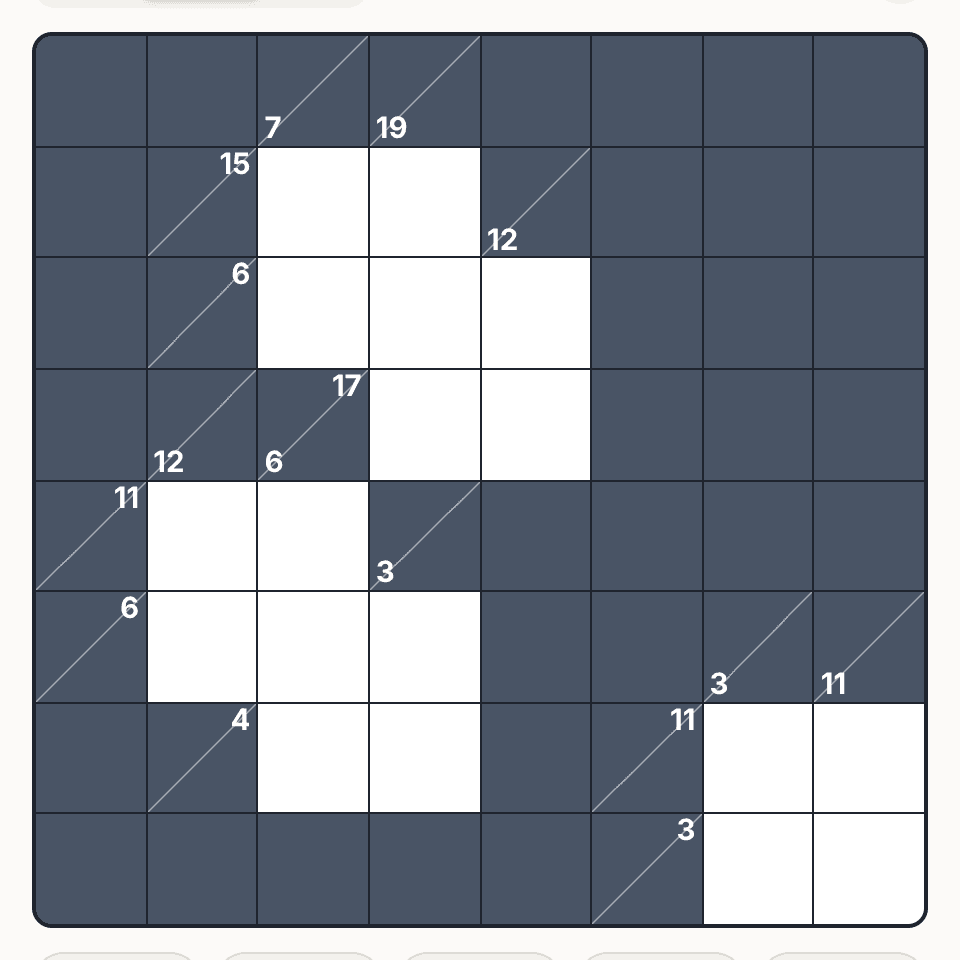
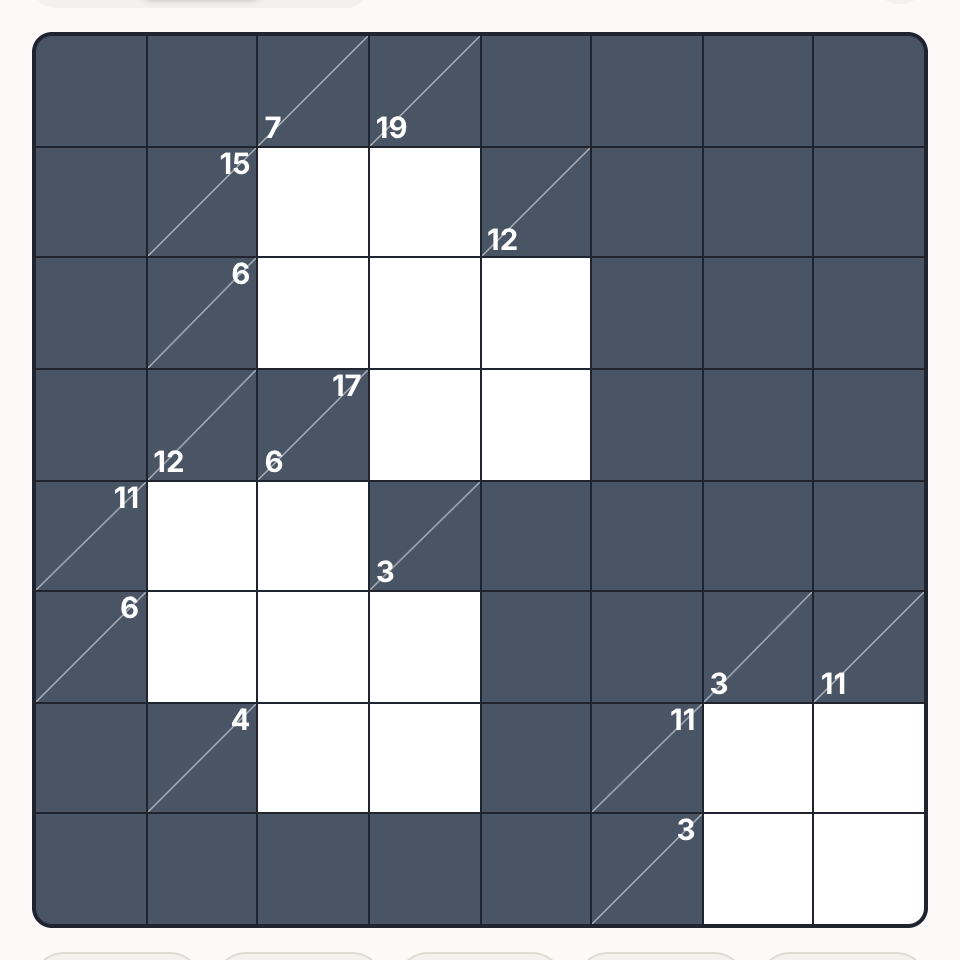
- Understand the grid. Kakuro looks like a crossword. Black cells block the grid, white cells are yours to fill, and special clue cells hold the target sums.
- Read the clues. A number above a diagonal slash is the sum for the run of white cells going down; a number below the slash is the sum for the run going right.
- Fill with 1 to 9. Every white cell takes a single digit from 1 to 9. Zero is never used.
- Match every sum. The digits in each horizontal run must add up to its right-pointing clue, and each vertical run must add up to its down-pointing clue.
- Never repeat in a run. No digit may appear twice within the same horizontal or vertical run — though the same digit can appear in a crossing run.
- Use the crossings. Each white cell belongs to one across run and one down run, so a digit must satisfy both sums at once. Let those two constraints narrow your options.
- Finish and check. The puzzle is solved when every white cell is filled and every run hits its clue with no repeats.
What is the difference between Kakuro and Sudoku?
Sudoku is pure placement logic with no arithmetic, while Kakuro adds a layer of addition: you choose digits so that each run sums to a target, making it a true cross between a crossword and a math puzzle.
Strategy & tips
Kakuro rewards pattern memory more than raw calculation. These tactics turn a blank grid into a chain reaction:
- Learn the forced combinations. Some clues have only one possible digit set. A two-cell run summing to 3 must be 1 and 2; a two-cell run of 17 must be 8 and 9; a three-cell run of 6 must be 1, 2 and 3.
- Start where forced clues cross. When two of those locked runs intersect, the shared cell is often pinned to a single digit instantly.
- Hunt the extremes. The smallest and largest sums for a given run length have the fewest combinations, so they are the easiest footholds.
- Pencil in candidates. Jot the possible digits for a cell, then eliminate any that break the crossing run's sum.
- Use the “magic” totals. Memorizing the unique-combination clues (like 45 across nine cells using every digit once) saves enormous time.
This forced-combination approach is exactly what the experts recommend. Conceptis Puzzles, a leading worldwide supplier of number-logic puzzles, advises solvers to use these forced digit combinations and to start where two such clues cross — that intersection is your reliable opening move. The puzzle's human-friendly design is no accident: Nikoli co-founder Maki Kaji, often called the “Godfather of Sudoku,” championed hand-crafted, human-solvable puzzles and built Kakuro into one of Japan's top pencil puzzles before Sudoku eclipsed it (source).
If you enjoy that blend of logic and numbers, you'll likely love our other grids — try the arithmetic-driven Killer Sudoku, the math-cage challenge of Calcudoku, or classic Sudoku for placement logic without the addition.
Is Kakuro hard for beginners?
No — Kakuro is approachable if you start with small grids and learn a few forced combinations, because those locked clues hand you guaranteed digits before any difficult deduction begins.
Watch a video tutorial
Watching a run get filled in makes the logic click. A clear starting point is “How to play Kakuro: beginner 8x8 walkthrough” by puzzling.com:
Two more solid walkthroughs are “Kakuro Tutorial: How to solve a Kakuro logic puzzle (HD)” and “How to Play Kakuro — The Crossword Numbers Game.”
Ready to solve?
The best way to learn Kakuro is to fill in that first forced run yourself. Open a fresh grid and play Kakuro free online — no download, nothing to install, just you, the sums, and the logic. Want more variety afterward? Sharpen your skills with Calcudoku, the picture logic of Nonograms, or our rotating daily puzzles, and see how far your deduction can take you.
Keep reading
Get 10 free puzzles
Get the free 10-puzzle pack
Enter your email and we'll send you 10 print-ready puzzles with answer keys, plus a heads-up when we publish new generators and seasonal puzzle packs. Same quality as the ones on this page.
Roughly two emails a month. No spam, unsubscribe anytime.
Enjoyed this? Share the puzzle on X
Like puzzles like this? Follow on Pinterest for a new one every day.