Play Calcudoku Online Free: Rules, History & Strategy
Learn how to play Calcudoku (KenKen/Mathdoku) with beginner rules, expert cage strategy, its history, and a free online board. Solve your first grid in minutes.
On this site: Play Calcudoku Online Free free·Browse 100+ free printables·Play today's puzzles
Imagine a Sudoku grid that quietly teaches you arithmetic — no instructions, no lectures, just dotted “cages” daring you to hit a target with a +, −, ×, or ÷. That is Calcudoku, the puzzle better known by its trademarked name KenKen. A Japanese math teacher built it to make brains stronger, and one grid is usually all it takes to get hooked.
📌 Key Takeaways
- Calcudoku — also sold as KenKen and Mathdoku — fills a grid so every row and column holds each digit once, while each outlined “cage” must reach a target using a stated math operation.
- It was invented in 2004 by Japanese math teacher Tetsuya Miyamoto as an “instruction-free” way to train arithmetic and logic.
- Grids range from gentle 3×3 puzzles up to brain-melting 9×9 ones, so it scales from kids to experts.
- The winning move is to start with single-cell “freebie” cages and cages that have only one possible combination.
- You can play Calcudoku free online right now — no app, no download.
The history of Calcudoku
Calcudoku was invented in 2004 by Tetsuya Miyamoto, a Japanese math teacher who wanted a way to sharpen arithmetic and logic without ever standing at a whiteboard. He called his method the “art of teaching without teaching”: hand a student a puzzle, no instructions, and let them learn through trial and discovery (source).
He named it from the Japanese word “ken,” meaning wisdom or cleverness — so KenKen roughly translates as “cleverness squared.” The puzzle was introduced to the wider world as KenKen at the 2007 Bologna Book Fair. In March 2008, Nextoy, LLC and chess and AI expert David Levy arranged for it to be published in The Times of London, and the New York Times soon followed, printing KenKen daily alongside its famous crossword with an introduction by puzzle editor Will Shortz (source).
So why the different names? “KenKen” and “KenDoku” are trademarked, so publishers who do not hold those rights use the labels “Calcudoku” and “Mathdoku” for the same puzzle. Under any name it has spread internationally through newspapers, books, and online platforms, and it has anchored a long line of best-selling Will Shortz puzzle collections (source).
Like this? We send 10 of these every month.
Free printable puzzles, answer keys included — same quality as the ones in this post.
One email. Unsubscribe anytime.
How to play Calcudoku
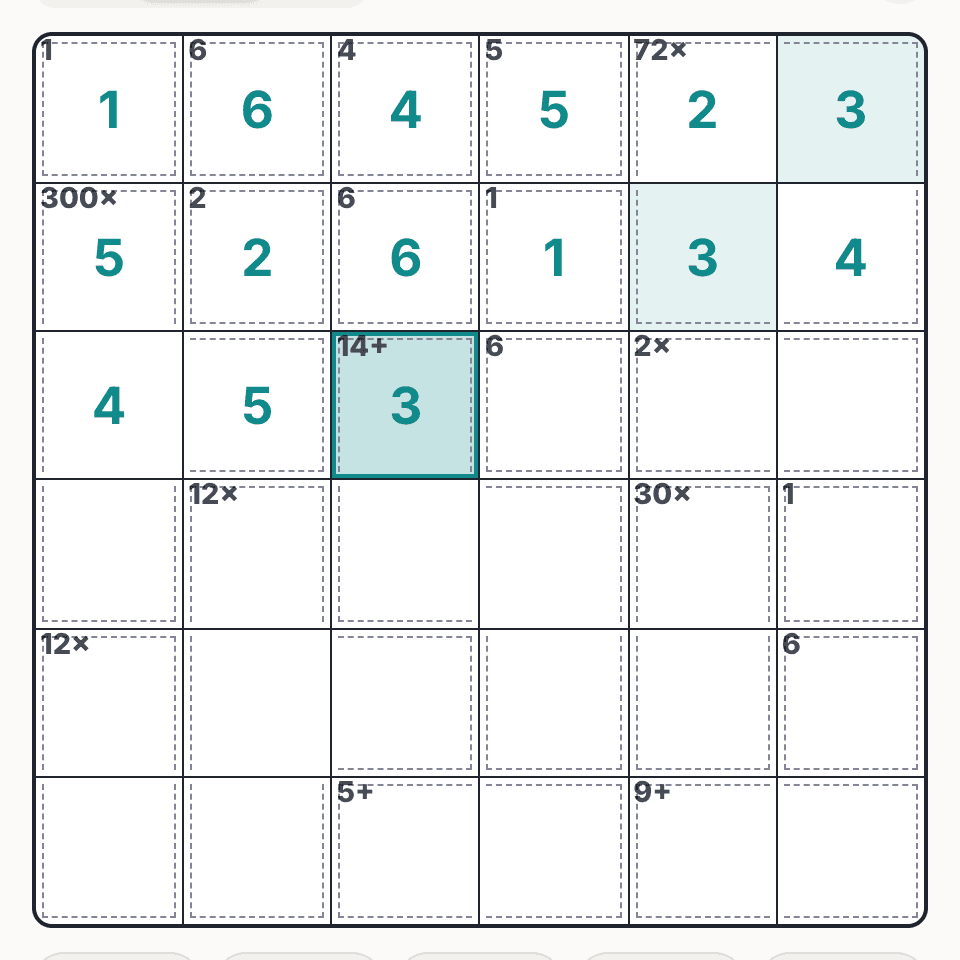
The rules are quick to learn, and you can open a fresh grid on our free Calcudoku board in seconds.
- Know the base rule. Like Sudoku, every row and every column must contain each digit exactly once. An N×N grid uses the digits 1 to N.
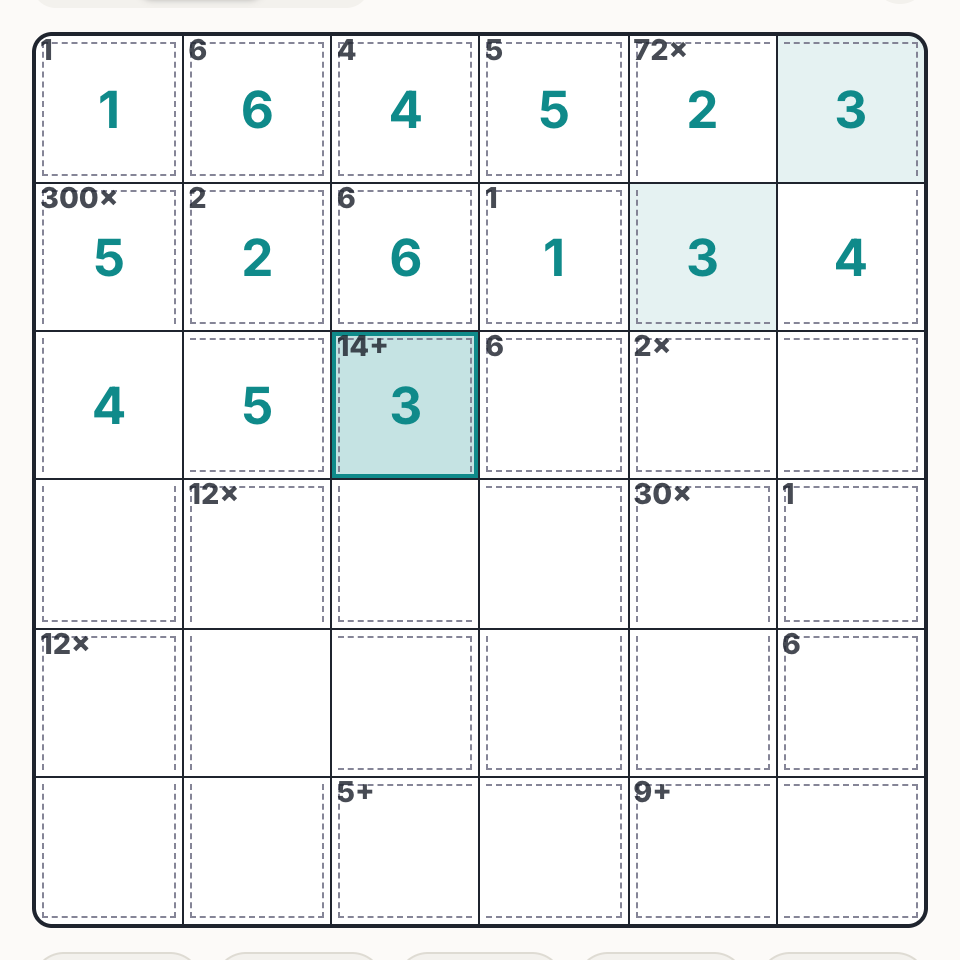
- Read the cages. Heavy outlines group cells into “cages.” Each cage shows a small target number and a math sign, such as “6×” or “2−”.
- Hit the target with the operation. The digits inside a cage must combine using that operation to produce the target — for example, a “6×” cage of two cells could be 2 and 3.
- Mind subtraction and division. For “−” and “÷” cages, the operation is applied between the cell values regardless of order, so a “2−” cage could be 5 and 3, or 1 and 3.
- Take the freebies. A single-cell cage simply shows a number with no operation — write that digit straight in.
- Remember digits can repeat in a cage. Unlike Killer Sudoku, a digit may repeat within a cage as long as it does not break the row and column rule.
- Finish and check. The puzzle is solved when every cell is filled, each row and column holds its digits once, and every cage matches its target.
Why are there single-cell cages?
Single-cell cages are “freebies” — a lone cell showing just a number and no operation, which means that exact digit belongs there, giving you a guaranteed starting point.
Strategy & tips
Calcudoku blends arithmetic with pure deduction. These tactics turn a grid of targets into a chain of certainties:
- Grab the freebies first: Fill every single-cell cage immediately — they cost no thought and seed your row and column logic.
- Hunt locked cages: Find cages with only one possible combination, like a “1−” two-cell cage in a small grid, and pencil those candidates in.
- List combinations, then prune: For a cage, jot every set of digits that hits the target, then delete any that would repeat a value in the same row or column.
- Lean on the no-repeat rule: A digit already placed in a row or column rules itself out of every other cell in that line, shrinking each cage’s options fast.
- Save the guesses for last: Eliminate first; only consider a tentative placement once logic alone stalls.
This eliminate-before-you-guess approach comes straight from New York Times puzzle editor Will Shortz, who introduced and edited KenKen for U.S. readers. Shortz advises beginners to start with the single-cell “freebie” cages that hand you a digit outright, then move to cages that have only one possible combination, using the row and column constraints to wipe out impossible options before ever resorting to a guess (source). It is a tactic that honors inventor Tetsuya Miyamoto’s original idea: the puzzle is meant to build your reasoning through self-directed discovery rather than memorized rules (source).
If this mix of math and logic clicks, try our sibling grids: the sum-based Killer Sudoku, the number-crossword Kakuro, or the diagonal twist of X-Sudoku.
Is Calcudoku the same as KenKen?
Yes — Calcudoku, KenKen, and Mathdoku are the same puzzle; “KenKen” is the trademarked name, while “Calcudoku” and “Mathdoku” are used by publishers who do not hold that trademark.
Watch a video tutorial
Seeing the cages and operations in motion makes the rules click instantly. The perfect starting point is “Learn KenKen in under 2 min.” from The New York Times, featuring Will Shortz:
Want a slower walkthrough? Try “How to Play KenKen — A Super Simple Lesson Fully Explained” for a thorough beginner primer, or “KenKen Puzzles — How To Solve [LESSON 1] — Step by Step!” for a guided first solve.
Ready to solve?
The fastest way to learn Calcudoku is to fill the freebie cages and let the row and column logic cascade from there. Jump into a fresh grid and play Calcudoku free online — no download, nothing to install, just you and the cages. Hungry for more afterward? Test yourself with Nonograms or our rotating daily puzzles, and see how far your reasoning can take you.
Keep reading
Get 10 free puzzles
Get the free 10-puzzle pack
Enter your email and we'll send you 10 print-ready puzzles with answer keys, plus a heads-up when we publish new generators and seasonal puzzle packs. Same quality as the ones on this page.
Roughly two emails a month. No spam, unsubscribe anytime.
Enjoyed this? Share the puzzle on X
Like puzzles like this? Follow on Pinterest for a new one every day.