Sudoku Puzzle Books KDP: The 2026 Niche Deep Dive
Sudoku puzzle books on KDP have repeat buyers, real competition, and clean royalty math. See the numbers, the large print senior angle, and a series plan.

Free to try
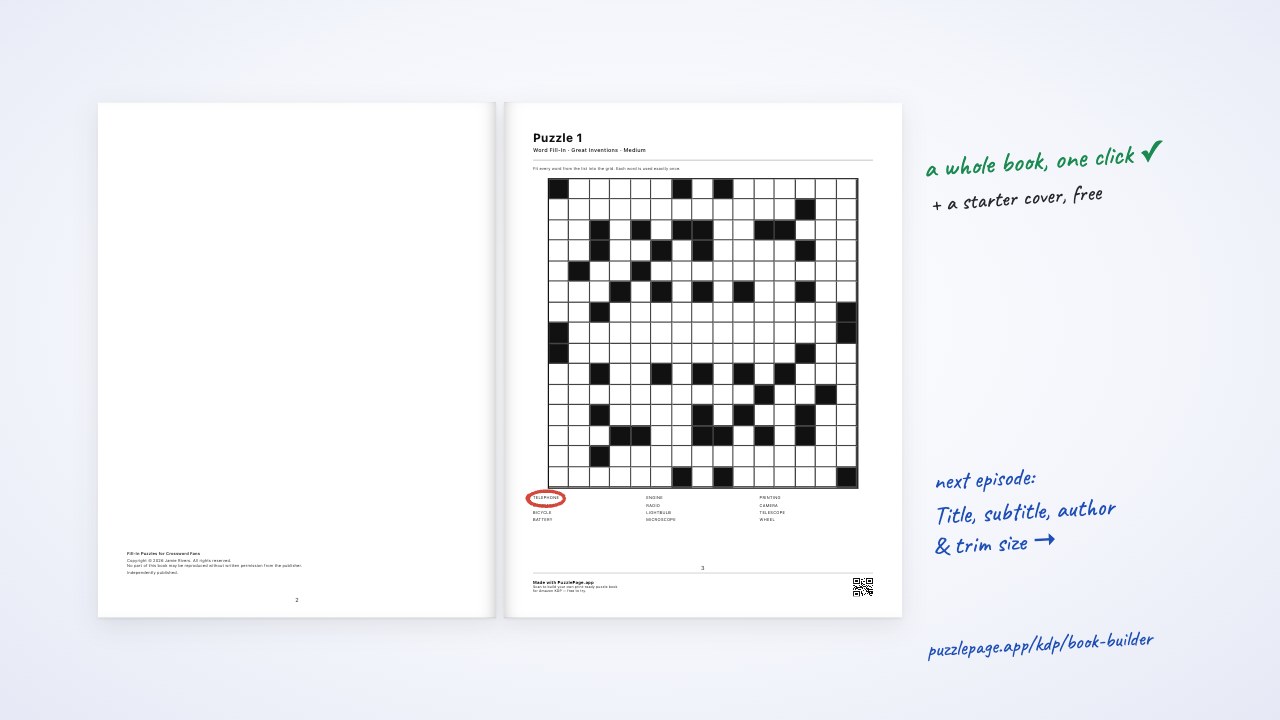
Build this book free in the PuzzlePage Book Studio
18 puzzle types, KDP margins and a full-wrap cover. Download the first 10 pages and the cover free.
For publishers: Build a book free in the Studio·Ready-made book templates·KDP calculators·Books made here
Sudoku is the puzzle niche people warn you away from and then quietly keep publishing into. The warning is fair on competition and wrong on economics.
What makes sudoku unusual is the buyer, not the grid. A solver who finishes a book in a week is not a one-time customer, and that single behaviour changes how the whole niche should be approached.
📌 Key Takeaways
- Sudoku buyers are reportedly high-frequency, working through roughly one book per week and buying for years, so read-through matters more here than in one-and-done niches.
- Competition is real: 226 top-seller listings use "sudoku" against 113 for "crossword" and 438 for "word", so generic titles have nowhere to hide.
- Large-print sudoku for seniors is the softer entry: motivated buyers, lower competition than standard sudoku, and strong gifting dynamics.
- Amazon prints 24 to 110 pages for a flat $2.30, so a thin sudoku book throws away free value.
- A well-reviewed sudoku book can reportedly hold BSR under 5,000 for months without ads, but no outcome is guaranteed and results vary.
 1:25
1:25Why is sudoku structurally different from other puzzle niches?
Sudoku is different because the buyer comes back. Committed solvers reportedly work through about one book per week and keep buying for years, which turns a catalog into an annuity rather than a lottery ticket.
Compare that to a themed gift book. Someone buys a cat-lover puzzle book for a birthday, gives it away, and never thinks about your author name again.
The sudoku solver is the opposite kind of customer. They finish your book, they liked the grid size, and they go looking for the next one with your name on it.
That is why read-through and series structure carry more weight in sudoku than almost anywhere else in low-content publishing. A single sudoku book is a sample; a five-volume ladder is a habit.
The durability shows up in rank behaviour too. A well-reviewed sudoku book can reportedly hold BSR under 5,000 for months without any advertising spend, which is not something you often hear about seasonal or novelty titles.
Treat that as a reported pattern rather than a promise. It describes what a good book in this niche is capable of, not what your book will do.
Pro Tip
Before you publish volume one, write down volumes two through five with their difficulty levels and page counts. In a repeat-buyer niche, the plan for the next book is part of the product.
Like this? We send 10 of these every month.
Free printable puzzles, answer keys included — same quality as the ones in this post.
One email. Unsubscribe anytime.
How crowded is the sudoku niche on Amazon, really?
Crowded, but not the most crowded. Among top-seller listings, 226 use the keyword "sudoku", against 113 for "crossword" and 438 for "word" in its various forms such as word search and word scramble.
Read those three numbers together and a picture forms. Word puzzles are the most contested space by a wide margin, sudoku sits in the middle, and crossword is thinner than its reputation suggests.
The mistake is reading 226 as a closed door. It is a signal that the generic slot is taken, not that the category is full.
Nobody is going to out-generic the incumbent sudoku books. They have review counts you cannot buy and rank history you cannot rush.
What they mostly do not have is specificity. The broad titles are built to be everything to everyone, which leaves the defined reader underserved and searchable.
Demand backs this up. Sudoku is reported at 30,000-plus US searches a month alongside word search, crossword and cryptogram, while "puzzle books for adults" runs around 96,873 a month.
Those are big pools. A small, well-aimed share of a 30,000-a-month keyword beats a dominant share of nothing.
The wider market context is favourable as well. Puzzle books reportedly exceed $450M annually on Amazon and are growing around 13% year over year, attributed to screen fatigue and wellness trends.
Circana also reported growth across screen-free categories in Q1 2026, covering guided journals, needlework, puzzle books, coloring books, and logic and brain teasers. Sudoku sits squarely inside that logic and brain-teaser lane.
| Puzzle type | Top-seller listings using the keyword | Buyer behaviour | What this means for you |
|---|---|---|---|
| Word (search, scramble, fill-in) | 438 | Broad, gift-heavy, theme-driven | Most contested keyword space; win on theme, not on volume |
| Sudoku | 226 | High-frequency, reportedly about a book a week, buys for years | Crowded but sticky; series and read-through do the work |
| Crossword | 113 | Loyal, clue-quality sensitive | Thinner than expected, but content is expensive to produce well |
| Cryptograms | 18 | Niche, quote-driven, gift-friendly | Wide open by comparison, smaller overall demand |
Notice what the table does not say. It does not say sudoku is easier, it says sudoku pays you back over a longer horizon if you earn the reader.
If you want the same competition lens applied across every puzzle format, our roundup of best-selling KDP puzzle book niches for 2026 covers the rest of the field.
Why is large print sudoku for seniors the smarter entry point?
Large-print sudoku for seniors is the smarter entry because the buyer is motivated, the competition is lower than standard sudoku, and the gifting dynamics are strong. It is the same puzzle with a narrower door.
Motivated buyers are the important half of that. A senior solver with tired eyes is not browsing for entertainment, they are shopping for a book they can actually read.
That solves your differentiation problem without any content gimmick. Grid size, contrast and page comfort are the product.
The gifting layer is the second engine. Adult children and grandchildren buy these books repeatedly, often around birthdays and holidays, and they tend to buy the whole visible set once they trust one volume.
Format data supports the direction. "Bold and Easy" large-print is reported as one of the fastest-growing 2026 formats, with roughly +45% year over year, 2 to 3 times higher click-through, and a $1 to $3 price premium.
Sit with that click-through number for a moment. Two to three times the CTR on the same search results page is a structural advantage that no amount of extra puzzles can buy.
The price premium matters just as much for the math we will get to shortly. A $1 to $3 premium is the difference between scraping the royalty floor and clearing the 60% band comfortably.
This is exactly where our own catalog sits. We publish a Large Print Brain Games sudoku series, including easy and medium-and-hard editions built for seniors in extra-large print, and every interior comes out of our own free generators.
Pro Tip
Print one page and hand it to an actual senior before you build 200 more. If they reach for reading glasses, your grid is too small and no keyword will fix it.
The fastest way to get that test page is to build the book free in the Book Studio and print from the free first-10-pages download.
The other thing large print does is protect you from review damage. The single most common complaint on generic sudoku books is print size, and you can simply refuse to make that mistake.
Reviews compound in a repeat-buyer niche. The solver who can read your grids leaves a review that sells the next four volumes to strangers.
How do you build a difficulty ladder series?
A difficulty ladder is a series where each volume advances the challenge: easy, then medium, then hard, with the same cover family and the same grid comfort throughout. It fits sudoku because the buyer's ability improves faster than their patience for hunting new authors.
The solver who finishes an easy volume is not done, they are warmed up. If you do not have the next rung ready, someone else does.
Laddering also fixes the reviewer mismatch that sinks mixed-difficulty books. When easy and hard puzzles share one cover, beginners call it brutal and experts call it boring, and both are right.
Here is a five-volume plan built entirely on the flat-rate page band, with royalties calculated from Amazon's published rates for the Amazon.com marketplace using black ink.
| Volume | Difficulty | Pages | List price | Printing cost | Royalty per sale |
|---|---|---|---|---|---|
| 1 | Easy | 108 | $9.99 | $2.30 | $3.69 |
| 2 | Easy to medium | 108 | $10.99 | $2.30 | $4.29 |
| 3 | Medium | 110 | $11.99 | $2.30 | $4.89 |
| 4 | Medium to hard | 110 | $12.99 | $2.30 | $5.49 |
| 5 | Hard | 110 | $12.99 | $2.30 | $5.49 |
Every royalty in that table is the same arithmetic: 0.60 times the list price, minus $2.30 printing. Volume 4 works out to (0.60 × 12.99) − 2.30 = 7.794 − 2.30 = $5.49.
The list prices are illustrative rather than prescriptive. What is not illustrative is the structure: same page band, same royalty rate band, rising difficulty, one visual family.
Keep the ladder legible on the cover itself. A big "Volume 3" and a plain difficulty word beat any clever subtitle, because the returning solver is scanning, not reading.
Pro Tip
Put the difficulty word in the title, not buried in the description. "Easy", "Medium" and "Hard" are how solvers search, and mixed-difficulty books collect reviews from readers who wanted only one rung.
For the pricing side of the ladder in more depth, we walk through the bands and the psychology in how to price a KDP puzzle book in 2026.
What does the royalty math look like for a sudoku book?
The formula is simple and it is Amazon's own: royalty rate times list price, minus printing cost. For paperbacks on the Amazon.com marketplace, the rate is 60% at list prices of $9.99 and above, and 50% at $9.98 and below.
Printing is where sudoku gets interesting. For black ink on white or cream paper, 24 to 110 pages costs a flat $2.30 with no per-page charge, and 110 to 828 pages costs $1.00 plus $0.012 per page.
You can verify all of this on Amazon KDP. These are their published rates for the Amazon.com marketplace, they can change, and they differ by marketplace.
Work one example all the way through. A 100-page book listed at $9.99 costs $2.30 to print, so the royalty is (0.60 × 9.99) − 2.30 = 5.994 − 2.30 = $3.69 per sale.
Now drop the price by a single cent. At $9.98 you fall into the 50% band, and a 120-page book that printed for $2.44 goes from (0.60 × 9.99) − 2.44 = $3.55 down to (0.50 × 9.98) − 2.44 = $2.55.
One cent, about a dollar a sale. There is no reason to publish a sudoku book below $9.99 unless you have a deliberate strategic reason and have done this arithmetic yourself.
The 110-page ceiling is the part that matters most for sudoku specifically. Grids are cheap to add, so page count is a lever you control almost for free.
A 30-page book and a 110-page book both cost $2.30 to print. Publishing the 30-page version is handing money back.
Cross the line and the formula flips. At 111 pages, printing becomes $1.00 + (111 × $0.012) = $2.33, and at 200 pages it becomes $1.00 + $2.40 = $3.40.
| Pages | Printing formula | Printing cost | Royalty at $9.99 (60%) |
|---|---|---|---|
| 30 | Flat rate, 24 to 110 pages | $2.30 | $3.69 |
| 100 | Flat rate, 24 to 110 pages | $2.30 | $3.69 |
| 110 | Flat rate, 24 to 110 pages | $2.30 | $3.69 |
| 111 | $1.00 + $0.012 per page | $2.33 | $3.66 |
| 120 | $1.00 + $0.012 per page | $2.44 | $3.55 |
| 200 | $1.00 + $0.012 per page | $3.40 | $2.59 |
Read the last column top to bottom and the strategy writes itself. At a fixed $9.99, a 200-page sudoku book earns $1.10 less per sale than a 110-page one.
That does not mean big books are wrong. It means a big book has to justify itself with a higher price, because every page past 110 is now costing you $0.012.
Our own large-print sudoku titles run well past the flat band at 200 to 350 puzzles, and that is a deliberate trade. A chunky book at a higher price can be the right call; a chunky book at $9.99 usually is not.
The market gives you room to price up, too. The $10 to $20 band reportedly holds about 50.7% of puzzle book listings, reported at 659 ASINs, which is the largest single share.
So $9.99 is the floor of good economics, not the ceiling of what buyers accept. Half the shelf lives above it.
How do you validate a sudoku sub-niche before publishing?
Use a two-part screen that is commonly cited for low-content publishing: the top 10 books should sit under BSR 100,000, and there should be fewer than roughly 200 competing titles. The first checks that money moves, the second checks that you can be seen.
Both halves are needed. A niche with great ranks and 2,000 titles is a fight, and a niche with 12 titles and BSR 900,000 is a warning.
To translate rank into something intuitive, use the rough estimates: BSR 50,000 is approximately 5 sales a day, and BSR 100,000 is approximately 1 sale a day. Amazon does not publish sales figures, so treat these strictly as estimates that vary by category and season.
Run the screen on the specific phrase, not the parent category. "Sudoku" as a whole is not a niche you can validate, because 226 top-seller listings already use the word.
Instead validate phrases a real buyer would type, and check each one separately:
- large print sudoku for seniors plus a difficulty word such as easy or hard.
- extra large print sudoku, which is a genuinely different reader from large print.
- easy sudoku for beginners, where the promise is confidence rather than challenge.
- sudoku for stress relief or similar wellness framing, which rides the screen-free trend.
Then apply the 2026 pattern that runs through every puzzle format: hyper-specific adult activity books are what is working, including profession-targeted titles. Sudoku can absorb that specificity through the audience and the format even though the grid never changes.
One caution on rank estimates. Puzzle books swing seasonally, so a December snapshot of a gift-driven sub-niche will flatter you and a February one will scare you.
For niches that clear the "fewer than 200 titles" half of the screen more easily, our list of low-competition KDP puzzle niches for 2026 is a useful cross-check before you commit.
How do you compete in sudoku without being generic?
You compete by refusing to sell "sudoku" and selling a specific reader's version of sudoku instead. The grid is a commodity; the reader, the format and the ladder are not.
There are only a few honest levers in this niche, and they stack:
- Print size. Large and extra-large print are real product decisions with reported CTR and price advantages, not cosmetic ones.
- Audience. Seniors, beginners, and stress-relief buyers want different books even at identical difficulty.
- Difficulty honesty. One rung per volume, named on the cover, beats a mixed bag every time.
- Series identity. A visual family that makes volume five obviously belong to volume one.
- Solutions and comfort. Full answer keys, generous margins, and one puzzle per page respect the reader who solves daily.
None of that requires inventing a new puzzle type. It requires deciding who the book is for and then being disciplined about it on every page.
Our Large Print Brain Games series is built on exactly these levers. The easy edition and the medium-and-hard edition are separate books for separate readers, both in extra-large print for seniors, rather than one compromise volume trying to serve everyone.
The process is the part I can vouch for. We lay out every book in the PuzzlePage Book Studio and generate grids with our own free sudoku maker, which means a new volume costs time rather than money, and a failed experiment costs almost nothing.
That changes how you can behave in a crowded niche. When interiors are free, you can afford to test a narrow audience that a paid-content publisher would never risk.
Pro Tip
Fill the flat-rate band before you fill the catalog. Taking volume one from 80 pages to 108 pages costs $0.00 in printing and makes the book look and feel like better value on the shelf.
Should sudoku be your first KDP puzzle book at all?
Sudoku is a good first niche if you intend to build a series, and a poor one if you want a single quick title. The repeat-buyer behaviour that makes it durable only pays out to publishers who keep publishing.
If you want one book and no follow-up, the competition numbers argue for somewhere thinner. Cryptograms appear in only 18 top-seller listings against sudoku's 226, and word fill-ins remain comparatively underbuilt.
There is also a portfolio answer. Sudoku is a fine anchor precisely because it is evergreen, and a themed word search volume can catch seasonal and gift traffic that sudoku never will.
Format share supports the general low-content direction as well. Puzzle, coloring, journal and tracker, workbook and planner formats together make up roughly 56% of what gets built on low-content publishing platforms, based on May to July 2026 data.
What none of this data can tell you is whether your book will sell. Publishing outcomes vary enormously, most books earn little, and no research screen changes that.
Treat the numbers as a way to avoid obviously bad bets rather than a way to guarantee good ones. The dossier can rule things out; only the market rules things in.
If you want to see how the levers in this post look in finished books, our catalog page lists the whole PuzzlePage shelf, including the large-print sudoku series.
What is the shortest path to a publishable sudoku volume?
Pick one reader, pick one difficulty, fill the flat-rate band, and price at $9.99 or above. Everything else in this post is refinement on top of those four decisions.
Order matters more than speed. Choosing the reader before the puzzles is what keeps you from generating 200 grids you later have to throw away.
A workable sequence looks like this:
- Validate the phrase. Top 10 under BSR 100,000, fewer than roughly 200 competing titles, checked on the specific phrase.
- Lock the format. Large or extra-large print, one puzzle per page, full solutions at the back.
- Generate the interior. Free tools, one difficulty, enough grids to land near 110 pages. Make this book.
- Do the arithmetic. Confirm your printing cost and royalty before you set a price, not after.
- Plan volume two. In a repeat-buyer niche, the second book is not optional, it is the business model.
The last step is the one most publishers skip. Sudoku rewards the person who is still there in volume five, which is a slower and less romantic answer than most niche advice offers.
📚 Build Your Book in the PuzzlePage Book Studio
If you are serious about a KDP catalog, the PuzzlePage Book Studio turns your puzzles into a complete, print-ready interior with answer keys, page numbers and a matching full-wrap cover, all in one place. Download the first 10 pages plus the cover free, then pick a KDP plan when you are ready to publish.
Start a Free Book →Free to try
Try the Book Studio free: first 10 pages and cover, no card
Build the whole book in your browser, watch the real printed pages as you go, and download the first 10 pages plus the cover to check them before you decide anything.
- ✓18 puzzle types with difficulty ramps and answer keys
- ✓KDP trim sizes and margins checked as you build
- ✓A matching full-wrap cover, spine included
- ✓Download the first 10 pages and the cover free
Build first, decide later. You only pay when you want the full interior.
Frequently Asked Questions
Are sudoku puzzle books still profitable on KDP in 2026?
The economics work when you price at $9.99 or above, which puts you in Amazon's 60% royalty band, and fill the 24 to 110 page flat-rate band that prints for $2.30. A 100-page book at $9.99 returns (0.60 × 9.99) − 2.30 = $3.69 per sale on the Amazon.com marketplace. Profitability still depends on demand and competition, and outcomes vary.
Is the sudoku niche too competitive to enter?
It is crowded but not closed: 226 top-seller listings use "sudoku", compared with 438 for word puzzles and 113 for crossword. The generic slot is taken, so compete on a defined reader such as large print sudoku for seniors, which is reported to have lower competition and more motivated buyers.
How many pages should a KDP sudoku book have?
Land near 110 pages if you are pricing around $9.99, because Amazon charges a flat $2.30 to print anything from 24 to 110 pages of black ink. Past 110 pages the cost becomes $1.00 plus $0.012 per page, so a 200-page book prints for $3.40 and needs a higher list price to earn the same royalty.
Why does difficulty laddering work so well for sudoku?
Because sudoku buyers are reportedly high-frequency, working through about one book per week and buying for years, so a solver who finishes your easy volume is ready for the next rung immediately. One difficulty per volume also prevents the mixed-bag reviews that hit books where beginners and experts share a cover.
Sudoku interiors come from the same generator as every other type — see where the free tier ends for KDP work.
More you can make here
One puzzle is the start. Here is the rest of the kit.
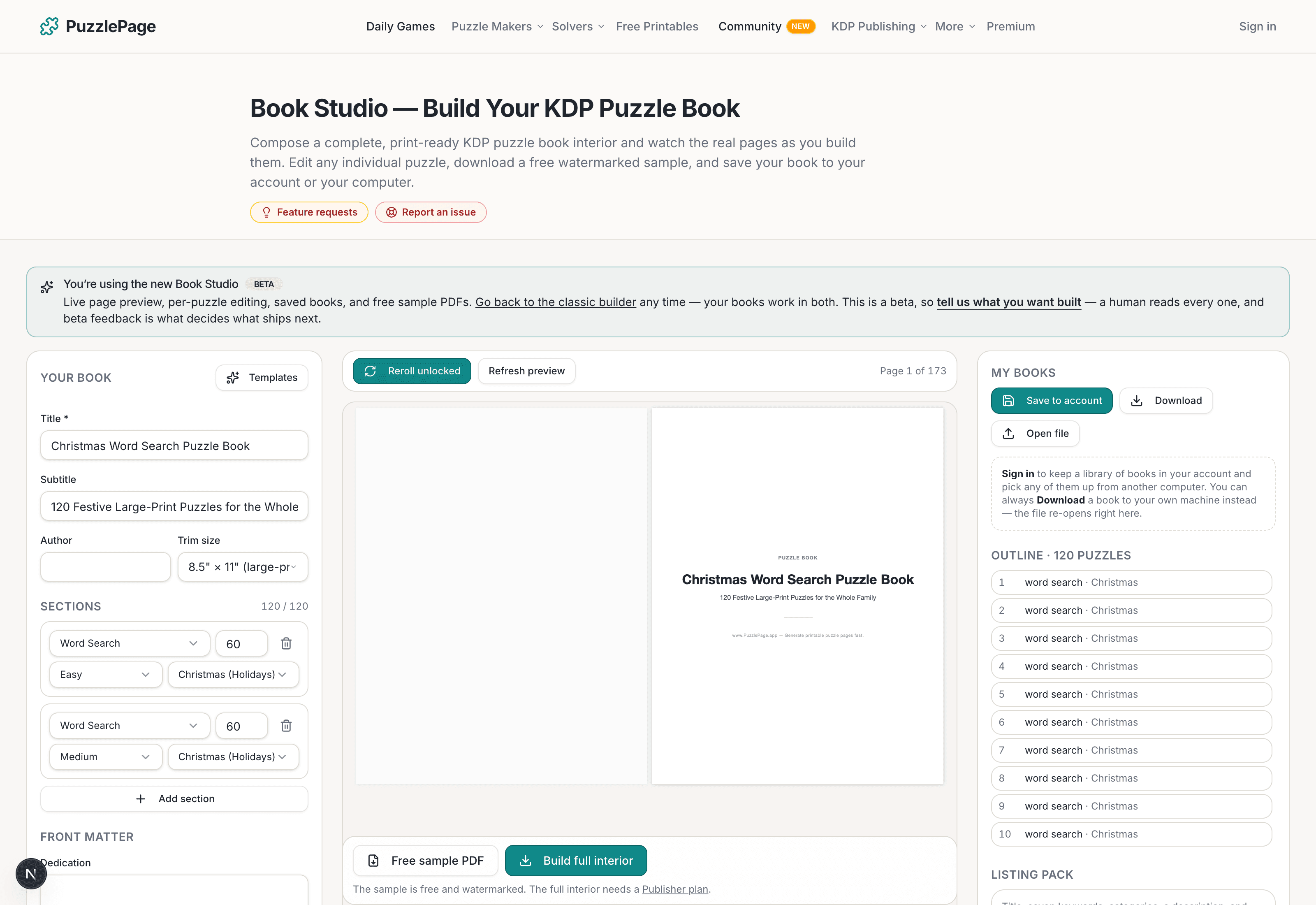
KDP Book Studio
Lay out a full puzzle book for Amazon KDP: templates, trim sizes, page checks and a cover designer.
Start a puzzle book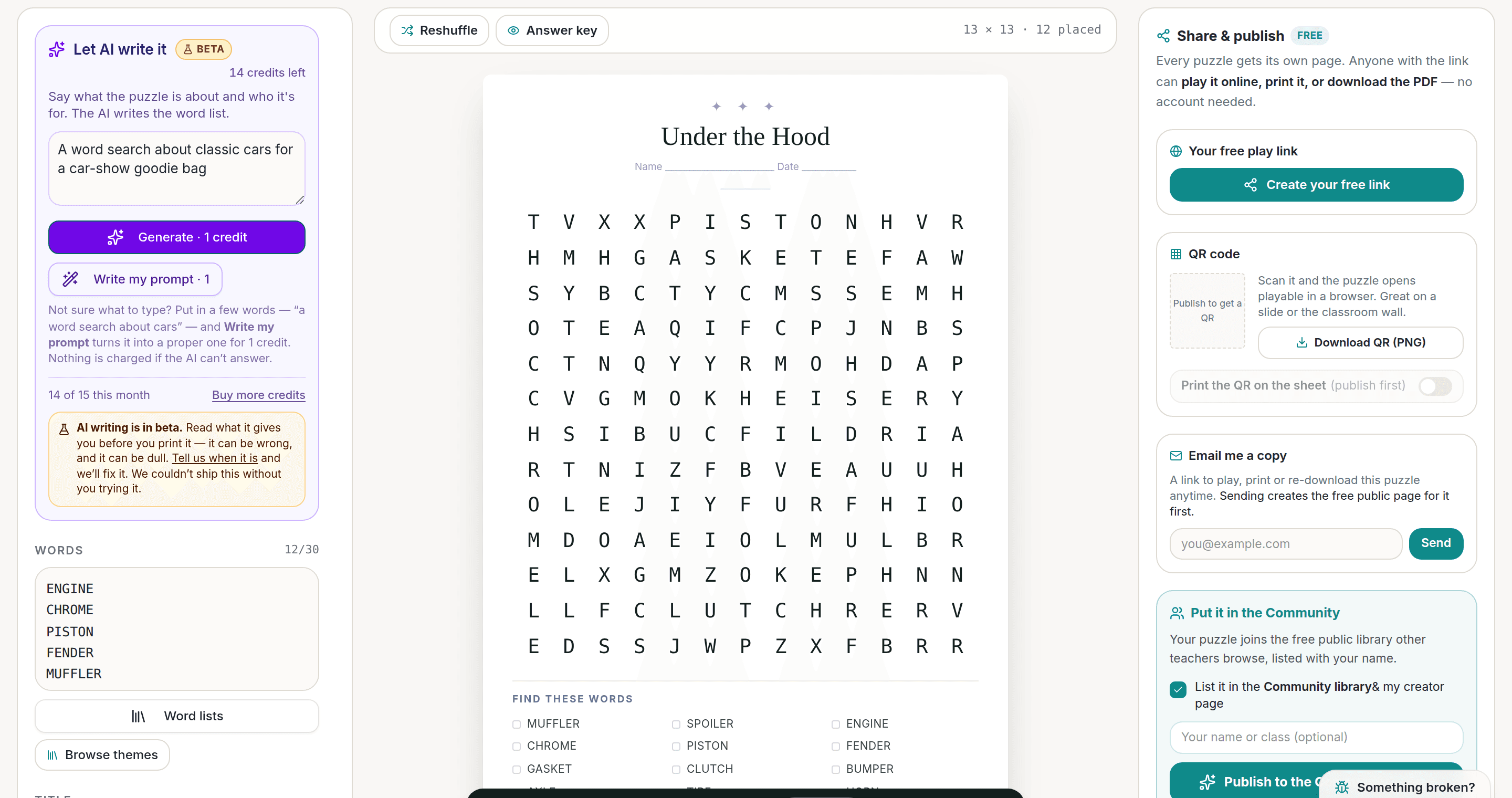
AI Puzzle Generator
Type a topic, get a themed word list and a finished puzzle. Premium also removes the footer credit and adds Word export.
Try the AI generator New
NewWorksheet Builder
Put a word search, a cryptogram and a scramble on one page, or build a whole themed packet. Prints with answer keys.
Build a worksheet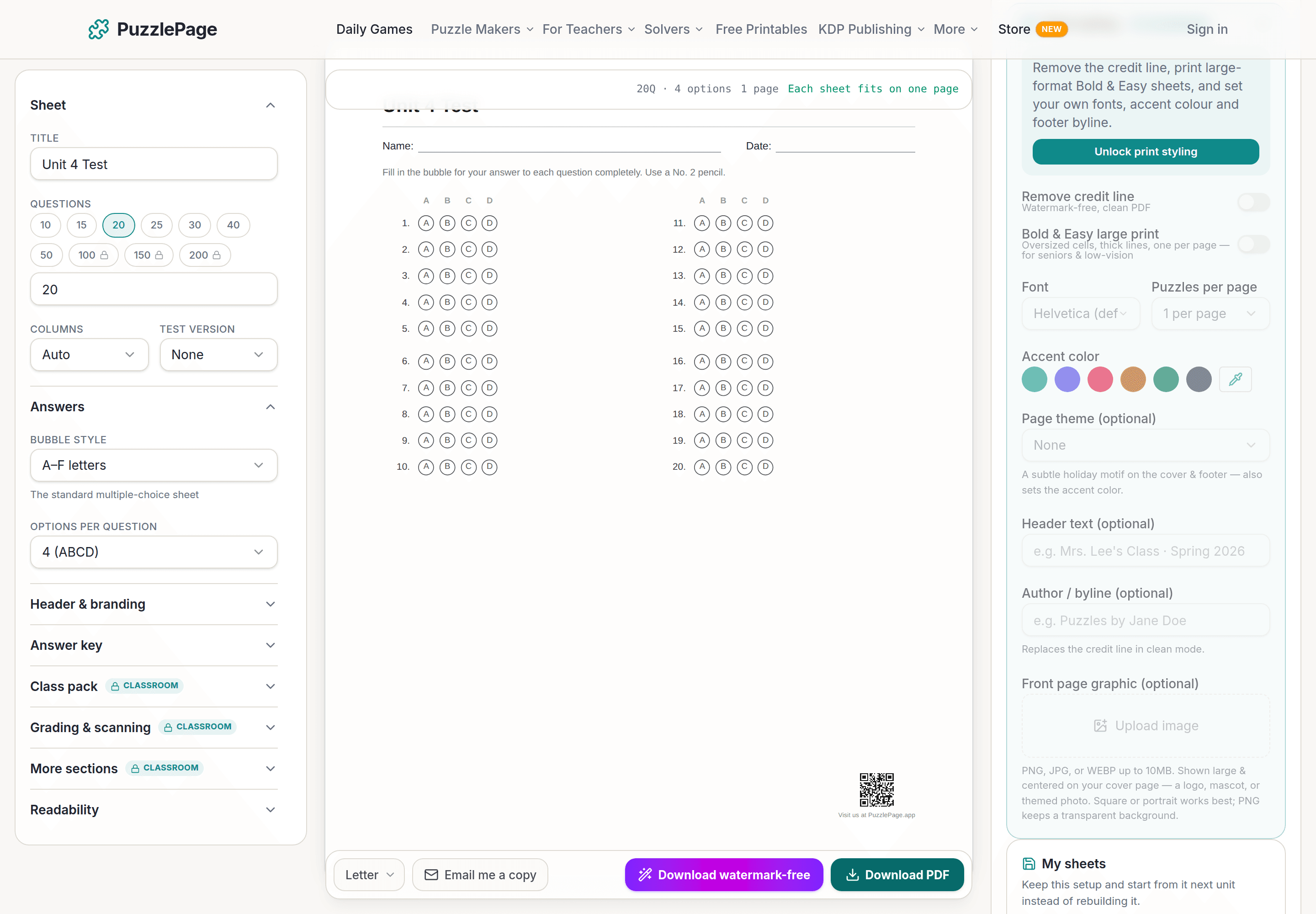
Bubble Sheet Studio
Answer sheets for any test length, with sections, versions, student ID grids and a matching answer key.
Make a bubble sheetPublisher plans unlock full print-ready interiors and covers, with a commercial licence to sell every book.
See plans →Free daily games
Need a two-minute break? Today's puzzles are live.
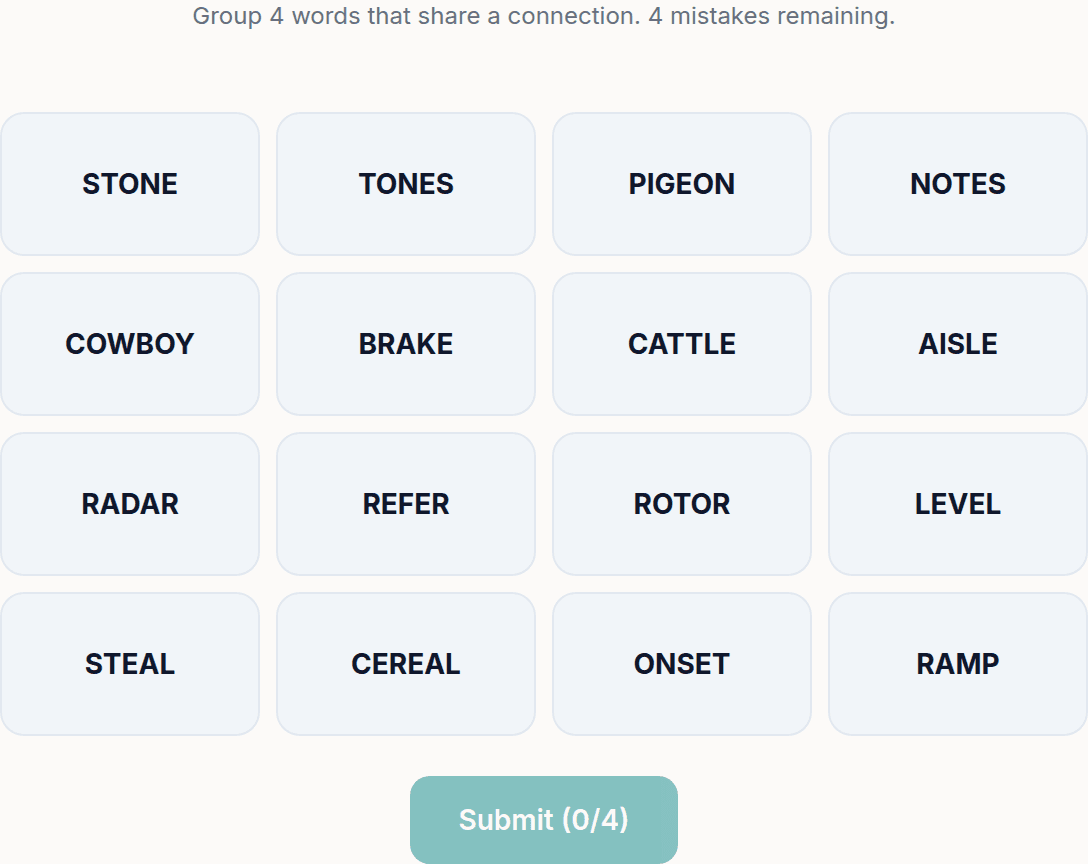
A new Sudoku and a new Connections board every day. No download, no account.


Keep reading
Get 10 free puzzles
Get the free 10-puzzle pack
Enter your email and we'll send you 10 print-ready puzzles with answer keys, plus a heads-up when we publish new generators and seasonal puzzle packs. Same quality as the ones on this page.
Roughly two emails a month. No spam, unsubscribe anytime.
Ready to build?
Build this book free in the PuzzlePage Book Studio
18 puzzle types, KDP margins and a full-wrap cover. Download the first 10 pages and the cover free.
Or start from a ready-made book template, or see books other publishers made here.
Enjoyed this? Share the puzzle on X
Like puzzles like this? Follow on Pinterest for a new one every day.