KDP Puzzle Book Niche Research: A 2026 Validation Guide
KDP puzzle book niche research, step by step: read BSR honestly, check reviews and pricing, run Amazon's real royalty math, and know when to walk away.

Free to try
Build this book free in the PuzzlePage Book Studio
18 puzzle types, KDP margins and a full-wrap cover. Download the first 10 pages and the cover free.
For publishers: Build a book free in the Studio·Ready-made book templates·KDP calculators·Books made here
Most people research a KDP niche by scrolling Amazon until a title feels promising. That is a vibe, not a screen, and vibes are how catalogs of dead books get built.
This post is the methodology companion to our roundup of best-selling KDP puzzle book niches. That piece tells you where the demand is sitting; this one is the repeatable process for proving it before you spend a weekend on an interior.
We publish 36 puzzle books on Amazon and build every interior with our own free generators, so the validation work here is the work we actually do. Every number below comes from Amazon's published rates or from reported industry figures, and the estimates are labelled as estimates throughout.
📌 Key Takeaways
- Screen every niche on three signals: best seller rank, review counts, and pricing on the top results.
- BSR is a ranking, not a sales report. Any BSR to sales conversion is an estimate that shifts by category and season.
- Amazon's published royalty math is the only hard number in the process, so run it before you fall in love with an idea.
- A low competitor count can mean thin supply or thin demand, and search volume is how you tell the two apart.
- Knowing when to walk away is a research skill. Most niches you test should fail your own screen.
 1:25
1:25What is the three-signal screen for KDP puzzle book niche research?
The three-signal screen checks best seller rank, review counts, and pricing across the top results for your target search. Together they answer whether money moves in the niche, how entrenched the incumbents are, and what a buyer expects to pay.
The commonly cited viability bar is that the top 10 books sit under BSR 100,000 and fewer than roughly 200 competing titles show up for the search. That is an industry rule of thumb rather than an Amazon rule, and it works because it forces you to hold two ideas at once.
The first idea is that something must be selling. The second is that not too many people can already be selling it.
Each signal covers a blind spot in the other two. Rank without review counts tells you a book sells but not how hard it will be to displace, and both without pricing tells you nothing about whether the sales are worth having.
| Signal | What it answers | Pass | Fail |
|---|---|---|---|
| Best seller rank | Is anyone actually selling here? | Top 10 results all under BSR 100,000 | Several of the top 10 above BSR 500,000 |
| Competing titles | How crowded is the shelf? | Fewer than about 200 relevant results | Thousands of close-matching titles |
| Review counts | Can a new book break in? | Top sellers in the double digits | Everything on page one in the thousands |
| Pricing | Is the revenue worth the work? | Top results sit in the $10 to $20 band | Page one is a race to $5.99 |
| Search demand | Are buyers looking for this? | A clear monthly volume for the exact phrase | No measurable volume for any variant |
Treat that scorecard as a gate, not a score. A niche that passes four rows and fails one is a niche that fails, because the failing row is usually the one that decides whether the book earns.
Pro Tip
Record the screen in a spreadsheet with one row per niche and one column per signal, and date the row. Ranks and prices move, so a screen you ran four months ago is a memory, not data.
Like this? We send 10 of these every month.
Free printable puzzles, answer keys included — same quality as the ones in this post.
One email. Unsubscribe anytime.
What does best seller rank actually tell you?
Best seller rank tells you how a book is selling relative to other books in its category right now, and nothing more. Amazon does not publish sales figures, so every BSR to sales number you have ever seen is an estimate built by people watching rank move.
The estimates most often quoted are that a BSR of roughly 50,000 corresponds to about 5 sales a day and a BSR of roughly 100,000 corresponds to about 1 sale a day. Those are estimates only, and they vary by category and by season.
The variance is not a footnote. A rank that means one sale a day in a sleepy category can mean something quite different in a category that spikes every December, and puzzle books do have a gifting season.
Here is what BSR does tell you. It tells you a book has sold recently, it tells you roughly where that book sits against its neighbours, and it updates often enough to reveal momentum when you check it more than once.
Here is what BSR does not tell you. It does not tell you units, it does not tell you revenue, it does not distinguish a paid sale from a heavily discounted one, and it does not tell you whether the seller is paying for ads to hold that position.
That last one matters more than most guides admit. A book parked at a strong rank on the back of an ad budget is not evidence of organic demand, and you cannot see the ad spend from the outside.
Pro Tip
Check the same five ASINs on three different days across two weeks before you trust the picture. A single BSR reading is a snapshot of one moment; three readings show you whether the niche has a pulse or just had a good Tuesday.
Stability is a signal in its own right. Reporting on sudoku suggests a well-reviewed book can hold a BSR under 5,000 for months without advertising, which is a different quality of demand than a title that spikes and sinks.
That stability comes from buyer behaviour, not from the book. Committed sudoku solvers reportedly work through about one book a week and keep buying for years, which is the kind of repeat purchase that holds a rank steady.
How do you turn a BSR estimate into a revenue sanity-check?
You convert an estimated sales rate into an estimated monthly royalty using Amazon's published royalty formula, which is the one genuinely hard number in this whole process. Everything upstream of it is an estimate, but the royalty math itself is arithmetic you can verify.
Amazon's paperback royalty on the Amazon.com marketplace is the royalty rate multiplied by the list price, minus the printing cost. The rate is 50% for list prices at or below $9.98 and 60% for list prices at or above $9.99, and Expanded Distribution pays 40% of list price minus printing.
Printing cost for black ink on white or cream paper has two bands. Books of 24 to 110 pages cost a flat $2.30 with no per-page charge, and books of 110 to 828 pages cost $1.00 plus $0.012 per page.
These are Amazon's published rates for the Amazon.com marketplace, documented on the Amazon KDP help pages. Rates can change and they differ by marketplace, so check them against the source before you build a plan on them.
Now run the sanity-check. Take the BSR 100,000 estimate of about 1 sale a day, which works out to roughly 29 sales in a month, and price a book the way puzzle books are actually priced.
| Book | Printing cost | Royalty per sale | Estimated at 29 sales/mo |
|---|---|---|---|
| 100 pages at $9.99 | $2.30 flat | (0.60 × 9.99) − 2.30 = $3.69 | about $107 |
| 100 pages at $9.98 | $2.30 flat | (0.50 × 9.98) − 2.30 = $2.69 | about $78 |
| 120 pages at $9.99 | $1.00 + $1.44 = $2.44 | (0.60 × 9.99) − 2.44 = $3.55 | about $103 |
| 120 pages at $14.99 | $1.00 + $1.44 = $2.44 | (0.60 × 14.99) − 2.44 = $6.55 | about $190 |
Read that bottom row carefully. About 29 sales a month at roughly one a day, on a 120-page book priced at $14.99, is the scale of a $200 a month title at typical puzzle-book pricing.
That is a sanity-check, not a projection. The sales rate is an estimate, the rank is a moving target, and nothing here promises that your book will hold BSR 100,000 or any other number.
What the math does give you is a ceiling to reason against. If the top result in your niche is sitting at BSR 400,000 and priced at $6.99, the arithmetic tells you the whole niche is small before you waste a month finding out the slow way.
Two structural facts fall out of Amazon's formula and both change how you value a niche. The first is the $9.99 cliff: pricing at $9.98 instead of $9.99 drops you from the 60% band to the 50% band and costs roughly a dollar per sale on the same book.
The second is the 110-page flat rate. A 30-page book and a 110-page book both cost $2.30 to print, so a thin puzzle book is giving away value that a fuller book keeps.
Cross the 110-page line and the formula changes. At 111 pages printing is $1.00 plus $1.332, or $2.33, and at 200 pages it is $1.00 plus $2.40, or $3.40.
Our own catalog reflects that math. When we build a Large Print Brain Games sudoku interior or a Decode & Inspire cryptogram volume, page count is a pricing decision made during validation, not an afterthought once the puzzles exist.
For the deeper treatment of the royalty bands and how they interact with market size, see our breakdown of market size, royalties and competition. This post treats the math strictly as a screening tool.
What do keyword counts among top sellers reveal about competition?
Keyword usage among top sellers is a direct read on how crowded a puzzle type is. Across a sample of top-selling listings, 438 used "word" in some form, 226 used "sudoku", 113 used "crossword", and just 18 used "cryptograms".
The naive reading is that cryptograms are wide open and word search is a bloodbath. That reading is half right, and the half that is wrong is the half that costs you a book.
A low count like 18 has two possible causes and they look identical from the outside. Either supply is thin because publishers have not noticed the niche yet, or supply is thin because there is not much demand to serve.
Search volume is what separates them. If a puzzle type shows real monthly search demand while very few top sellers use the term, you have found thin supply against live demand, which is the shape of an opportunity.
If the term shows almost no search volume and almost no listings, you have found a niche nobody wants. Publishing into that is not clever contrarianism, it is just a slower way to publish nothing.
| Listing count | Search demand | What it likely means | What to do |
|---|---|---|---|
| Low | High | Thin supply against live demand | Best case. Verify BSR, then move quickly |
| Low | Low | Nobody is buying it | Walk away, however empty the shelf looks |
| High | High | Proven demand, entrenched incumbents | Enter only through a narrower sub-niche |
| High | Low | Publishers chased a trend that faded | Avoid. The supply will not clear |
| Low | Unmeasurable | Too new or too obscure to read | Park it. Re-screen in three months |
Cryptograms are the interesting case because they land in the first row rather than the second. Cryptogram search demand is reported at 30,000 or more a month, alongside sudoku, word search and crossword, while only 18 top-selling listings use the term.
That gap between real demand and thin supply is why we built five titles in the Decode & Inspire cryptogram series rather than a sixth sudoku book. You can test the same thing yourself in an afternoon with the cryptogram template in the Book Studio or our free cryptogram maker.
The word category shows the opposite shape. With 438 listings using the term against strong demand, entering plain word search means competing with everyone, which is why our senior-focused large-print work targets a narrower slice instead.
The general rule holds across every puzzle type. High listing counts do not disqualify a niche, they disqualify the generic entry point into that niche.
Where does price tell you about a niche?
Price on page one tells you what buyers in that niche have been trained to expect, and it caps your revenue before you write a puzzle. The $10 to $20 band holds roughly 50.7% of puzzle book listings, reported across a sample of 659 ASINs, which makes it the largest single share.
That band is where you want to land, and the royalty math explains why. Once you are above the $9.99 threshold you are in the 60% band, and every extra dollar of list price flows through at sixty cents.
A niche whose top results all sit at $6.99 is telling you something. It is telling you buyers there anchor low, and that any book you publish will have to clear its printing cost from a much thinner slice.
Large print is the clearest example of price signalling a healthy niche. Bold and easy large-print formats are reported to be among the fastest-growing 2026 formats, with roughly 45% year-over-year growth, 2 to 3 times higher click-through, and a $1 to $3 price premium.
A premium that survives is a premium buyers accept. When a whole format holds an extra $1 to $3 without losing click-through, that is a market saying the format solves a real problem rather than a publisher wishing it did.
Read price dispersion too, not just the average. A page one where prices range from $6.99 to $16.99 has room in it, while a page one clustered tightly at one price point is a niche that has already settled.
Pro Tip
Write down the list price and the page count of the top five results together. Price alone is noise; price against page count tells you what royalty your competitors are actually earning under Amazon's formula.
How should you weigh a head term against a long-tail one?
A head term proves the category exists and a long-tail term proves you can win a specific search. You need both, and confusing one for the other is the most common mistake in low content niche validation.
The reported volumes make the contrast concrete. The phrase "puzzle books for adults" runs at roughly 96,873 searches a month, while "kakuro puzzle book" runs at roughly 36,635 a month, and sudoku, word search, crossword and cryptogram each clear 30,000 a month.
The head term is not where you compete. Roughly 96,873 monthly searches for "puzzle books for adults" means every publisher on Amazon is chasing the same phrase, and a new book has no realistic path to page one for it.
The long-tail term is where a new book can actually rank. About 36,635 searches a month for "kakuro puzzle book" is a fraction of the head term, but it is a fraction attached to a shopper who already knows what they want.
Intent is the reason the smaller number is often the better one. Someone typing a specific puzzle type into the search bar has moved past browsing and into buying, and that shopper converts at a rate a general browser does not.
The 2026 trend runs in exactly this direction. Hyper-specific adult activity books, including profession-targeted titles, are where the movement is, which is why our catalog includes puzzle books for teachers, nurses, stage managers, flight attendants and cruise fans rather than a generic adult puzzle book.
Use the head term as a floor check. If the broad category shows real volume but your specific long-tail phrase shows none, the niche you picked is a slice nobody is asking for, even though the category around it is healthy.
Use the long-tail term as the go decision. That is the phrase your title, subtitle and keywords will target, and it is the phrase whose page one you have to be able to survive.
What does a full validation workflow look like?
The workflow is five passes, run in order, and each one is allowed to kill the idea. Running them in order matters because the cheap checks come first and the expensive ones come last.
Start with the demand pass. Take your candidate long-tail phrase, confirm it has measurable monthly search volume, and confirm the head term above it is alive too.
Move to the supply pass. Search the phrase on Amazon, count the genuinely relevant results, and check whether the count sits under the roughly 200-title bar or blows past it.
Run the rank pass third. Pull the BSR on the top 10 results, check whether they all sit under 100,000, and remember that the sales estimates attached to those ranks are estimates that swing with category and season.
Then run the economics pass. Take the median list price on page one, pick a page count, and run Amazon's formula to see what a sale in this niche is actually worth to you.
Finish with the differentiation pass. Look at the top five covers and interiors and write one sentence describing what your book does that theirs does not, and if you cannot write that sentence, the niche has passed four gates and failed the one that matters.
Only then does production start. This is where our process gets cheap: we build a sample interior with our own free generators, so testing a niche costs an afternoon rather than a freelancer invoice.
You can do the same thing at zero cost. Build a draft in the PuzzlePage Book Studio and download the first 10 pages and the cover free, or generate a handful of pages with the free word search maker, print them at your intended trim size, and see whether the format you validated survives contact with paper.
Pro Tip
Run the differentiation pass before you run the economics pass if you are prone to falling in love with ideas. It is much easier to abandon a niche you cannot differentiate than one you have already imagined a royalty figure for.
For a worked set of niches that have already been through this screen, our list of low-competition KDP puzzle niches shows the output of the process. Our own published puzzle book catalog shows what it looks like once the screen says go.
When should you walk away from a niche?
You should walk away far more often than you publish, and the publishers who last are the ones comfortable with that ratio. A validation process that approves every idea you feed it is not a process, it is permission.
Walk away when the top 10 results are not all under BSR 100,000. If the books already on page one are barely selling by the standard estimates, your book joining them does not change the demand.
Walk away when page one is thousands of titles deep and every one of them has thousands of reviews. Review counts are the moat, and a new book with zero reviews does not cross a moat that wide by being slightly better.
Walk away when the niche is empty and the searches are empty too. The low-listings, low-demand quadrant is the trap that catches beginners, because an empty shelf feels like an opportunity right up until it stays empty.
Walk away when the price band is wrong. If page one anchors below the $9.99 threshold, you are fighting for the 50% royalty band on a book that costs the same to print as a $14.99 one.
Walk away when you cannot describe your edge in one sentence. Not a better cover, not more puzzles, but a specific reason a specific reader picks yours.
Walk away when the top book is clearly running ads and you are not going to. You are not competing with the book, you are competing with the budget behind it, and that is a different fight than the one you screened for.
There is one more, and it is the quietest. Walk away when you cannot imagine volume ten, because a niche that supports exactly one book is a niche that will never pay back the time you spent validating it.
None of this comes with a promise attached. Publishing outcomes vary widely, the sales estimates in this post are estimates rather than forecasts, and the honest version of niche research is a process that improves your odds rather than one that removes the risk.
📚 Build Your Book in the PuzzlePage Book Studio
If you are serious about a KDP catalog, the PuzzlePage Book Studio turns your puzzles into a complete, print-ready interior with answer keys, page numbers and a matching full-wrap cover, all in one place. Download the first 10 pages plus the cover free, then pick a KDP plan when you are ready to publish.
Start a Free Book →Free to try
Try the Book Studio free: first 10 pages and cover, no card
Build the whole book in your browser, watch the real printed pages as you go, and download the first 10 pages plus the cover to check them before you decide anything.
- ✓18 puzzle types with difficulty ramps and answer keys
- ✓KDP trim sizes and margins checked as you build
- ✓A matching full-wrap cover, spine included
- ✓Download the first 10 pages and the cover free
Build first, decide later. You only pay when you want the full interior.
Frequently Asked Questions
How do you validate a KDP niche?
Check three signals on the top results: best seller rank, review counts, and pricing. A commonly cited bar is that the top 10 books sit under BSR 100,000 with fewer than about 200 competing titles, then confirm the phrase has real monthly search volume.
What BSR is good for a puzzle book?
The common screen looks for the top 10 results under BSR 100,000. Estimates suggest BSR 50,000 is about 5 sales a day and BSR 100,000 is about 1 sale a day, but Amazon does not publish sales, so those are estimates that vary by category and season.
How much does a KDP puzzle book earn per sale?
Amazon pays 60% of list price minus printing at $9.99 and above, and 50% at $9.98 and below. A 120-page black-ink book at $14.99 costs $2.44 to print, so the royalty is about $6.55 per sale on the Amazon.com marketplace. Rates can change and vary by marketplace.
Is a niche with few competing books always a good sign?
No. Few listings can mean thin supply or thin demand, and the two look identical on Amazon. Compare listing counts against monthly search volume: low listings with high search demand is an opportunity, while low listings with low demand is a niche nobody wants.
Validated a niche? The next step is the interior. Here is what the generator produces free, and what the Publisher plan adds.
More you can make here
One puzzle is the start. Here is the rest of the kit.
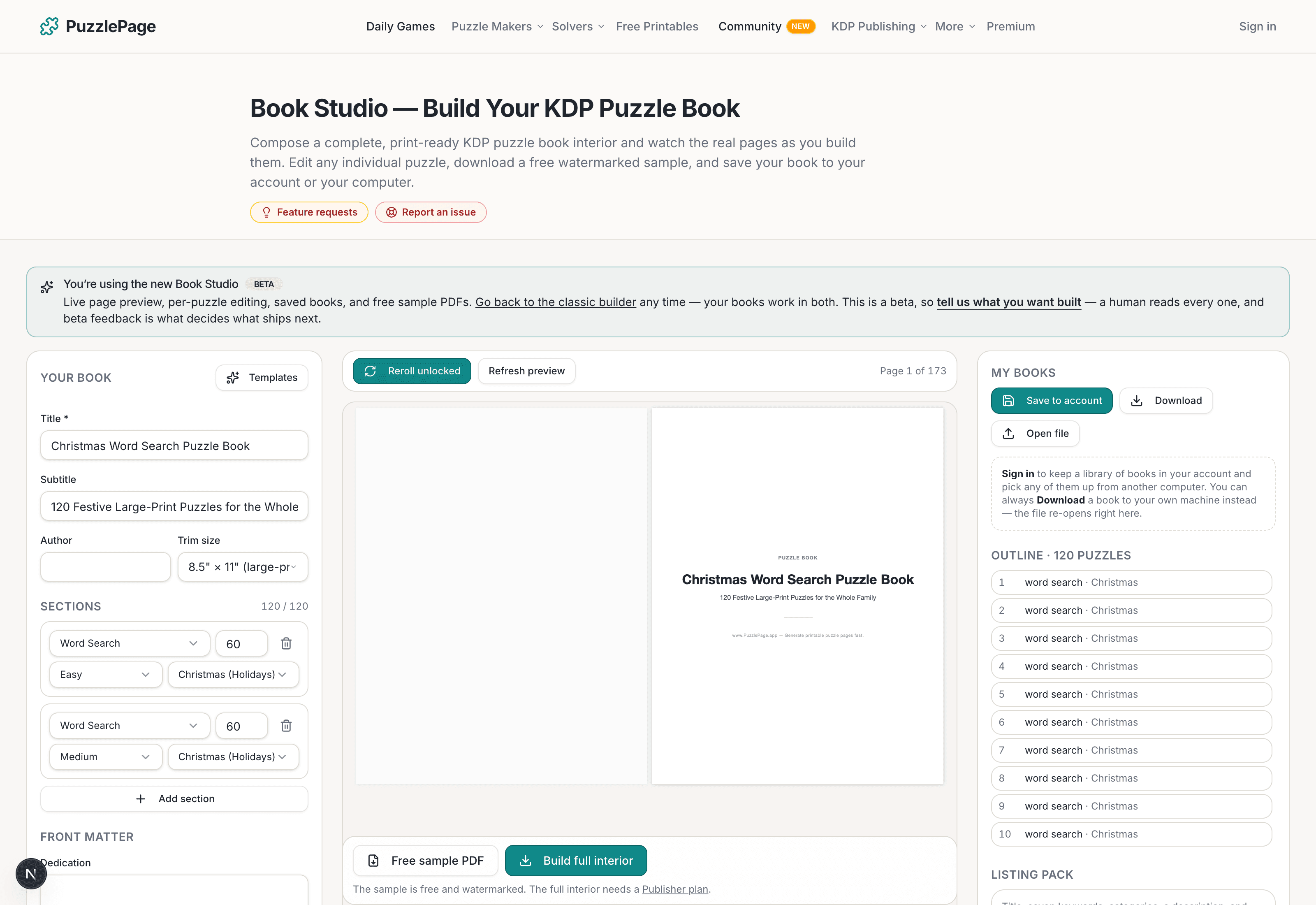
KDP Book Studio
Lay out a full puzzle book for Amazon KDP: templates, trim sizes, page checks and a cover designer.
Start a puzzle book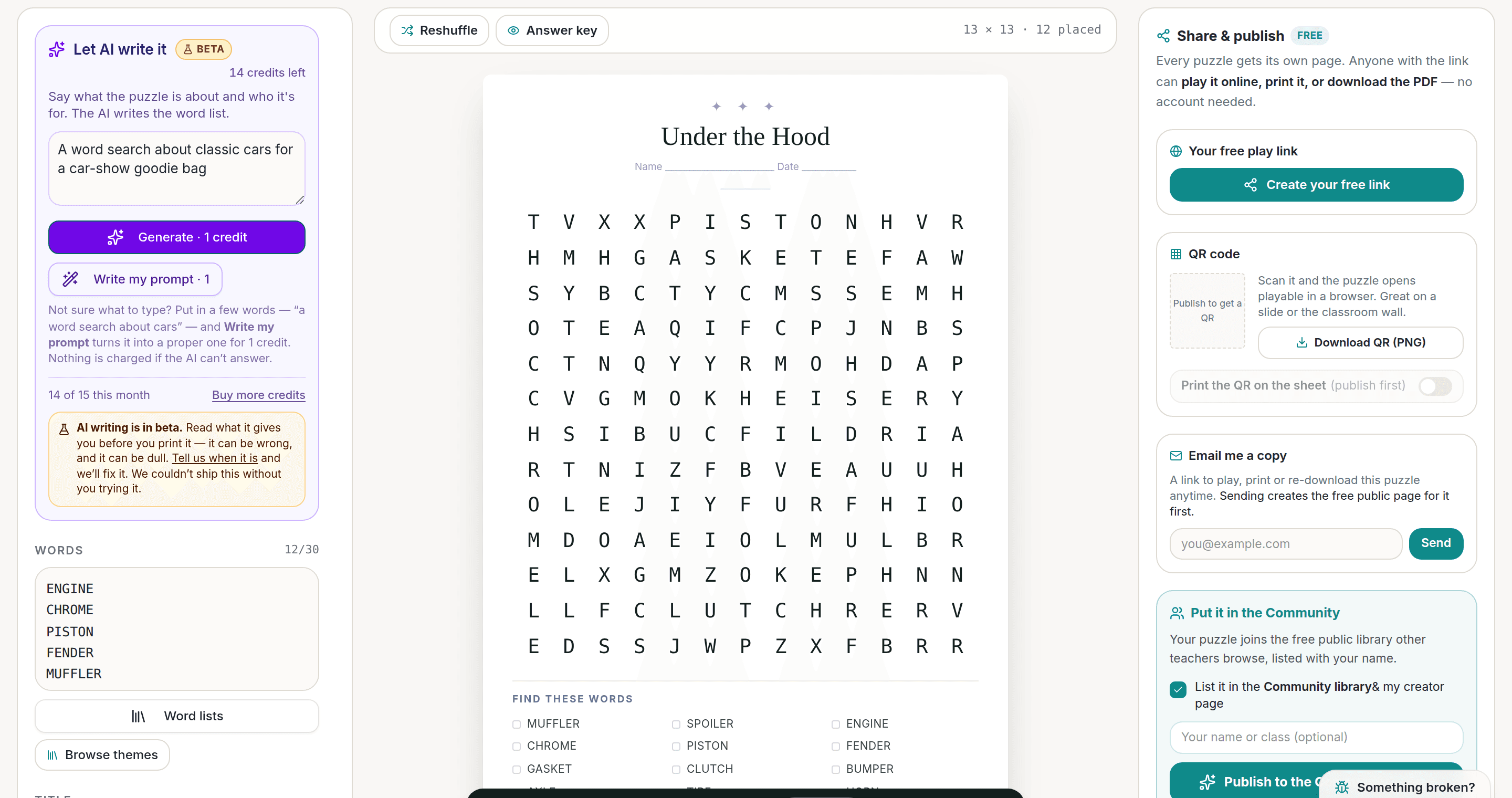
AI Puzzle Generator
Type a topic, get a themed word list and a finished puzzle. Premium also removes the footer credit and adds Word export.
Try the AI generator New
NewWorksheet Builder
Put a word search, a cryptogram and a scramble on one page, or build a whole themed packet. Prints with answer keys.
Build a worksheet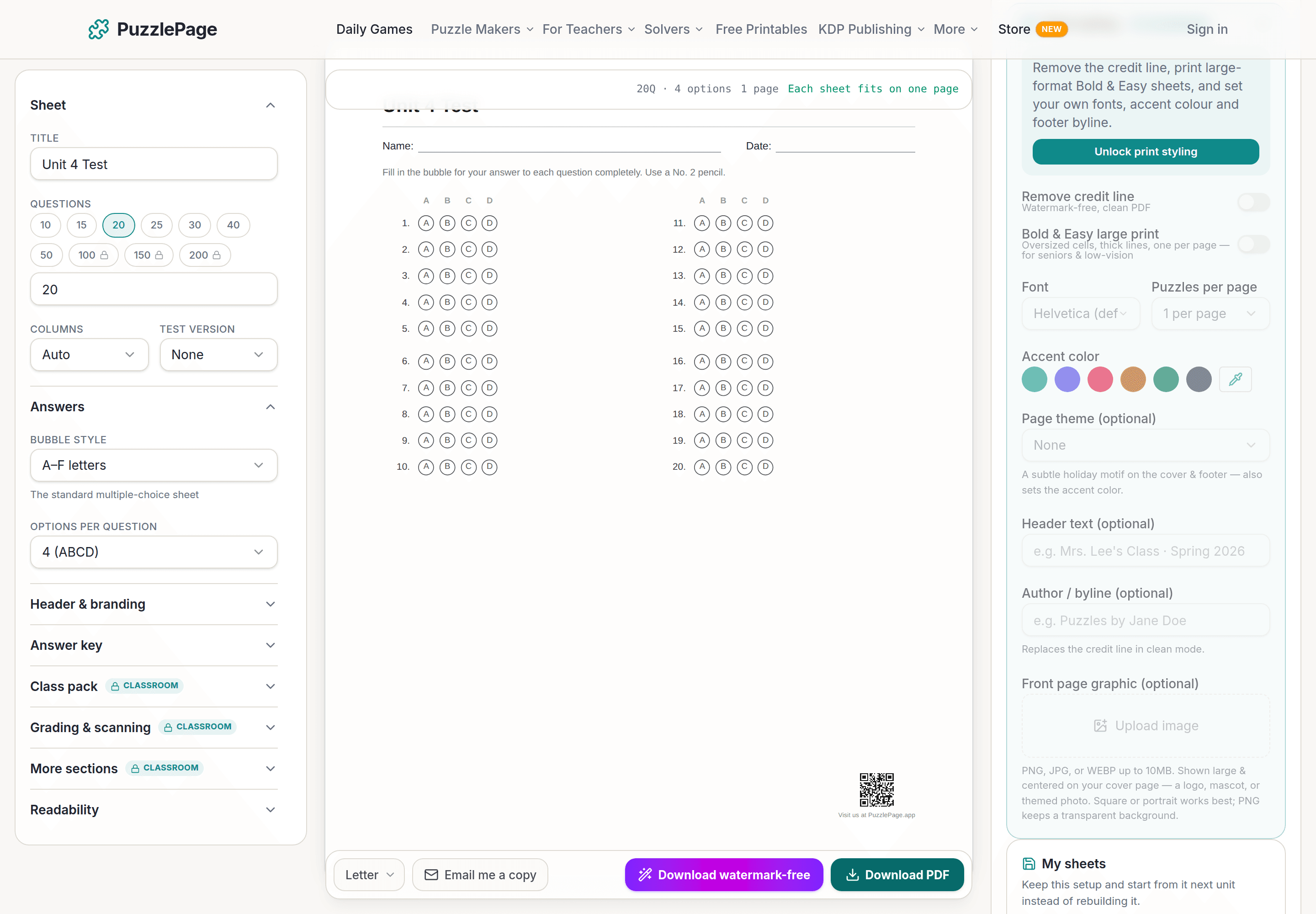
Bubble Sheet Studio
Answer sheets for any test length, with sections, versions, student ID grids and a matching answer key.
Make a bubble sheetPublisher plans unlock full print-ready interiors and covers, with a commercial licence to sell every book.
See plans →Free daily games
Need a two-minute break? Today's puzzles are live.
A new Sudoku and a new Connections board every day. No download, no account.


Keep reading
Get 10 free puzzles
Get the free 10-puzzle pack
Enter your email and we'll send you 10 print-ready puzzles with answer keys, plus a heads-up when we publish new generators and seasonal puzzle packs. Same quality as the ones on this page.
Roughly two emails a month. No spam, unsubscribe anytime.
Ready to build?
Build this book free in the PuzzlePage Book Studio
18 puzzle types, KDP margins and a full-wrap cover. Download the first 10 pages and the cover free.
Or start from a ready-made book template, or see books other publishers made here.
Enjoyed this? Share the puzzle on X
Like puzzles like this? Follow on Pinterest for a new one every day.