KDP Puzzle Book Royalty Calculator + 2024-2026 Market Data
Try the live KDP royalty calculator: enter your list price and page count to see what each puzzle book sale pays, then check 2024-2026 market size and competition data.

From puzzle book to sales
Build once, sell on Amazon KDP
Build it in Book Studio
Your puzzle book
Download the files
Upload to Amazon KDP
Earn on every sale
Free to try
Build this book free in the PuzzlePage Book Studio
18 puzzle types, KDP margins and a full-wrap cover. Download the first 10 pages and the cover free.
For publishers: Build a book free in the Studio·Ready-made book templates·KDP calculators·Books made here
Most posts about publishing puzzle books on Amazon give you a vibe instead of a number. This one gives you the arithmetic, and shows the working so you can check every cell yourself.
Two kinds of numbers appear below, and the difference matters. Amazon's royalty and printing rates are published facts you can verify, while market size and sales estimates are industry reporting that should be treated as directional.
📌 Key Takeaways
- Puzzle books reportedly clear $450M a year on Amazon, growing about 13% year over year on screen fatigue and wellness demand.
- The royalty formula is (royalty rate × list price) − printing cost, with a 50% rate at or below $9.98 and 60% at or above $9.99.
- That one-cent gap is worth about $1.00 per sale, which makes $9.98 the single worst price on the board.
- Printing is flat at $2.30 from 24 to 110 pages, so a 30-page book and a 110-page book cost the same to print.
- Competition is lopsided by type: 438 top listings used "word" against just 18 using "cryptograms".
 1:33
1:33Live calculator
Work out your royalty per sale
- Royalty per sale
- $3.69
- Printing cost
- $2.30
- Royalty rate
- 60%
- Break-even list price
- $4.60
- Earned per 100 copies
- $369.00
60% of list minus printing
Black ink, regular trim, 110 pages
60% from $9.99, 50% at $9.98 and below
The lowest price that earns anything. KDP will not let you list below it.
Where each sale goes
KDP printing costs and royalty tiers from KDP's printing cost page, checked 24 September 2026. Excludes VAT and expanded distribution (40%). Amazon sets the final number, so confirm in KDP's own calculator before you publish.
Open in Book Studio with these specsHow big is the KDP puzzle book market in 2026?
Puzzle books reportedly exceed $450M annually on Amazon and are growing at roughly 13% year over year. Industry reporting attributes that growth to screen fatigue and the broader wellness trend.
Treat that figure the way you would any third-party market estimate. Amazon does not publish category revenue, so the number is a reported estimate rather than an audited disclosure.
The shape of the market matters more than the headline anyway. Puzzle, coloring, journal and tracker, workbook, and planner formats together make up roughly 56% of what gets built on low-content publishing platforms according to May to July 2026 data.
Demand on the search side is genuinely large. The query "puzzle books for adults" reportedly draws about 96,873 US searches a month, and sudoku, word search, crossword, and cryptogram each pull 30,000-plus monthly searches on their own.
One outlier is worth flagging. "Kakuro puzzle book" reportedly sees about 36,635 searches a month, which is a striking volume for a puzzle type most publishers never touch.
Pro Tip
Search volume is demand, not opportunity. A 96,873-a-month query with thousands of established listings is worse for a new publisher than a 30,000-a-month query with a thin, dated catalog, so always read volume and competition together.
Like this? We send 10 of these every month.
Free printable puzzles, answer keys included — same quality as the ones in this post.
One email. Unsubscribe anytime.
Why is the puzzle and activity book market growing?
The growth is being driven by people deliberately buying their way off a screen. Circana reported growth across screen-free categories in Q1 2026, including guided journals, needlework, puzzle books, coloring books, and logic and brain teasers.
That is a meaningful signal because it spans unrelated product types. When journals, needlework, and puzzle books all rise together, the common factor is a behaviour, not a fad in any one category.
Screen fatigue and wellness are the two reasons cited for the roughly 13% annual growth in Amazon puzzle book sales. A paper puzzle book is one of the few products that is valuable precisely because it does nothing else.
Format trends point the same way. "Bold and Easy" large-print is reportedly among the fastest-growing 2026 formats at about +45% year over year, with 2 to 3 times higher click-through and a $1 to $3 price premium.
Read that premium alongside the printing table further down and it gets interesting. Larger type costs you puzzle density per page, but the pages themselves are free up to 110, so the premium is close to pure margin.
Buyer behaviour reinforces it. Committed sudoku solvers reportedly work through about one book per week and keep buying for years, and a well-reviewed sudoku book can reportedly hold a BSR under 5,000 for months without any advertising.
How do KDP paperback royalties actually work?
Amazon's paperback royalty is one line of arithmetic: (royalty rate × list price) − printing cost = royalty. Your royalty rate is set by your list price, and your printing cost is set by your page count.
On the Amazon.com marketplace, Amazon's published rates are 50% for list prices at or below $9.98 and 60% for list prices at or above $9.99. Expanded Distribution pays 40% of list price minus printing cost.
Amazon also enforces a floor and a ceiling. Your minimum list price is printing cost divided by your royalty rate, calculated per title, and the maximum list price is $250.
These figures come from Amazon KDP's own help pages for the Amazon.com marketplace with black ink. You can confirm them at Amazon KDP, and you should, because rates change over time and differ by marketplace.
Here is the formula applied across the common price points for a 100-page black-and-white book, which prints for a flat $2.30. Every row is (rate × list) − 2.30.
| List price | Royalty rate | Rate × list | Printing | Royalty per sale |
|---|---|---|---|---|
| $6.99 | 50% | $3.50 | $2.30 | $1.20 |
| $7.99 | 50% | $4.00 | $2.30 | $1.70 |
| $8.99 | 50% | $4.50 | $2.30 | $2.20 |
| $9.98 | 50% | $4.99 | $2.30 | $2.69 |
| $9.99 | 60% | $5.99 | $2.30 | $3.69 |
| $10.99 | 60% | $6.59 | $2.30 | $4.29 |
| $11.99 | 60% | $7.19 | $2.30 | $4.89 |
| $12.99 | 60% | $7.79 | $2.30 | $5.49 |
| $14.99 | 60% | $8.99 | $2.30 | $6.69 |
| $16.99 | 60% | $10.19 | $2.30 | $7.89 |
| $19.99 | 60% | $11.99 | $2.30 | $9.69 |
Notice the shape of that table. Royalty climbs in a smooth line everywhere except one place, where it jumps a full dollar for a one-cent price increase.
Run your own numbers in the KDP royalty calculator. If you want the pricing decision on its own, we go deeper in how to price a KDP puzzle book. The rest of this section explains why that one row behaves so strangely.
What is the $9.99 cliff and why does one cent cost a dollar?
The $9.99 cliff is the point where Amazon's royalty rate jumps from 50% to 60%. Because the rate applies to the whole list price rather than the amount above the threshold, adding one cent to your price adds roughly a dollar to your royalty.
Work it on a 120-page book so the printing cost is not flat. Printing is $1.00 + (120 × $0.012) = $1.00 + $1.44 = $2.44.
At $9.98 you are in the 50% band: (0.50 × $9.98) − $2.44 = $4.99 − $2.44 = $2.55. At $9.99 you are in the 60% band: (0.60 × $9.99) − $2.44 = $5.994 − $2.44 = $3.55.
One cent of list price is worth $1.00 of royalty. You sell the same book to the same reader and keep 39% more per copy.
The same gap appears on a 100-page book at the flat $2.30 printing cost. $9.98 returns $2.69 and $9.99 returns $3.69, again a clean dollar for a penny.
This makes $9.98 the worst price on the entire board. Every price below it is at least honestly cheap, and $9.99 is one cent more expensive while paying a dollar better.
Pro Tip
If you ever run a price promotion, do not drop from $9.99 to $9.49. You cross into the 50% band and lose more royalty to the rate change than you lose to the discount itself, so promote from a higher anchor instead and stay above $9.99.
Why does a 30-page book cost the same to print as a 110-page book?
Because Amazon charges a flat printing cost with no per-page charge in that range. For black ink on white or cream paper, 24 to 110 pages costs a fixed $2.30 with no per-page component at all.
Above that, the formula changes. From 110 to 828 pages, printing is $1.00 fixed plus $0.012 per page.
The consequence is that pages 25 through 110 are free. A 30-page book and a 110-page book both cost you $2.30 to print, and both can be listed at the same price.
| Pages | Which formula | Printing cost | Royalty at $9.99 (60%) |
|---|---|---|---|
| 24 | Flat rate | $2.30 | $3.69 |
| 30 | Flat rate | $2.30 | $3.69 |
| 60 | Flat rate | $2.30 | $3.69 |
| 110 | Flat rate (last page it applies) | $2.30 | $3.69 |
| 111 | $1.00 + $0.012/page | $2.33 | $3.66 |
| 120 | $1.00 + $0.012/page | $2.44 | $3.55 |
| 150 | $1.00 + $0.012/page | $2.80 | $3.19 |
| 200 | $1.00 + $0.012/page | $3.40 | $2.59 |
| 300 | $1.00 + $0.012/page | $4.60 | $1.39 |
Two things jump out of that table. A thin 30-page puzzle book gives away value for nothing, and a fat 300-page book at $9.99 earns a quarter of what a 110-page book earns at the same price.
There is a small wrinkle at exactly 110 pages, where both published ranges technically meet. The flat rate is $2.30 while the per-page formula would give $1.00 + $1.32 = $2.32, which is a two-cent difference and not worth losing sleep over.
The practical read is that 110 pages is a natural design target for a $9.99 puzzle book. You are handing the reader the most content the flat rate will carry before printing starts charging you per page.
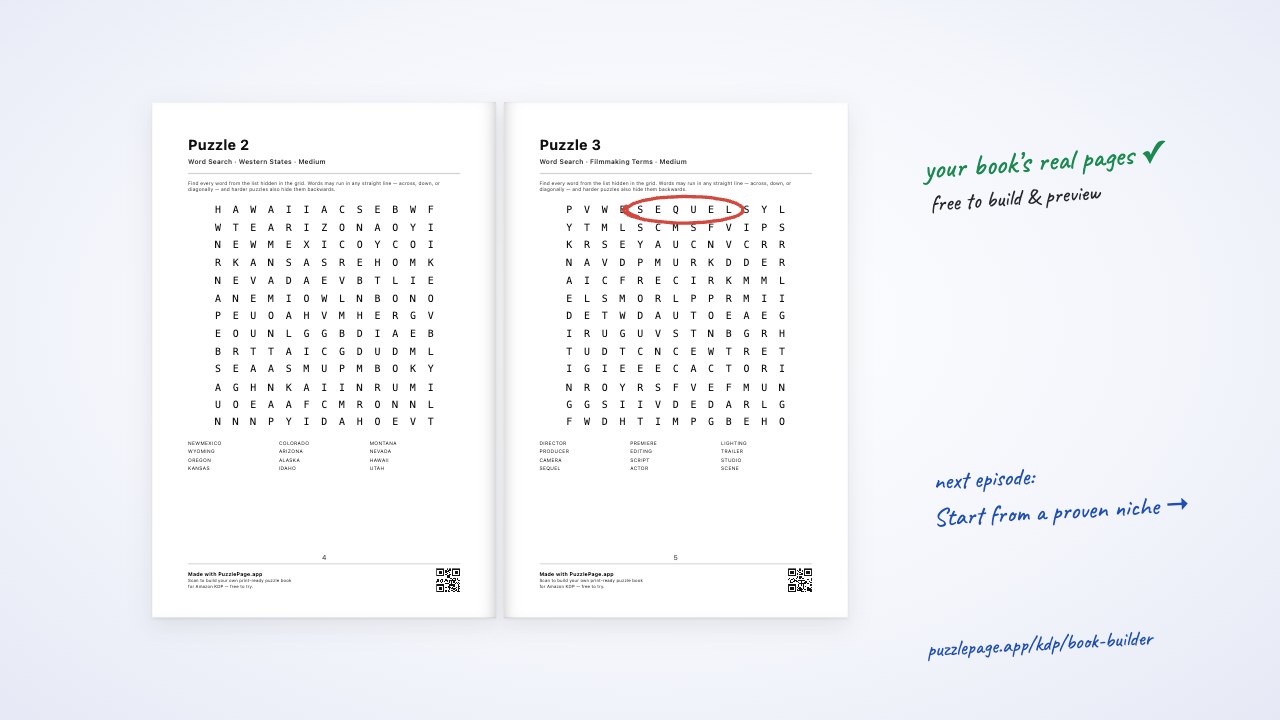
This shaped how we build our own catalog. We publish 36 puzzle books on Amazon, and the interiors all come out of our own free generators, so adding puzzles to fill out a book costs time rather than money. The same tools are open to you on the PuzzlePage for KDP hub.
That is the part people underestimate. When a word search maker or sudoku maker produces the pages for free, the flat-rate ceiling stops being trivia and becomes the actual design brief.
Build a 110-page book (flat $2.30 printing)
Every page up to 110 costs the same to print, so fill them. The PuzzlePage Book Studio counts pages as you add puzzles, sets KDP margins for your trim size and builds the full-wrap cover to match. Download the first 10 pages and the cover free.
Build a 110-page book free →If you want to see the finished books, our published catalog is the honest version of the output. The Large Print Brain Games sudoku series in particular exists because large type plus free pages is a combination the printing table rewards.
Pro Tip
Large-print editions and the 110-page ceiling solve each other. Bigger type means fewer puzzles per page, but since pages up to 110 are free, you can spread the same puzzle count across more pages and sell the comfort rather than eat the cost.
What does Expanded Distribution do to your royalty?
Expanded Distribution pays 40% of list price minus the same printing cost, against 60% through Amazon itself at $9.99 and up. It widens where your book can be sold and narrows what you keep.
The gap is large enough to plan around. On a 100-page book printing at $2.30, here is what the two channels pay at the same list prices.
| List price | Amazon.com (60%) | Expanded Distribution (40%) | Difference |
|---|---|---|---|
| $9.99 | $3.69 | $1.70 | $2.00 |
| $11.99 | $4.89 | $2.50 | $2.40 |
| $14.99 | $6.69 | $3.70 | $3.00 |
| $19.99 | $9.69 | $5.70 | $4.00 |
The 40% rate also raises your price floor. Minimum list price is printing cost divided by royalty rate, so a $2.30 printing cost needs at least $2.30 ÷ 0.40 = $5.75 through Expanded Distribution against $2.30 ÷ 0.50 = $4.60 in the 50% band.
Page count moves that floor with it. A 200-page book printing at $3.40 needs $3.40 ÷ 0.40 = $8.50 minimum through Expanded Distribution, which is most of the way to $9.99 before you have earned anything.
None of this makes Expanded Distribution wrong. It makes it a channel you enable knowingly, priced with the 40% rate in mind rather than discovered later in a royalty report.
How competitive is the KDP puzzle book market?
Competition is real but wildly uneven across puzzle types. Among top sellers, 438 listings used "word" for word search and word scramble, 226 used "sudoku", 113 used "crossword", and only 18 used "cryptograms".
That last number is the most useful line in this entire post. Cryptograms reportedly draw 30,000-plus monthly searches while just 18 top listings target the keyword, which is a demand-to-supply ratio that word search cannot come close to.
| Keyword in top listings | Listings using it | Share vs "word" | What it means for you |
|---|---|---|---|
| word (search, scramble) | 438 | 100% | Densest field, hardest to enter generically |
| sudoku | 226 | About half | Crowded, but buyers repeat-purchase heavily |
| crossword | 113 | About a quarter | Moderate, and content is costly to produce |
| cryptograms | 18 | About 4% | Thin supply against 30,000-plus monthly searches |
Be careful about the conclusion you draw from 18. Thin supply can mean an overlooked niche, and it can also mean a niche that sells less well than its search volume suggests, which is exactly why you screen before you commit.
We publish a Decode and Inspire cryptogram series of five titles, including large-print and extra-large-print editions of the same book. Building both editions of one title is cheap when the puzzles are generated (the Book Studio has a large-print cryptogram template for exactly this), and it doubles your shelf presence in a category with 18 competitors instead of 438.
Pricing tells its own story about the field. The $10 to $20 band reportedly holds about 50.7% of puzzle book listings at 659 ASINs, making it the largest single share by a wide margin.
That band sits directly above the $9.99 cliff, which is not a coincidence. Roughly half the market has already worked out that the 60% rate starts at $9.99 and priced accordingly.
It also tells you what a $7.99 listing signals. You are not undercutting the market so much as announcing that you are outside the band where half of it trades, while collecting $1.70 a copy instead of $3.69.
How do you screen a niche for viability?
A commonly cited screen is that a niche is workable when the top 10 books sit under BSR 100,000 and there are fewer than roughly 200 competing titles. The first test proves people buy, and the second proves you can still be seen.
Both halves matter, and each fails on its own. A niche where the top 10 sit under BSR 100,000 with 2,000 competitors is a market you cannot break into, and one with 12 competitors all above BSR 800,000 is a market nobody is shopping in.
Set the screen against the keyword counts above and the picture sharpens. Cryptograms at 18 listings clears the competition half of the test comfortably, which leaves the BSR half as the question actually worth researching.
Large-print sudoku for seniors is reportedly another strong sub-niche on the same logic: motivated buyers, lower competition than standard sudoku, and strong gifting dynamics. Our Large Print Brain Games sudoku series of five titles, split into easy and medium and hard editions for seniors in extra-large print, is built on exactly that reasoning.
The broader 2026 trend is hyper-specific adult activity books, including profession-targeted titles. Our catalog leans hard into this with books for teachers, nurses and healthcare workers, IT and engineers, stage managers, sound operators, flight attendants, parents, dads, college freshmen, cruise fans, and cat and dog owners.
Each of those is a smaller pond by design. A puzzle book for stage managers will never see word search volume, and it also is not competing with 438 listings for attention.
We work through the screening process in more detail in low-competition KDP puzzle niches, and the niche shortlist itself lives in best-selling KDP puzzle book niches for 2026. This post is the numbers underneath both of them. When a niche passes the screen, the KDP hub has every tool you need to build and price the book.
What can you honestly expect to earn?
Nobody can tell you that, and you should be skeptical of anyone who tries. Amazon does not publish sales figures, so every sales number you have read in a KDP post is an estimate inferred from BSR.
The common rules of thumb are that BSR 50,000 is roughly 5 sales a day and BSR 100,000 is roughly 1 sale a day. Those are estimates only, they vary by category and by season, and they should be used to compare two niches rather than to forecast your income.
What you can calculate exactly is the per-sale side. A 110-page book at $9.99 pays $3.69 per copy through Amazon.com, and that figure is arithmetic rather than a projection.
What you cannot calculate is how many copies sell. That depends on your cover, your niche, your keywords, your reviews, and timing, and it is where essentially all of the variance lives.
So the honest framing is this. The royalty math tells you what a sale is worth, market data tells you the category is growing at a reported 13% a year, and neither one tells you that your book will sell.
Publishing outcomes vary enormously, and most books sell modestly. The reason the flat-rate ceiling and the $9.99 cliff are worth this much attention is that they are the two variables you fully control, on a per-sale basis, before you have any idea what your sales volume will be.
📚 Build Your Book in the PuzzlePage Book Studio
If you are serious about a KDP catalog, the PuzzlePage Book Studio turns your puzzles into a complete, print-ready interior with answer keys, page numbers and a matching full-wrap cover, all in one place. Download the first 10 pages plus the cover free, then pick a KDP plan when you are ready to publish.
Start a Free Book →Free to try
Try the Book Studio free: first 10 pages and cover, no card
Build the whole book in your browser, watch the real printed pages as you go, and download the first 10 pages plus the cover to check them before you decide anything.
- ✓18 puzzle types with difficulty ramps and answer keys
- ✓KDP trim sizes and margins checked as you build
- ✓A matching full-wrap cover, spine included
- ✓Download the first 10 pages and the cover free
Build first, decide later. You only pay when you want the full interior.
Frequently Asked Questions
How big is the KDP puzzle book market?
Puzzle books reportedly exceed $450M annually on Amazon and grow around 13% year over year, which industry reporting attributes to screen fatigue and wellness trends. Amazon does not publish category revenue, so treat that as a reported estimate rather than an official figure.
How much royalty does a KDP puzzle book pay?
Royalty is (royalty rate × list price) − printing cost. On Amazon.com a 100-page black-and-white book prints for $2.30, so at $9.99 you earn (0.60 × 9.99) − 2.30 = $3.69 per sale. Rates can change and differ by marketplace.
Why should I price at $9.99 instead of $9.98?
Amazon pays 50% at or below $9.98 and 60% at or above $9.99, and the rate applies to the whole list price. On a 120-page book that penny moves your royalty from $2.55 to $3.55, so $9.98 costs you about $1.00 per sale.
How many pages should a KDP puzzle book have?
Printing is a flat $2.30 from 24 to 110 pages with no per-page charge, so a 30-page book costs the same to print as a 110-page book. Filling up to about 110 pages adds value at no printing cost, while going past 110 starts charging $0.012 per page.
Once the numbers make sense, the next question is which tool builds the interior. See what a free puzzle generator for KDP actually covers, and where the free tier stops.
More you can make here
One puzzle is the start. Here is the rest of the kit.
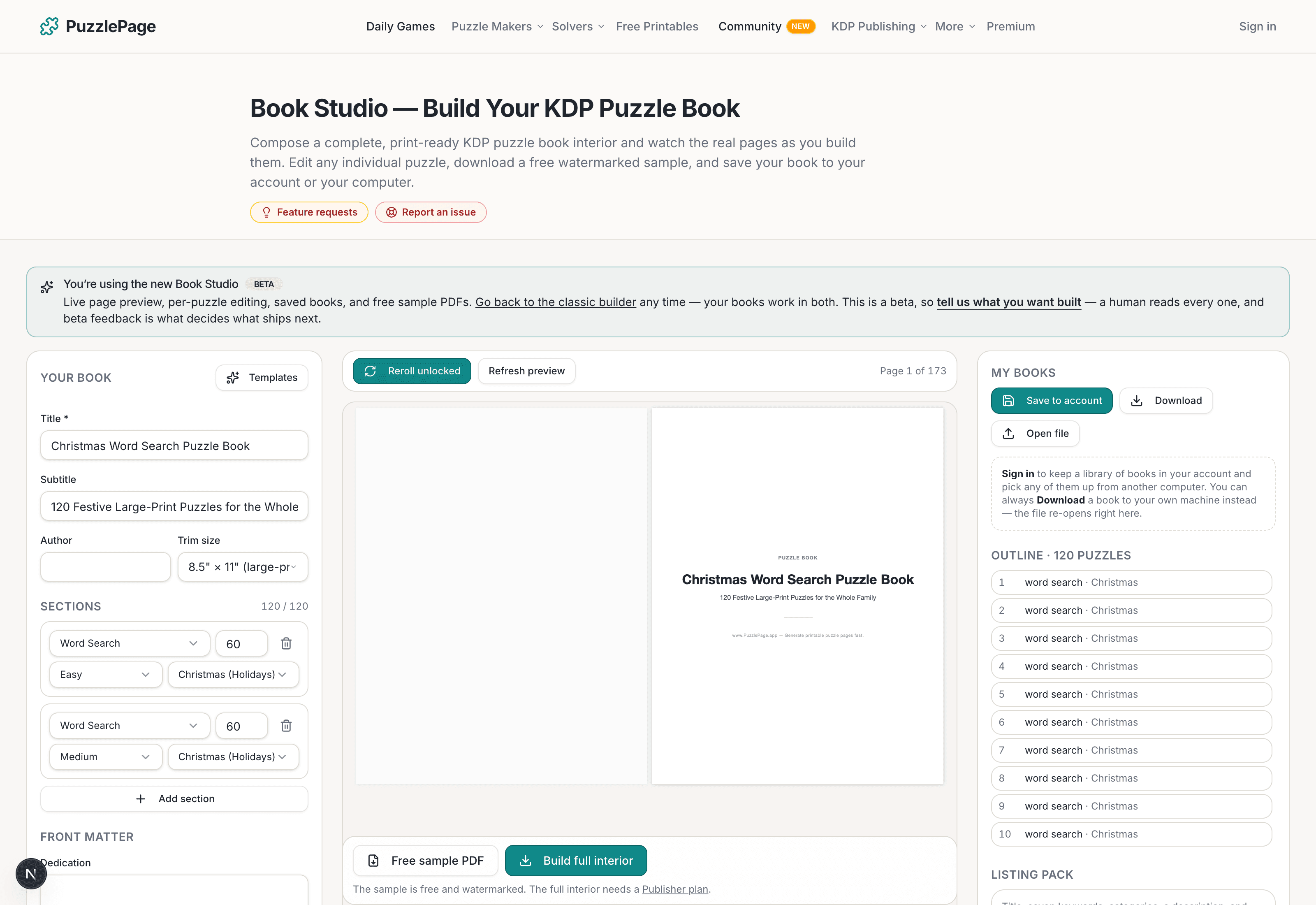
KDP Book Studio
Lay out a full puzzle book for Amazon KDP: templates, trim sizes, page checks and a cover designer.
Start a puzzle book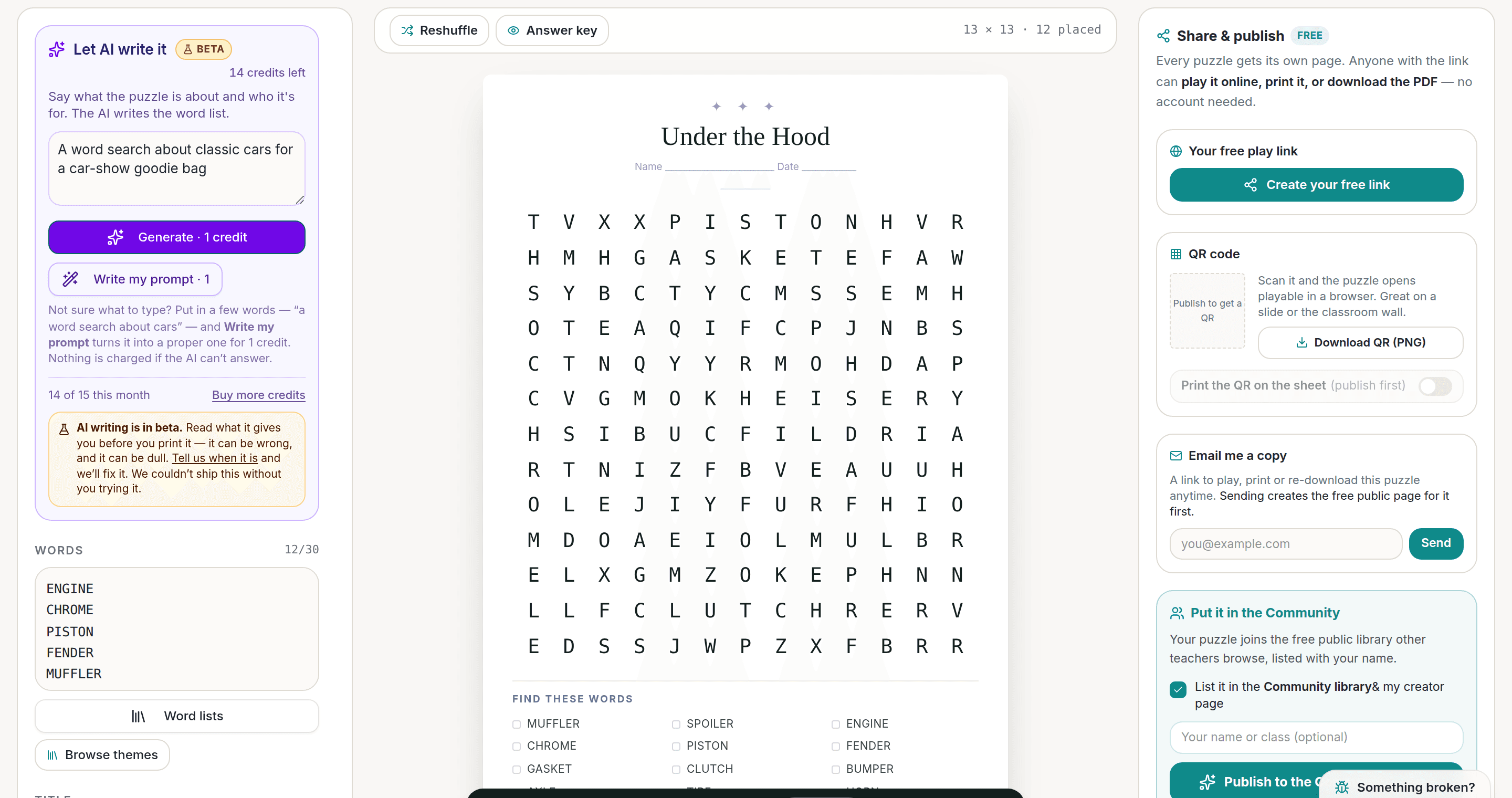
AI Puzzle Generator
Type a topic, get a themed word list and a finished puzzle. Premium also removes the footer credit and adds Word export.
Try the AI generator New
NewWorksheet Builder
Put a word search, a cryptogram and a scramble on one page, or build a whole themed packet. Prints with answer keys.
Build a worksheet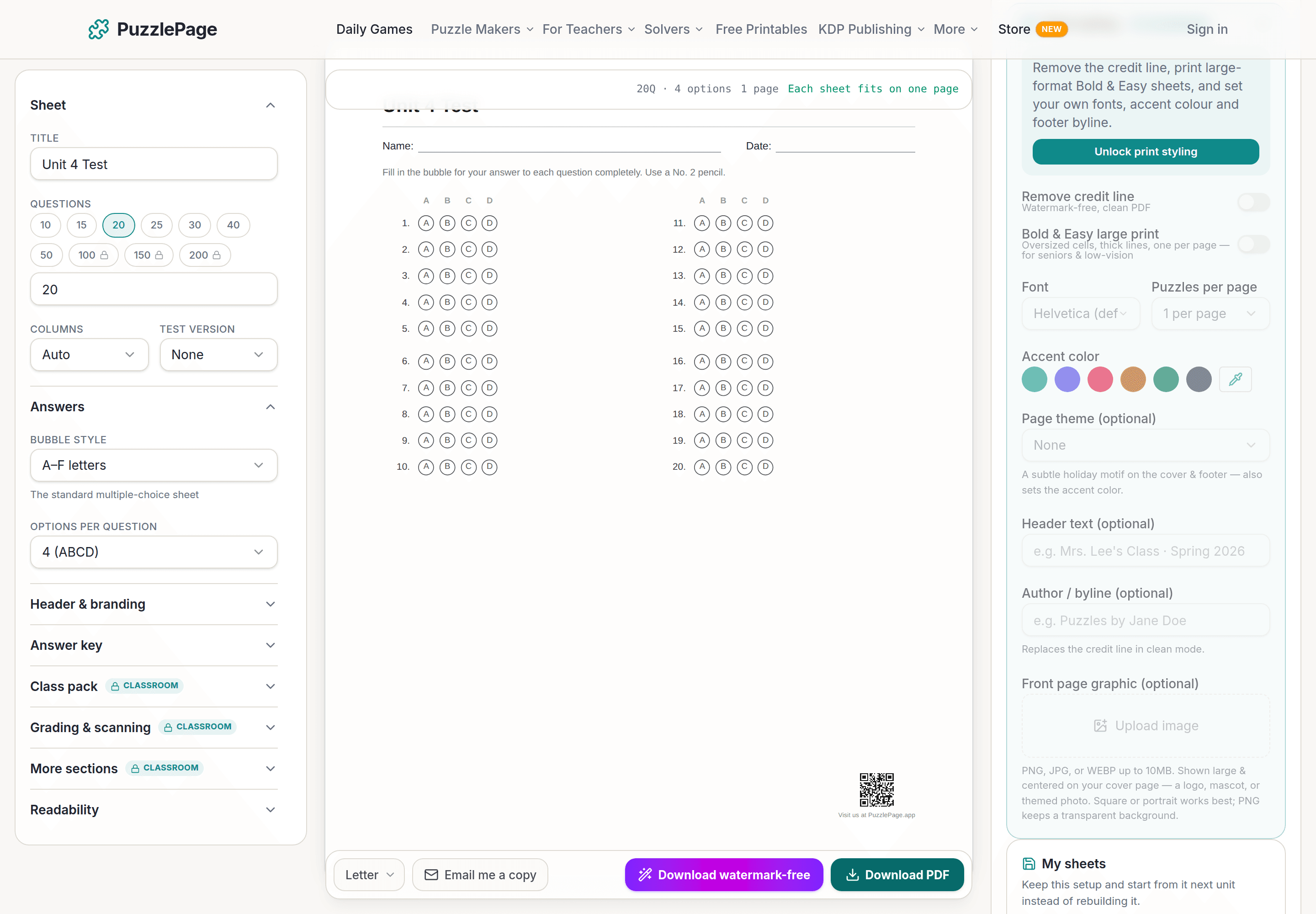
Bubble Sheet Studio
Answer sheets for any test length, with sections, versions, student ID grids and a matching answer key.
Make a bubble sheetPublisher plans unlock full print-ready interiors and covers, with a commercial licence to sell every book.
See plans →Free daily games
Need a two-minute break? Today's puzzles are live.
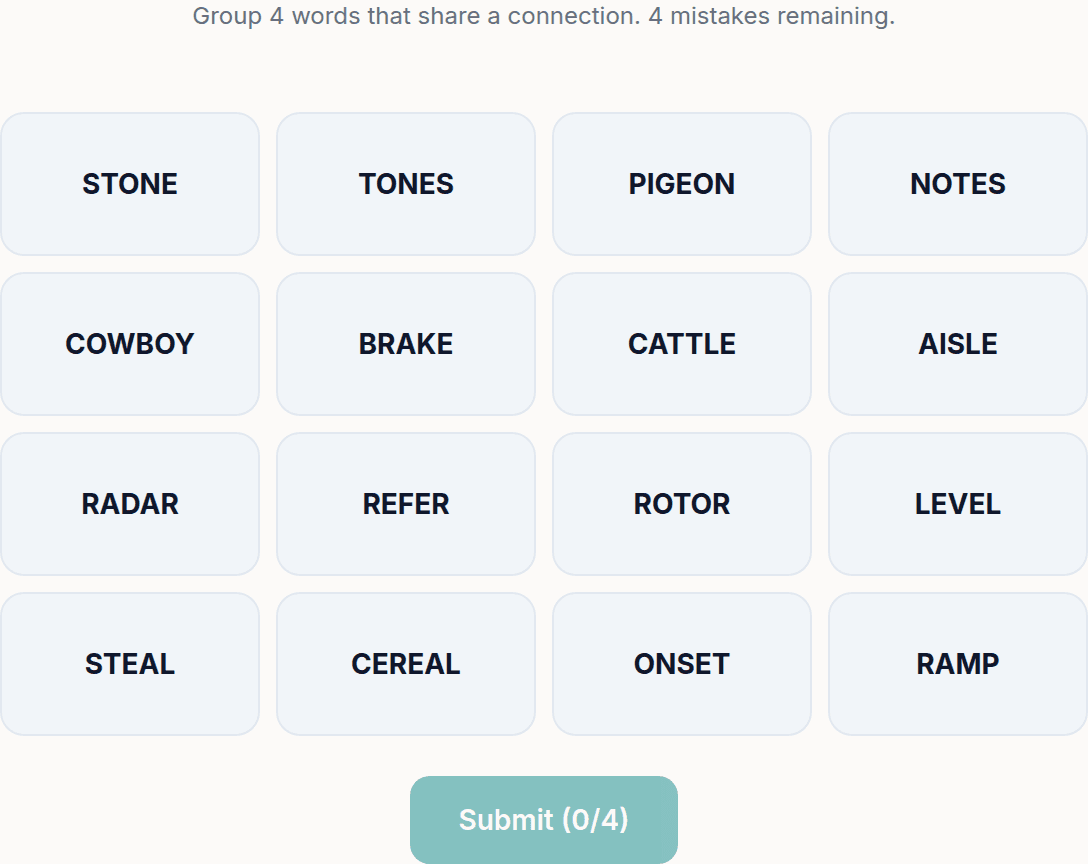
A new Sudoku and a new Connections board every day. No download, no account.


Keep reading
Get 10 free puzzles
Get the free 10-puzzle pack
Enter your email and we'll send you 10 print-ready puzzles with answer keys, plus a heads-up when we publish new generators and seasonal puzzle packs. Same quality as the ones on this page.
Roughly two emails a month. No spam, unsubscribe anytime.
Ready to build?
Build this book free in the PuzzlePage Book Studio
18 puzzle types, KDP margins and a full-wrap cover. Download the first 10 pages and the cover free.
Or start from a ready-made book template, or see books other publishers made here.
Enjoyed this? Share the puzzle on X
Like puzzles like this? Follow on Pinterest for a new one every day.