How to Price a KDP Puzzle Book in 2026: Royalty Math
How to price a KDP puzzle book using Amazon's published royalty formula. The $9.99 cliff, printing cost by page count, and every number worked out for you.

Free to try
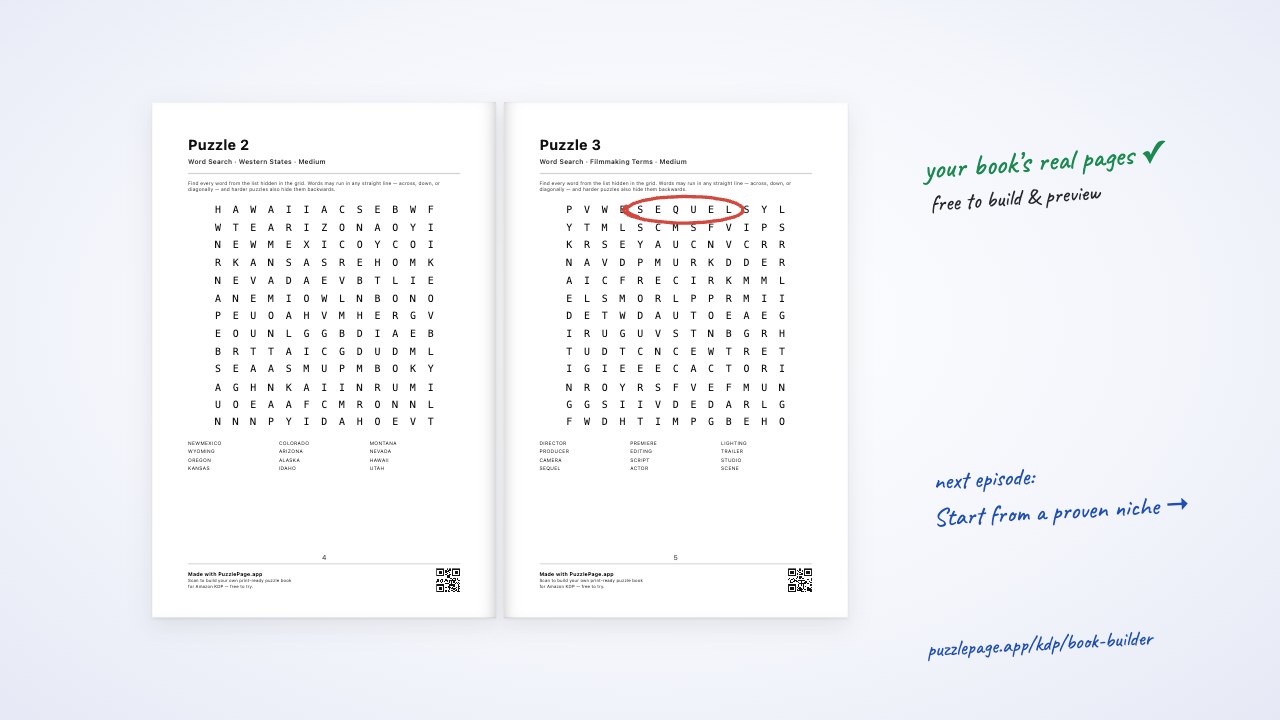
Build this book free in the PuzzlePage Book Studio
18 puzzle types, KDP margins and a full-wrap cover. Download the first 10 pages and the cover free.
For publishers: Build a book free in the Studio·Ready-made book templates·KDP calculators·Books made here
Most puzzle book pricing advice is vibes. The actual answer is arithmetic, and Amazon publishes every input you need to do it yourself.
This post works through the whole formula with real numbers: the two royalty tiers, the printing cost table, the minimum list price rule, and what Expanded Distribution does to your margin. Every figure below comes from Amazon's own published rates, and I show the math so you can check each line.
We publish 36 puzzle books on Amazon, including a Large Print Brain Games sudoku series, and I have run this calculation for every one of them. The math is the same whether you are on book one or book thirty-six.
📌 Key Takeaways
- The paperback formula is (royalty rate × list price) − printing cost, and nothing else enters it.
- Pricing at $9.98 instead of $9.99 drops you from 60% to 50% and costs about $1.00 on every single sale.
- Printing is a flat $2.30 from 24 to 110 pages, so a 30-page book and a 110-page book cost the same to print.
- Above 110 pages the formula becomes $1.00 plus $0.012 per page, and every added page now eats margin.
- The reported $10 to $20 band holds about 50.7% of puzzle book listings, so $9.99 is the low end of the real market.
 1:33
1:33How do you price a KDP puzzle book?
You price a KDP puzzle book by running Amazon's published paperback formula: (royalty rate × list price) − printing cost = royalty. There are only three inputs, and you control two of them.
The list price is your decision. The royalty rate is determined by that list price. The printing cost is determined by your page count, ink, and trim.
That is the entire model. There is no separate Amazon fee line, no per-order handling charge, and no hidden deduction on the Amazon.com marketplace for a black-ink paperback.
The royalty rate has exactly two settings on Amazon.com:
- 50% for list prices at or below $9.98.
- 60% for list prices at or above $9.99.
- 40% for sales made through Expanded Distribution, at any price.
Work one example end to end. Take a 120-page black-ink paperback listed at $9.99, which is a normal shape for a sudoku or word search volume.
Printing cost is $1.00 + (120 × $0.012) = $2.44. The royalty rate at $9.99 is 60%, so 0.60 × $9.99 = $5.994. Subtract printing: $5.994 − $2.44 = $3.55 per sale.
That $3.55 is what lands in your account when a copy sells on Amazon.com. Now change one input at a time and watch what happens, because that is where the money actually is.
Pro Tip
Run the formula on a scrap of paper before you open the KDP pricing screen. If you walk in already knowing your printing cost and your target royalty, you will not be talked into a round number by the interface.
Like this? We send 10 of these every month.
Free printable puzzles, answer keys included — same quality as the ones in this post.
One email. Unsubscribe anytime.
What is the $9.99 cliff and why does one cent cost a dollar?
The $9.99 cliff is the point where Amazon's royalty rate jumps from 50% to 60%. Because the jump is a step and not a slope, dropping your price by a single cent from $9.99 to $9.98 costs you roughly $1.00 on every copy.
Keep the 120-page book from the last section and price it both ways. Printing cost stays at $2.44 either way, because printing does not care what you charge.
At $9.99 you are in the 60% band: (0.60 × $9.99) − $2.44 = $5.994 − $2.44 = $3.55.
At $9.98 you are in the 50% band: (0.50 × $9.98) − $2.44 = $4.99 − $2.44 = $2.55.
You lowered the price by one cent and your royalty fell by a dollar. The buyer saved a penny, and you gave up 28% of your margin to hand it to them.
This is the single most expensive mistake in low-content publishing, and it happens constantly because $9.98 looks cheaper and feels clever. It is not clever. It is a $1.00 tax you volunteer to pay on every sale for the life of the title.
Here is the full royalty curve for that same 120-page book across the prices publishers actually consider. Every cell is (rate × price) − $2.44, computed from Amazon's formula.
| List price | Rate | Rate × price | Printing | Royalty |
|---|---|---|---|---|
| $6.99 | 50% | $3.50 | $2.44 | $1.06 |
| $8.99 | 50% | $4.50 | $2.44 | $2.06 |
| $9.98 | 50% | $4.99 | $2.44 | $2.55 |
| $9.99 | 60% | $5.99 | $2.44 | $3.55 |
| $11.99 | 60% | $7.19 | $2.44 | $4.75 |
| $14.99 | 60% | $8.99 | $2.44 | $6.55 |
Read the $6.99 row slowly. You are handing Amazon $5.93 of a $6.99 sale and keeping $1.06, which means you need six sales to match a single $14.99 sale.
The gap between $9.98 and $9.99 is one cent of price and one dollar of royalty. The gap between $9.99 and $11.99 is two dollars of price and $1.20 of royalty, which is the normal, boring, sloped part of the curve.
Only one step on this table is a cliff, and it is the one that costs nothing to step over. Price at $9.99 or above unless you have a deliberate reason not to.
How much does Amazon charge to print a puzzle book?
For a black-ink paperback on white or cream paper, Amazon's published printing cost has two brackets. From 24 to 110 pages it is a flat $2.30 with no per-page charge, and from 110 to 828 pages it is $1.00 plus $0.012 per page.
That is the whole table for a standard puzzle book. Colour changes it substantially, but almost no puzzle interior needs colour, which is exactly why puzzle books are a friendly format for margin.
For reference, premium colour runs $3.60 flat from 24 to 40 pages and $1.00 + $0.065 per page from 42 to 828 pages, while standard colour runs $1.00 + $0.0255 per page from 72 to 600 pages. Compare $0.065 per page to $0.012 per page and you can see why we build every interior in black ink.
Here is what black-ink printing actually costs across the page counts a puzzle publisher realistically considers, with the resulting royalty at a $9.99 list price.
| Pages | Bracket | Printing math | Printing cost | Royalty at $9.99 |
|---|---|---|---|---|
| 60 | 24 to 110 | flat | $2.30 | $3.69 |
| 100 | 24 to 110 | flat | $2.30 | $3.69 |
| 110 | 24 to 110 | flat | $2.30 | $3.69 |
| 111 | 110 to 828 | $1.00 + $1.332 | $2.33 | $3.66 |
| 150 | 110 to 828 | $1.00 + $1.80 | $2.80 | $3.19 |
| 200 | 110 to 828 | $1.00 + $2.40 | $3.40 | $2.59 |
| 300 | 110 to 828 | $1.00 + $3.60 | $4.60 | $1.39 |
Notice the shape of that last column. Royalty at $9.99 is flat at $3.69 all the way to 110 pages, then declines steadily, and by 300 pages it has collapsed to $1.39.
A 300-page puzzle book at $9.99 earns less than a 60-page one. If you want to publish a thick book, the page count has to be paid for by the price, not absorbed by your margin.
Pro Tip
Every 100 pages you add above 110 costs you exactly $1.20 in printing, because 100 × $0.012 = $1.20. Memorise that one number and you can price a thick book in your head.
Why does the 110-page ceiling change what you build?
Because printing is flat at $2.30 from 24 to 110 pages, a 30-page book and a 110-page book cost you exactly the same to print. Every page you leave out below 110 is free value you chose not to give the reader.
This is the second big insight that falls out of Amazon's table, and it is worth more than most marketing advice. Pages between 24 and 110 are literally free.
Run it. A 30-page book at $9.99 earns (0.60 × $9.99) − $2.30 = $3.69. A 110-page book at $9.99 earns (0.60 × $9.99) − $2.30 = $3.69.
Identical royalty. One book has 80 more pages of puzzles in it, which means more perceived value, better reviews, and a stronger argument for holding your price against a thinner competitor.
So a thin puzzle book is a self-inflicted wound. It earns you the same per sale while giving the buyer less reason to choose it, keep it, or come back for volume two.
Where it gets interesting is the boundary. At 111 pages you switch formulas and pay $1.00 + (111 × $0.012) = $2.33, which is three cents more than the flat rate.
Three cents is nothing, so do not treat 110 as a hard wall you must never cross. Treat it as a floor you should never sit far below.
The practical rule I use across our catalog: build to roughly 110 pages unless the book has a reason to be longer. A 350-puzzle sudoku volume with full solutions has that reason, and its price reflects it.
This is also why generation cost matters so little and generation quality matters so much. Filling 110 pages is trivial with a free maker, so the work goes into difficulty curves, print size, and layout instead.
You can build a full 110-page interior in an afternoon in the PuzzlePage Book Studio, which counts pages as you go so you can land on 110, or make single pages with our sudoku maker or word search maker, both free, both print-ready with answer keys. We use the same tools for every book in our own Amazon catalog.
What is the minimum list price for your puzzle book?
Amazon calculates a minimum list price per title using printing cost ÷ royalty rate. You cannot list below it, because below it Amazon would be paying you to print the book.
The logic is simple once you see it. If royalty = (rate × price) − printing, then royalty hits zero when rate × price = printing, which rearranges to price = printing ÷ rate.
Because the rate itself depends on the price, this produces a slightly awkward but checkable set of numbers. Work them for the page counts above.
| Pages | Printing | ÷ 50% (at or below $9.98) | ÷ 60% (at or above $9.99) | ÷ 40% (Expanded Distribution) |
|---|---|---|---|---|
| 100 | $2.30 | $4.60 | $3.83 | $5.75 |
| 120 | $2.44 | $4.88 | $4.07 | $6.10 |
| 200 | $3.40 | $6.80 | $5.67 | $8.50 |
| 300 | $4.60 | $9.20 | $7.67 | $11.50 |
Look at the 300-page row in the 50% column. The break-even price is $9.20, which means a 300-page book priced anywhere in the 50% band earns you almost nothing.
At $9.20 exactly you earn zero. At $9.98 you earn (0.50 × $9.98) − $4.60 = $0.39, which is not a business.
Now add Expanded Distribution to that same 300-page book and the minimum climbs to $11.50, which is above the entire 50% band. That single fact quietly forces long books into 60% territory whether you planned it or not.
The minimum list price is a floor, not a target. It tells you where the book stops being viable, and the useful reading is how much room sits between that floor and where the market actually prices.
What does Expanded Distribution do to the math?
Expanded Distribution pays 40% of list price minus printing cost, at any price. There is no 60% tier and no $9.99 cliff, just a flat 40%.
Take the 120-page book at $9.99 one more time. Through Amazon.com you earn (0.60 × $9.99) − $2.44 = $3.55.
Through Expanded Distribution you earn (0.40 × $9.99) − $2.44 = $3.996 − $2.44 = $1.56. That is 44% of the direct royalty for the same book at the same price.
The 20-point rate gap is not a penalty so much as the cost of reaching bookstores and libraries that Amazon does not serve directly. Whether that reach is worth $1.99 a copy depends entirely on your book.
For puzzle books, my honest read is that it usually is not the main event. Puzzle buyers overwhelmingly shop on Amazon, so Expanded Distribution tends to add a trickle rather than a channel.
It is still generally worth enabling, because a trickle at $1.56 beats zero. Just do not let it drive your pricing decision, and do not be surprised when the reports stay quiet.
Where it does bite is on long books. Run a 300-page volume at $9.99 through Expanded Distribution: (0.40 × $9.99) − $4.60 = $3.996 − $4.60, which is negative, which is exactly why Amazon's minimum jumps to $11.50 for that title.
Pro Tip
If enabling Expanded Distribution suddenly forces your list price up, that is the 40% minimum talking, not a glitch. Either accept the higher price or cut pages until the printing cost fits the price you wanted.
Where does the market actually price puzzle books?
The reported $10 to $20 band holds about 50.7% of puzzle book listings, measured across 659 ASINs, which makes it the largest single share by a wide margin. Roughly half the market lives directly above the $9.99 cliff.
That is the most reassuring number in this entire post. The price that pays you 60% is also the price shoppers already expect, so you are not choosing between margin and competitiveness.
It also reframes the $9.98 mistake. Undercutting to $9.98 does not position you as the affordable option, because half your competitors are priced between $10 and $20 and shoppers are not scanning for pennies.
Large print gives you further room. Bold and easy large-print formats are reported as among the fastest-growing 2026 shapes, with roughly +45% year over year growth, 2 to 3 times higher click-through, and a $1 to $3 price premium.
Put that premium through the formula on a 110-page book. At $9.99 you earn $3.69; at $12.99 you earn (0.60 × $12.99) − $2.30 = $7.794 − $2.30 = $5.49.
A $3.00 price premium becomes $1.80 of extra royalty, which is a 49% margin increase for setting your type larger. That is the best return on effort available in this format, and it is why our Large Print Brain Games sudoku series is built in extra-large print rather than merely large print.
The wider context supports holding a real price. Puzzle books reportedly exceed $450M annually on Amazon and are growing about 13% year over year, attributed to screen fatigue and wellness trends, and Circana reported growth across screen-free categories in Q1 2026.
Demand is not the constraint. Puzzle books for adults reportedly draws about 96,873 US searches a month, and sudoku, word search, crossword and cryptogram each clear 30,000 a month.
Sudoku buyers in particular reward a real price. Committed solvers reportedly work through about one book per week and keep buying for years, and a well-reviewed sudoku book can reportedly hold a BSR under 5,000 for months without advertising.
That buyer is not price-shopping a penny. They are looking for a book that feels good to solve, and $9.99 versus $12.99 is not what decides it.
For more on choosing where to compete, see our guides to best-selling KDP puzzle book niches and validating a niche before you publish. The market size and competition breakdown covers the demand side in more depth.
How do you pick a price for your next book?
Work backwards from the two structural facts and the market band. Build to at least 110 pages because those pages are free, then price at $9.99 or above because that is where the 60% rate and half the listings live.
To test a price against a real book, build a 110-page interior free in the Book Studio and check the page count before you set the list price.
Here is the sequence I actually run, in order:
- Set the page count first. Get to 110 if you can, because printing is flat up to there and the pages cost you nothing.
- Compute printing cost. Flat $2.30 at or under 110 pages, or $1.00 + $0.012 per page above it.
- Start at $9.99 and check the royalty. If (0.60 × price) − printing is thin, the book is too long for the price, not the other way round.
- Test the large-print premium. If the book is genuinely large print, price it $1 to $3 higher and re-run the formula.
- Confirm you clear the minimum. Printing ÷ 0.60, and printing ÷ 0.40 if you enable Expanded Distribution.
Two things I want to be honest about. Every royalty and printing figure here is Amazon's published rate for the Amazon.com marketplace with black ink on white or cream paper, and those rates can change and do differ by marketplace.
You should confirm them against Amazon KDP before you commit, and re-check when you expand to other marketplaces. The maximum list price is $250, which nobody publishing puzzle books will ever meet.
The second honest note is that none of this promises income. This math tells you what a sale pays, not how many sales you will get, and publishing outcomes vary enormously.
What the math does guarantee is that you stop leaking margin for no reason. Between the $9.99 cliff and the 110-page ceiling, most first-time puzzle publishers are giving away a dollar a sale and 80 pages of value at the same time.
Fix those two and your unit economics roughly double without selling one extra copy. That is why I run this calculation before I generate a single grid.
📚 Build Your Book in the PuzzlePage Book Studio
If you are serious about a KDP catalog, the PuzzlePage Book Studio turns your puzzles into a complete, print-ready interior with answer keys, page numbers and a matching full-wrap cover, all in one place. Download the first 10 pages plus the cover free, then pick a KDP plan when you are ready to publish.
Start a Free Book →Free to try
Try the Book Studio free: first 10 pages and cover, no card
Build the whole book in your browser, watch the real printed pages as you go, and download the first 10 pages plus the cover to check them before you decide anything.
- ✓18 puzzle types with difficulty ramps and answer keys
- ✓KDP trim sizes and margins checked as you build
- ✓A matching full-wrap cover, spine included
- ✓Download the first 10 pages and the cover free
Build first, decide later. You only pay when you want the full interior.
Frequently Asked Questions
How do you price a KDP puzzle book?
Use Amazon's published formula: (royalty rate × list price) − printing cost. Price at $9.99 or above to earn the 60% rate rather than 50%, and build to at least 110 pages, where black-ink printing is a flat $2.30. A 120-page book at $9.99 returns $3.55 per sale.
Why is $9.99 the magic price on KDP?
Amazon pays 50% at or below $9.98 and 60% at or above $9.99, so the rate changes as a step. On a 120-page book, $9.99 pays $3.55 and $9.98 pays $2.55, which means a one-cent discount costs you roughly $1.00 on every copy sold.
How much does KDP charge to print a paperback?
For black ink on white or cream paper on Amazon.com, printing is a flat $2.30 from 24 to 110 pages with no per-page charge, then $1.00 plus $0.012 per page from 110 to 828 pages. So 200 pages costs $3.40 and 300 pages costs $4.60. Rates can change and vary by marketplace.
What is the minimum list price for a KDP puzzle book?
Amazon sets it per title as printing cost divided by your royalty rate. A 100-page book at $2.30 printing needs $3.83 in the 60% band, $4.60 in the 50% band, and $5.75 if you enable Expanded Distribution at 40%. Longer books push that floor higher.
Pricing only matters once there is a book to price. Compare what the free and paid generator tiers produce before you set a list price.
More you can make here
One puzzle is the start. Here is the rest of the kit.
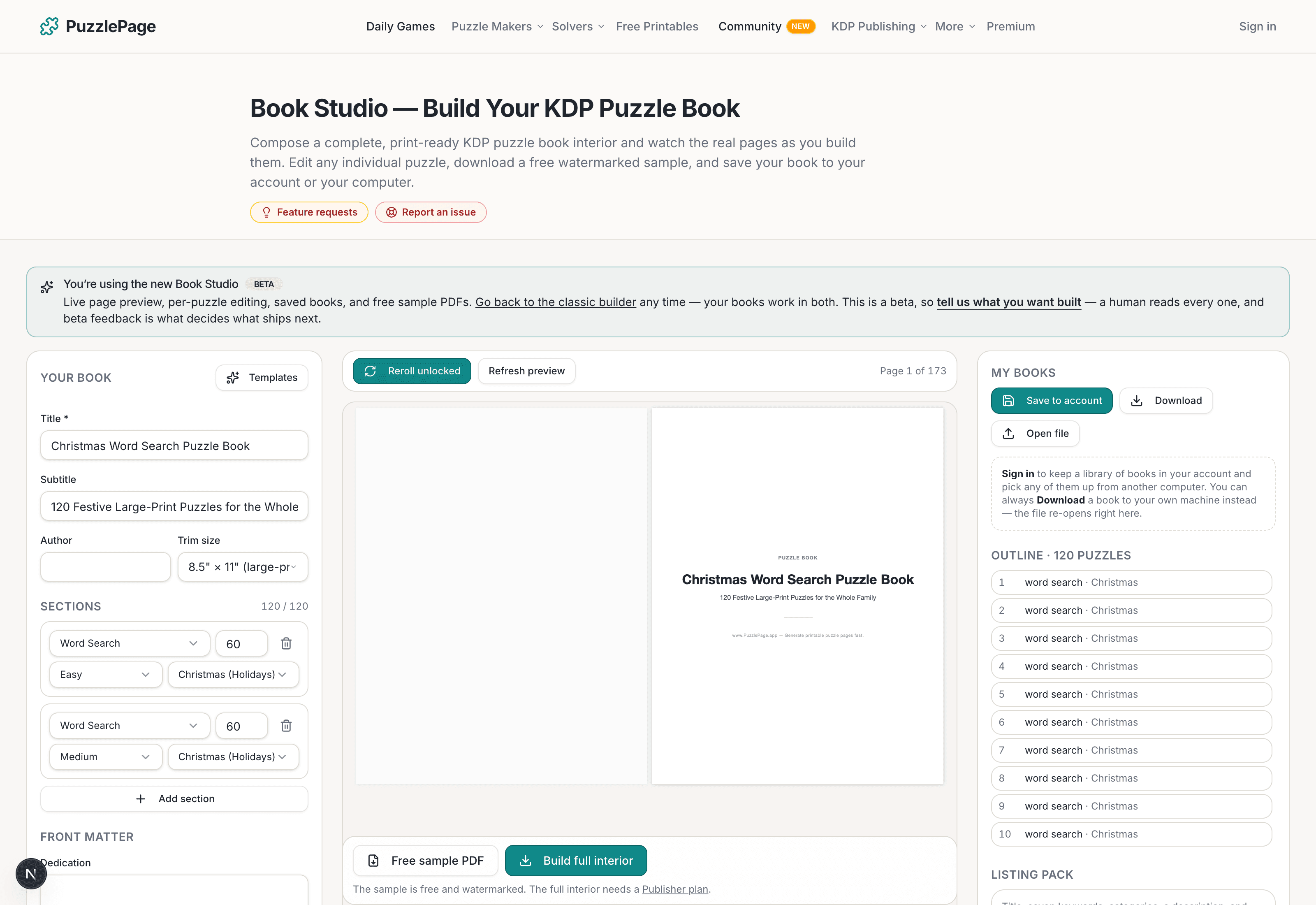
KDP Book Studio
Lay out a full puzzle book for Amazon KDP: templates, trim sizes, page checks and a cover designer.
Start a puzzle book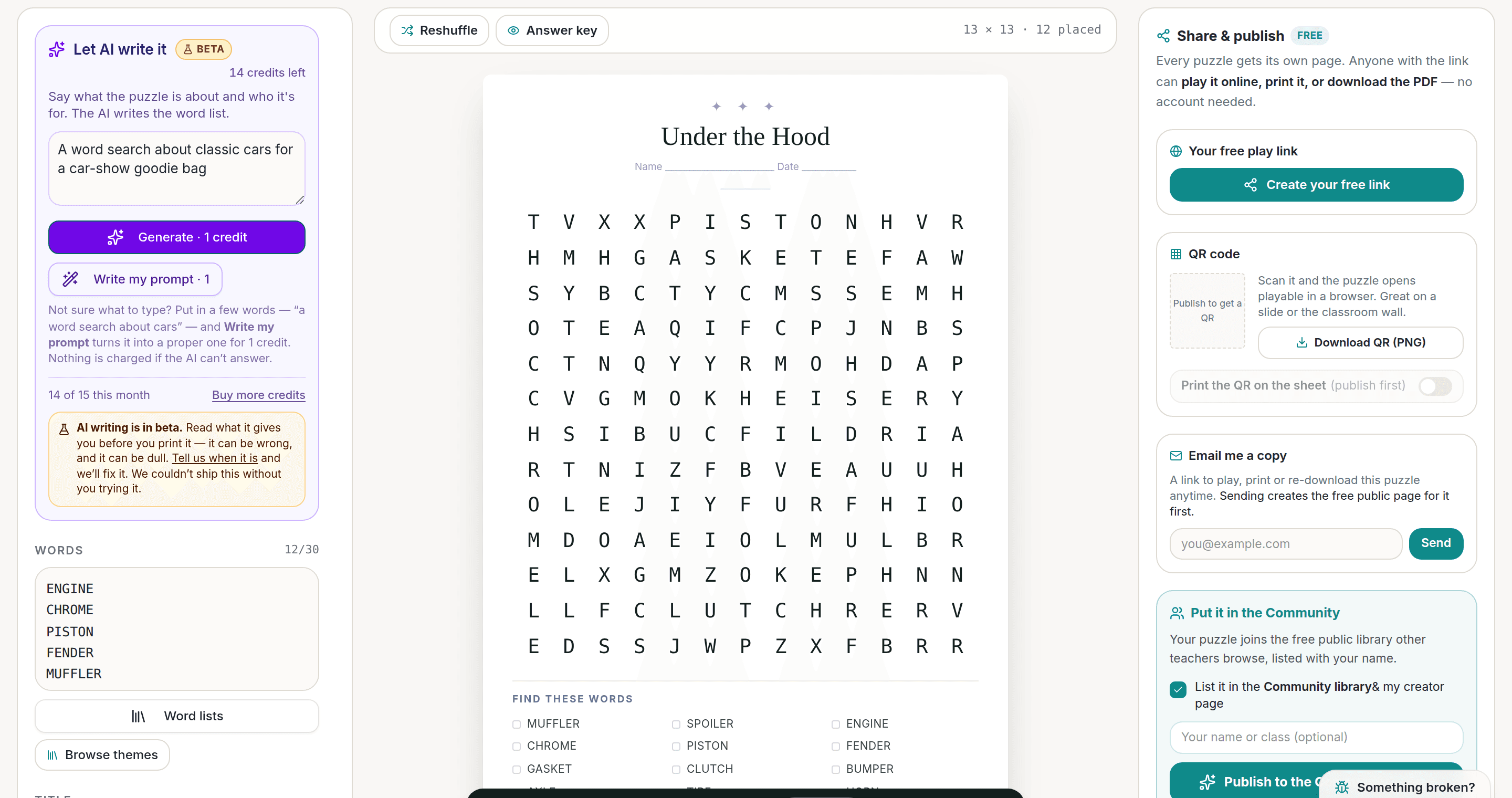
AI Puzzle Generator
Type a topic, get a themed word list and a finished puzzle. Premium also removes the footer credit and adds Word export.
Try the AI generator New
NewWorksheet Builder
Put a word search, a cryptogram and a scramble on one page, or build a whole themed packet. Prints with answer keys.
Build a worksheet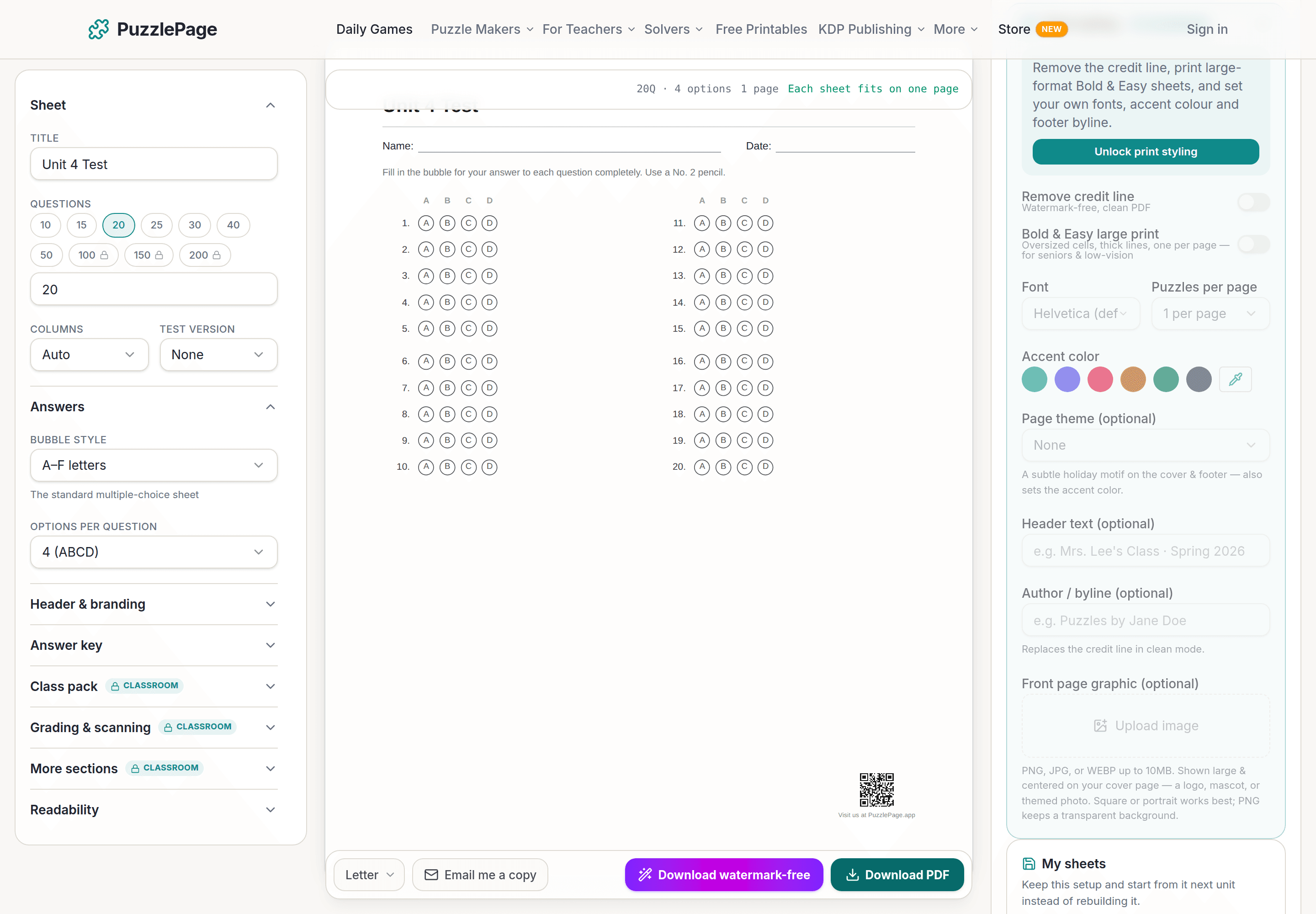
Bubble Sheet Studio
Answer sheets for any test length, with sections, versions, student ID grids and a matching answer key.
Make a bubble sheetPublisher plans unlock full print-ready interiors and covers, with a commercial licence to sell every book.
See plans →Free daily games
Need a two-minute break? Today's puzzles are live.
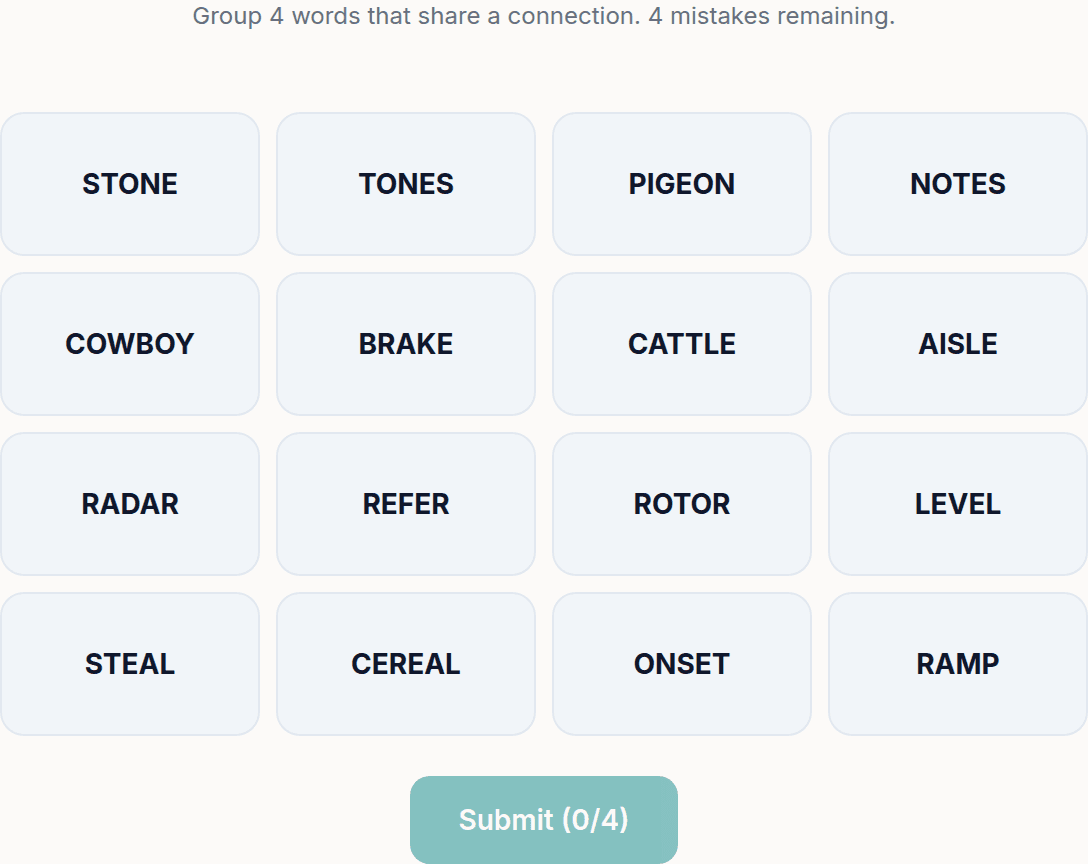
A new Sudoku and a new Connections board every day. No download, no account.


Keep reading
Get 10 free puzzles
Get the free 10-puzzle pack
Enter your email and we'll send you 10 print-ready puzzles with answer keys, plus a heads-up when we publish new generators and seasonal puzzle packs. Same quality as the ones on this page.
Roughly two emails a month. No spam, unsubscribe anytime.
Ready to build?
Build this book free in the PuzzlePage Book Studio
18 puzzle types, KDP margins and a full-wrap cover. Download the first 10 pages and the cover free.
Or start from a ready-made book template, or see books other publishers made here.
Enjoyed this? Share the puzzle on X
Like puzzles like this? Follow on Pinterest for a new one every day.