What Is NYT Pips? Rules, Strategy & How to Play the New Daily Game
A complete guide to NYT Pips — the new daily domino-logic game from the New York Times. How to play, the easy/medium/hard difficulty tiers, and the strategies that actually work.

On this site: Play a free daily Sudoku — another logic puzzle from PuzzlePage·Browse 100+ free printables·Play today's puzzles
The New York Times launched Pips as its newest daily logic game — a domino-based puzzle that plays a lot like Sudoku and Connections had a calmer, more meditative cousin. This guide covers what Pips actually is, how the rules work in plain English, and the strategies that move a brand-new player from frustrated to fluent.
📌 Key Takeaways
- Pips is a daily logic puzzle from the NYT Games team — domino tiles, color-coded constraint regions, one solution
- There are three daily difficulties: easy, medium, and hard — same rules, different constraint density
- The single biggest strategy: solve the most constrained regions first (the same heuristic as Sudoku's "naked singles")
- Average solve time is ~3–4 minutes for easy, ~6–8 for medium, ~10–15 for hard
- If you like Pips, you'll like Sudoku, Kakuro, and KenKen — same constraint-satisfaction mechanic in different shells
What is NYT Pips?
Pips is a daily puzzle where you place domino tiles onto a grid divided into colored regions. Each region has a numeric constraint (a sum, a maximum value, an "all equal" rule, or a "less than" rule), and your job is to lay out the dominoes so every constraint is satisfied. Like Sudoku, the puzzle has exactly one valid solution, and reaching it requires logical deduction rather than guessing.
Unlike Wordle (which is mostly about vocabulary recall) or Connections (which is about category recognition), Pips is a pure logic puzzle. There's no language, no pop-culture knowledge, and no element of luck. That makes it the most accessible NYT daily game for non-native English speakers — and the most satisfying for solvers who like Sudoku-style certainty.
Like this? We send 10 of these every month.
Free printable puzzles, answer keys included — same quality as the ones in this post.
One email. Unsubscribe anytime.
The rules in plain English
Every Pips puzzle has the same three elements:
- A grid divided into colored regions of various shapes and sizes.
- A set of dominoes waiting to be placed. Each domino has two halves, and each half shows 0–6 pips (the dots you'd see on a regular domino).
- Constraints on each region. The four constraint types you'll see:
- Sum ("region must total 9"): the pips on every tile half in that region add up to the target
- All equal ("region must be all 4s"): every pip value in the region must be the same number
- Less than ("region must be less than 12"): the total stays under the cap
- Empty ("region must total 0"): the region accepts only blank-blank dominoes (a 0-0)
You drag dominoes onto the grid in any orientation. Every region must be fully filled, and every constraint must be satisfied at once. There's exactly one solution per puzzle.
Pro Tip
Start with the constraint that has the fewest valid options. An "all equal: 6" region of 2 cells admits only the 6-6 domino — that's a free placement and unlocks the rest of the board.
The three difficulty tiers — what actually changes
NYT publishes Pips at three difficulties each day:
- Easy — usually a smaller grid (often 4×4 or 4×5), fewer constraint regions, and at least one constraint that gives a free placement (an "all equal: 6" 2-cell region, for example). Beatable in 3–4 minutes once you know the rules.
- Medium — larger grid, more constraint regions, and at least one "less than" or sum constraint that requires checking several candidate placements. Average solve: 6–8 minutes.
- Hard — denser constraints, more overlapping regions, and at least one constraint that requires you to forward-chain through 2–3 placements before you can confirm anything. Average solve: 10–15 minutes.
The difficulty curve roughly tracks Sudoku — easy puzzles fall to direct deduction, hard puzzles require holding two possibilities in your head while you eliminate one.
The four strategies that consistently work
If you've solved Sudoku, you'll recognize these. They all come back to one principle: solve the most constrained cells first.
- Find the forced placements. An "all equal" region with only one valid value pins the entire region. A "sum: 1" region with a single cell admits only the 1-half of a domino — pair it with whichever other cell satisfies its constraint. Sweep the board for these on the first pass.
- Solve the smallest regions first. A 2-cell region has only a handful of valid dominoes; a 6-cell region has hundreds. Lock down the small regions and watch them constrain the larger ones around them.
- Watch the domino pool. Pips gives you a finite set of tiles. If you've already placed every 5-5 in the available pool, you don't need to consider another 5-5 in the next region — the constraint gets tighter as the pool shrinks.
- Forward-chain on bottlenecks. If a region has only two possible placements, try one mentally and see which constraints break. If both options lead to contradictions, you misread an earlier constraint; if exactly one survives, that's your answer.
How Pips compares to other daily puzzles
| Game | Type | Time | Best for |
|---|---|---|---|
| Wordle | Vocabulary | 2–5 min | Word lovers |
| Connections | Categorization | 3–8 min | Pattern thinkers |
| Strands | Word search variant | 5–15 min | Themed solving |
| Crossword | Knowledge + wordplay | 15–60 min | Trivia depth |
| Pips | Pure logic | 3–15 min | Sudoku fans, ESL solvers |
Pips lands closest to Sudoku in spirit. Both reward methodical sweep-the-board logic; neither rewards guessing. If you like Sudoku and want something with a different visual texture, Pips fits perfectly.
What to play after you've finished today's Pips
If you enjoyed Pips, the same satisfaction-curve applies to other constraint-satisfaction puzzles. Sudoku is the obvious next step — and PuzzlePage has a free daily Sudoku you can play in the browser right now (mobile-friendly, with a live leaderboard). For printable practice, the Sudoku maker lets you generate as many unique puzzles as you want with answer keys.
Other constraint-style logic puzzles worth trying: Kakuro (cross-sums), KenKen (math constraints in a Sudoku grid), and Slitherlink (closed-loop logic). All four scratch the same itch as Pips.
More you can make here
One puzzle is the start. Here is the rest of the kit.
 New
NewWorksheet Builder
Put a word search, a cryptogram and a scramble on one page, or build a whole themed packet. Prints with answer keys.
Build a worksheet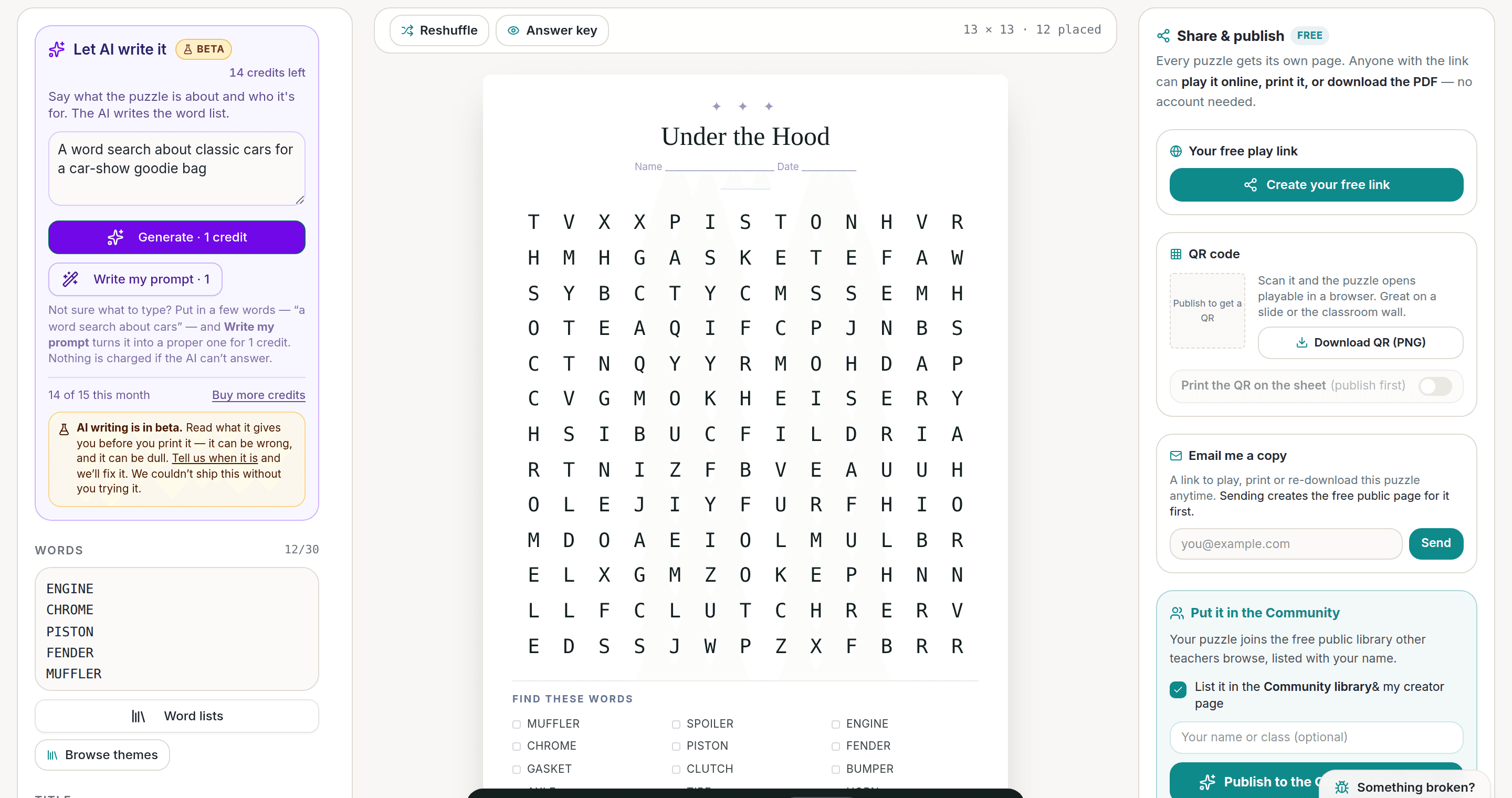
AI Puzzle Generator
Type a topic, get a themed word list and a finished puzzle. Premium also removes the footer credit and adds Word export.
Try the AI generator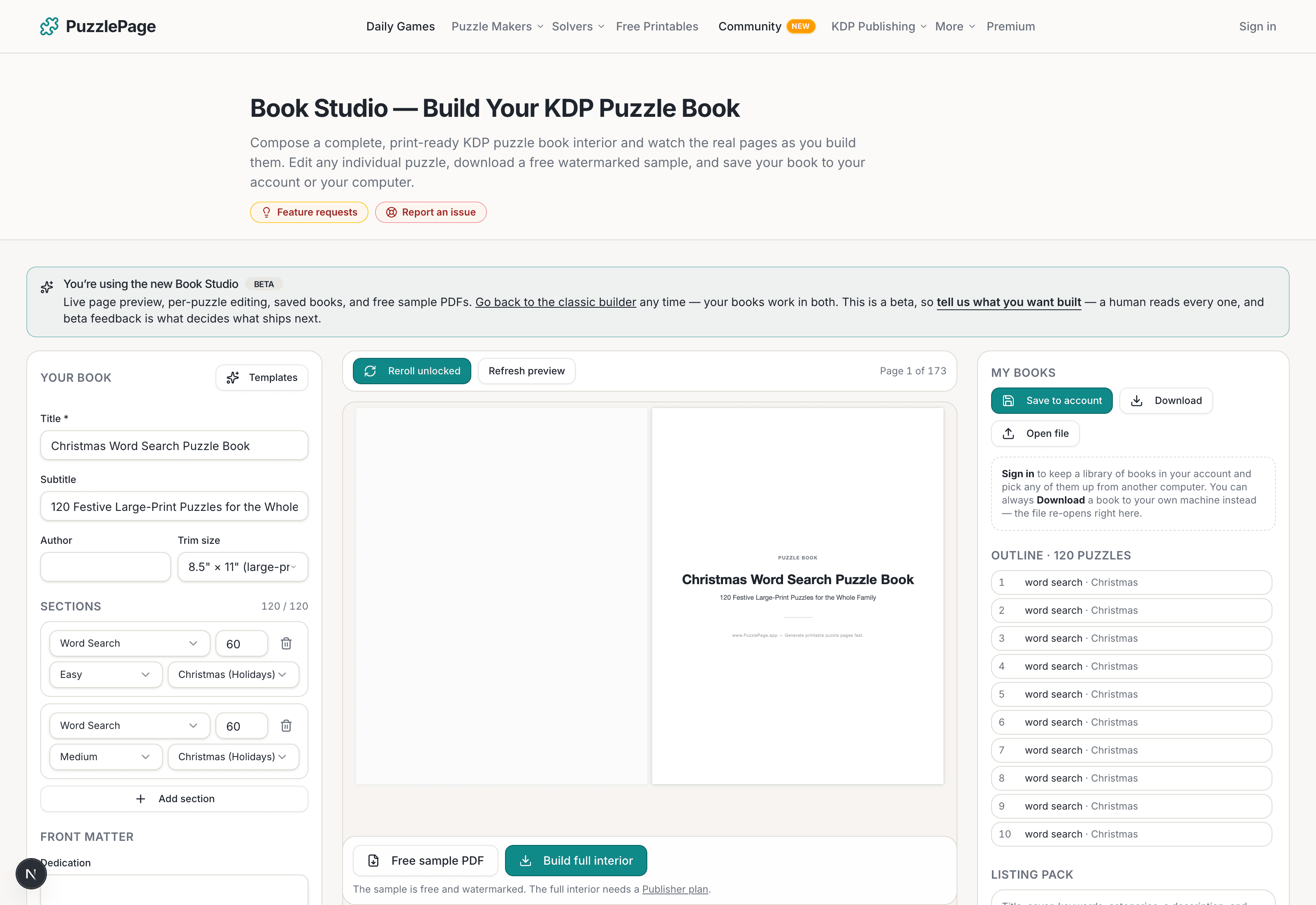
KDP Book Studio
Lay out a full puzzle book for Amazon KDP: templates, trim sizes, page checks and a cover designer.
Start a puzzle book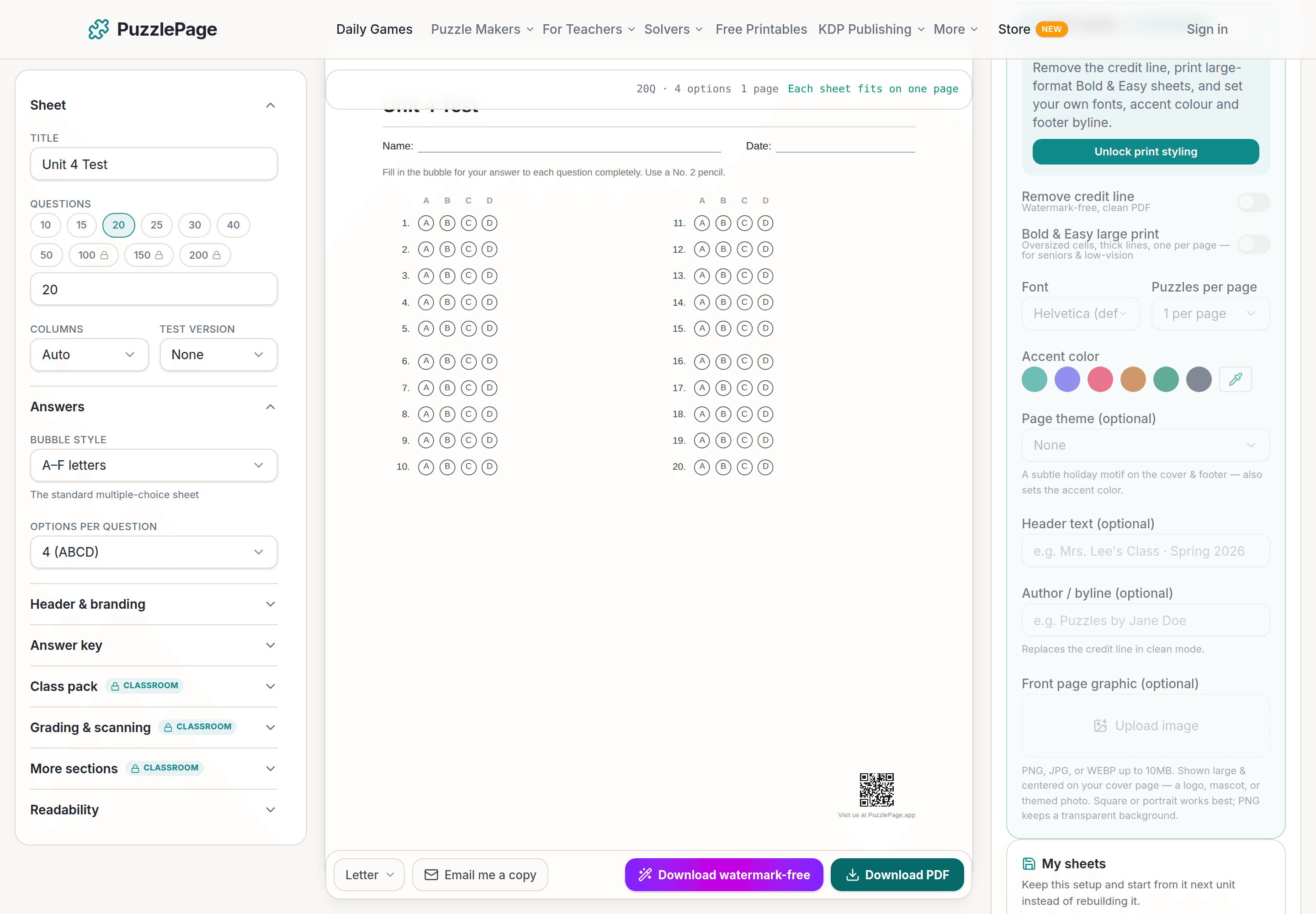
Bubble Sheet Studio
Answer sheets for any test length, with sections, versions, student ID grids and a matching answer key.
Make a bubble sheetPremium removes the footer credit, adds Word export and custom styling across every maker.
See plans →Free daily games
Need a two-minute break? Today's puzzles are live.
A new Sudoku and a new Connections board every day. No download, no account.


Keep reading
Get 10 free puzzles
Get the free 10-puzzle pack
Enter your email and we'll send you 10 print-ready puzzles with answer keys, plus a heads-up when we publish new generators and seasonal puzzle packs. Same quality as the ones on this page.
Roughly two emails a month. No spam, unsubscribe anytime.
Enjoyed this? Share the puzzle on X
Like puzzles like this? Follow on Pinterest for a new one every day.