Sudoku for Beginners: How to Solve Your First Puzzle
Sudoku for beginners explained step by step. Learn the rules, naked singles, hidden singles, and scanning. Solve your first puzzle with our free generator.

On this site: Play a free beginner Sudoku puzzle now·Browse 100+ free printables·Play today's puzzles
Sudoku for beginners is mostly a confidence problem. The rules fit on a napkin, but the empty grid stares back at you with 81 squares and what feels like a thousand possible numbers, and the temptation is to guess. The truth is that an easy Sudoku puzzle can be solved entirely with two techniques and a method called scanning, no guessing required.
I started teaching Sudoku to my dad after he retired, and I kept a tally on the fridge of how long each puzzle took him. His first puzzle ran 47 minutes with a lot of erasing. By his fifteenth puzzle, he was finishing easy grids in under 8 minutes, using only the two beginner techniques in this guide.
📌 Key Takeaways
- Sudoku has one rule: every row, column, and 3x3 box must contain the digits 1 through 9 exactly once
- Two beginner techniques solve almost every easy puzzle: naked singles and hidden singles
- Scanning means working number by number ("where can a 7 go in this box?") rather than cell by cell
- Guessing is the single biggest beginner mistake and almost always leads to a stuck grid
- Pencil marks (small candidate digits) help you track possibilities without committing to a number
 1:02
1:02The Rules of Sudoku in 60 Seconds
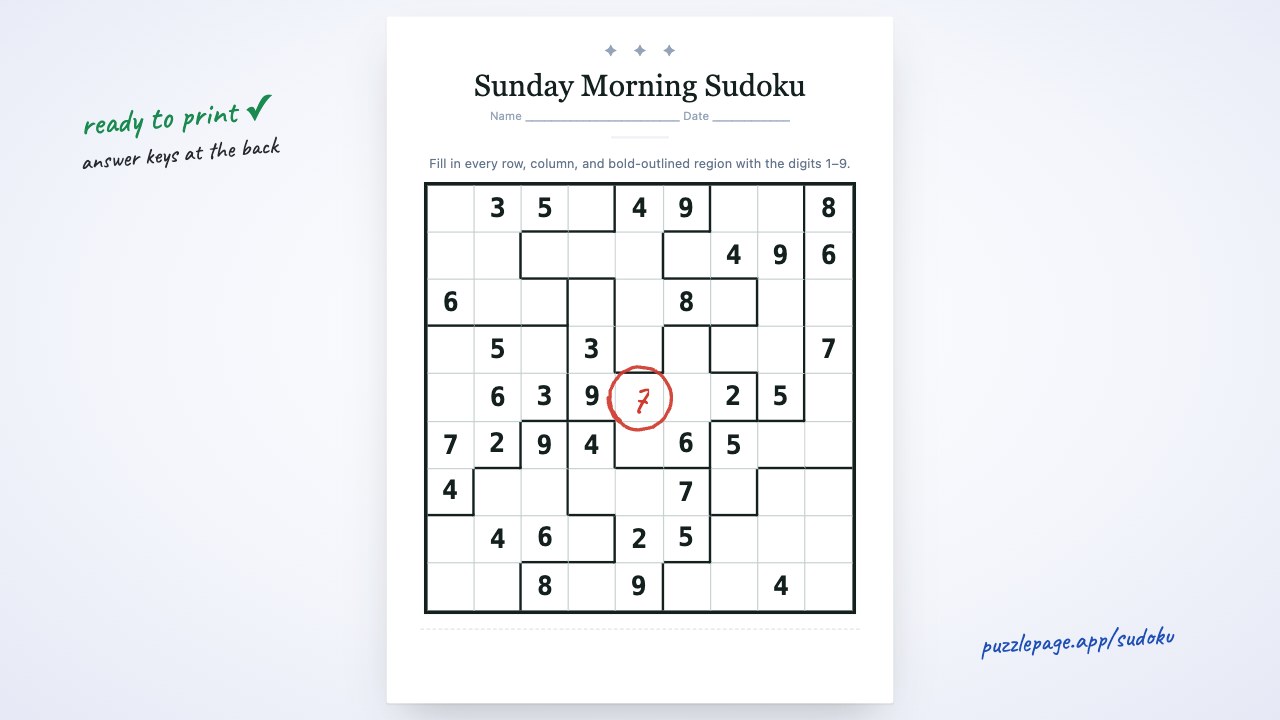
Sudoku is a 9x9 grid divided into nine 3x3 boxes. Some cells start with given digits, and your job is to fill every empty cell with a number from 1 to 9 so that three constraints are satisfied at once. There are no math operations, just placement logic.
The three constraints are:
- Each row across the grid must contain the digits 1 through 9 exactly once.
- Each column down the grid must contain the digits 1 through 9 exactly once.
- Each 3x3 box (there are nine of them) must contain the digits 1 through 9 exactly once.
Every solving technique flows from those three rules, including the advanced ones with names like X-wing and Swordfish. As a beginner, you only need to understand how those constraints eliminate possibilities cell by cell.
For broader background, the Wikipedia entry on Sudoku covers the history and the math behind unique-solution puzzles.
Like this? We send 10 of these every month.
Free printable puzzles, answer keys included — same quality as the ones in this post.
One email. Unsubscribe anytime.
The Two Beginner Techniques That Solve Easy Puzzles
An easy Sudoku puzzle is engineered so that you can solve it using just two techniques: naked singles and hidden singles. Master these two patterns and you can finish any beginner-rated puzzle on PuzzlePage, the New York Times Monday grid, or any starter book. The trick is recognizing each pattern quickly.
Here is what each technique actually means in plain language.
Naked single means a cell where, after you eliminate every digit that already appears in the same row, column, or box, only one number is left. That number is forced. You are not guessing, you are reporting what the constraints already decided.
Hidden single works the other way around. Instead of looking at one cell and asking "what could go here," you look at one number and ask "where in this box can a 7 go?" If exactly one empty cell in the box can hold a 7, that cell is forced even if other digits could also technically fit there.
Most beginners learn naked singles first because they feel more obvious. Hidden singles are the bigger payoff, because they let you fill cells where two or three candidates still seem possible at first glance.
Pro Tip
Always look for hidden singles before reaching for pencil marks. A beginner who scans for hidden singles first will finish a puzzle in half the time of one who fills every candidate number into every cell.
The Scanning Method Step by Step
Scanning is the engine that drives every easy Sudoku solve. You pick a digit, then move through the grid asking where it can and cannot go based on the cells already filled in.
Most beginners scan cell by cell, which is slow. Scanning by number is faster and reveals hidden singles immediately.
Here is the routine I teach my dad and my tutoring students:
- Pick a digit that already appears several times in the grid. A digit that is already in five or six places will block out most of the grid for you, making the remaining options easy to spot.
- Look at each 3x3 box in turn. For each box that does not yet contain your digit, scan the rows and columns of the cells already holding that digit elsewhere on the board.
- Cross out forbidden rows and columns mentally. Any row or column already containing your digit cannot hold it again in the current box.
- If exactly one empty cell remains in the box, place the digit. That is a hidden single.
- Move to the next digit and repeat. Each placed digit changes the constraints, so it is worth cycling through 1 through 9 several times.
Consider a small example. Say the digit 7 already appears in row 1, row 4, and column 8. When you look at the top-right 3x3 box, you can rule out the top row (already has a 7 in row 1) and the rightmost column (column 8 has a 7).
If the remaining cells in that box are mostly already filled, you often find that exactly one empty cell can hold the 7.
| Step | What You Ask | What You Look For |
|---|---|---|
| 1 | Where does this digit already live? | Three or more existing placements |
| 2 | Which boxes are missing it? | Boxes with no copy of the digit yet |
| 3 | Which rows and columns block it? | Lines already holding that digit |
| 4 | Is only one cell left? | Forced hidden single, place it |
A Worked Example for Your First Puzzle
Imagine you are looking at the top-right 3x3 box of a fresh easy puzzle. The given digits in that box are 2 in the top-right corner and 9 in the middle-left of the box. The rest of the cells in this box are empty.
You decide to scan for the digit 5. Looking at the rest of the grid, you spot that row 1 already has a 5 somewhere, and column 7 also already has a 5. That means in the top-right box, no cell in row 1 can hold a 5, and no cell in column 7 can hold a 5.
| x | x | 2 |
| 9 | 5 | x |
| . | . | x |
In this mini-grid, the yellow squares are blocked because row 1 or column 7 already contains a 5. The pink squares are already filled with their given digits.
That leaves the middle cell as the only place a 5 can go in this box. Hidden single, place it, move on.
Now you scan for the next digit. Each placement you make changes what is possible in adjacent boxes, so it is worth re-scanning the same numbers after every two or three placements. The cascade is what makes Sudoku satisfying: one forced cell tends to open up two more.
Pro Tip
Whenever you place a new digit, immediately re-scan that same digit across the whole board. The newly placed number often creates a forced placement in two or three other boxes, and catching the chain saves minutes of staring.
Common Beginner Mistakes to Avoid
Most beginners get stuck on easy puzzles for one of four reasons, and all four are fixable habits. I see the same mistakes every time I teach a new solver, and watching out for them shortens the learning curve dramatically.
- Guessing. If you cannot find a forced placement, the answer is to scan a different number, not to guess. An easy puzzle has at least one forced cell available at every step.
- Skipping pencil marks. When two candidates remain in a cell, write both digits small in the corner. Trying to hold candidates in your head leads to mistakes.
- Scanning cell by cell. Asking "what goes in this cell" is slow. Asking "where can this digit go in this box" is fast and reveals hidden singles.
- Erasing givens. Sounds silly, but it happens. Use ink for the starting numbers and pencil for your own placements so you always know which is which.
If you find yourself stuck, the right response is almost never to make a guess. Stop, step away for a minute, then come back and scan a digit you have not scanned recently. Most "stuck" moments break in under thirty seconds with a fresh scan target.
When to Move On From a Cell
One of the hardest beginner habits to build is leaving a cell blank when you do not yet know the answer. The instinct is to commit to something, but Sudoku rewards patience over decisiveness. If three numbers could go in a cell, write all three as pencil marks and move on.
The right time to revisit a cell is after you have placed a few more digits elsewhere. Those new placements tighten the constraints on the cell you skipped, and what looked like three candidates may now be a single forced value. This is how cascades happen.
I tell my students to treat the grid like a crossword: you do not start at 1 across and refuse to move on. You skip around, build partial information, and circle back when intersecting answers narrow the options. Sudoku rewards exactly the same rhythm.
Picking the Right Difficulty for Your First Solve
Difficulty in Sudoku is determined by how many givens the puzzle starts with and which techniques you need to reach the solution. An easy puzzle usually starts with 35 to 45 given digits and can be solved entirely with naked and hidden singles. A medium puzzle has 28 to 34 givens and may require one or two intermediate techniques.
For a true first solve, aim for a puzzle in the easy range. The PuzzlePage Sudoku generator lets you pick an easy difficulty and download a printable PDF with the answer key on a separate page. Print two or three at the easy level before stepping up.
If you finish an easy puzzle in under 12 minutes without erasing, you are ready to try a medium grid. Going one step at a time keeps frustration low and confidence high, which is the whole game when you are starting out.
Pro Tip
Print three easy puzzles at a time and solve them in one sitting. Repeating the same difficulty back to back is the fastest way to internalize the scanning rhythm, and your third puzzle will feel noticeably faster than the first.
Where to Go After Your First Puzzle
Once easy Sudoku feels comfortable, you have a few directions to grow. You can step up to medium difficulty, where you start to need techniques called locked candidates and naked pairs. You can also branch sideways into other logic puzzles that use the same scanning skill.
If you enjoyed the constraint-driven feel of Sudoku, you will likely enjoy word fill-ins. They are a word-based cousin to Sudoku, with placement logic, intersecting constraints, and the same satisfying cascade of forced moves. My guide on word fill-in puzzles as a crossword alternative walks through the same scanning thought process in a letter-grid context.
If you are thinking about building activity books that include Sudoku, my breakdown of the best puzzle types for KDP activity books covers which formats sell well and how to mix logic puzzles with word puzzles for variety. For more background reading on the cognitive benefits of regular puzzling, Britannica's Sudoku entry has a concise overview.
Frequently Asked Questions
What is the easiest way to start a Sudoku puzzle?
Scan for the digit that already appears most often in the starting grid. A digit with five or six placements has the most constraints, which makes finding a forced placement in an empty box much easier. Start there, then cycle through other frequent digits.
Should beginners use pencil marks?
Yes, but sparingly. Write small candidate digits only in cells where you have already narrowed the options to two or three numbers. Filling every cell with every possible candidate creates clutter and slows you down. Pencil marks are a tool, not a strategy.
How long should an easy Sudoku take a beginner?
A first easy puzzle often takes 30 to 50 minutes with frequent pauses. By your tenth easy puzzle, expect to finish in 10 to 15 minutes, and by your twentieth in under 10 minutes. The time drop is mostly about pattern recognition, not raw speed.
What is the difference between naked singles and hidden singles?
A naked single is a cell where only one digit can fit after eliminating row, column, and box conflicts. A hidden single is a digit that can only go in one cell within a row, column, or box, even if other digits could also fit there. Hidden singles are usually the bigger payoff for beginners.
More you can make here
One puzzle is the start. Here is the rest of the kit.
 New
NewWorksheet Builder
Put a word search, a cryptogram and a scramble on one page, or build a whole themed packet. Prints with answer keys.
Build a worksheet
AI Puzzle Generator
Type a topic, get a themed word list and a finished puzzle. Premium also removes the footer credit and adds Word export.
Try the AI generator
KDP Book Studio
Lay out a full puzzle book for Amazon KDP: templates, trim sizes, page checks and a cover designer.
Start a puzzle book
Bubble Sheet Studio
Answer sheets for any test length, with sections, versions, student ID grids and a matching answer key.
Make a bubble sheetPremium removes the footer credit, adds Word export and custom styling across every maker.
See plans →Free daily games
Need a two-minute break? Today's puzzles are live.
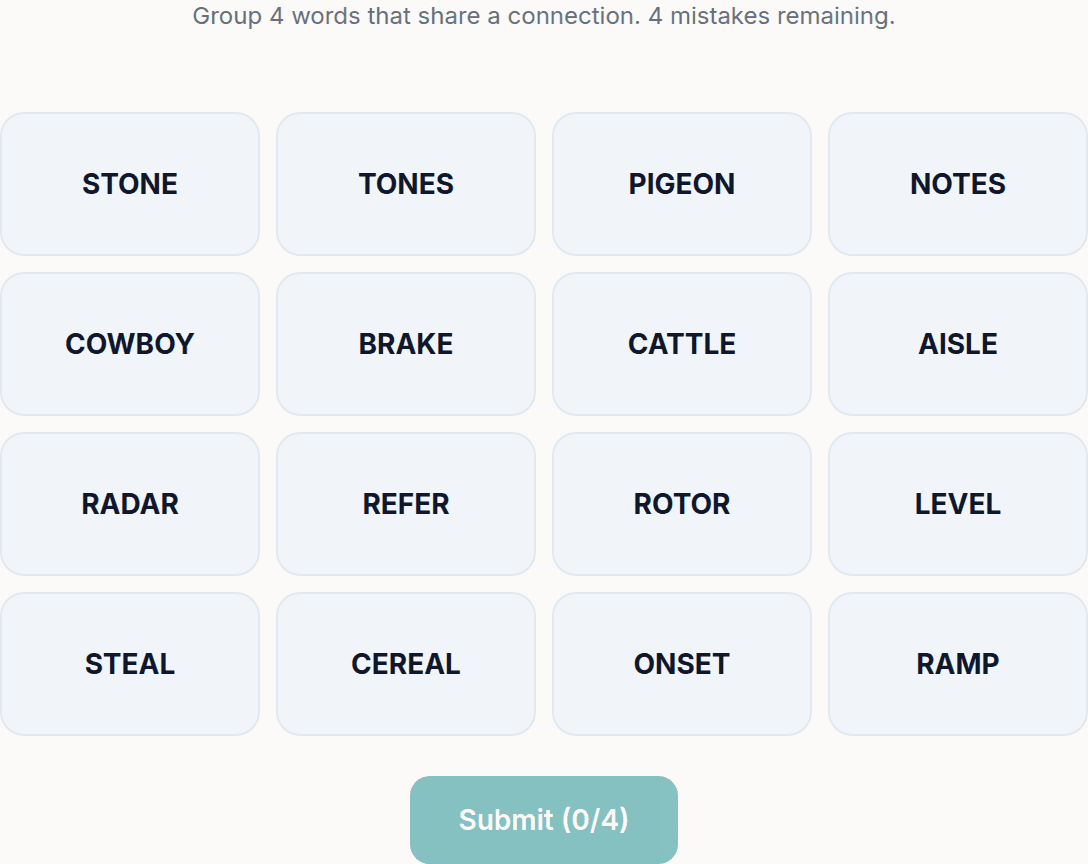
A new Sudoku and a new Connections board every day. No download, no account.


Keep reading
Get 10 free puzzles
Get the free 10-puzzle pack
Enter your email and we'll send you 10 print-ready puzzles with answer keys, plus a heads-up when we publish new generators and seasonal puzzle packs. Same quality as the ones on this page.
Roughly two emails a month. No spam, unsubscribe anytime.
Enjoyed this? Share the puzzle on X
Like puzzles like this? Follow on Pinterest for a new one every day.