Large Print Word Search Books on KDP: Specs, Price, Q4
Large print word search book KDP guide: 8.5 x 11 trim, 16 to 20pt type, 15 x 15 grids, royalty at $9.99 to $12.99, gift themes, and a Christmas edition plan.

Free to try
Build this book free in the PuzzlePage Book Studio
18 puzzle types, KDP margins and a full-wrap cover. Download the first 10 pages and the cover free.
Find these words
- AMAZON
- CATEGORY
- CLARITY
- COMFORT
- INTERIOR
- KEYWORDS
- LARGEPRINT
- MARGINS
- NICHE
- PAPERBACK
- PUBLISHING
- READABLE
- ROYALTY
- SENIORS
Drag across the grid to trace each hidden word.
KDP Large-Print Word Search
14 publishing terms for the large-print senior word-search niche
Word List
- LARGEPRINT
- PUBLISHING
- PAPERBACK
- KEYWORDS
- INTERIOR
- CATEGORY
- READABLE
- SENIORS
- ROYALTY
- MARGINS
- CLARITY
- COMFORT
- AMAZON
- NICHE
Free companion PDF
KDP Large-Print Word Search
14 publishing terms for the large-print senior word-search niche. Grab the PDF now and we'll send 10 more printable puzzles, plus a heads-up when new generators or seasonal packs go live. Roughly two emails a month — unsubscribe anytime.
No payment · Letter-size · Answer key included
For publishers: Build a book free in the Studio·Ready-made book templates·KDP calculators·Books made here
The large print word search book KDP niche runs on two buyers: people who solve puzzles and want to read them comfortably, and the adult children and activity coordinators who buy for them. Both reward the same thing, a book that is genuinely easy to read.
This guide covers the trim, type sizes, page count, price and themes for a large print word search book, plus a plan for getting a Christmas edition live this season. It was refreshed in October 2026 with KDP's current print costs and our own Book Studio data.
📌 Key Takeaways
- Use the 8.5 x 11 trim. Smaller trims with big type force cramped grids.
- Set type at 16pt or more; 18pt and up reads as extra large.
- Large trim printing is $2.84 flat up to 110 pages, so a long book needs a higher price.
- Themes sell the book: gardening, birds, classic TV, recipes, road trips and holidays.
- Large print word search for seniors is the most-started template in our Book Studio, so a sharp theme matters.
 1:24
1:24Why do large print word search books keep selling?
Large print word search books keep selling because the buying is routine, not seasonal. Activity coordinators restock common rooms, solvers finish one book and buy the next, and gift buyers return every birthday and holiday.
The niche is also popular with publishers. Of 103 template starts in the PuzzlePage Book Studio by mid-October 2026, 22 were the large print word search for seniors template, more than any other.
That means a plain "large print word search" title faces a crowd. A themed volume, with a cover that names its reader, is how a new book gets chosen.
Free Word Search PDF — KDP Large-Print Word Search
Print-ready · answer key included · unsubscribe anytime
What trim size does a large-print word search book need?
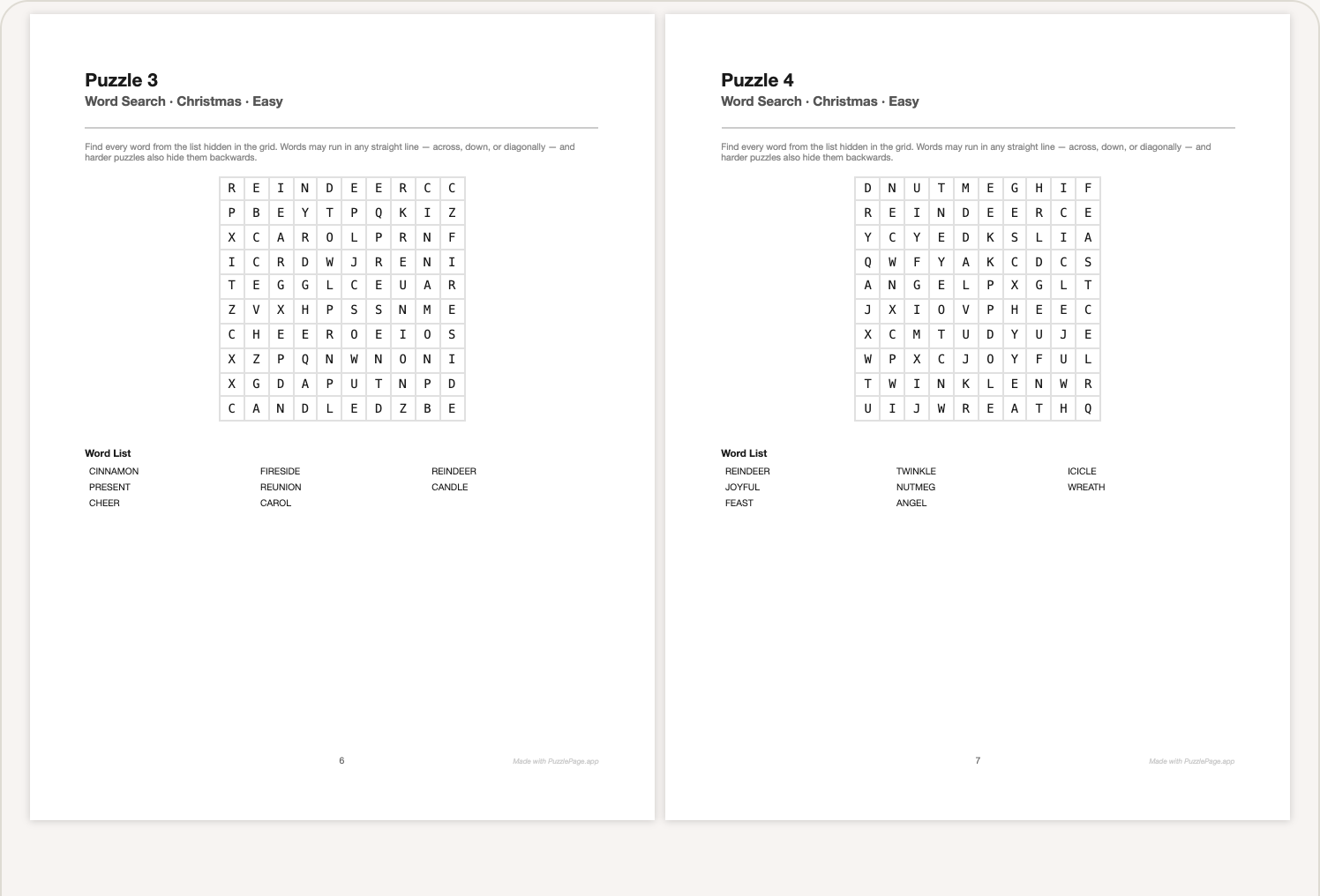
Use 8.5 x 11 inches. It is the only common trim with room for a 15 x 15 grid at large print sizes plus a word list that fits on the same page.
KDP counts any trim wider than 6.12 inches or taller than 9 inches as a large trim, which costs a little more to print. That is a fair trade here, because a 6 x 9 book with big type ends up with small grids and disappointed readers.
What font size counts as large print?
Large print starts at 16pt. Our free large print checker rates 14pt as enlarged, 16pt as large and 18pt or more as extra large, and it shows the biggest grid that fits a page at each size.
| Element | Recommended | Why |
|---|---|---|
| Grid letters | 16pt to 20pt | Readable at arm's length without glasses for many solvers |
| Word list | Same size as the grid | A tiny list undoes a big grid |
| Grid size | Up to 15 x 15 | Bigger grids force smaller letters on a letter-size page |
| Words per puzzle | 15 to 20 | Enough to feel substantial without crowding the list |
| Paper | White, black ink | Highest contrast for grids |
The Book Studio offers 14, 16, 18 and 20pt large print and keeps one puzzle per page at those sizes. For single pages, the free word search maker and the large print puzzles page let you test a size on your own printer.
Pro Tip
Print one page at actual size and read it at arm's length under an ordinary lamp. If you have to lean in, go up a size. That single check prevents the most common complaint in this niche.
How should you price a large print word search book?
Price at $9.99 or more and watch the page count. KDP pays 60% at $9.99 and up, but large trim printing jumps from a flat $2.84 to $1.00 plus 1.7 cents a page once you pass 110 pages.
| 8.5 x 11, black ink | Printing | At $9.99 | At $11.99 | At $12.99 |
|---|---|---|---|---|
| 110 pages | $2.84 | $3.15 | $4.35 | $4.95 |
| 130 pages | $3.21 | $2.78 | $3.98 | $4.58 |
| 173 pages | $3.94 | $2.05 | $3.25 | $3.85 |
These US estimates use KDP's paperback printing cost table, checked in September 2026. Run your own numbers in the free royalty calculator before you publish.
Which themes work for large print word search?
Themes that a reader identifies with work best, because they turn a generic book into a gift. Each of these has enough vocabulary for several volumes:
- Classic TV and movies: show titles and character names from past decades.
- Gardening: flowers, herbs, vegetables and tools, one volume each.
- Bird watching: species, habitats and birding gear.
- Classic recipes: comfort-food dishes and ingredients.
- Road trips: national parks, scenic routes and small towns.
- Holidays: Christmas, winter and New Year words for a Q4 edition.
Swap any of these into the large print template with your own word lists. For a mixed volume later, add pages from the free cryptogram maker or a large print sudoku section.
How to get a large print Christmas edition live this season
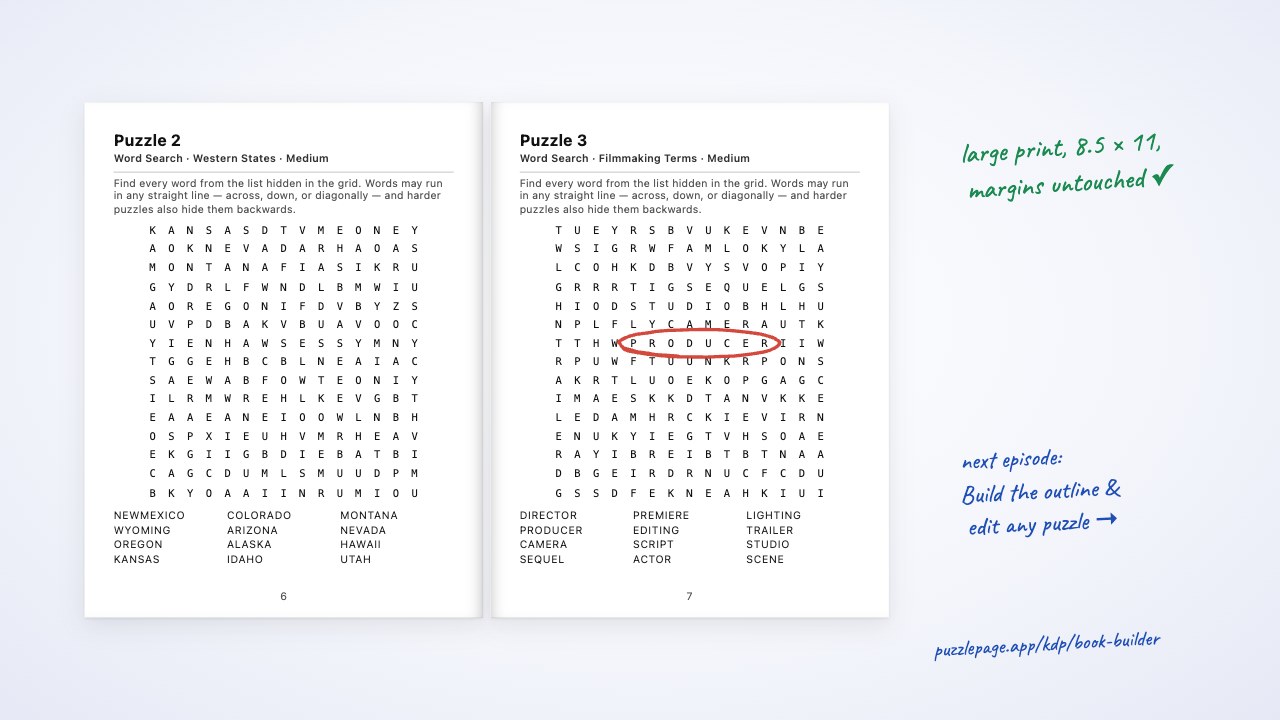
Start from the Christmas template, which already uses the 8.5 x 11 trim, and make it yours. The whole build fits in an afternoon.
- Open the Christmas word search template in the Book Studio.
- Pick a large print size of 16pt or more, and change the title and subtitle to name your reader.
- Swap in your own word lists for a theme, such as a Christmas kitchen or carols.
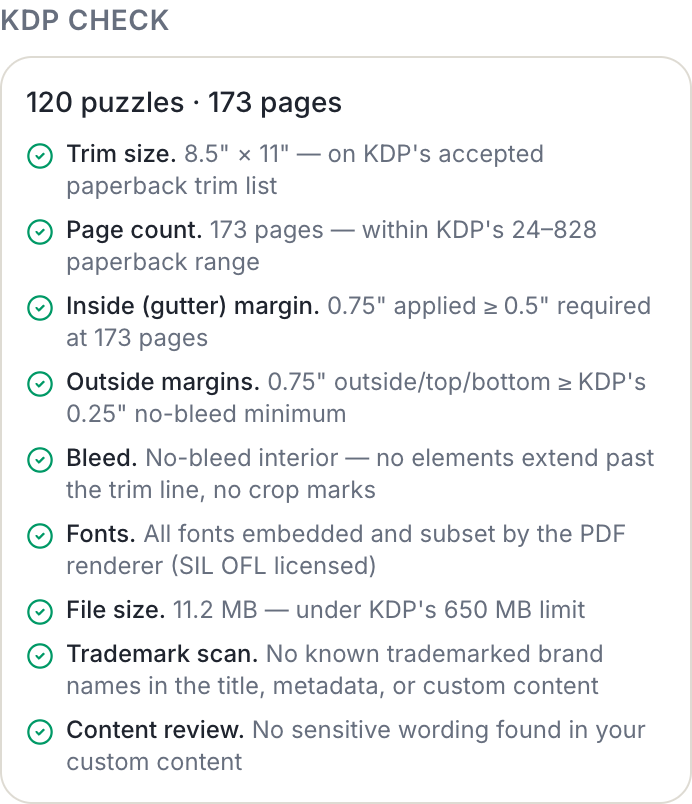
- Build the book and read the KDP check panel for trim, page count, margins and fonts.
- Download the first 10 pages and the cover free and print them at actual size.
- Export the full interior with a Publisher plan, upload it to KDP and order a proof.
Heads up
KDP review can take up to 72 hours, and a printed proof takes time to arrive. Holiday shoppers browse from October, so a Christmas edition finished in early November still has a season, but one finished in December mostly waits for next year.
For the bigger picture, see our best puzzle types for KDP activity books, the KDP puzzle book pricing guide, and every free tool on the KDP hub.
Free to try
Try the Book Studio free: first 10 pages and cover, no card
Build the whole book in your browser, watch the real printed pages as you go, and download the first 10 pages plus the cover to check them before you decide anything.
- ✓18 puzzle types with difficulty ramps and answer keys
- ✓KDP trim sizes and margins checked as you build
- ✓A matching full-wrap cover, spine included
- ✓Download the first 10 pages and the cover free
Build first, decide later. You only pay when you want the full interior.
Frequently Asked Questions
What font size counts as large print for a word search book?
Treat 16pt as the floor for a large print word search book, and 18pt or more as extra large. The PuzzlePage large print checker rates 14pt as enlarged, 16pt as large and 18pt and up as extra large, and the Book Studio offers 14, 16, 18 and 20pt.
Do I need to publish in hardcover, or is paperback enough for the senior niche?
An 8.5 x 11 paperback covers most of the large print word search market and is the cheapest to print. Add a hardcover of a title that already sells if you want a premium gift option.
How many puzzles should a large print word search book contain?
Around 100 puzzles is a common size; the Book Studio's large print template uses 100, split into easy and medium. Large print takes one puzzle per page, so check that a thicker book is still priced for its printing cost.
What price should a large print word search book be?
Most 8.5 x 11 large print word search books need a list price of $9.99 or more. A 110-page book earns about $3.15 at $9.99, while a 173-page book earns about $2.05 at $9.99 and about $3.85 at $12.99.
Live demo
Make your own word search right here
Swap in your own words (a spelling list, residents' names, a unit's vocabulary) and press Generate. The full maker adds answer keys, size options and PDF export.
More you can make here
One puzzle is the start. Here is the rest of the kit.
KDP Book Studio
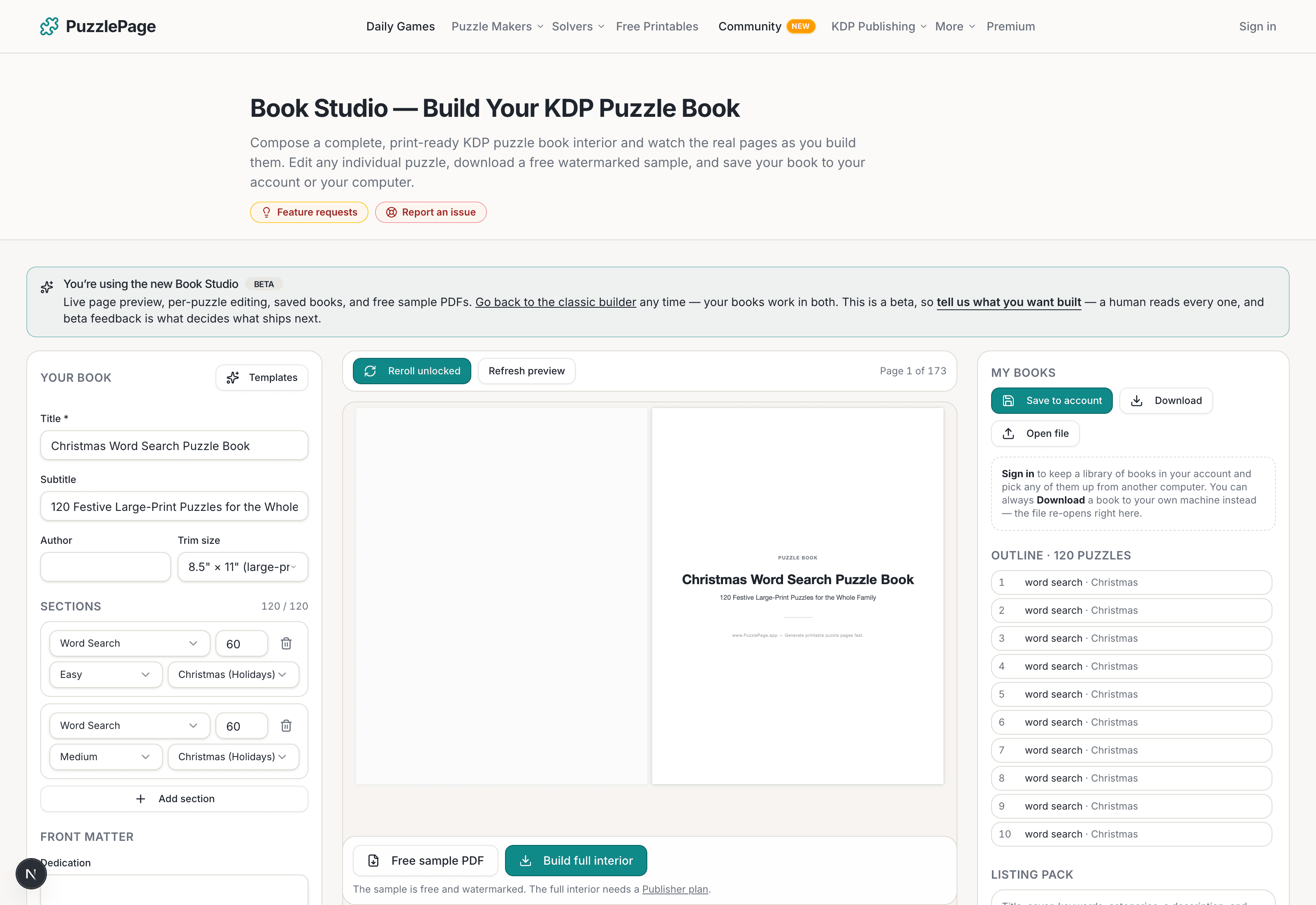
Lay out a full puzzle book for Amazon KDP: templates, trim sizes, page checks and a cover designer.
Start a puzzle book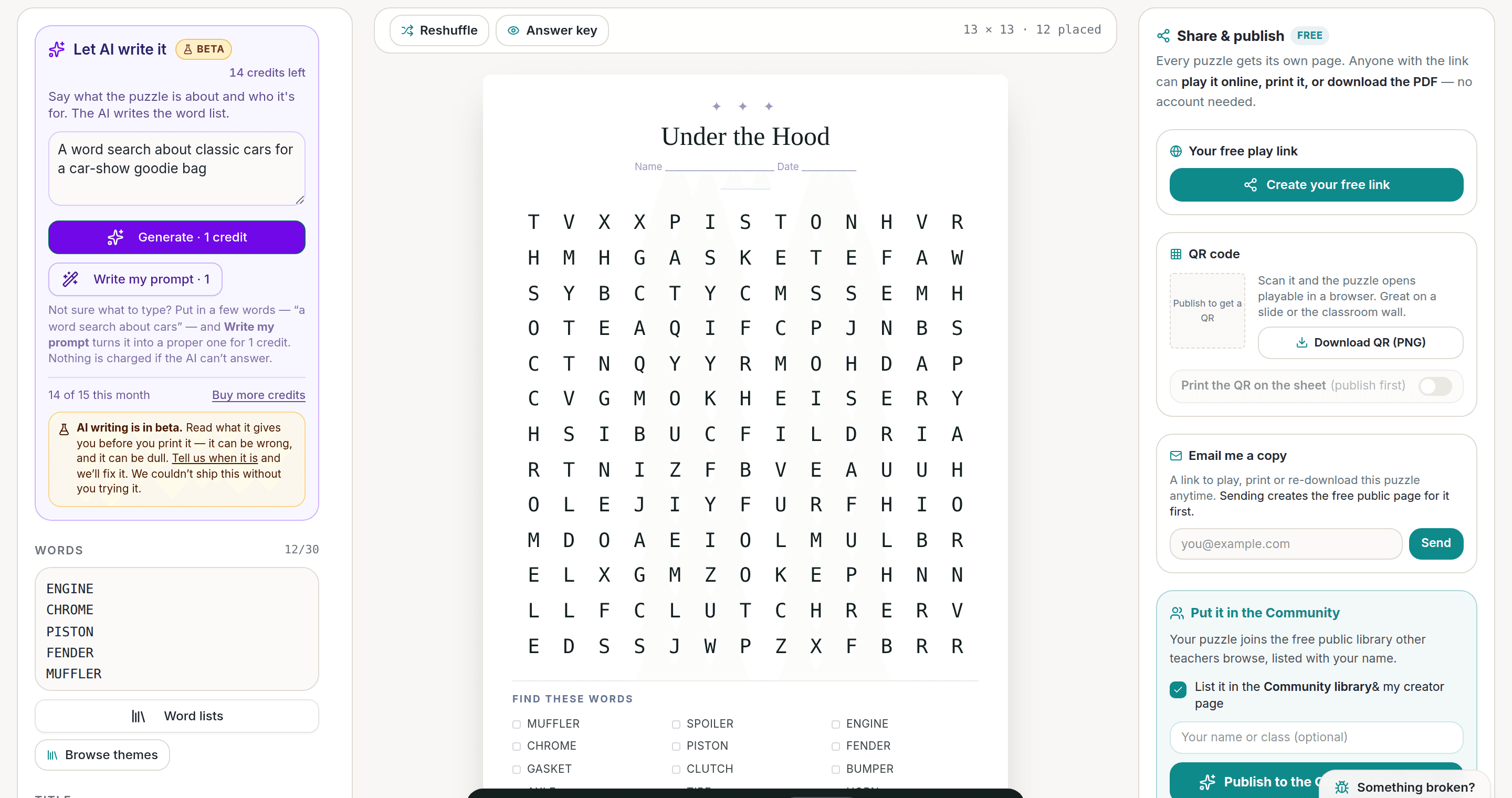
AI Puzzle Generator
Type a topic, get a themed word list and a finished puzzle. Premium also removes the footer credit and adds Word export.
Try the AI generator New
NewWorksheet Builder
Put a word search, a cryptogram and a scramble on one page, or build a whole themed packet. Prints with answer keys.
Build a worksheet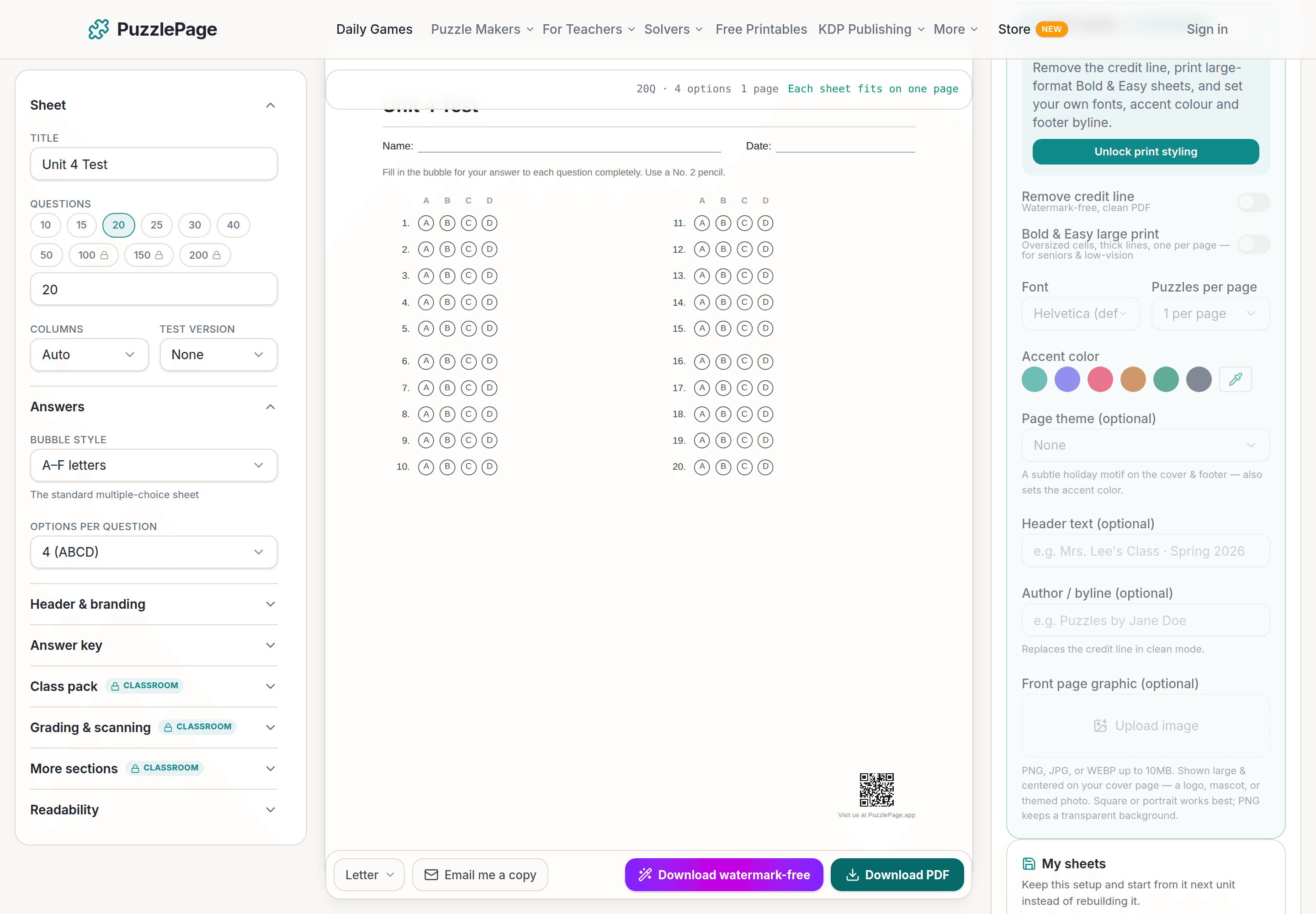
Bubble Sheet Studio
Answer sheets for any test length, with sections, versions, student ID grids and a matching answer key.
Make a bubble sheetPublisher plans unlock full print-ready interiors and covers, with a commercial licence to sell every book.
See plans →Free daily games
Need a two-minute break? Today's puzzles are live.
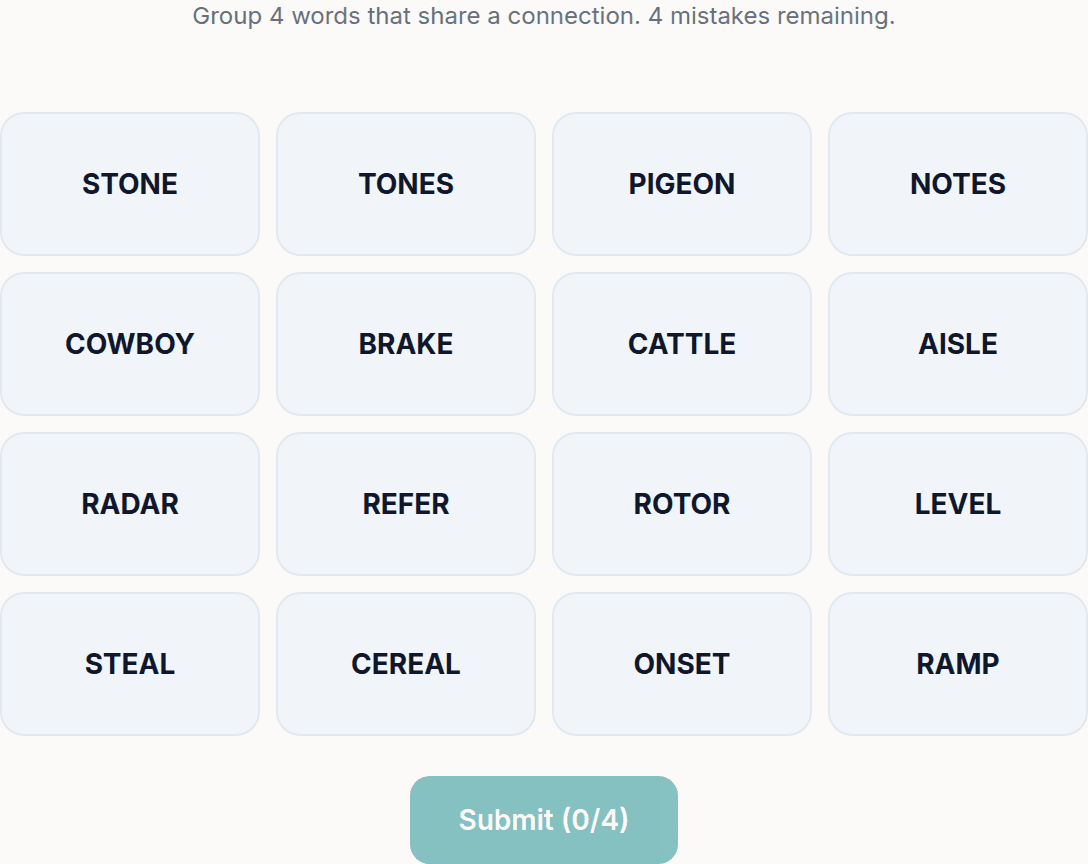
A new Sudoku and a new Connections board every day. No download, no account.


Keep reading
Take the puzzle with you
Free Word Search PDF — KDP Large-Print Word Search
Print-ready · answer key included · unsubscribe anytime
Ready to build?
Build this book free in the PuzzlePage Book Studio
18 puzzle types, KDP margins and a full-wrap cover. Download the first 10 pages and the cover free.
Or start from a ready-made book template, or see books other publishers made here.
Enjoyed this? Share the puzzle on X
Like puzzles like this? Follow on Pinterest for a new one every day.