Kindergarten Sight Word Scramble Worksheets [Free]
Free printable kindergarten sight word scramble worksheets covering all 52 Dolch pre-primer and primer words. Teacher lesson plan tips included.

- 1.
- 2.
- 3.
- 4.
- 5.
- 6.
- 7.
- 8.
- 9.
- 10.
- 11.
- 12.
Word bank
Sight Word Scramble
Unscramble 12 kindergarten sight words
- 1.OKOL
- 2.PYAL
- 3.MJUP
- 4.IKLE
- 5.OECM
- 6.EHPL
- 7.AMEK
- 8.OODG
- 9.ANTW
- 10.TSIH
- 11.ATTH
- 12.LWLI
Word Bank
LOOK · PLAY · JUMP · LIKE · COME · HELP · MAKE · GOOD · WANT · THIS · THAT · WILL
Free companion PDF
Sight Word Scramble
Unscramble 12 kindergarten sight words. Grab the PDF now and we'll send 10 more printable puzzles, plus a heads-up when new generators or seasonal packs go live. Roughly two emails a month — unsubscribe anytime.
No payment · Letter-size · Answer key included
Prefer to play online? There's a new puzzle every day.
Free daily word games — play instantly. Come back tomorrow for a fresh one.
On this site: Create a free sight word scramble worksheet·Browse 100+ free printables·Play today's puzzles
A kindergarten sight word scramble takes the 52 Dolch words your students already see every day and turns them into a low-pressure pattern-recognition activity. Sight words like the, and, see, look, and play get rearranged into short anagrams that kids decode by sounding out and matching letters. This article gives you two ready-to-print scramble tables, a breakdown of the Dolch pre-primer and primer lists, and four ways to drop the worksheet into your weekly literacy plan.
I run a small literacy center rotation for a class of 18 kindergartners, and last September I tested a 10-word sight word scramble with the morning group. Fourteen of eighteen kids finished it without raising a hand, which told me the format was developmentally on target. The other four needed a partner read, which is its own win.
📌 Key Takeaways
- A kindergarten sight word scramble reinforces letter order and word recognition at the same time
- The Dolch list has 40 pre-primer and 52 primer words, and most are 3 to 5 letters long
- Three difficulty tiers: 3-letter words (the, and, can), 4-letter words (with, like, jump), 5-letter words (where, funny, three)
- Works as a literacy center, a sub plan, a partner read warm-up, or a homework page
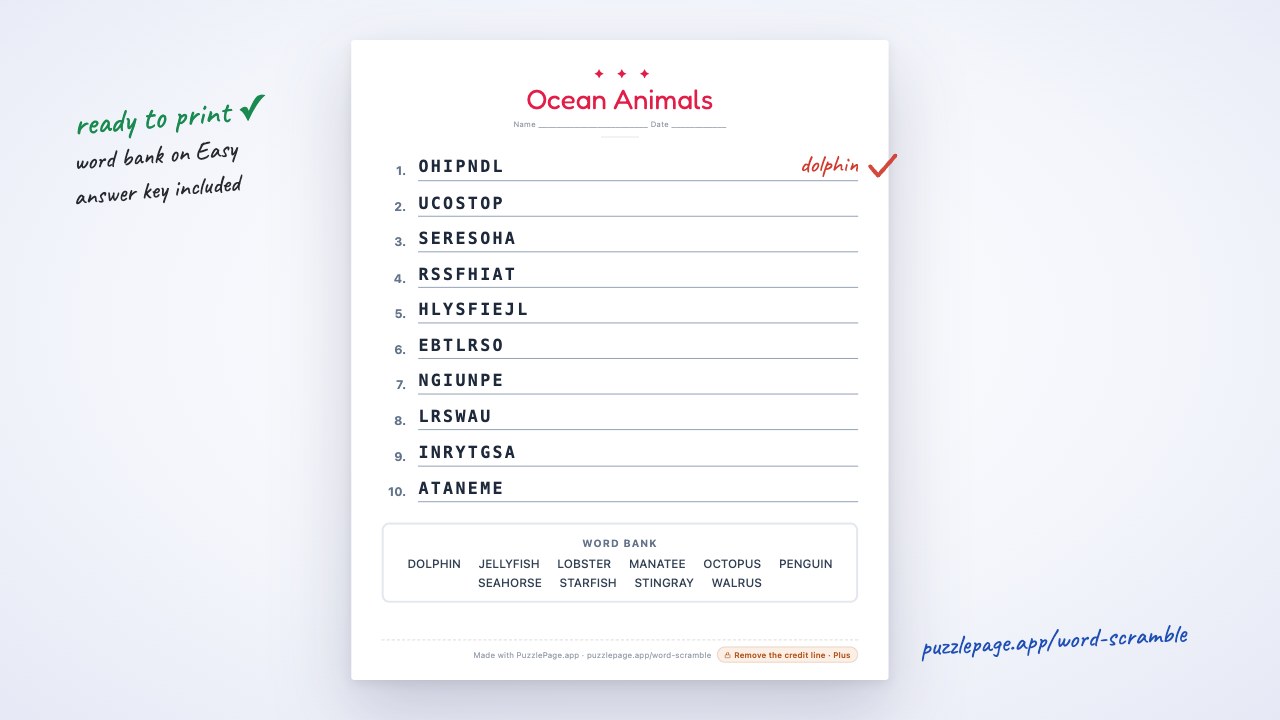
- PuzzlePage's free word scramble generator builds a print-ready PDF with answer key in under a minute
 0:50
0:50Why Sight Word Scrambles Work in Kindergarten
Sight words are the small high-frequency words a beginning reader is expected to recognize on sight instead of sounding out. The challenge for many five- and six-year-olds is that words like the, was, and where don't follow the phonics rules they just learned. A scramble forces the brain to encode the letters visually and rebuild the word from memory, which is exactly the skill sight word practice is meant to build.
There is a second reason it works. Unscrambling is a low-stakes puzzle, not a test. A child who freezes when asked to "read this word out loud" will happily slide letter tiles around to make THE out of HTE, because the activity feels like a game.
The format also self-differentiates. A child reading at level A can decode NCA as CAN while a level C reader in the same group is working on HEWRE as WHERE, and both feel successful at the same table.
Pro Tip
Before kids start the worksheet, post the full word bank on the board in a visible spot. A scramble is not a memory test, and giving the answers up front shifts the activity from "do I know this?" to "can I match the letters?" which is the actual skill you are training.
Free Word Scramble PDF — Sight Word Scramble
Print-ready · answer key included · unsubscribe anytime
The Dolch Sight Word List: Pre-Primer and Primer
Dr. Edward Dolch published his list of high-frequency words in 1948, and it remains the backbone of most kindergarten and first grade sight word programs. The pre-primer list has 40 words intended for the beginning of kindergarten, and the primer list adds 52 more words for the end of kindergarten through early first grade. Together that is 92 words, almost all of them 2 to 5 letters long.
Below is a representative sample of 20 Dolch words organized into three difficulty tiers. The full lists are widely available from sources like Reading Rockets, and you can drop any subset into the PuzzlePage word scramble generator to build a custom worksheet.
The three tiers below give you a built-in differentiation ladder. Most kindergarten classrooms have readers across all three at the same time, so a single worksheet that mixes tiers usually beats three separate worksheets.
- Tier 1 (3 letters): the, and, can, see, you, big, for, get, not, run
- Tier 2 (4 letters): with, like, jump, help, play, look, must, good, that, here
- Tier 3 (5 letters): where, funny, three, black, brown, white, which, green, there, every
Sample Sight Word Scramble Table 1: Tier 1 and 2 Mix
This first table is what I hand to my morning small group on a Monday. The mix of 3- and 4-letter words means every student finds a starting point, and the easier words at the top build confidence before the trickier ones at the bottom.
| Scrambled | Answer |
|---|---|
| HTE | THE |
| DNA | AND |
| NCA | CAN |
| ESE | SEE |
| OUY | YOU |
| IWTH | WITH |
| KLIE | LIKE |
| MJUP | JUMP |
| PELH | HELP |
| YPLA | PLAY |
After the table, give kids two minutes to read each word out loud in order. Saying the words after solving them is the bridge from "I unscrambled letters" to "I can read this word on the page next time," which is the actual literacy goal.
Pro Tip
For students still mastering letter formation, add a "write it three times" line under each answer column. Triple writing the unscrambled word turns the puzzle into a handwriting page without adding a second worksheet to your prep stack.
Sample Sight Word Scramble Table 2: Tier 3 Challenge
This second table is the one I save for Wednesday or Thursday once kids have already seen the Monday worksheet. It uses the harder 5-letter Dolch words and reaches into the primer list. Most kindergartners need a partner or a peek at the word bank for the bottom half, which is fine.
| Scrambled | Answer |
|---|---|
| OOLK | LOOK |
| DOGO | GOOD |
| HTAT | THAT |
| ERHE | HERE |
| HEWRE | WHERE |
| YNFUN | FUNNY |
| HREET | THREE |
| CKLAB | BLACK |
| NEERG | GREEN |
| ERHTE | THERE |
Notice how Tier 3 mixes color words with directional and quantity words. That mix is intentional. Color words anchor the student in vocabulary they already use verbally, while words like where and there push them into sight words they are still learning to recognize cold.
Four Ways to Use the Worksheet in Your Week
The sight word scramble is the worksheet; how you place it in the day is what makes it stick. Here are four configurations that fit a normal kindergarten schedule without adding prep time.
Literacy center rotation
Drop one scramble worksheet at the independent reading station. Kids who finish their book early grab the scramble and work it solo. The station becomes a self-managing 15-minute slot in your rotation.
Sub plan in your folder
Print 25 copies of a Tier 1 scramble and leave them in the emergency sub folder. A substitute teacher who doesn't know your phonics curriculum can still run a productive 20-minute literacy block with this single worksheet.
Partner read warm-up
Pair a stronger reader with a developing reader and give them one shared scramble. The stronger reader reads each scrambled cluster, the developing reader writes the answer. Five minutes of this before a shared decodable book makes the book itself feel easier.
Friday homework page
Send the worksheet home Friday with a parent note explaining what sight words are. Most parents have never been told the word "Dolch," and one short note converts the homework page into a teaching moment for the family.
Teachers building a fuller literacy week can pair the scramble with a sight word search on the same word list. The two formats train slightly different skills (letter sequencing versus letter scanning) and reinforce the same vocabulary twice. Our guide to using a word search generator for teachers walks through grid sizing for kindergarten, and the animal word search collection works well as a Friday treat once the week's sight word goals are met.
Print Your Own Kindergarten Sight Word Scramble
If you want to print one of the tables above, or build your own list (your district's sight word sequence, your weekly word wall, a holiday set), the PuzzlePage free word scramble generator takes about a minute total, and the PDF keeps a clean, readable grid.
- Type or paste your sight word list (10 to 20 words works best for kindergarten).
- Click Generate to scramble each word into a true anagram.
- Download the PDF with the answer key on a separate page.
- Print double-sided to save paper, or run one copy per student.
For a sight word scramble that fits your exact week, dropping in your current word wall takes about 90 seconds. Once you have the file, save it as a template and rotate the word list each Monday for a year of weekly practice.
Frequently Asked Questions
What is a kindergarten sight word scramble?
A kindergarten sight word scramble is a worksheet that takes high-frequency Dolch words like the, and, and see and rearranges their letters into a short anagram. Students unscramble each one back to the original word, reinforcing visual letter recognition and sight word recall at the same time.
How many Dolch sight words should I cover in kindergarten?
Most kindergarten programs target the 40 pre-primer words by midyear and the 52 primer words by the end of the year, for a total of 92 sight words. A weekly scramble that covers 10 words at a time matches that pacing well, with review sessions every fourth week.
Are sight word scrambles too hard for kindergarten students?
No, as long as you start with 3-letter words and post the word bank on the board. Most kindergartners can solve a 3-letter scramble by mid-September, a 4-letter one by November, and 5-letter Dolch words by February. The visible word bank removes the memory test and keeps the focus on letter matching.
How do I print a free sight word scramble PDF?
Drop your sight word list into the free generator at puzzlepage.app/word-scramble and click "Generate PDF." The download is a print-ready worksheet with the answer key on a separate page, at no cost.
Live demo
Make your own word scramble right here
Swap in your own words (a spelling list, residents' names, a unit's vocabulary) and press Generate. The full maker adds answer keys, size options and PDF export.
More you can make here
One puzzle is the start. Here is the rest of the kit.
 New
NewWorksheet Builder
Put a word search, a cryptogram and a scramble on one page, or build a whole themed packet. Prints with answer keys.
Build a worksheet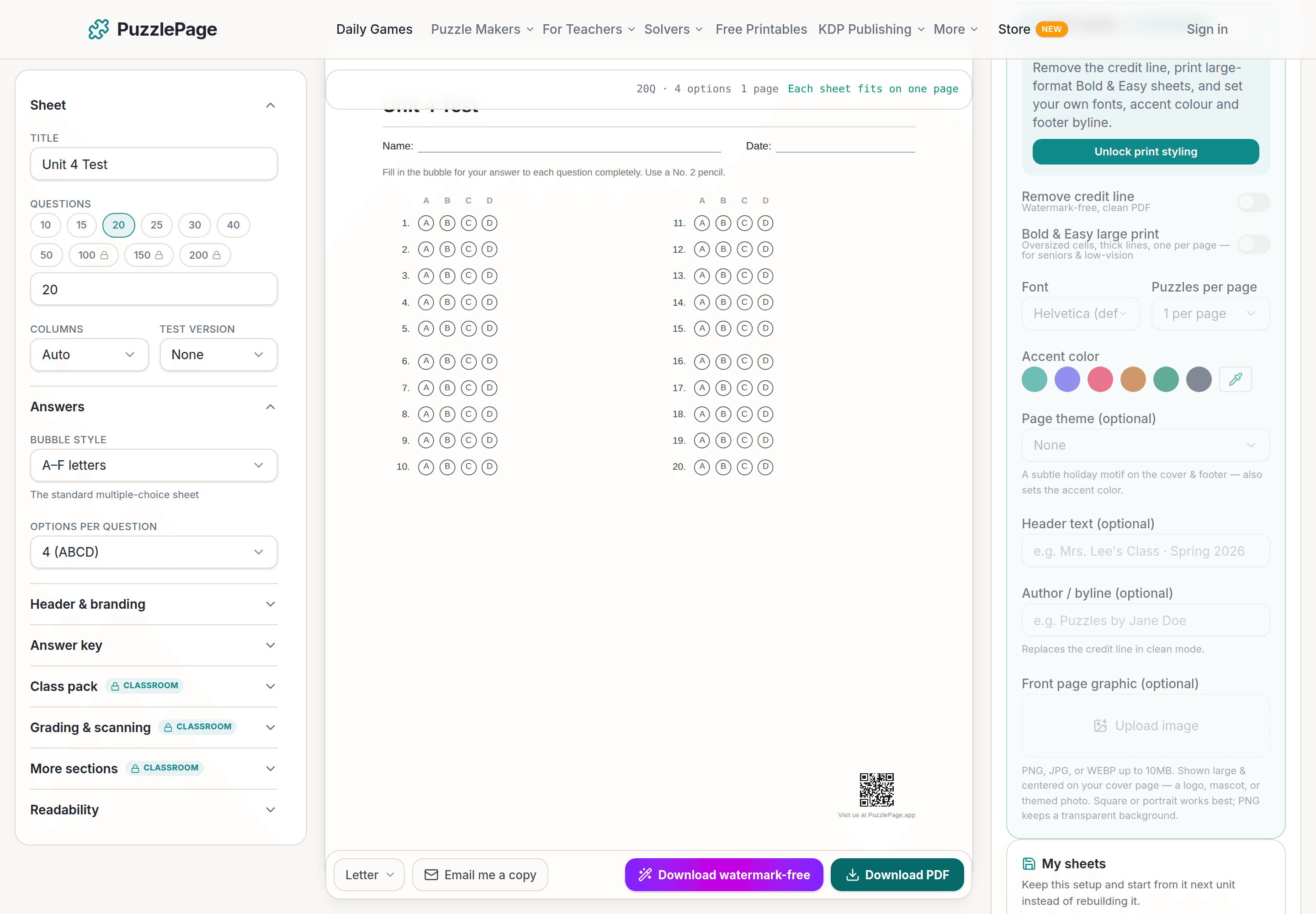
Bubble Sheet Studio
Answer sheets for any test length, with sections, versions, student ID grids and a matching answer key.
Make a bubble sheet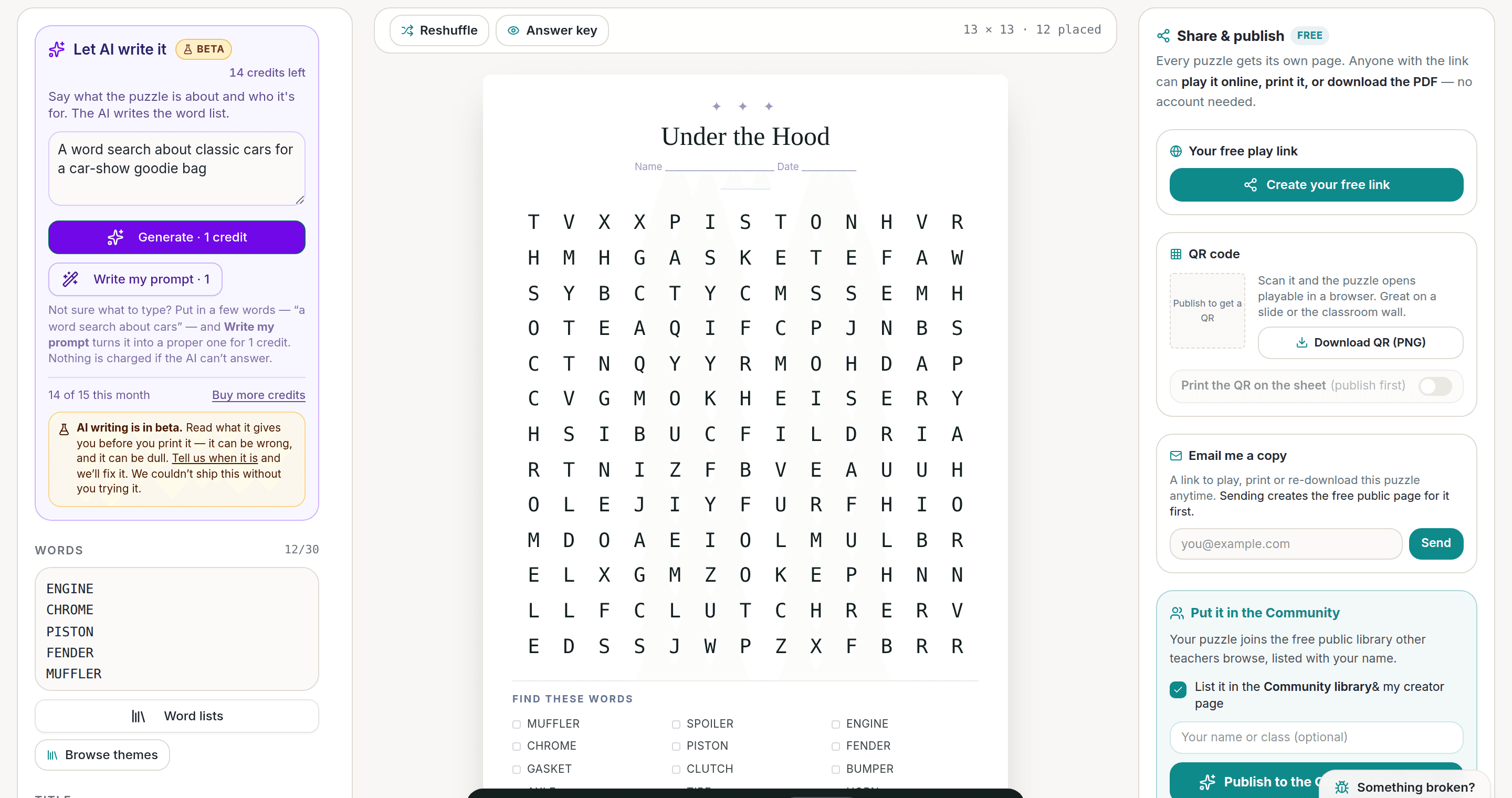
AI Puzzle Generator
Type a topic, get a themed word list and a finished puzzle. Premium also removes the footer credit and adds Word export.
Try the AI generator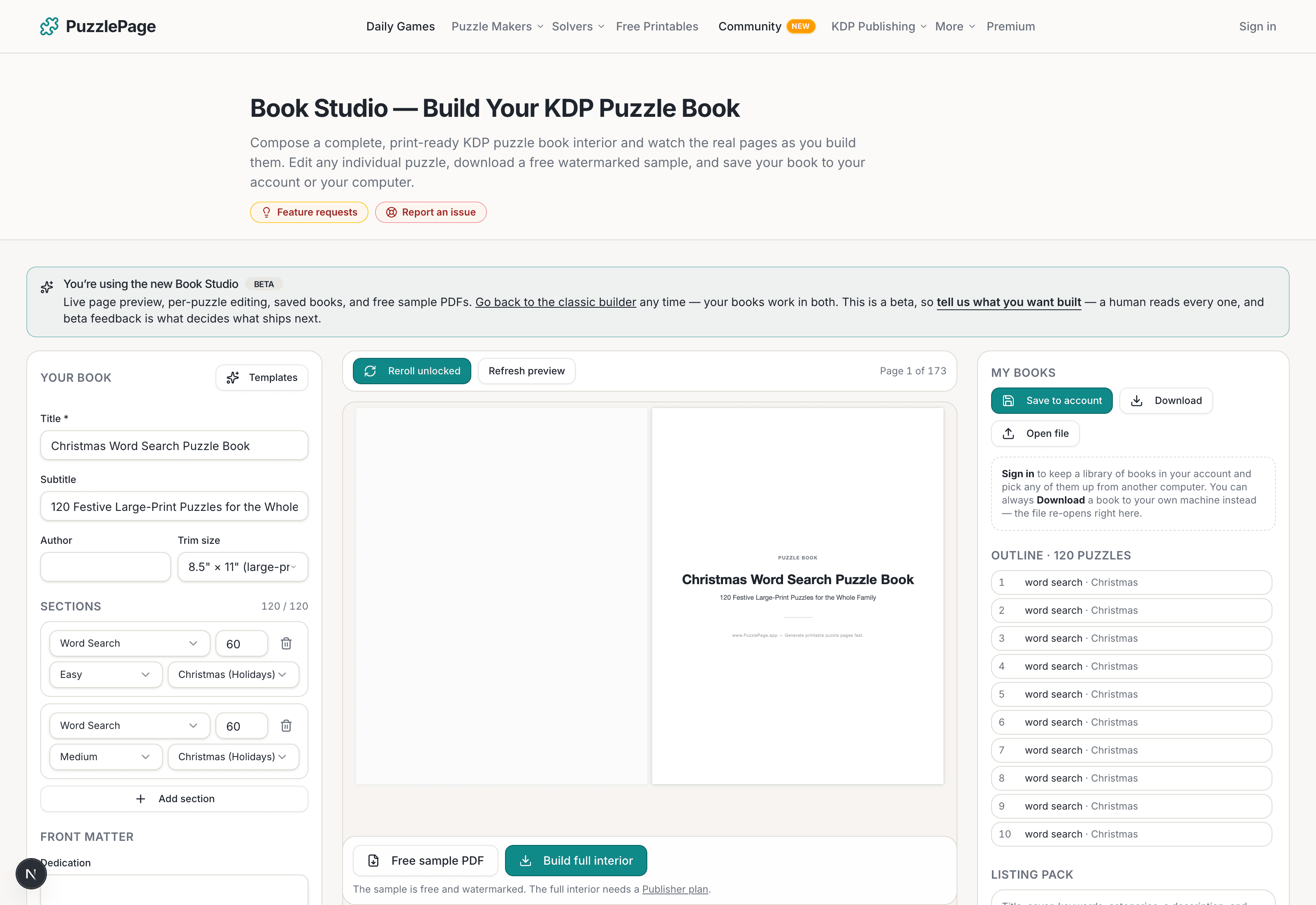
KDP Book Studio
Lay out a full puzzle book for Amazon KDP: templates, trim sizes, page checks and a cover designer.
Start a puzzle bookPremium removes the footer credit, adds Word export and custom styling across every maker.
See plans →Free daily games
Need a two-minute break? Today's puzzles are live.
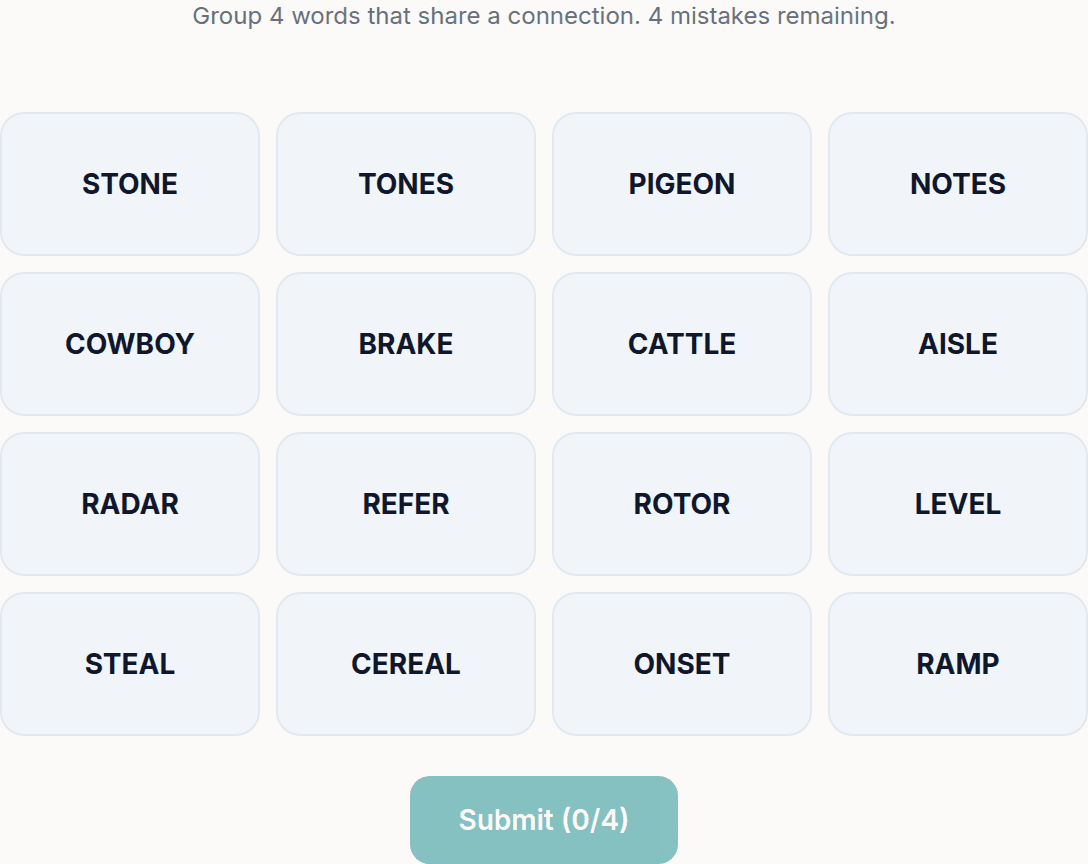
A new Sudoku and a new Connections board every day. No download, no account.


Keep reading
Take the puzzle with you
Free Word Scramble PDF — Sight Word Scramble
Print-ready · answer key included · unsubscribe anytime
Enjoyed this? Share the puzzle on X
Like puzzles like this? Follow on Pinterest for a new one every day.