Animal Word Search Printables for Kids [Free PDF]
Free printable animal word search puzzles for kids. Organized by habitat: zoo, farm, ocean, jungle, forest, desert, Arctic. Grades K-2, 3-5, 6-8 difficulty.

Find these words
- DOLPHIN
- ELEPHANT
- GIRAFFE
- HORSE
- KANGAROO
- LION
- MONKEY
- PANDA
- PARROT
- PENGUIN
- RABBIT
- TIGER
- TURTLE
- ZEBRA
Drag across the grid to trace each hidden word.
Animal Word Search
15 favorite animals for young puzzlers
Word List
- ELEPHANT
- KANGAROO
- GIRAFFE
- DOLPHIN
- PENGUIN
- MONKEY
- RABBIT
- TURTLE
- PARROT
- TIGER
- ZEBRA
- PANDA
- HORSE
- LION
Free companion PDF
Animal Word Search
15 favorite animals for young puzzlers. Grab the PDF now and we'll send 10 more printable puzzles, plus a heads-up when new generators or seasonal packs go live. Roughly two emails a month — unsubscribe anytime.
No payment · Letter-size · Answer key included
Prefer to play online? There's a new puzzle every day.
Free daily word games — play instantly. Come back tomorrow for a fresh one.
On this site: Create a free animal word search·Browse 100+ free printables·Play today's puzzles
An animal word search for kids is one of the most reliable activities in a teacher's or parent's back pocket. Animals are universally interesting, the vocabulary stretches naturally across grade levels, and the printable lives equally well on a kindergarten table or a fifth-grade reading center. This guide organizes seven habitat-themed puzzles by grade band, with a sample word list for each and ideas for tying the activity to vocabulary work.
Every list below is sized to drop directly into PuzzlePage's free word search generator. You will get a print-ready PDF with the answer key included, in under two minutes.
📌 Key Takeaways
- Seven habitat-themed animal word searches cover zoo, farm, ocean, jungle, forest, desert, and Arctic species
- Each puzzle is sized to a grade band (K-2, 3-5, or 6-8) so the word list and grid size match the reader
- Habitat is a stronger frame than "animals in general" because it ties directly to elementary science vocabulary
- PuzzlePage's free word search generator handles grid size, word directions, and answer key in under two minutes
- Pair each puzzle with a 2 to 3 sentence habitat sentence to turn a free animal word search printable into real vocabulary work
 1:02
1:02Why Habitat Is the Right Frame for an Animal Word Search for Kids
A generic "animal word search" can include anything from elephants to butterflies to barnyard chickens. That mix is fine for early-finisher minutes, but it does not give a teacher any handle on grade-level vocabulary, science standards, or read-aloud tie-ins.
Habitat changes that. When the puzzle is "Ocean animals" rather than "animals," the words start to align with the elementary science vocabulary kids are already learning: producer, consumer, food chain, ecosystem, adaptation.
I built a habitat unit last fall for a third grade class of 24 students and 19 of them could name the habitat of every puzzle word by the end of the week. The puzzle did not do the teaching. It served as the visual anchor that kept the vocabulary in front of them all week.
Habitat also gives parents and homeschoolers a way to sequence the activities. A zoo trip, a farm visit, an aquarium morning, a forest hike, each turns into a printable kids can do on the car ride or that evening. Reading Rockets talks about exactly this kind of repeated, themed exposure as a way young readers move new words from "I have heard it" to "I can use it."
There is a second reason habitat works as a frame: it gives the teacher a built-in next question. After kids finish the Arctic puzzle, the conversation moves naturally to "what do these animals have in common?" That is a vocabulary stretch (cold climate, blubber, fur, migration) that would feel forced if the puzzle were a random animal mix.
The same is true at the kindergarten end. After the farm puzzle, you can ask which animals lay eggs, which animals give milk, which animals are mammals. The grid is the prompt; the conversation is the lesson.
Pro Tip
Print two versions of the same habitat puzzle: one with the word bank visible (easier) and one with the word bank hidden (harder). Same vocabulary, two differentiation tiers, one minute of extra work in the generator.
Free Word Search PDF — Animal Word Search
Print-ready · answer key included · unsubscribe anytime
The Seven Habitats at a Glance
Here is the master table of all seven habitat puzzles in this guide, with grade band, recommended grid size, and a vocabulary tie-in suggestion.
| Habitat | Grade band | Grid size | Vocabulary tie-in |
|---|---|---|---|
| Zoo | K-2 | 10x10 | Animal names, syllable claps |
| Farm | K-2 | 10x10 | Animal sounds, sight words |
| Ocean | 3-5 | 15x15 | Marine biome, food chain |
| Jungle | 3-5 | 15x15 | Rainforest layers, canopy |
| Forest | 3-5 | 15x15 | Seasons, life cycle |
| Desert | 6-8 | 15x15 | Adaptation, climate |
| Arctic | 6-8 | 15x15 | Climate zones, blubber |
Zoo, Farm, and Ocean Habitats
1. Zoo Animals (K-2, 10x10 grid)
The zoo list leans on animals kids recognize from picture books and field trips. Short to medium word length, easy to scan.
Word list: LION, TIGER, BEAR, ZEBRA, GIRAFFE, MONKEY, ELEPHANT, KANGAROO, PANDA, SEAL, PARROT, FLAMINGO.
Grade-level adaptation: For K-1, drop to 8 words (LION, TIGER, BEAR, ZEBRA, MONKEY, PANDA, SEAL, PARROT) and a 10x10 grid with horizontal and vertical only.
Vocabulary tie-in: After solving, ask kids to clap the syllables in each animal name. GI-RAFFE is two claps, KAN-GA-ROO is three.
2. Farm Animals (K-2, 10x10 grid)
Familiar barnyard species, ideal for emergent readers and as a follow-up to a farm field trip.
Word list: COW, PIG, HEN, DUCK, SHEEP, GOAT, HORSE, RABBIT, TURKEY, DONKEY, GOOSE, LAMB.
Grade-level adaptation: Kindergarteners do well with this exact list. For grade 2, add CALF, CHICK, and FOAL for a baby-animals stretch.
Vocabulary tie-in: Pair the puzzle with a sound-matching activity (the cow says MOO, the duck says QUACK). This works as a phonemic awareness warm-up.
3. Ocean Animals (3-5, 15x15 grid)
A stronger vocabulary list that supports a marine-biome science unit. Includes some longer words to build reading endurance.
Word list: DOLPHIN, WHALE, OCTOPUS, JELLYFISH, STARFISH, SEAHORSE, SHRIMP, CRAB, LOBSTER, TURTLE, STINGRAY, CLOWNFISH, MANATEE, NARWHAL.
Grade-level adaptation: For grade 3, use horizontal and vertical only. For grade 5, add diagonals.
Vocabulary tie-in: Sort the animals into mammal, fish, and invertebrate columns after solving. NARWHAL is a mammal, JELLYFISH is an invertebrate.
Pro Tip
For the ocean puzzle, hand out blue colored pencils for circling instead of standard pencils. The visual reinforcement (ocean = blue) is small but kids remember it.
Jungle, Forest, Desert, and Arctic Habitats
4. Jungle Animals (3-5, 15x15 grid)
Rainforest-themed list that supports a layers-of-the-jungle science unit (forest floor, understory, canopy, emergent).
Word list: TOUCAN, SLOTH, JAGUAR, GORILLA, ORANGUTAN, IGUANA, CHAMELEON, MACAW, ANTEATER, CAPYBARA, FROG, TAPIR.
Grade-level adaptation: Strong fit for grade 4. For grade 3, swap out ANTEATER and CAPYBARA for shorter words like SNAKE and BAT.
Vocabulary tie-in: After solving, ask kids to place each animal in a rainforest layer. SLOTH lives in the canopy, JAGUAR lives on the forest floor.
5. Forest Animals (3-5, 15x15 grid)
Temperate forest species kids can connect to local hikes and state parks. Friendly word list, no scary themes.
Word list: DEER, FOX, OWL, RACCOON, SQUIRREL, RABBIT, BEAVER, CHIPMUNK, SKUNK, BADGER, HEDGEHOG, MOOSE.
Grade-level adaptation: Works as-is for grades 3 to 5. For a stretch version, add OPOSSUM, PORCUPINE, and WOODPECKER.
Vocabulary tie-in: Pair with a seasons activity. Which forest animals hibernate in winter? Which ones stay active year-round?
6. Desert Animals (6-8, 15x15 grid)
A middle school list that supports an adaptation and climate science unit. Drier word list with some real vocabulary stretch.
Word list: CAMEL, COYOTE, ROADRUNNER, RATTLESNAKE, GILA, TARANTULA, SCORPION, MEERKAT, FENNEC, JERBOA, ARMADILLO, TORTOISE.
Grade-level adaptation: Standard for grade 7. For grade 6, drop GILA and JERBOA. For grade 8, add ADDAX and ORYX.
Vocabulary tie-in: Ask students to name one adaptation for each animal. The CAMEL stores fat in its hump. The FENNEC fox has oversized ears for heat dissipation.
7. Arctic Animals (6-8, 15x15 grid)
Cold-climate species, fits a climate zones or biomes unit. Good vocabulary stretch with words like LEMMING and WALRUS.
Word list: POLARBEAR, WALRUS, SEAL, REINDEER, MOOSE, ARCTICFOX, LEMMING, PUFFIN, BELUGA, NARWHAL, MUSKOX, SNOWYOWL.
Grade-level adaptation: Works for grades 6 to 8. For grade 6, replace MUSKOX with HARE.
Vocabulary tie-in: Discuss blubber as an adaptation. Which animals on the list rely on blubber for insulation, and which rely on fur?
Pro Tip
Compound-word animals like POLARBEAR, ARCTICFOX, and SNOWYOWL are placed without spaces in the grid because word search generators treat spaces as breaks. Tell kids ahead of time so they scan for the full string.
How to Build Each Puzzle in Under Two Minutes
PuzzlePage's free word search generator is built to handle any of the seven word lists above without configuration headaches.
- Open the word search generator and paste one of the habitat word lists above.
- Set the grid size to match the grade band: 10x10 for K-2, 15x15 for grades 3 to 8.
- Choose word directions. Horizontal and vertical only for K-3, add diagonals for grade 4 and up, add reverse words for grade 6 and up.
- Click Generate PDF. The download includes the puzzle, the word bank, and the answer key.
- Print on standard paper, single-sided if you want to use the answer key separately as a teacher reference.
For a vocabulary extension that goes beyond pattern-finding, pair each habitat puzzle with a quick word scramble using three or four of the same animal names. The companion word search generator guide for teachers has more on grid sizing, and the kindergarten sight word scramble worksheets post covers the K-1 reading angle.
Try It Yourself
Any of the seven habitat lists above will give you a free animal word search printable in under two minutes. Build one habitat as a sample, see how the layout looks at your grade band, then run the other six over a week or two.
Homeschoolers often run all seven as a single biomes unit, one habitat per day. Classroom teachers tend to align each puzzle to a current science chapter. Parents print whichever one matches the next field trip.
Same generator, same free PDF, three very different uses.
A small note for teachers building a year-long file: save each habitat PDF in a folder named by science unit, with the grade band in the file name. After two school years you will have a complete library of differentiated animal vocabulary puzzles you can reuse every semester without rebuilding anything from scratch.
Frequently Asked Questions
What grade levels does an animal word search for kids work best for?
All seven habitat puzzles in this guide span kindergarten through grade 8. Zoo and farm lists are sized for K-2 with a 10x10 grid, ocean and jungle and forest for grades 3 to 5 at 15x15, and desert and Arctic for grades 6 to 8 with optional reverse word directions.
Are these animal word search printables free to download?
Yes. PuzzlePage's word search generator at puzzlepage.app/word-search lets you paste any of the lists above and download a print-ready PDF with the answer key at no cost. The puzzle grid stays clean and readable.
Can I make a dinosaur word search printable with the same tool?
Yes. Paste a dinosaur list (TREX, STEGOSAURUS, TRICERATOPS, BRACHIOSAURUS, RAPTOR, PTERODACTYL, ANKYLOSAURUS, DIPLODOCUS) into the same generator, set a 15x15 grid, and download the PDF. The format works identically for any themed word list.
How do I make these animal word searches harder for older kids?
Three settings increase difficulty without changing the word list. Add diagonal words, then add reverse words, then hide the word bank so kids have to remember what they are searching for. Each change is one click in the generator.
Live demo
Make your own word search right here
Swap in your own words (a spelling list, residents' names, a unit's vocabulary) and press Generate. The full maker adds answer keys, size options and PDF export.
More you can make here
One puzzle is the start. Here is the rest of the kit.
 New
NewWorksheet Builder
Put a word search, a cryptogram and a scramble on one page, or build a whole themed packet. Prints with answer keys.
Build a worksheet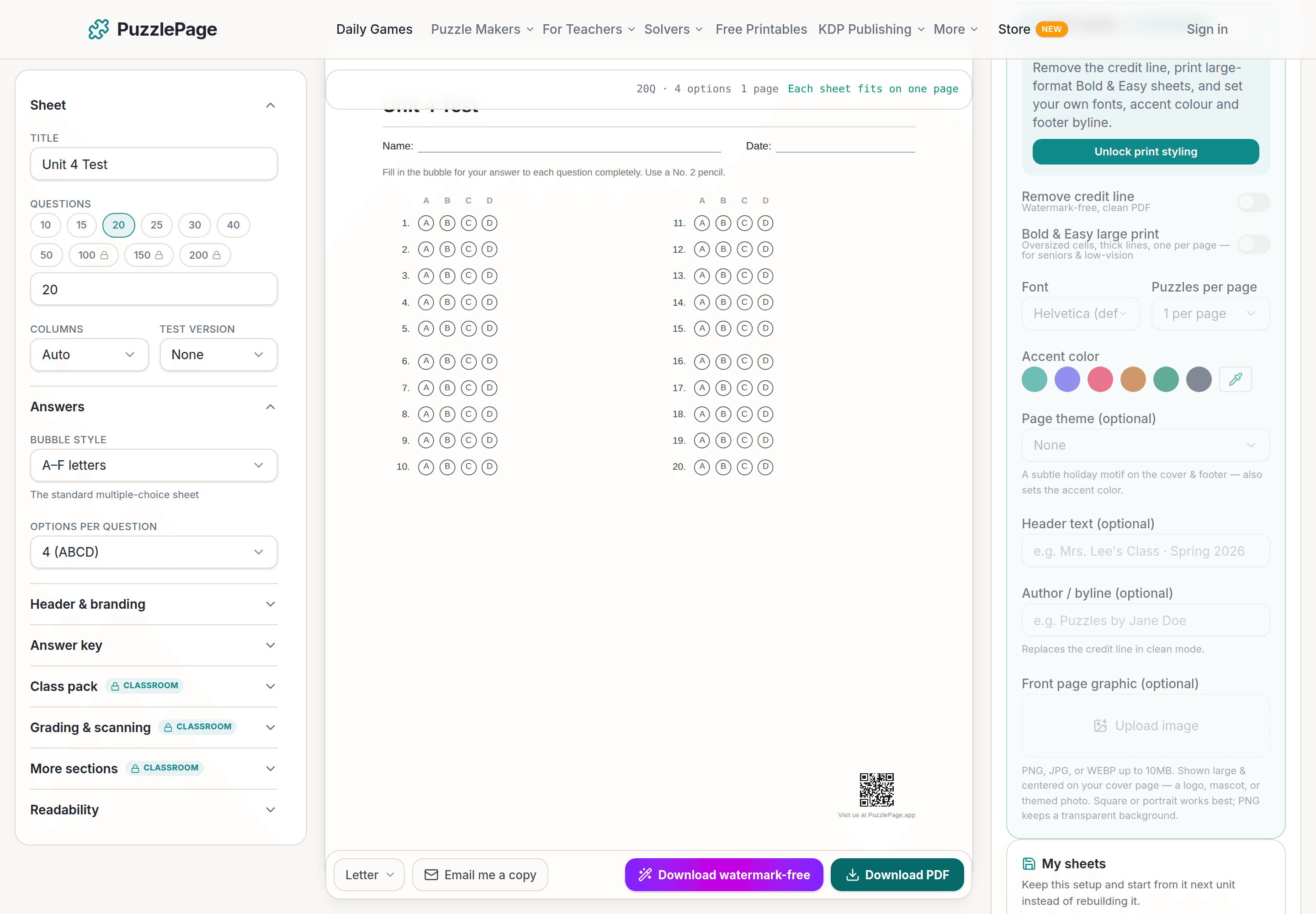
Bubble Sheet Studio
Answer sheets for any test length, with sections, versions, student ID grids and a matching answer key.
Make a bubble sheet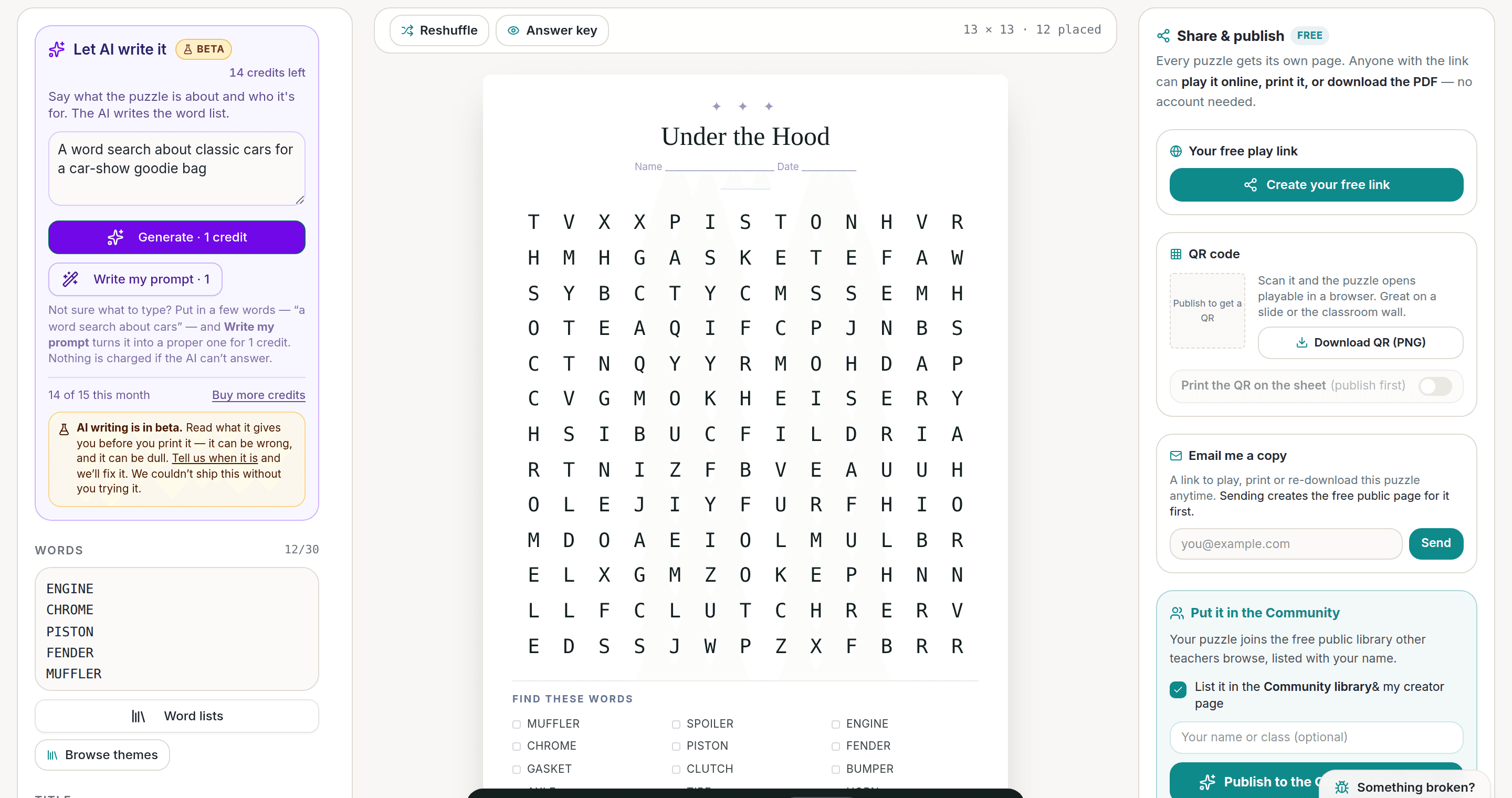
AI Puzzle Generator
Type a topic, get a themed word list and a finished puzzle. Premium also removes the footer credit and adds Word export.
Try the AI generator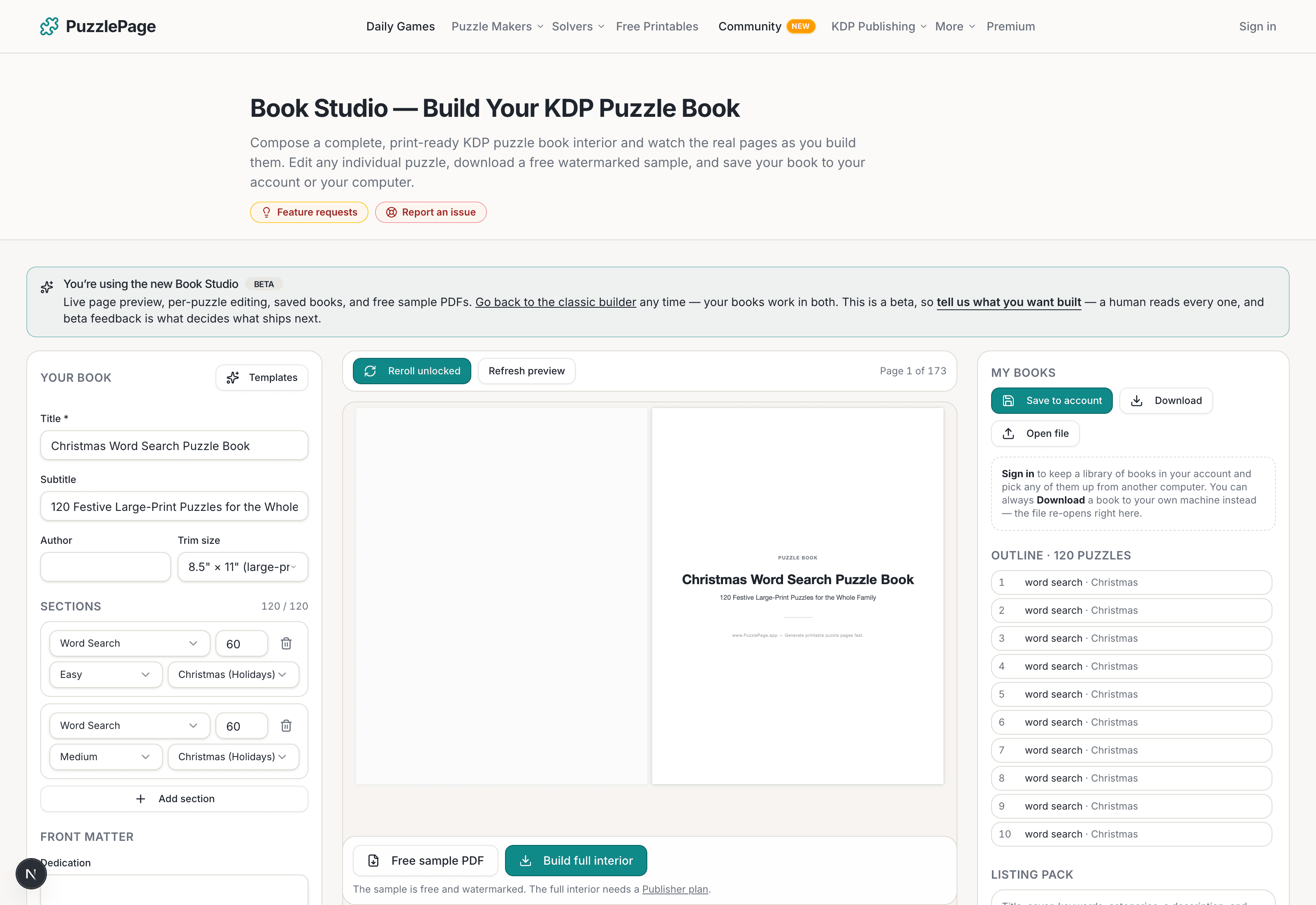
KDP Book Studio
Lay out a full puzzle book for Amazon KDP: templates, trim sizes, page checks and a cover designer.
Start a puzzle bookPremium removes the footer credit, adds Word export and custom styling across every maker.
See plans →Free daily games
Need a two-minute break? Today's puzzles are live.
A new Sudoku and a new Connections board every day. No download, no account.


Keep reading
Take the puzzle with you
Free Word Search PDF — Animal Word Search
Print-ready · answer key included · unsubscribe anytime
Related printable themes
All themesEnjoyed this? Share the puzzle on X
Like puzzles like this? Follow on Pinterest for a new one every day.