Word Unscrambler & Anagram Solver: How They Work and When to Use Them
A complete guide to word unscramblers and anagram solvers — how they work under the hood, which letter patterns are hardest to solve, and how to choose the right tool for crosswords, Scrabble, and puzzle games.

- 1.
- 2.
- 3.
- 4.
- 5.
- 6.
- 7.
- 8.
- 9.
- 10.
- 11.
- 12.
Anagram Practice Scramble
Unscramble 12 words to sharpen your anagram skills
- 1.MNGAARA
- 2.ELTREST
- 3.UBLEMJ
- 4.ZLZPUE
- 5.LEWVOS
- 6.VORLSE
- 7.NATRTPE
- 8.SHFULEF
- 9.ODEEDC
- 10.AAEGNRR
- 11.GAMNINE
- 12.INSLTE
Free companion PDF
Anagram Practice Scramble
Unscramble 12 words to sharpen your anagram skills. Grab the PDF now and we'll send 10 more printable puzzles, plus a heads-up when new generators or seasonal packs go live. Roughly two emails a month — unsubscribe anytime.
No payment · Letter-size · Answer key included
Prefer to play online? There's a new puzzle every day.
Free daily word games — play instantly. Come back tomorrow for a fresh one.
On this site: Try the free word unscrambler·Browse 100+ free printables·Play today's puzzles
A word unscrambler is the single most-used puzzle tool on the internet. People reach for one when they're stuck on a word scramble worksheet, a Scrabble rack, a Wordle clue, a crossword fill, or a tip-of-the-tongue word they almost remember. This guide explains how unscramblers actually work, the letter patterns that defeat them, and the right way to use one without ruining the puzzle for yourself.
📌 Key Takeaways
- A word unscrambler is just a fast dictionary lookup keyed on sorted letters — the underlying algorithm is simple
- The hardest letters to unscramble aren't rare letters (J, Q, X, Z) — they're combinations of vowels that can form many valid words (E, A, I, O, U all together)
- For Scrabble, sort by point value; for crosswords, filter by length; for Wordle, filter by known letter positions
- Most online unscramblers use the public-domain ENABLE1 wordlist (~172,000 words) — the same dictionary that powers Scrabble's TWL
- PuzzlePage's unscrambler (launching soon) runs entirely in your browser — no server round-trip per query — and works offline once loaded
What a word unscrambler actually does
The internal mechanic is simpler than it looks. Every unscrambler works in three steps:
- Take your input letters and sort them alphabetically. "PUZZLE" becomes "ELPUZZ". This sorted string becomes the key.
- Look up every word in the dictionary that shares the same sorted key. "ELPUZZ" matches PUZZLE. "AEILRT" matches RETAIL, RETIAL, and TAILER.
- Optionally find sub-anagrams. For an input like "RETAIL", also return every shorter word whose sorted letters are a subset: ART, ARE, IRATE, LATER, ALERT, ALTER, and so on.
That's it. The "AI" in most word unscramblers is just a hash map keyed on sorted letters. The dictionary is loaded once when the page opens, and every query after that is a constant-time lookup. Modern unscramblers can serve thousands of queries per second from a single browser tab.
Free Word Scramble PDF — Anagram Practice Scramble
Print-ready · answer key included · unsubscribe anytime
What makes a set of letters hard to unscramble
You'd guess that the hardest scrambles are the ones with rare letters like J, Q, X, or Z. The data says otherwise. Rare letters make scrambles easier, not harder — they sharply narrow the candidate space. A scramble containing a Q almost always contains a U too, and the QU pair anchors the rest of the word almost immediately.
The actually-hardest scrambles are vowel-heavy ones. Consider a 7-letter scramble that contains E, A, I, O, U, R, and N — there are dozens of valid English words hidden in there (RETINA, RAVINE, IRONE, OURIE, plus many more). Without context, you can't choose between them. Computers can list them all instantly, but a human stares at the scramble for minutes.
The second-hardest category is double-letter scrambles — patterns like SS, LL, EE, OO, TT. These appear in ~32% of all common English words, and the doubled letter dramatically expands the candidate list (BUTTER, MUTTER, GUTTER, NUTTER, PUTTER...).
Pro Tip
If you have a vowel-heavy scramble and no anchor, start with the consonants and look for common patterns: TR-, ST-, -ING, -TION. The right consonant cluster narrows a 7-letter scramble from 80+ candidates to 5–10 in seconds.
The three legitimate uses for an unscrambler
Unscramblers have a reputation problem in puzzle communities — using one feels like cheating. There are three contexts where it isn't:
1. Learning, not solving
If you're stuck on a Wordle, a crossword, or a word scramble worksheet for 20 minutes and you've genuinely exhausted your ideas, looking up the answer and reading why it's right teaches you the pattern for next time. The shame is in checking before you've tried; the value is in checking after you've stalled.
2. Scrabble and word-game training
Competitive Scrabble players study every 7-letter rack — they call it a "bingo" study. Running every plausible rack through an unscrambler and memorizing the high-value plays is exactly how top players prepare. You won't beat a tournament player without it.
3. Puzzle book and crossword construction
If you're building a word scramble puzzle for KDP, a crossword, or a classroom activity, an unscrambler is the QA tool that catches the rare case where your "scrambled" letters accidentally form a different valid word that solvers might write down. It's one of the few places where the puzzle creator needs the same tool as the puzzle solver.
How to use an unscrambler for each puzzle type
| Puzzle | Filter setting | What to look at |
|---|---|---|
| Word scramble worksheet | Length = letter count | The single longest match (worksheets always use the full letter set) |
| Scrabble rack | Length 2–7, sorted by point value | Top 5 highest-point plays |
| Crossword fill | Length = exact slot length | Words that match the known-letter mask |
| Wordle | Length = 5, position filter | Words matching greens and not contradicting yellows/grays |
| Anagram pun / riddle | Length = letter count, alphabetical | All matches — the "aha" is usually a synonym of the source |
Why PuzzlePage's unscrambler runs in the browser, not on a server
Most online unscramblers send every query to a server. That feels invisible until you try to use one on a flight, on a subway, or anywhere with flaky cellular — each keystroke pauses for 100–300ms. PuzzlePage's unscrambler (launching soon) takes a different approach: load the ENABLE1 dictionary once when you open the page, then run every query locally in a Web Worker. The first lookup is a few hundred milliseconds (downloading and parsing the dictionary). Every lookup after that is sub-millisecond. Works offline, works on planes, works on the train, works as fast as you can type.
It's also a privacy decision. Your letters never leave your device. We don't log queries, we don't sell scramble data, and the unscrambler never sees an email or an IP.
If you also want to make word scrambles
The inverse tool — generating a scramble from a known word — is on the same site. The PuzzlePage word scramble maker handles classroom worksheets, KDP activity books, and printable letter jumbles with answer keys. Pair the unscrambler (for solving) with the maker (for creating) and you've got both sides of the puzzle covered.
Live demo
Make your own word scramble right here
Swap in your own words (a spelling list, residents' names, a unit's vocabulary) and press Generate. The full maker adds answer keys, size options and PDF export.
More you can make here
One puzzle is the start. Here is the rest of the kit.
 New
NewWorksheet Builder
Put a word search, a cryptogram and a scramble on one page, or build a whole themed packet. Prints with answer keys.
Build a worksheet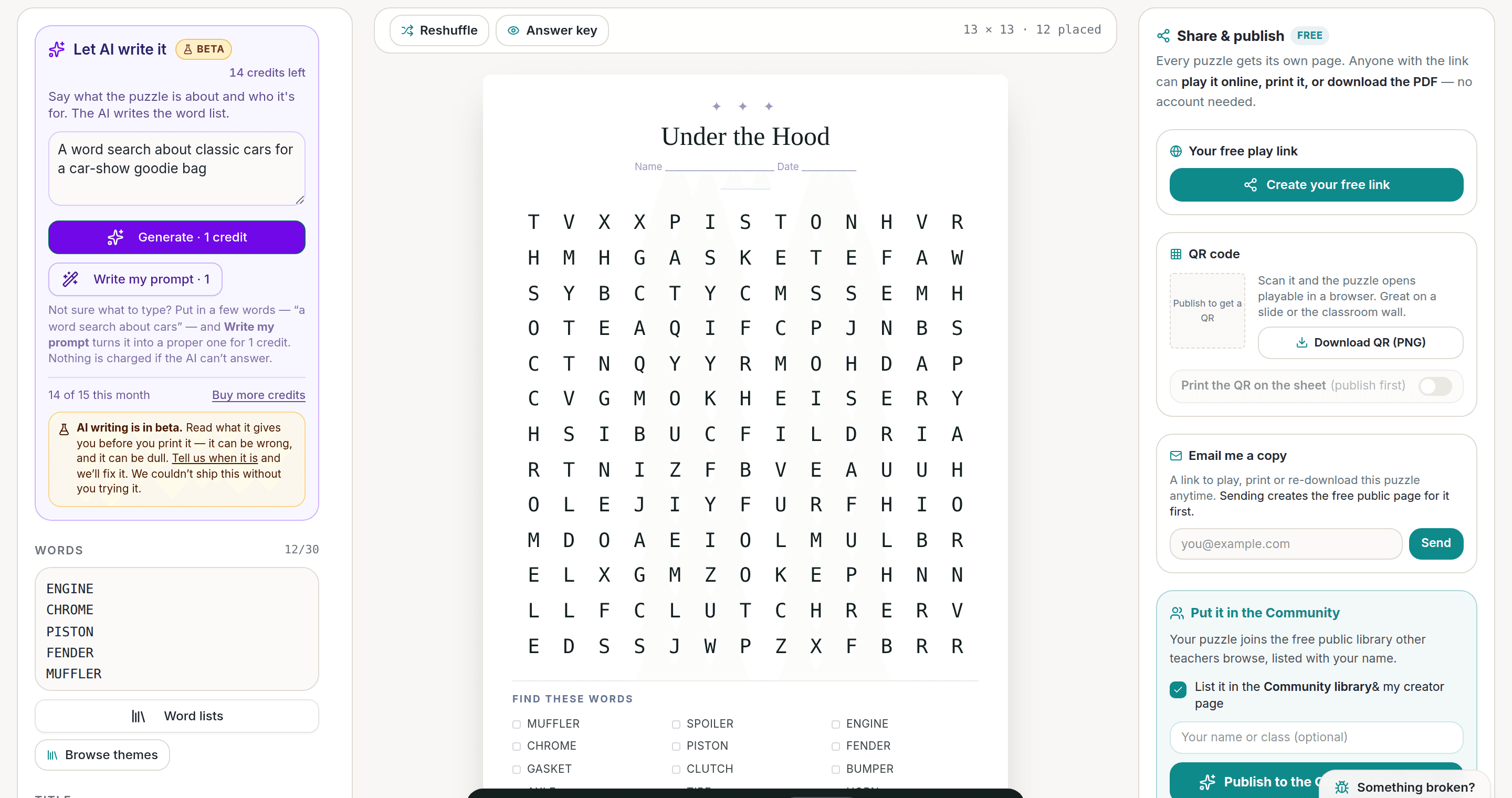
AI Puzzle Generator
Type a topic, get a themed word list and a finished puzzle. Premium also removes the footer credit and adds Word export.
Try the AI generator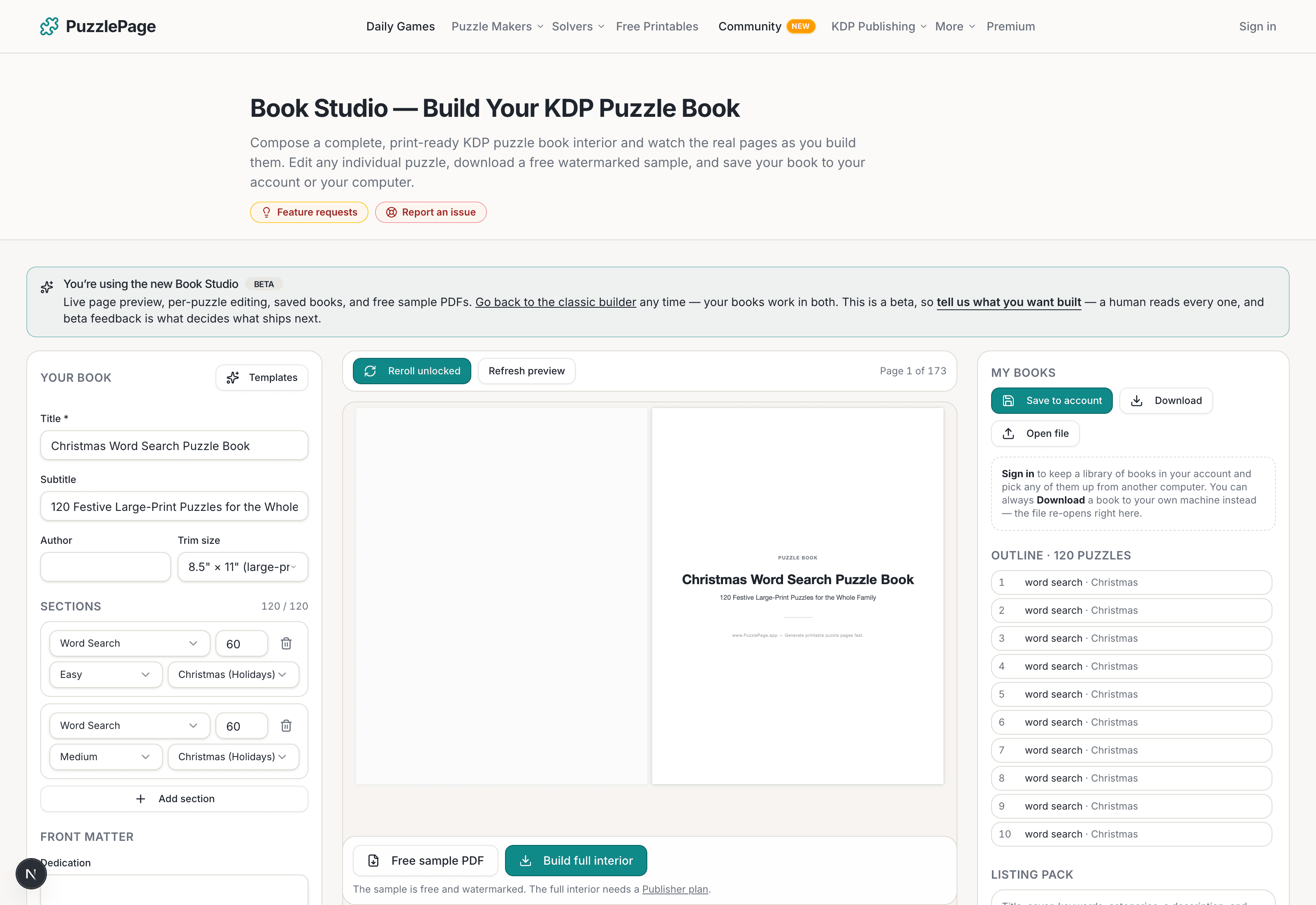
KDP Book Studio
Lay out a full puzzle book for Amazon KDP: templates, trim sizes, page checks and a cover designer.
Start a puzzle book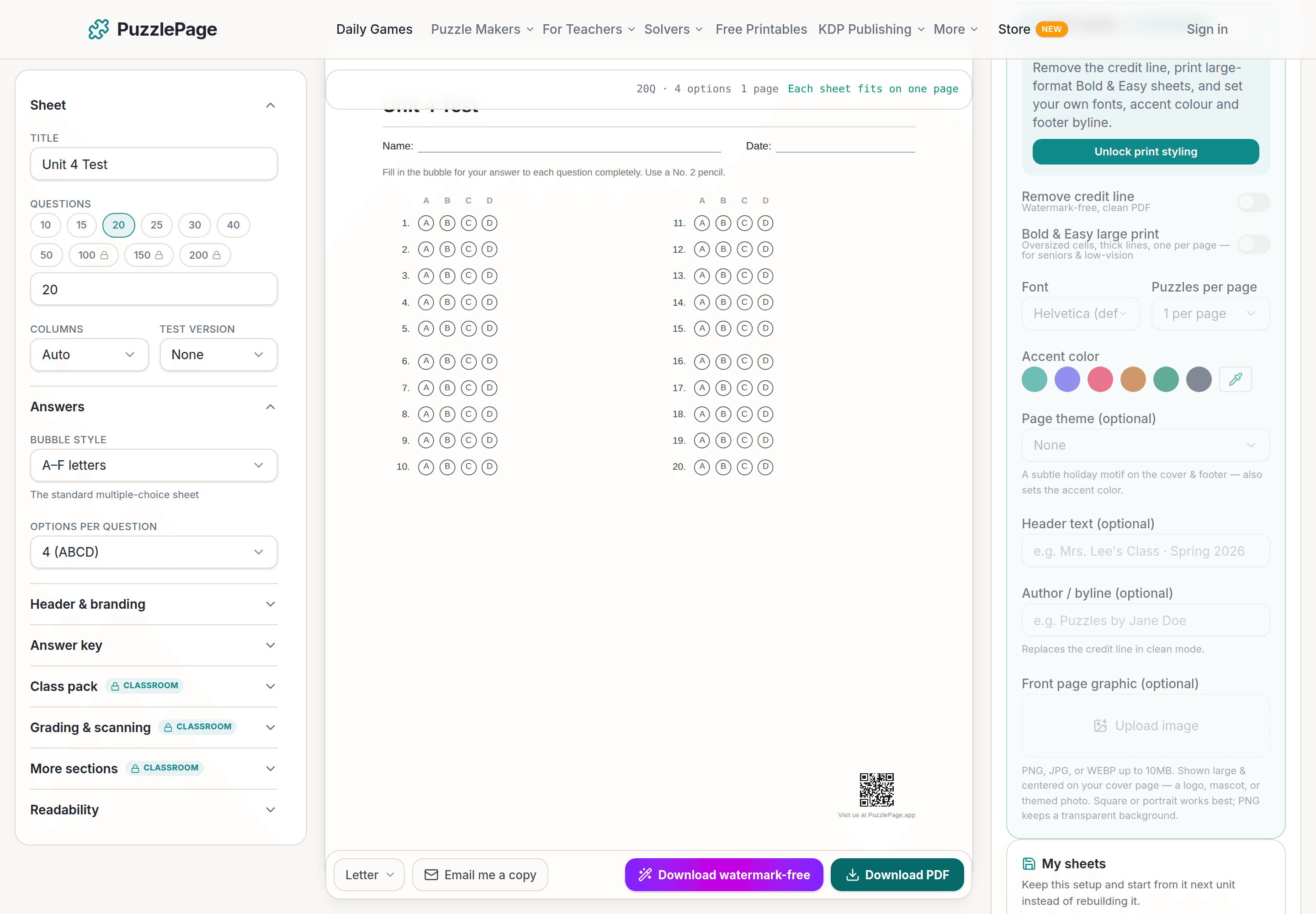
Bubble Sheet Studio
Answer sheets for any test length, with sections, versions, student ID grids and a matching answer key.
Make a bubble sheetPremium removes the footer credit, adds Word export and custom styling across every maker.
See plans →Free daily games
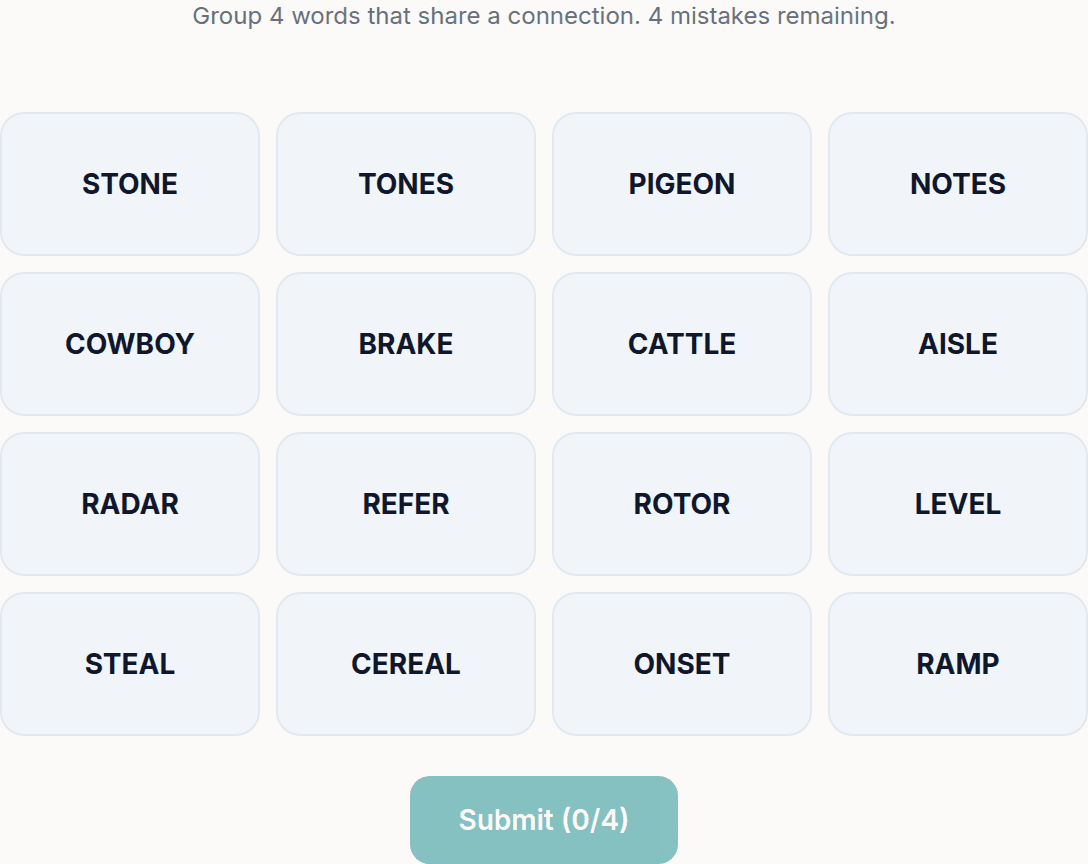
Need a two-minute break? Today's puzzles are live.
A new Sudoku and a new Connections board every day. No download, no account.


Keep reading
Take the puzzle with you
Free Word Scramble PDF — Anagram Practice Scramble
Print-ready · answer key included · unsubscribe anytime
Enjoyed this? Share the puzzle on X
Like puzzles like this? Follow on Pinterest for a new one every day.