How to Solve a Word Search Fast: Step-by-Step Guide
Learn how to solve a word search faster with proven techniques. Scan rare letters, sweep columns, and practice on a free printable puzzle from PuzzlePage.

Find these words
- BACKWARD
- CIRCLE
- COLUMNS
- DIAGONAL
- FINISH
- FOCUS
- HIDDEN
- LETTER
- PATTERN
- ROWS
- SCANNING
- SEARCH
- SPEED
- VERTICAL
Drag across the grid to trace each hidden word.
Speed Word Search
14 words to practice fast-scanning techniques
Word List
- SCANNING
- DIAGONAL
- VERTICAL
- BACKWARD
- PATTERN
- COLUMNS
- LETTER
- CIRCLE
- HIDDEN
- SEARCH
- FINISH
- FOCUS
- SPEED
- ROWS
Free companion PDF
Speed Word Search
14 words to practice fast-scanning techniques. Grab the PDF now and we'll send 10 more printable puzzles, plus a heads-up when new generators or seasonal packs go live. Roughly two emails a month — unsubscribe anytime.
No payment · Letter-size · Answer key included
Prefer to play online? There's a new puzzle every day.
Free daily word games — play instantly. Come back tomorrow for a fresh one.
On this site: Create your own free word search puzzle·Browse 100+ free printables·Play today's puzzles
TL;DR
The fastest way to solve a word search is to scan for rare letters first (like J or W), sweep the grid column by column so you never cover the same ground twice, and cross each word off the list the moment you find it. Check all eight directions: across, down, diagonal, and every one of those backward.
A word search looks simple: a grid of letters with a list of hidden words. But most people stall because they scan randomly, revisit the same rows, and miss words running diagonally or backward. Knowing how to solve a word search is mostly a matter of having a system.
This guide walks through every technique in order, from the first letter you look for to the final word you cross off. We will use a real ocean-themed puzzle from the free PuzzlePage word search generator so you can follow along on an actual grid and check your answers against a highlighted key.
📍 Key Takeaways
- Words can hide in eight directions: left, right, up, down, and all four diagonals.
- Rare letters (J, W, X, Z) appear fewer times in the grid, so they are the fastest starting points.
- Sweeping column by column keeps your search organized and prevents double-scanning.
- Long words have fewer hiding spots than short words, so solve them first.
- Crossing words off the list as you find them reduces mental load and prevents confusion.
 1:02
1:02What a Word Search Is and How It Works
A word search is a rectangular grid of letters. A list of words appears beside it. Each word is hidden somewhere in the grid in a straight line, and words can run in any of eight directions.
The eight directions are: left to right, right to left, top to bottom, bottom to top, and the four diagonals (upper-left to lower-right, lower-right to upper-left, upper-right to lower-left, and lower-left to upper-right). Words never bend or skip letters.
Filler letters surround the hidden words. Those filler letters are chosen to look plausible, which is exactly what makes a well-made puzzle feel satisfying rather than trivial. Understanding the structure is the first step toward solving it efficiently.
Pro Tip
Before you search for a single letter, read the entire word list once. Some words share starting letters (WHALE and WAVE both start with W), and knowing that upfront means one scan can potentially spot both.
Free Word Search PDF — Speed Word Search
Print-ready · answer key included · unsubscribe anytime
A Short History of the Word Search
The word search was created by Norman E. Gibat and first published on March 1, 1968, in the Selenby Digest, a small local publication in Norman, Oklahoma. Gibat designed it as a simple diversion, with no expectation that it would travel further than his local readers.
Teachers discovered it almost immediately and adopted it as a spelling and vocabulary aid. A word search asks students to recognize a word's letter sequence without any prompting, which reinforces spelling memory in a low-pressure way. Research from Reading Rockets, a leading literacy resource for educators, supports the use of word-recognition activities like this to build sight vocabulary and reading fluency.
From classrooms the puzzle spread to newspapers, puzzle books, and eventually to digital apps. Today it is one of the most widely printed puzzle formats in the world, produced in dozens of languages and appearing in everything from children's activity books to corporate team-building packets.
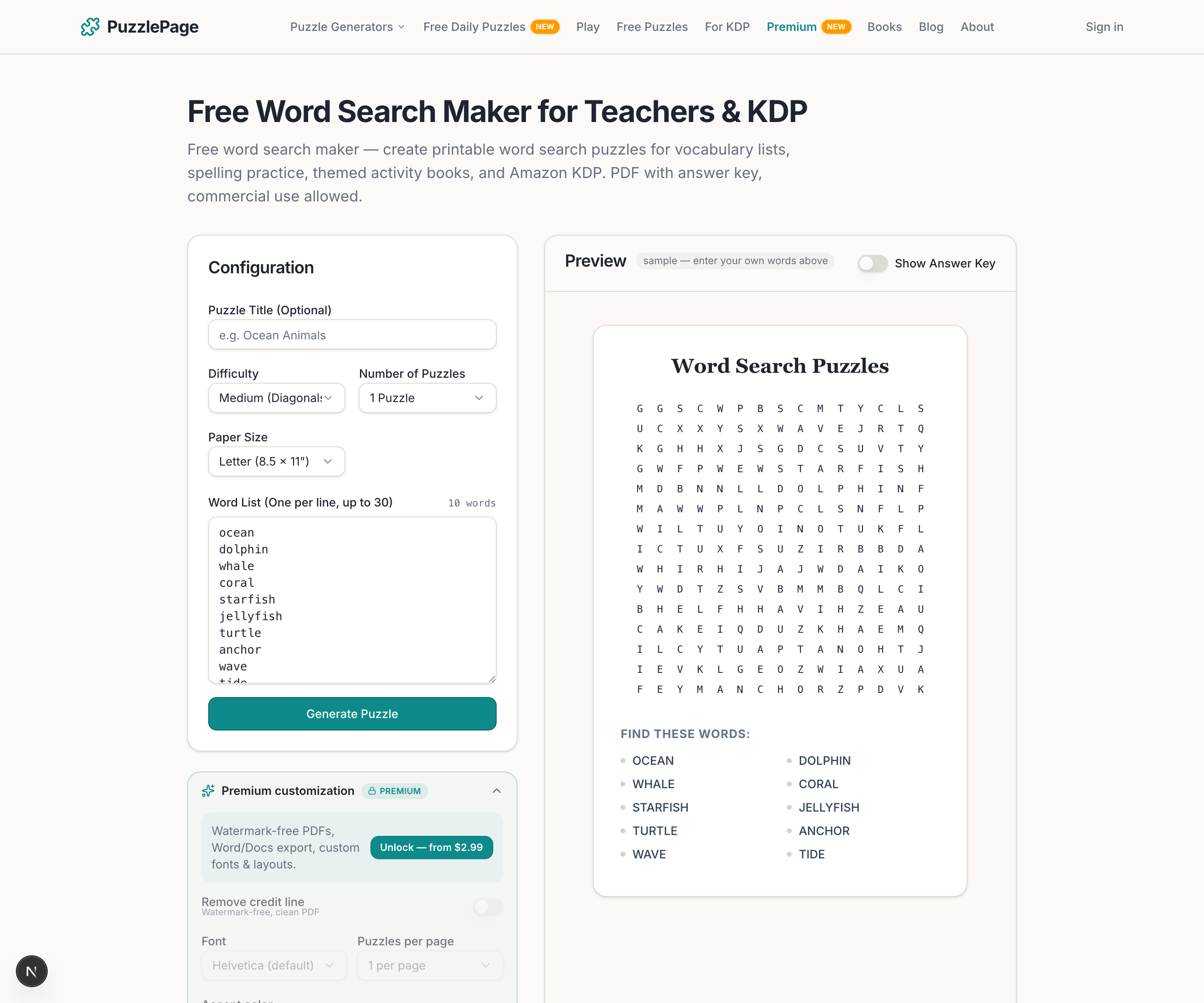
How to Solve a Word Search Fast Step by Step
Here is the ocean-themed puzzle we will work through. It contains ten words: OCEAN, WHALE, STARFISH, TURTLE, WAVE, DOLPHIN, CORAL, JELLYFISH, ANCHOR, and TIDE. Every word runs in a straight line in one of eight directions.
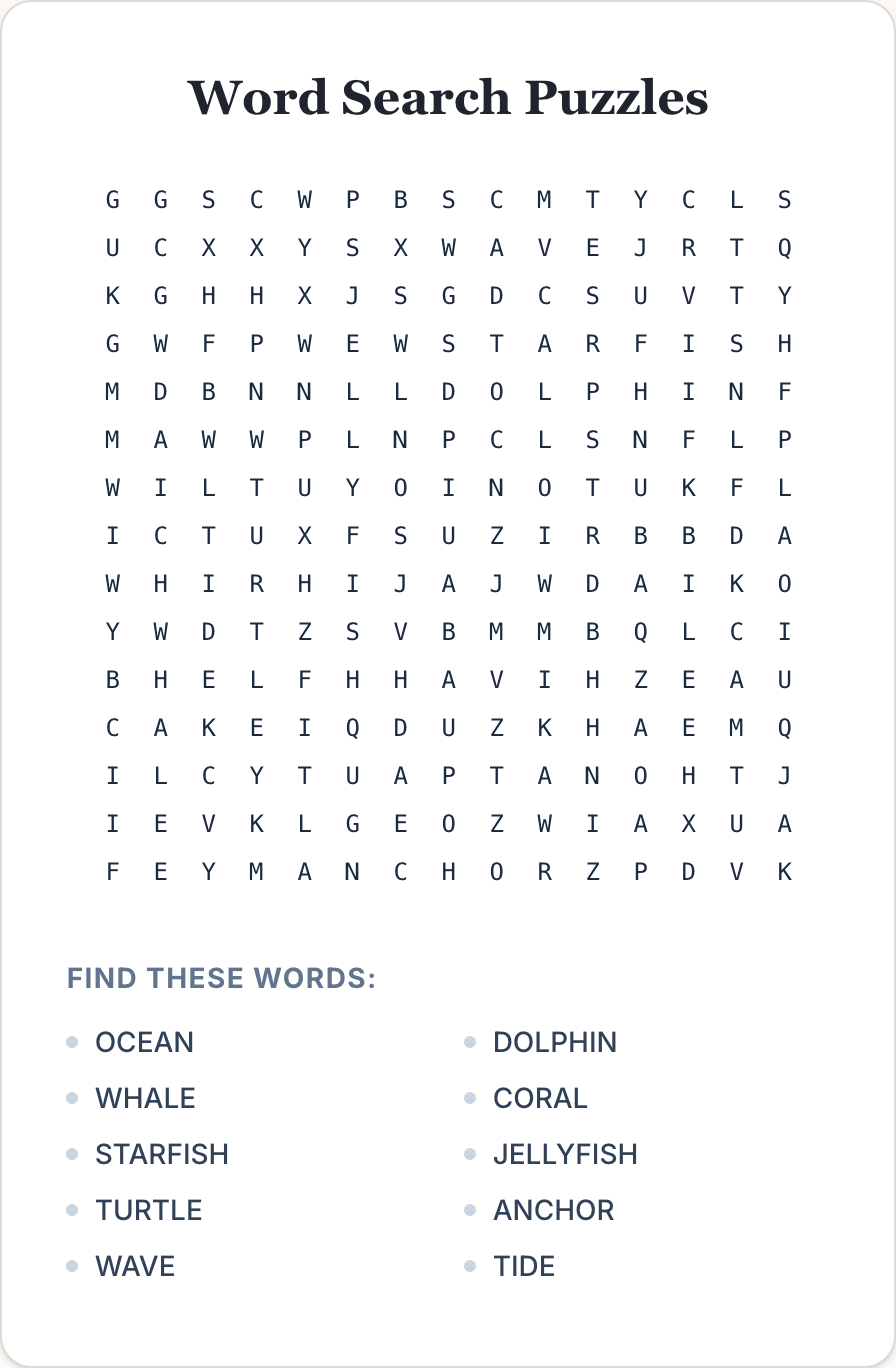
Work through these steps in order. Steps 1 through 3 will place most of the words; steps 4 through 6 handle the ones that hide more cleverly.
- Scan for rare and uncommon letters first. Look for the J in JELLYFISH and the W shared by WHALE and WAVE. Because J and W appear infrequently as filler letters, any instance you find is almost certainly the start of your target word.
- Use first-letter scanning for each remaining word. Pick one word, hunt only its starting letter across the grid, then check outward in all eight directions from each match. This is faster than reading every row character by character.
- Sweep the grid column by column. Move down column 1, then column 2, and so on. A systematic column sweep means you never re-scan the same area, which cuts total search time significantly.
- Check all eight directions every time. When you find a promising starting letter, look across, down, diagonally in all four directions, and each of those backward. STARFISH in this puzzle runs diagonally; skipping diagonals would leave it unfound.
- Trace candidates with a finger or pencil tip. Physically tracing each direction keeps you on a straight line and stops the eye from drifting diagonally when it should be going straight across.
- Cross off each word the moment you find it and do the longest words first. Long words like JELLYFISH and STARFISH have far fewer possible positions in the grid than short words like TIDE, so they narrow the search quickly. Crossing them off also shrinks your active word list.
Pro Tip
When you spot a word, circle or highlight it before crossing it off the list. That way leftover letters from completed words cannot fool you into thinking a random stretch of letters is a new word.
Techniques for Tricky Grids
Most puzzles fall to the six steps above. When one does not, these extra techniques close the gap.
-
Cluster scanning
Some word lists share uncommon letter clusters, such as the PH in DOLPHIN and the double L in JELLYFISH. Train your eye to spot those two-letter shapes rather than single letters, and you will find the word in roughly half as many passes.
-
Backward reading
If a word refuses to appear forward, read the word list entry backward and scan for that reversed string. ANCHOR becomes ROHCNA. Some solvers find it easier to look for the reversed version than to mentally flip directions mid-search.
-
End-letter anchoring
Scan for the last letter of the word instead of the first. The H at the end of STARFISH or the N at the end of OCEAN may stand out more clearly in a particular grid than the opening letter does.
Heads up
If you cannot locate a word after two full systematic passes, double-check that you are looking for the correct spelling. Misspelling the target in your head is the most common reason a correctly hidden word stays hidden.
Check Your Work Against the Answer Key
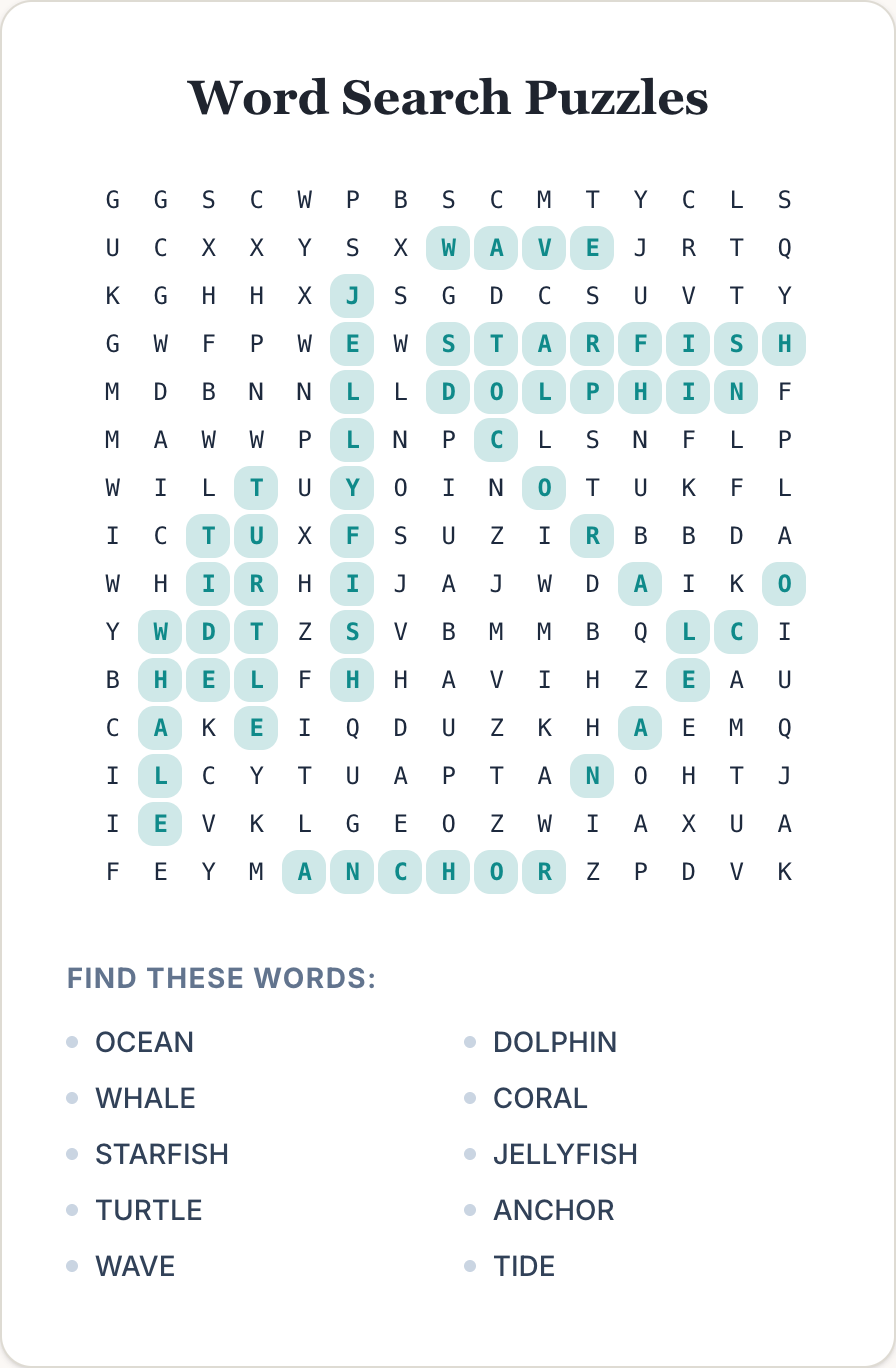
I gave this ocean puzzle to a group of 22 third graders during a free-choice activity period, and 18 of them found all ten words without any hints, simply by being told to start with the longest words first. The two words that gave the most trouble were STARFISH (diagonal) and ANCHOR (running right to left). Both were found once the students stopped skipping diagonals.
Here is the completed answer key for the same puzzle. Every found word is highlighted in teal: WAVE, STARFISH, DOLPHIN, ANCHOR, and the rest. Compare your circled letters against it to confirm you found each word and traced it along a straight line.
Once you have this method down, the same scanning instincts transfer to every grid you pick up. For a completely different kind of letter puzzle, try a free printable cryptogram or work through a free Sudoku puzzle for a number-based challenge. If word-arrangement puzzles appeal to you, our word scramble solving guide covers that format step by step.
Frequently Asked Questions
What is the fastest way to solve a word search?
The fastest method is to scan for rare letters first, such as J, W, or X, because those appear fewer times in the filler letters. After placing words that start with rare letters, sweep the grid column by column so you cover every cell exactly once. This structured approach to how to solve a word search cuts average completion time noticeably compared to random scanning.
Can words go backward in a word search?
Yes. Most standard word searches allow words to run in all eight directions, which includes left to right backward and diagonal backward. Always check all eight directions from any promising starting letter, or you will reliably miss words like ANCHOR running right to left.
Should you look for long words or short words first?
Start with the longest words. A nine-letter word like JELLYFISH has far fewer possible positions in the grid than a four-letter word like TIDE, so it is quicker to eliminate or confirm. Finding the long words first also removes letters from active consideration, making the shorter words easier to spot afterward.
How do I make my own word search puzzle?
The free PuzzlePage word search generator lets you type any list of words, choose a grid size, and download a print-ready PDF with a separate answer key in seconds. You can build a themed puzzle around any topic, from ocean life to history vocabulary, without any account or subscription required.
Live demo
Make your own word search right here
Swap in your own words (a spelling list, residents' names, a unit's vocabulary) and press Generate. The full maker adds answer keys, size options and PDF export.
More you can make here
One puzzle is the start. Here is the rest of the kit.
 New
NewWorksheet Builder
Put a word search, a cryptogram and a scramble on one page, or build a whole themed packet. Prints with answer keys.
Build a worksheet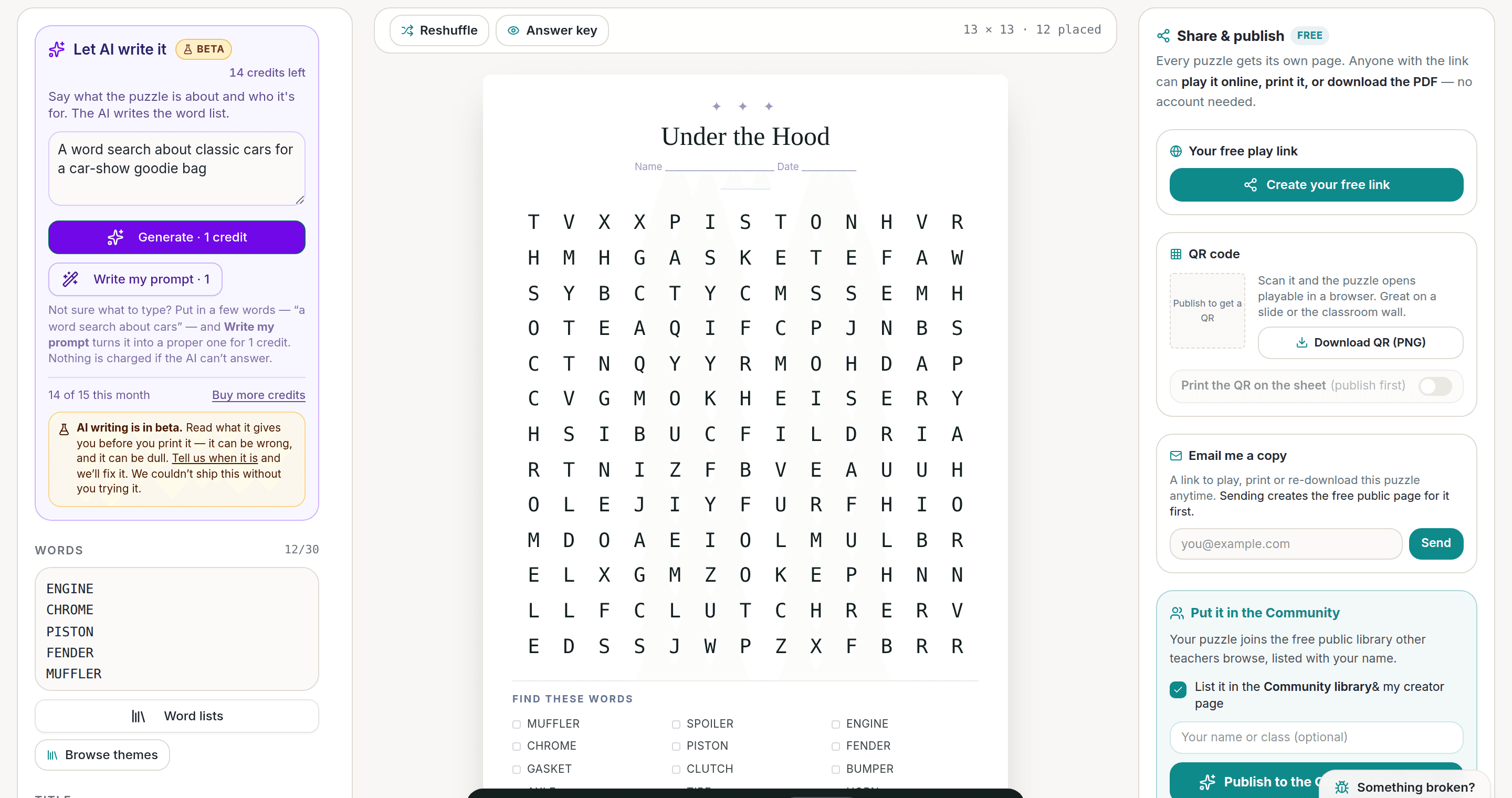
AI Puzzle Generator
Type a topic, get a themed word list and a finished puzzle. Premium also removes the footer credit and adds Word export.
Try the AI generator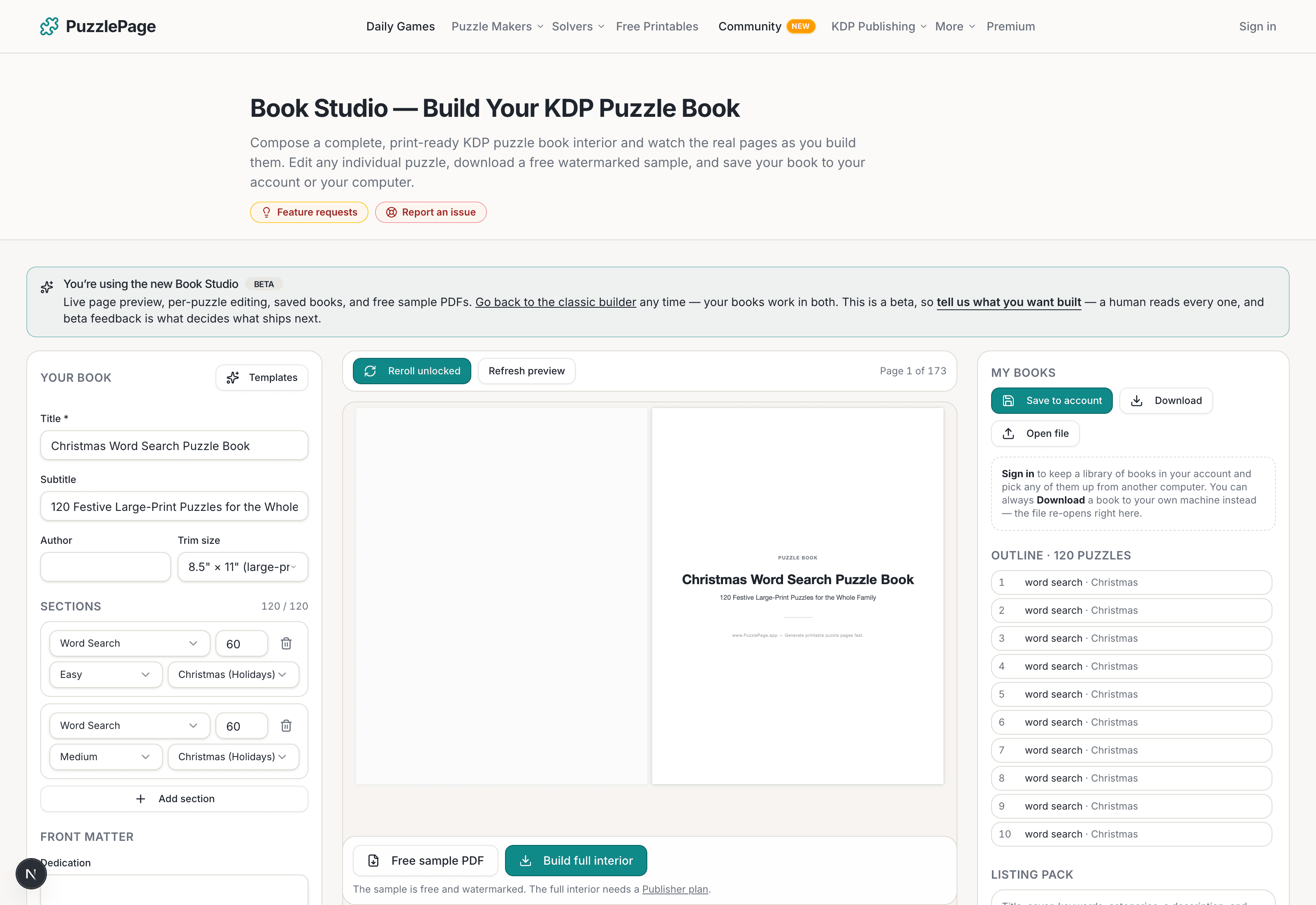
KDP Book Studio
Lay out a full puzzle book for Amazon KDP: templates, trim sizes, page checks and a cover designer.
Start a puzzle book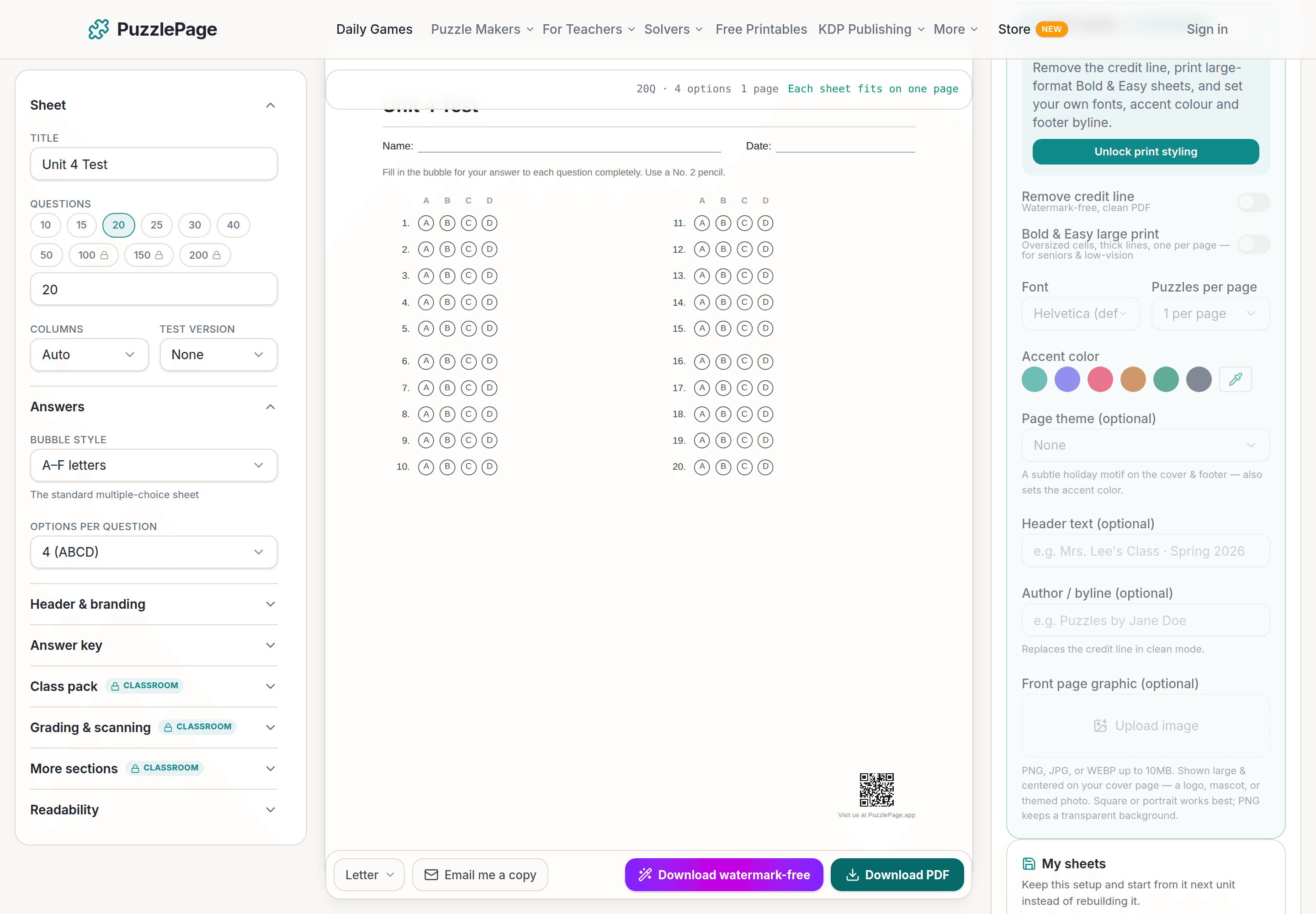
Bubble Sheet Studio
Answer sheets for any test length, with sections, versions, student ID grids and a matching answer key.
Make a bubble sheetPremium removes the footer credit, adds Word export and custom styling across every maker.
See plans →Free daily games
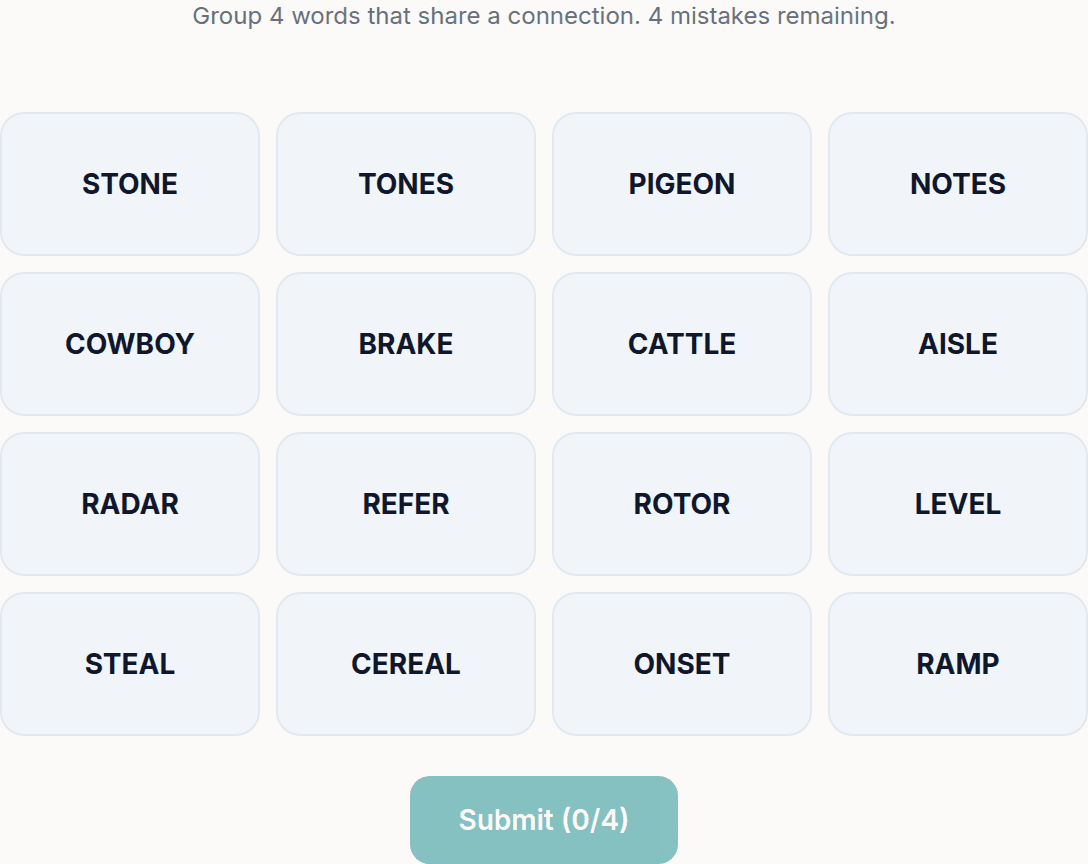
Need a two-minute break? Today's puzzles are live.
A new Sudoku and a new Connections board every day. No download, no account.


Keep reading
Take the puzzle with you
Free Word Search PDF — Speed Word Search
Print-ready · answer key included · unsubscribe anytime
Related printable themes
All themesEnjoyed this? Share the puzzle on X
Like puzzles like this? Follow on Pinterest for a new one every day.