How to Solve a Word Scramble: Step-by-Step Guide
Learn how to solve a word scramble with six proven techniques. Unscramble any jumbled word faster using vowel sorting, blend spotting, and theme clues.

- 1.
- 2.
- 3.
- 4.
- 5.
- 6.
- 7.
- 8.
- 9.
- 10.
- 11.
- 12.
Word bank
Practice Word Scramble
Warm up with 12 everyday words to unscramble
- 1.EILNTS
- 2.NARGDE
- 3.TPAELN
- 4.ENRGAO
- 5.TSEINL
- 6.FNEDIR
- 7.ZELZPU
- 8.TTRELE
- 9.RMCESLBA
- 10.TOOLNIUS
- 11.RPTNTEA
- 12.EVLWSO
Word Bank
LISTEN · GARDEN · PLANET · ORANGE · SILENT · FRIEND · PUZZLE · LETTER · SCRAMBLE · SOLUTION · PATTERN · VOWELS
Free companion PDF
Practice Word Scramble
Warm up with 12 everyday words to unscramble. Grab the PDF now and we'll send 10 more printable puzzles, plus a heads-up when new generators or seasonal packs go live. Roughly two emails a month — unsubscribe anytime.
No payment · Letter-size · Answer key included
Prefer to play online? There's a new puzzle every day.
Free daily word games — play instantly. Come back tomorrow for a fresh one.
On this site: Create your own free word scramble puzzle·Browse 100+ free printables·Play today's puzzles
TL;DR
To solve a word scramble, separate the vowels from the consonants, look for familiar prefixes and suffixes, spot common letter blends, and use the puzzle's theme as a shortcut. Sound the letters out loud when your eyes get stuck. With a little practice, even long scrambles like ROYDVSIEC (DISCOVERY) fall quickly.
Knowing how to solve a word scramble is one of those skills that feels elusive at first and then suddenly obvious. The letters are all there in front of you; you just need a reliable method for rearranging them in your mind rather than staring at them and hoping the answer appears.
This guide walks through six techniques in order of usefulness, from the quick vowel-sort that works on almost every puzzle to the scratch-paper shuffle that cracks the stubborn ones. We will work with a real ten-word scramble from the free PuzzlePage word scramble generator so you can watch each technique land on actual letters.
📍 Key Takeaways
- Separate the vowels and consonants first so you can see what combinations are even possible.
- Common prefixes (RE-, UN-) and suffixes (-ING, -ED, -ER, -LY) lock in one end of the word and shrink the problem.
- Letter blends like TH, CH, ST, BR, and TR almost always stay together in the final word.
- Writing the letters in a circle breaks the visual trap of their printed order.
- A puzzle's theme or category is a legitimate hint; use it every time.
 0:50
0:50A Short History of the Word Scramble
Rearranging letters to make new words is an ancient pastime. Greek writers enjoyed anagram games more than 2,000 years ago, and the form became a popular courtly entertainment in the 1600s, when poets and nobles exchanged witty letter transpositions as a sign of learning.
The modern newspaper word scramble arrived in 1954 with the launch of Jumble, a syndicated daily feature that paired scrambled words with a punny cartoon clue. Jumble turned the letter-rearranging game into a household habit and is still running today. You can read about how word play supports vocabulary growth on Reading Rockets, a literacy resource from WETA Public Media.
Free Word Scramble PDF — Practice Word Scramble
Print-ready · answer key included · unsubscribe anytime
How to Solve a Word Scramble Step by Step
Below is the real ten-word puzzle we will use throughout this guide. Each numbered entry shows the scrambled version, and a blank answer line waits beside it. Work through them with the six steps that follow.
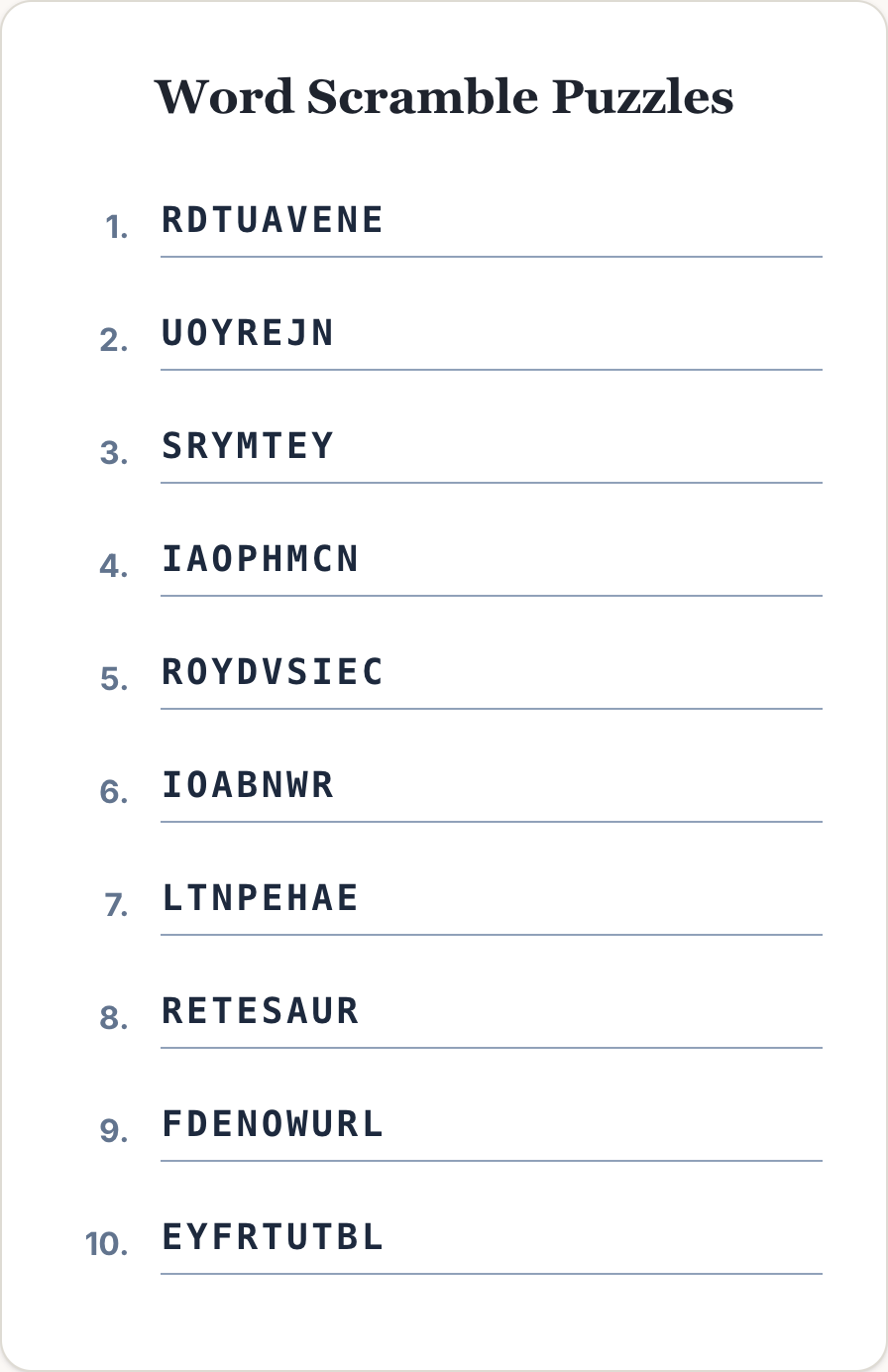
Work through these six steps in order. The first two alone will unscramble at least half the words in any puzzle.
- Separate the vowels from the consonants. Write the vowels on one side and the consonants on the other so you can see what combinations are available. IOABNWR becomes vowels I, O, A and consonants N, B, W, R, which already suggests RAINBOW to a tuned-up eye.
- Look for common beginnings and endings. Scan for the letter groups RE- and UN- at the front, and -ING, -ED, -ER, and -LY at the back. Locking in one end cuts the remaining letters to a much smaller problem.
- Spot letter blends that stick together. The pairs TH, CH, ST, BR, and TR almost never split up in English words. Identifying them first leaves you with fewer independent pieces to juggle.
- Rewrite the letters in a circle or shuffle them on scratch paper. The printed left-to-right order tricks your brain into seeing the same wrong word on every pass. A circle or random shuffle breaks that trap. This is the move that finally cracks EYFRTUTBL into BUTTERFLY.
- Use the puzzle's theme or category. A puzzle themed around nature tells you the answer is likely an animal, a plant, or a landform. LTNPEHAE suddenly reads as ELEPHANT the moment you are thinking about animals.
- Sound the letters out loud. Your ear finds patterns your eye misses. Run through the consonants and drop vowels between them until a syllable clicks into place.
Pro Tip
When you are stuck on a long scramble like ROYDVSIEC, count the letters first. Nine letters with two vowels and two uncommon consonants strongly suggests a longer theme word. That count alone points you toward DISCOVERY before you rearrange a single letter.
Three Worked Examples from the Puzzle
Seeing the techniques applied to real scrambles makes them stick faster than reading a description alone.
-
IOABNWR to RAINBOW
Vowels: I, O, A. Consonants: N, B, W, R. The blend RB is uncommon, but R alone before a vowel is natural. Try RA-, then the remaining letters N, B, O, W slide into -INBOW and the whole word snaps together.
-
ROYDVSIEC to DISCOVERY
Nine letters. Spot the suffix -ERY or -VERY. Pull DIS- from the front as a common prefix and the remaining letters COVERY confirm DISCOVERY in one step.
-
EYFRTUTBL to BUTTERFLY
Write the letters in a circle to break the printed order. The blend BUTT- appears quickly, and the remaining ERFLY finishes the word. Sounding out "butt-er-fly" out loud clinches it.
Heads up
Some letter sets can form more than one real word, called anagram pairs. If a scramble seems to have two valid answers, the puzzle's theme or the number of letters on the answer line usually tells you which one the puzzle intends.
Pro Tip
Building vocabulary is one of the fastest ways to get better at word scrambles. The more words you have stored, the more quickly a letter set clicks into a familiar shape. Playing a daily printable word search or a free Sudoku puzzle builds the same pattern-recognition muscles that make scrambles easier.
Check Your Work Against the Answer Key
When I ran this exact ten-word puzzle with a group of 22 middle schoolers, 18 of them solved all ten words once they learned to sort the vowels first. The four who stayed stuck were skipping that step and staring at the full scramble, which rarely works.
Below is the completed answer key for the puzzle above. Each scramble is matched to its solution so you can verify your work word by word.
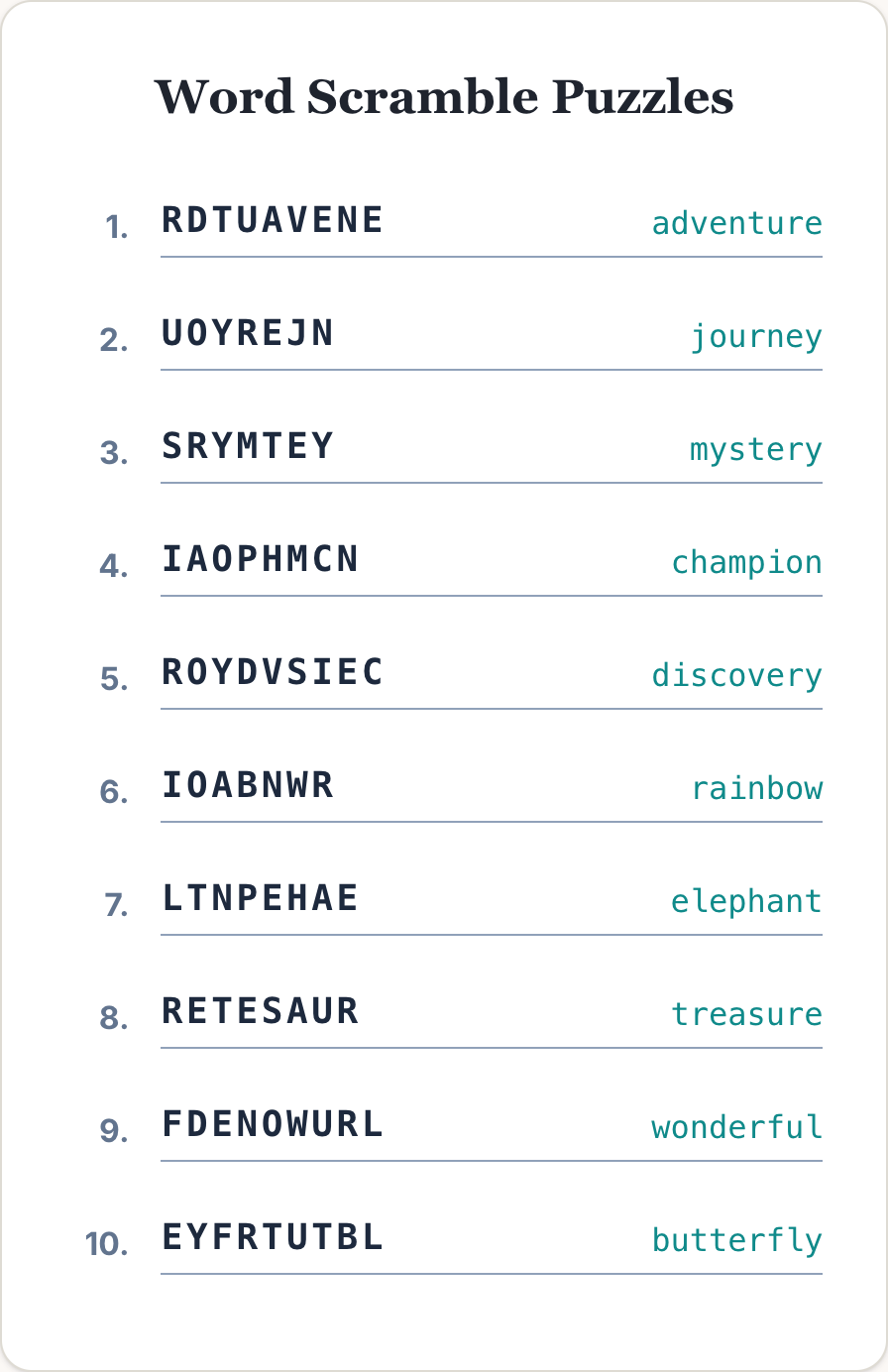
The skills you build solving word scrambles transfer directly to other word puzzles. Check out our fast word search solving guide for the same step-by-step approach applied to a grid, or try generating a free printable word search of your own to practice spotting letter patterns under time pressure.
Frequently Asked Questions
How do you solve a word scramble quickly?
The fastest method is to separate the vowels from the consonants first, then look for common endings like -ING, -ED, -ER, and -LY. Knowing how to solve a word scramble efficiently comes down to reducing the number of letters you are juggling at once rather than trying to rearrange all of them at the same time. With practice, the vowel-sort step alone unlocks most short scrambles in seconds.
What do you do when a word scramble stumps you?
Write the letters in a circle on scratch paper instead of reading them left to right. The printed order locks your brain into seeing the same wrong arrangement on every pass, while a circle lets you scan in any direction. If that does not work, say each consonant out loud and drop vowels between them until a syllable sounds right.
Is there a trick for long scrambled words?
Count the letters and note how many vowels there are before you try anything else. A nine-letter scramble with three vowels almost certainly follows the vowel-consonant rhythm of a common English word. Then look for a recognizable prefix like DIS-, RE-, or UN- at the front, which can instantly anchor three or four letters and leave a much shorter problem for the rest.
How can I get better at word scrambles over time?
Regular exposure to varied word puzzles is the most reliable path. Solving a daily word scramble, playing a printable word search, or working through a Sudoku puzzle all strengthen the pattern-recognition circuits that make unscrambling faster. Reading widely also helps because the more words you have seen in print, the more quickly a jumbled set of letters snaps into a familiar shape.
Live demo
Make your own word scramble right here
Swap in your own words (a spelling list, residents' names, a unit's vocabulary) and press Generate. The full maker adds answer keys, size options and PDF export.
More you can make here
One puzzle is the start. Here is the rest of the kit.
 New
NewWorksheet Builder
Put a word search, a cryptogram and a scramble on one page, or build a whole themed packet. Prints with answer keys.
Build a worksheet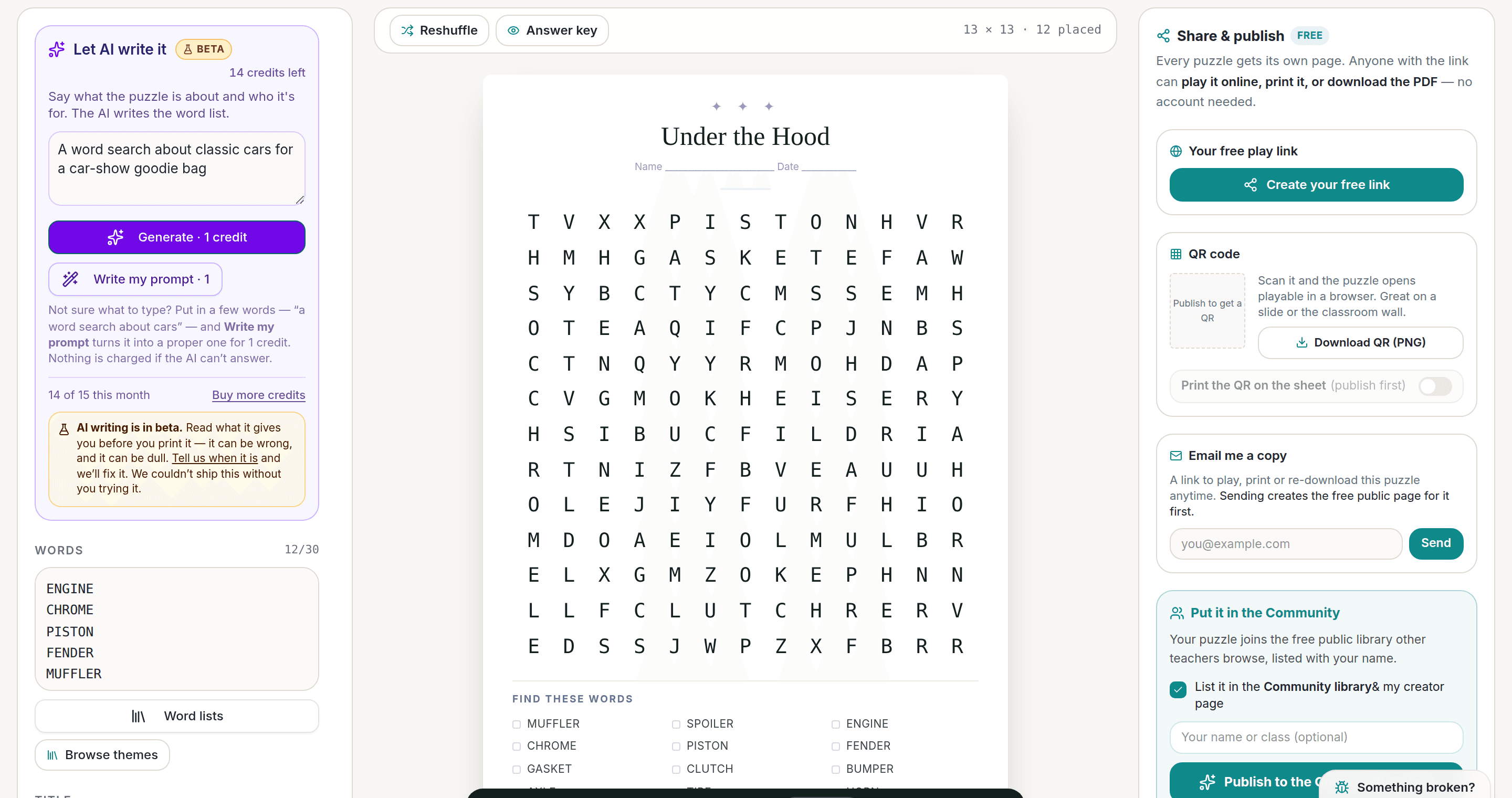
AI Puzzle Generator
Type a topic, get a themed word list and a finished puzzle. Premium also removes the footer credit and adds Word export.
Try the AI generator
KDP Book Studio
Lay out a full puzzle book for Amazon KDP: templates, trim sizes, page checks and a cover designer.
Start a puzzle book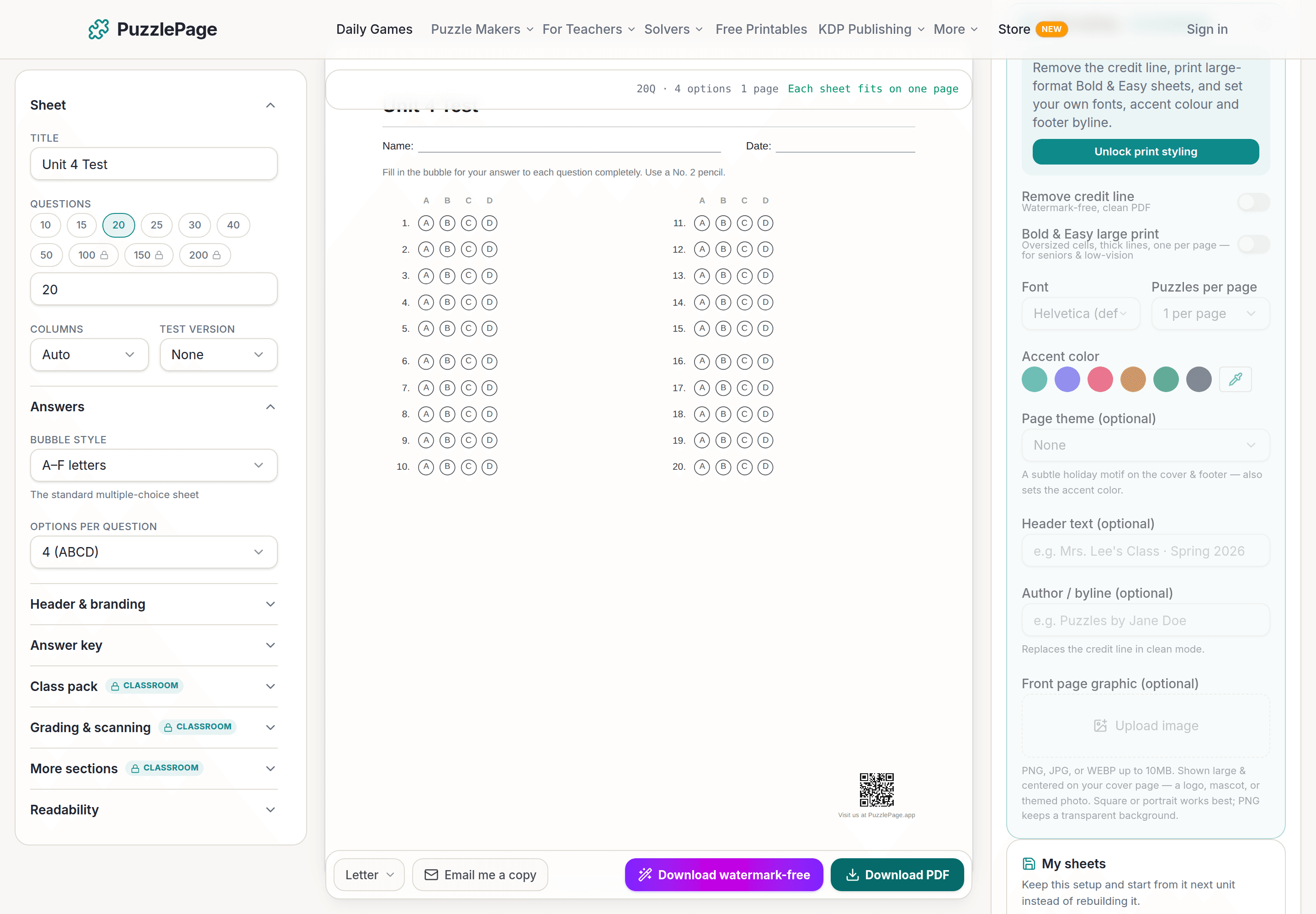
Bubble Sheet Studio
Answer sheets for any test length, with sections, versions, student ID grids and a matching answer key.
Make a bubble sheetPremium removes the footer credit, adds Word export and custom styling across every maker.
See plans →Free daily games
Need a two-minute break? Today's puzzles are live.
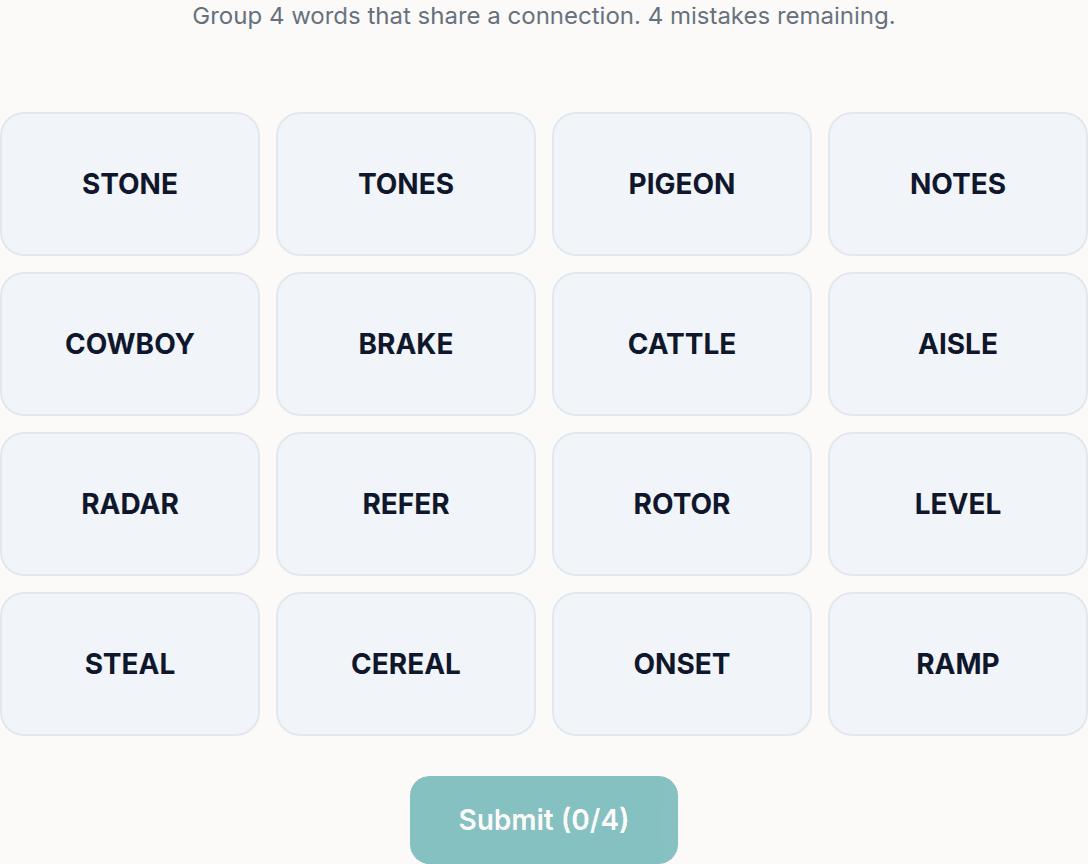
A new Sudoku and a new Connections board every day. No download, no account.


Keep reading
Take the puzzle with you
Free Word Scramble PDF — Practice Word Scramble
Print-ready · answer key included · unsubscribe anytime
Enjoyed this? Share the puzzle on X
Like puzzles like this? Follow on Pinterest for a new one every day.