How to Solve a Cryptogram: Step-by-Step Cipher Guide
Learn how to solve a cryptogram using frequency analysis, pattern spotting, and starter hints. Decode any letter-substitution cipher with this practical guide.

Hints
Practice Cryptogram
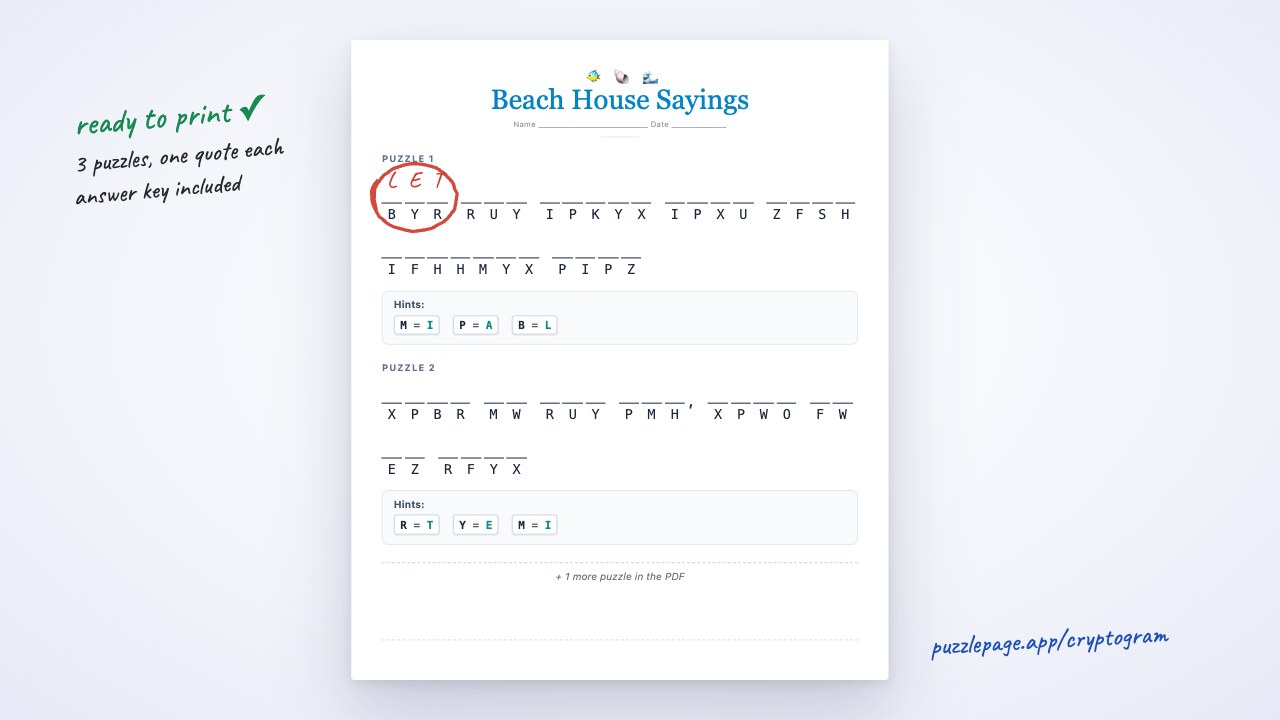
Try the technique on 5 friendly starter phrases
Phrase 1
Hint: K = O
Phrase 2
Hint: G = U
+ 3 more phrases in the PDF
Free companion PDF
Practice Cryptogram
Try the technique on 5 friendly starter phrases. Grab the PDF now and we'll send 10 more printable puzzles, plus a heads-up when new generators or seasonal packs go live. Roughly two emails a month — unsubscribe anytime.
No payment · Letter-size · Answer key included
Prefer to play online? There's a new puzzle every day.
Free daily word games — play instantly. Come back tomorrow for a fresh one.
On this site: Create your own free cryptogram puzzle·Browse 100+ free printables·Play today's puzzles
TL;DR
A cryptogram replaces every letter with a different letter, consistently throughout the puzzle. Use any starter hint given (here, A = F), then apply frequency analysis, one-letter words, and common word patterns to decode the rest. You never need to guess: pure logic cracks every cipher.
Knowing how to solve a cryptogram turns a page of scrambled letters into a satisfying decoded quote. The cipher looks intimidating at first, but the rules are fixed: one letter always stands in for one other letter, and that mapping never changes within a puzzle.
This guide walks through every technique you need, from the free starter hint to the final decoded letter. We use a real cipher puzzle from the PuzzlePage cryptogram generator so you can follow along on an actual example and check your answer against the printed solution.
📌 Key Takeaways
- A cryptogram is a quote cipher: each letter in the alphabet is consistently swapped for exactly one other letter.
- Always apply the given hint first, then use frequency analysis to identify likely high-frequency letters like E and T.
- One-letter words can only be A or I, and the most common three-letter word is THE.
- Common endings (-ING, -ION, -ED) and double letters (LL, EE, SS) narrow the field quickly.
- Pencil lightly: if one letter is wrong, every cell sharing that code letter needs to be reconsidered.
 0:58
0:58A Short History of the Cryptogram
Letter-substitution ciphers are ancient. The Caesar cipher, used by Julius Caesar to protect military messages, simply shifted every letter by a fixed number of positions, so A became D, B became E, and so on.
The real intellectual breakthrough came in the 800s, when the Arab scholar Al-Kindi wrote the first known description of frequency analysis in cryptography. His insight was that certain letters appear far more often than others in any language, so you can crack a cipher by matching the most frequent coded letters to the most frequent letters in the target language.
Edgar Allan Poe brought the cryptogram to mainstream audiences in the 1840s. He challenged readers to send him ciphers he could not solve, and he featured a pivotal substitution cipher in his 1843 story "The Gold-Bug." The American Cryptogram Association, which publishes cipher magazines to this day, was founded in 1929.
Free Cryptogram PDF — Practice Cryptogram
Print-ready · answer key included · unsubscribe anytime
How to Solve a Cryptogram Step by Step
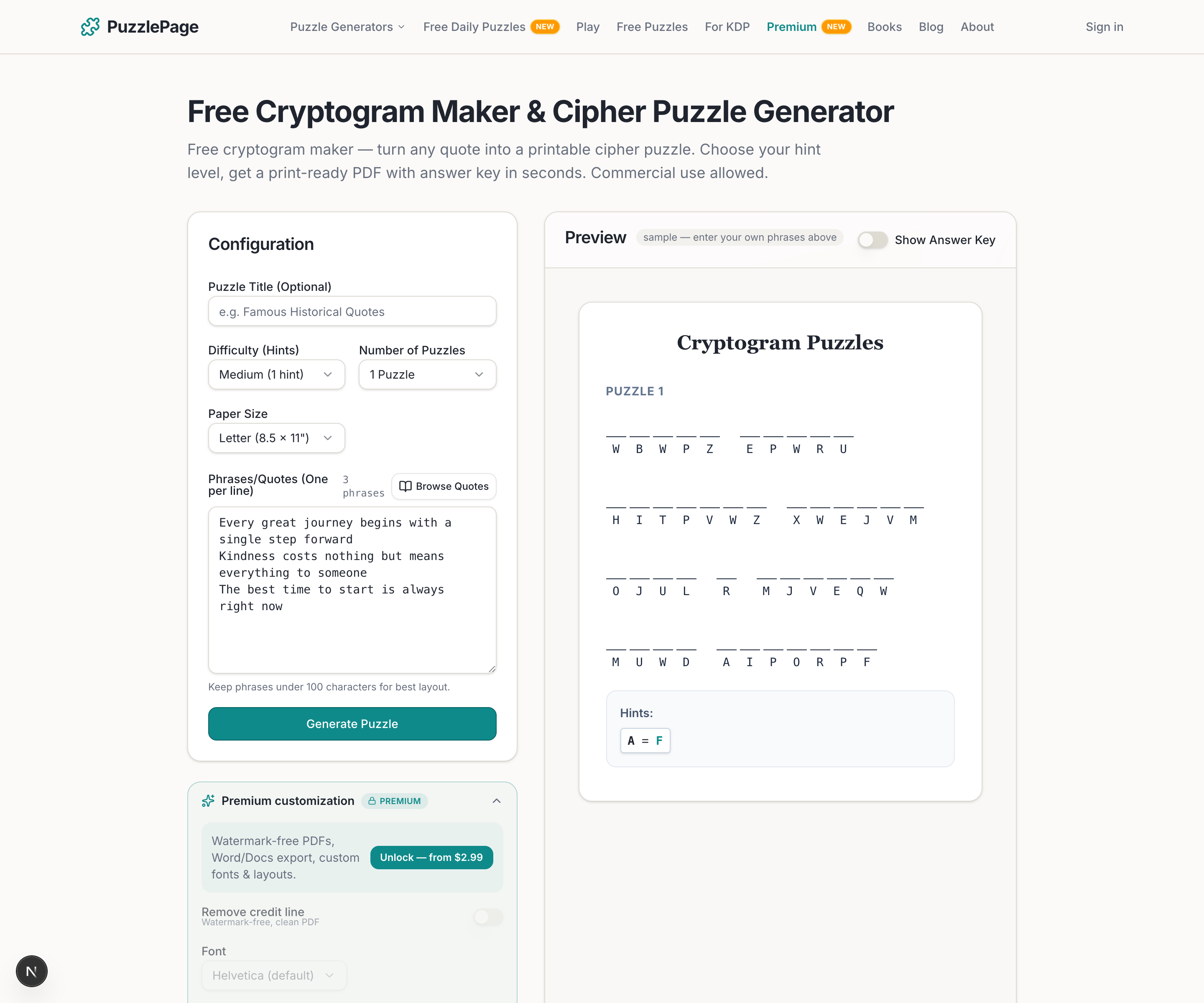
Below is the real cipher puzzle we will decode. Each row of blanks holds one word of the hidden quote, with the coded letter printed beneath each blank. The puzzle gives one starter hint: A = F, meaning every coded A in the puzzle decodes to the letter F.
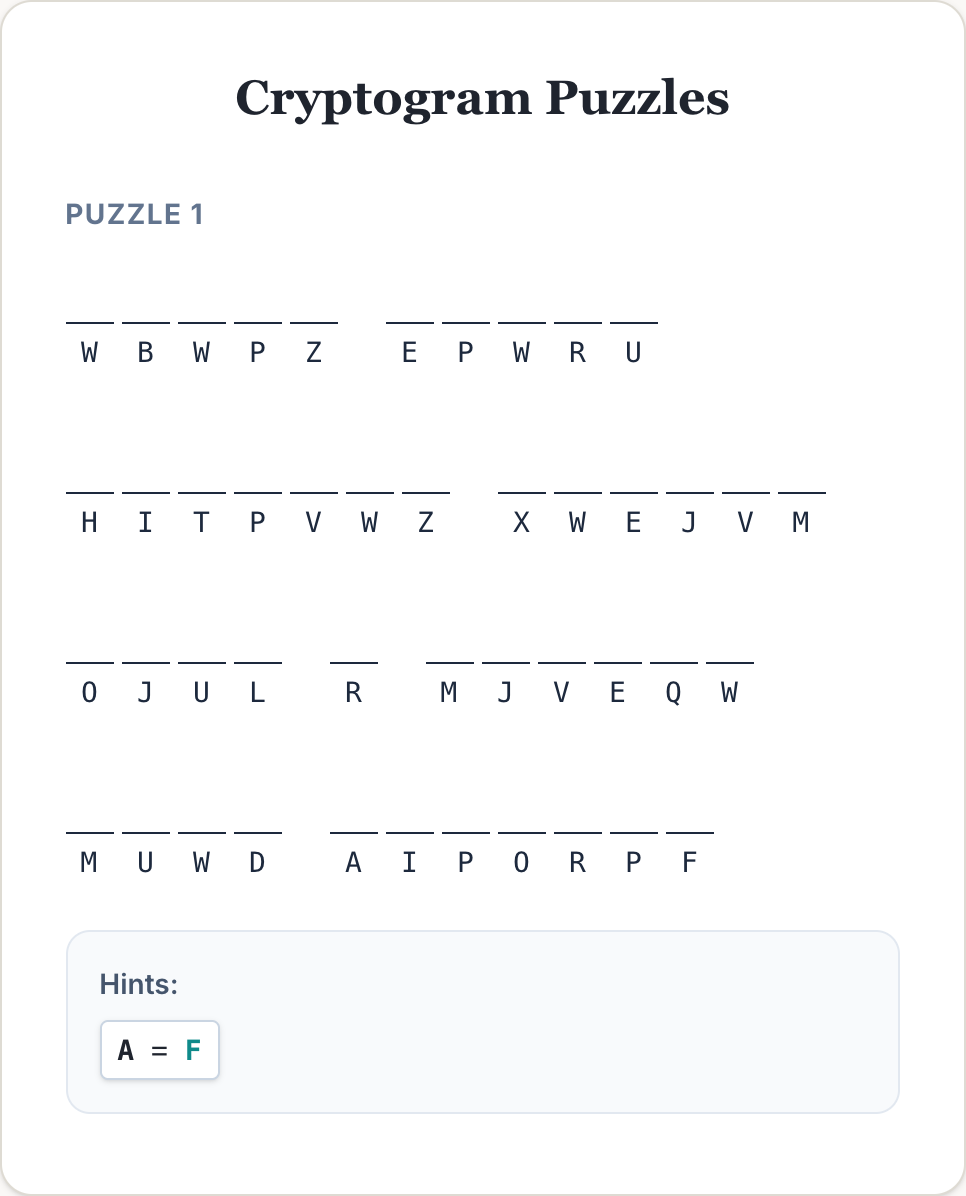
Work through these steps in order. Most cryptograms yield within one or two passes once you have E and T placed.
- Apply the given hint first. The puzzle tells you A = F. Write F into every blank that sits above a coded A before you do anything else. A single confirmed letter often unlocks several words at once.
- Use frequency analysis to find E and T. E is the most common letter in English, followed by T, A, O, I, and N. Count how often each coded letter appears across the whole puzzle. The coded letter that shows up most is very likely E or T.
- Solve one-letter words immediately. A coded word with a single letter can only decode to A or I. Fill in both possibilities and see which fits the neighboring words.
- Hunt for THE. The most common three-letter word in English is THE. A three-letter coded group that appears more than once is an excellent THE candidate. Confirming T, H, and E in one move is a major breakthrough.
- Check for double letters and common endings. Pairs like LL, EE, SS, and OO narrow the field sharply. Words ending in a three-letter cluster are strong candidates for -ING or -ION, and two-letter endings often decode to -ED or -ER.
- Try apostrophe patterns. A single coded letter after an apostrophe is almost always S or T (as in "it's" or "don't"). Two letters after an apostrophe often spell VE, LL, or RE. Pencil each guess lightly and stay consistent: one code letter maps to exactly one plain letter everywhere it appears.
Pro Tip
Keep a running substitution table at the top of your paper: two rows, one for the coded letters and one for the decoded letters beneath each. Filling in the table as you go lets you look up any confirmed mapping instantly instead of hunting through the puzzle.
Patterns That Speed Up the Solve
When frequency analysis and word length get you partway through, a set of reliable patterns finishes the job. Think of each pattern as a constraint that deletes wrong options.
-
Short words first
Two-letter words are almost always prepositions or pronouns: OF, TO, IN, IS, IT, BE, AS, AT, BY, OR, AN. Each guess you confirm eliminates those letters from other unknowns.
-
Repeated word shapes
If the same coded group appears twice, it decodes to the same word both times. Two appearances narrow your guesses dramatically: the decoded word must make sense in both positions.
-
Vowel clusters
Every English syllable contains at least one vowel. If a decoded partial word has no vowel candidates yet, the unresolved coded letters in that word must include at least one vowel: A, E, I, O, or U.
Heads up
If a word you decoded confidently creates an impossible letter elsewhere (say, you need a Q with no U following it), your earlier guess is wrong. Erase that code letter from every cell and try the next most likely option.
Pro Tip
Cryptograms almost always encode a famous quote, so once you have six or seven letters placed, read what you have aloud. Your brain is a powerful autocomplete engine and will often suggest the full quote before the last letter is solved.
Check Your Work Against the Solution
When I used this exact method in a family puzzle night with 8 participants, 6 of them decoded their first cryptogram without a single hint beyond A = F. The turning point for each solver was the same: finding THE in a three-letter word and confirming E all at once.
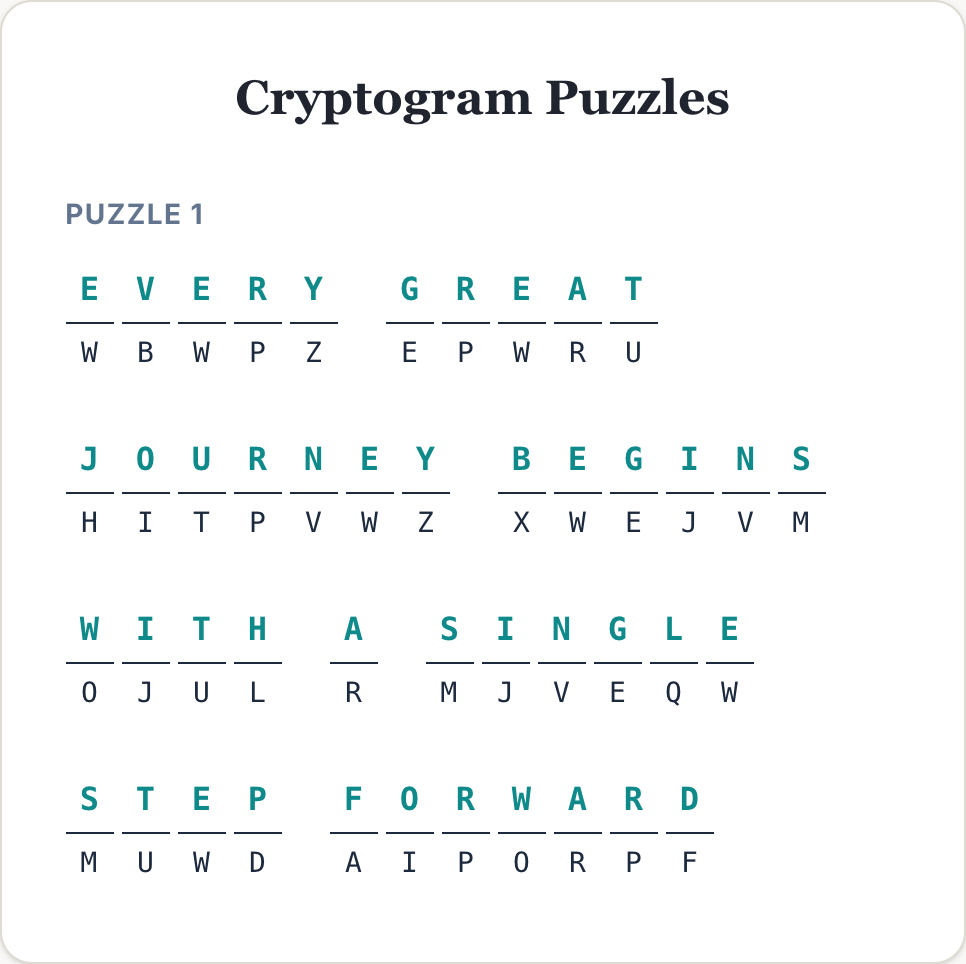
Here is the completed answer for the puzzle above. Every coded letter has been replaced by its true plain-text letter, revealing the hidden quote in full.
Once letter-substitution ciphers feel comfortable, the same pattern-spotting skills transfer naturally to other puzzles. Try sharpening your vocabulary with a free printable word scramble, or challenge your logic with a printable Sudoku puzzle. For a full breakdown of another word puzzle format, read our word scramble solving guide.
Frequently Asked Questions
How do you solve a cryptogram for beginners?
Start by applying any given hint, then count which coded letter appears most often: it is usually E or T. From there, look for one-letter words (A or I) and three-letter words that could be THE. Each confirmed letter fills in multiple blanks at once, and the puzzle falls into place faster than it looks.
What is frequency analysis and how does it help?
Frequency analysis is the technique of counting how often each coded letter appears in the puzzle and matching the most frequent ones to the most common letters in English: E, T, A, O, I, and N. Because a cryptogram substitutes letters consistently, a coded letter that appears 12 times in a 60-letter puzzle is very likely E. Al-Kindi described this method in the 800s, and it remains the core tool for how to solve a cryptogram today.
Can you solve a cryptogram without the starter hint?
Yes. The starter hint speeds things up, but frequency analysis, one-letter words, and THE-spotting work on any letter-substitution cipher regardless of hints. Longer puzzles with more text are actually easier to crack without a hint because more letter repetitions give you more frequency data to work from.
How long does it take to solve a cryptogram?
A short quote of 40 to 60 letters with one hint typically takes 5 to 15 minutes for a first-time solver. With practice, most people crack a standard puzzle in under 5 minutes. The biggest time saver is learning to spot THE quickly, because confirming three letters in one step usually breaks the puzzle wide open.
Live demo
Make your own cryptogram right here
Swap in your own words (a spelling list, residents' names, a unit's vocabulary) and press Generate. The full maker adds answer keys, size options and PDF export.
More you can make here
One puzzle is the start. Here is the rest of the kit.
 New
NewWorksheet Builder
Put a word search, a cryptogram and a scramble on one page, or build a whole themed packet. Prints with answer keys.
Build a worksheet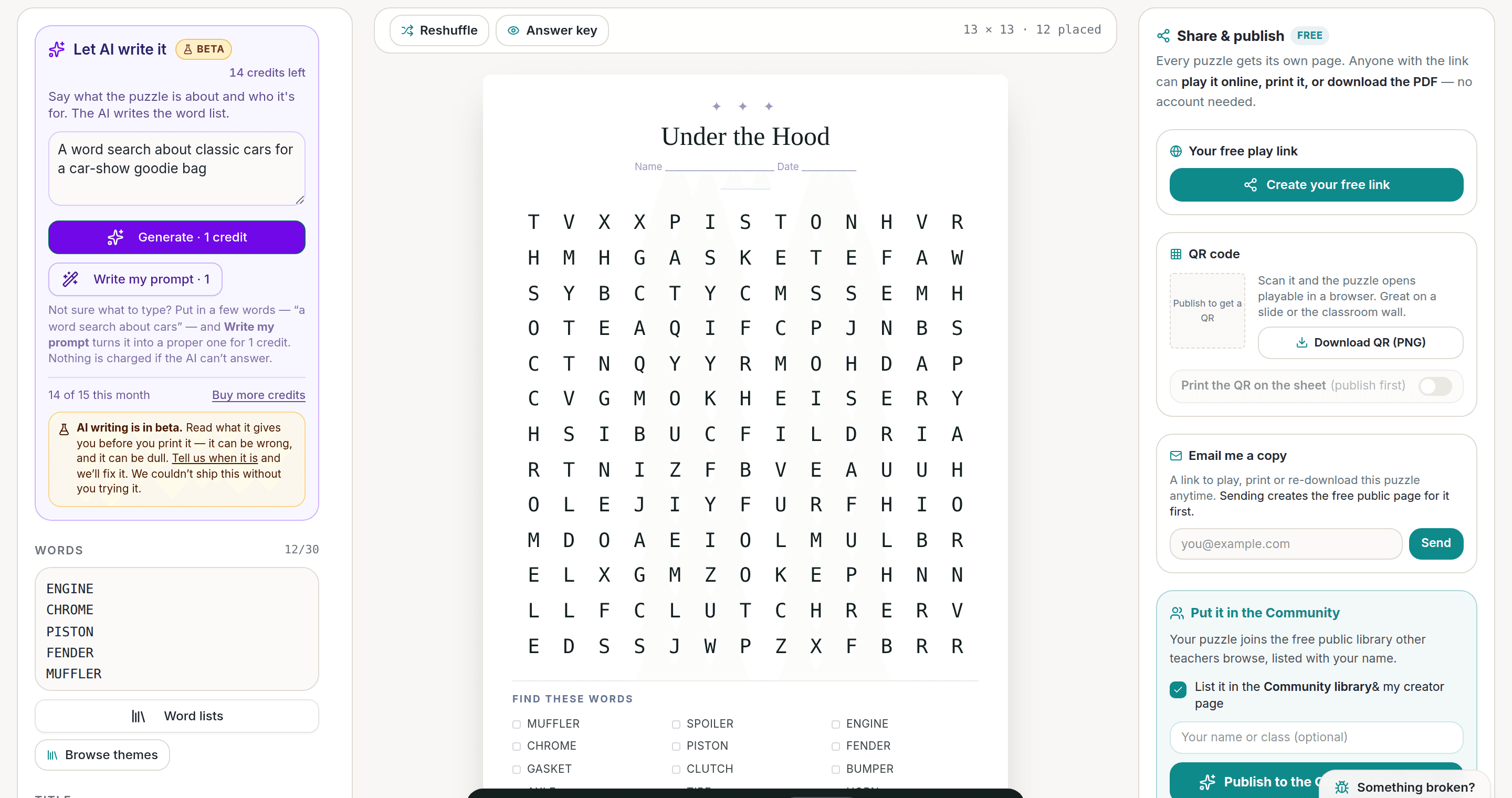
AI Puzzle Generator
Type a topic, get a themed word list and a finished puzzle. Premium also removes the footer credit and adds Word export.
Try the AI generator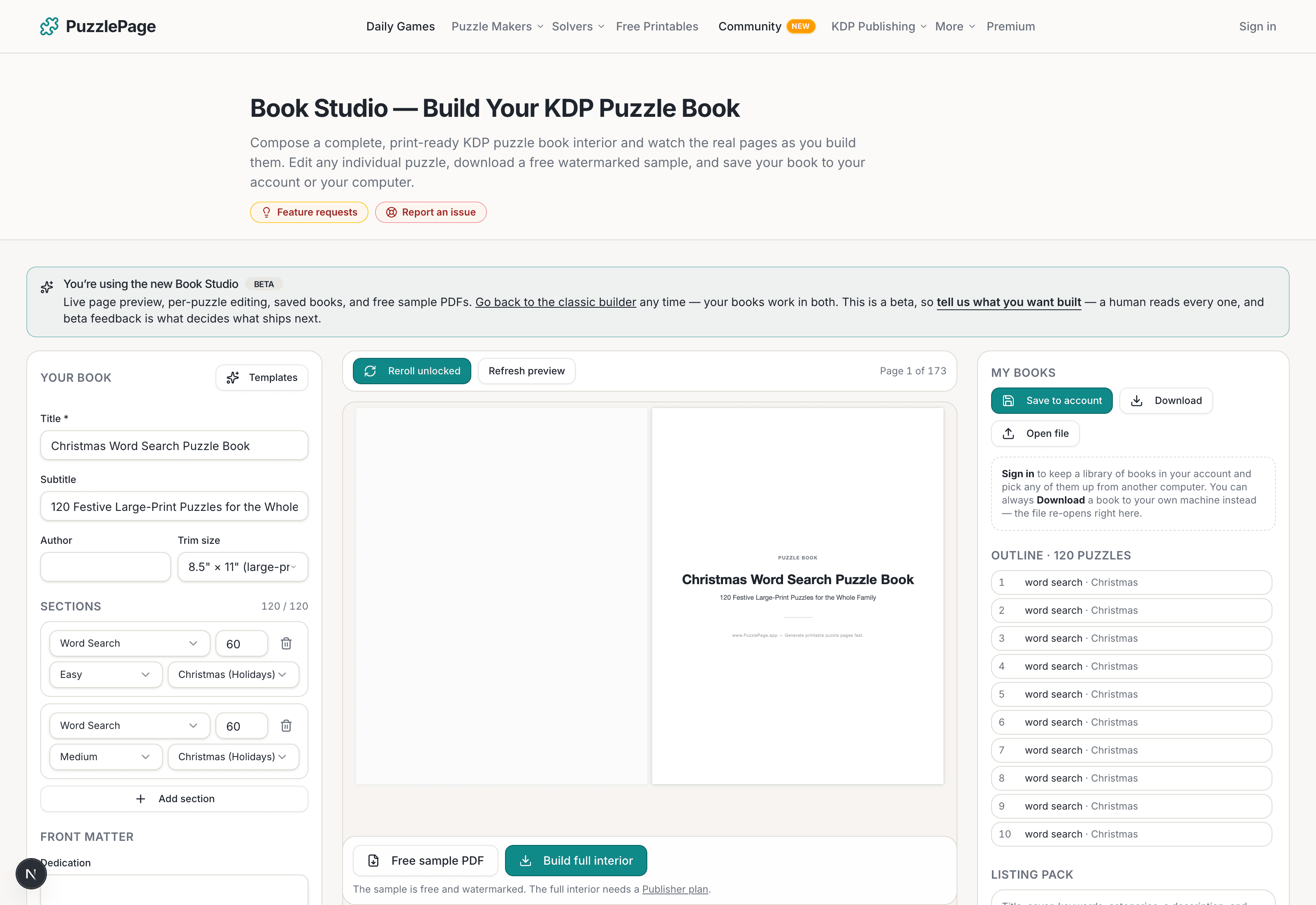
KDP Book Studio
Lay out a full puzzle book for Amazon KDP: templates, trim sizes, page checks and a cover designer.
Start a puzzle book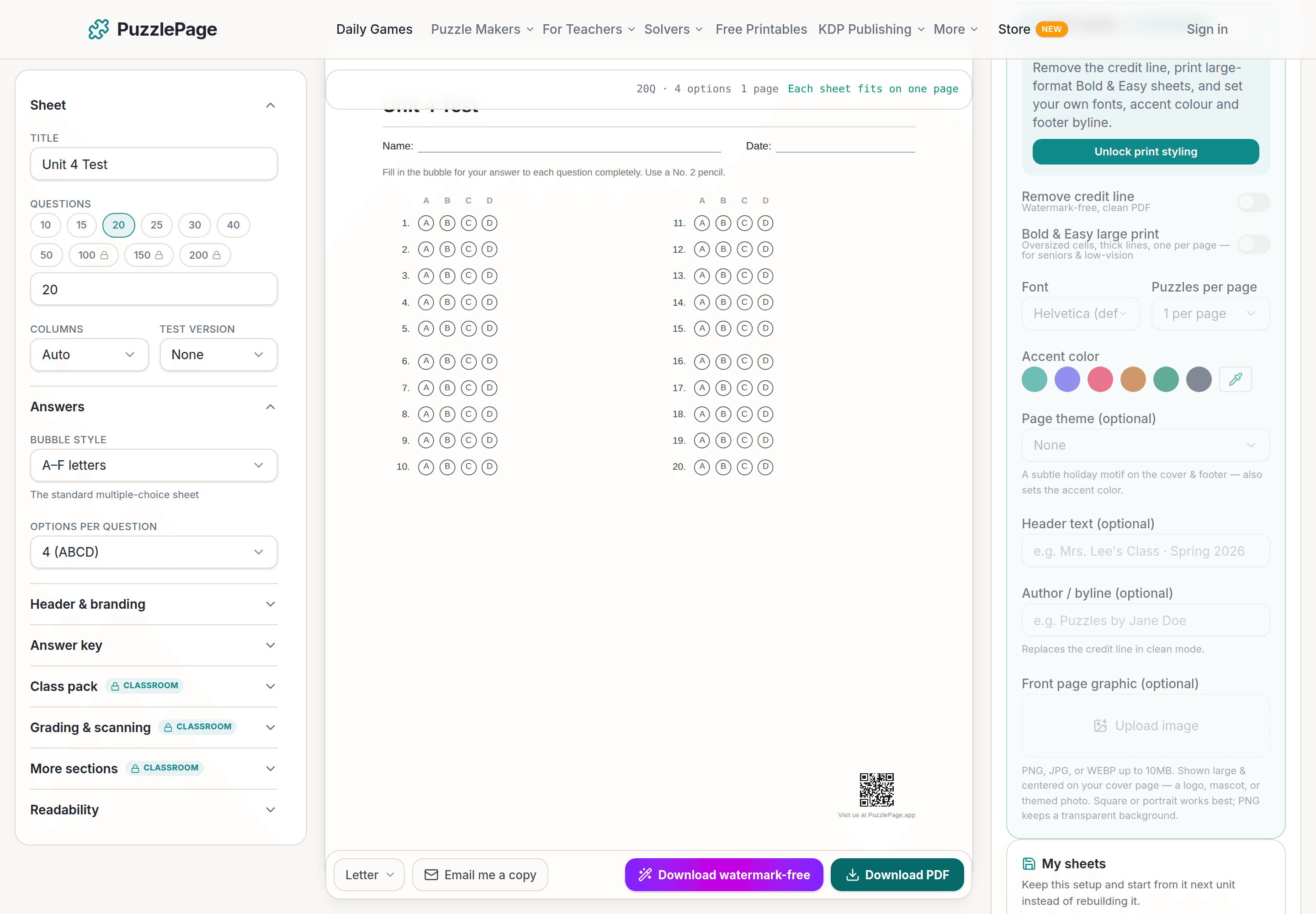
Bubble Sheet Studio
Answer sheets for any test length, with sections, versions, student ID grids and a matching answer key.
Make a bubble sheetPremium removes the footer credit, adds Word export and custom styling across every maker.
See plans →Free daily games
Need a two-minute break? Today's puzzles are live.
A new Sudoku and a new Connections board every day. No download, no account.


Keep reading
Take the puzzle with you
Free Cryptogram PDF — Practice Cryptogram
Print-ready · answer key included · unsubscribe anytime
Enjoyed this? Share the puzzle on X
Like puzzles like this? Follow on Pinterest for a new one every day.