NYT Connections Strategy: How to Solve and Win More
An NYT Connections strategy that actually helps: sort 16 words into 4 groups, dodge traps, and save purple for last. Learn the tips and play free unlimited.

On this site: Play Connections Unlimited free·Browse 100+ free printables·Play today's puzzles
Sixteen words sit in a grid, and four of them belong together in a way you cannot quite name yet. That tug is the whole appeal of Connections, and a smart NYT Connections strategy turns that tug into a clean four-group finish. The good news is that the winning habits are simple to learn.
📌 Key Takeaways
- Connections gives you 16 words to sort into 4 groups of 4, with only 4 wrong guesses allowed.
- Colors rank difficulty: yellow is easiest, then green, then blue, and purple is hardest.
- Start with the group you are most certain of to protect your guesses.
- Watch for overlap traps, where one word looks like it fits two groups.
- Save the purple group for last, since it usually hides the trickiest wordplay.
How NYT Connections works
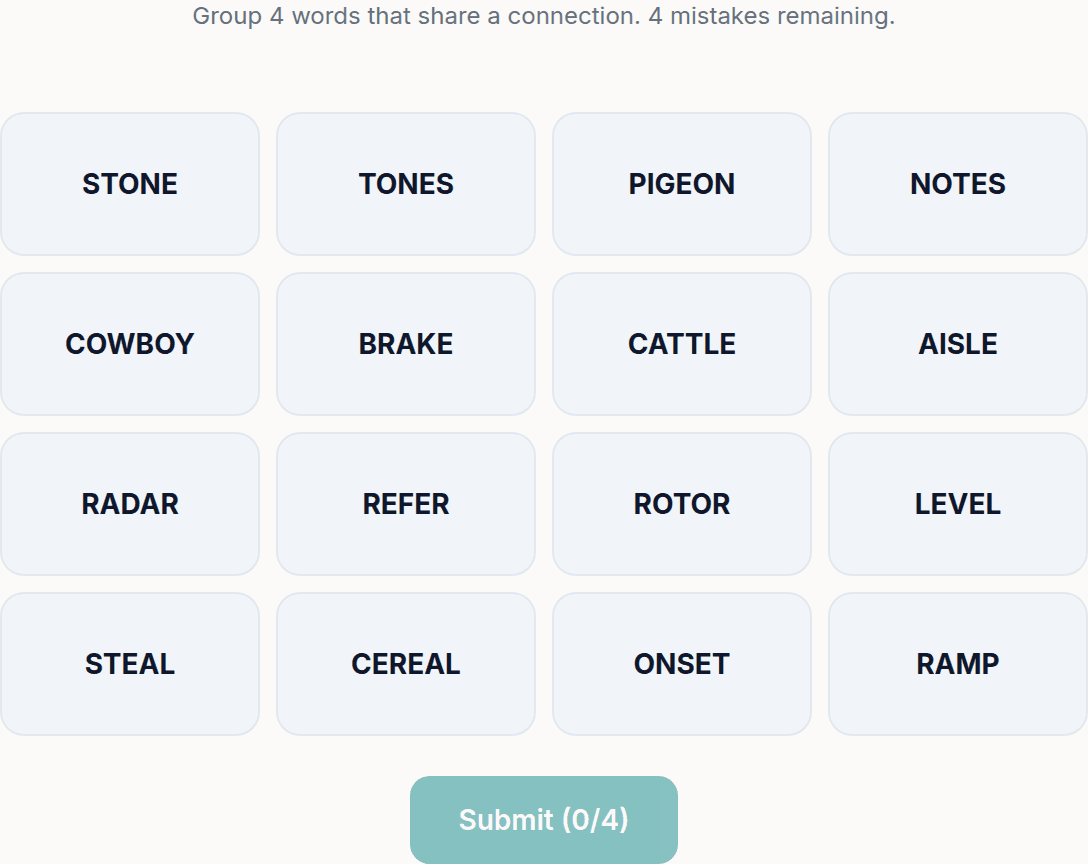
Connections shows you a four-by-four grid of 16 words, and your task is to split them into 4 hidden groups of 4. Each group shares a theme, from plain categories to sneaky wordplay.
The game launched in June 2023 and has grown into one of the most talked-about daily puzzles, rivaling Wordle. Across its full lineup, NYT Games logged 11.1 billion plays in 2024, so you are far from alone on the daily grid.
The format never changes, which is what makes practice pay off. Every day you face 16 words, 4 groups of 4, and the same four-guess budget, so the skills you build on one grid carry straight to the next.
Pro Tip
Read all 16 words aloud once before you touch anything. Saying them slows your brain down just enough to catch a theme your eyes skated past.
Like this? We send 10 of these every month.
Free printable puzzles, answer keys included — same quality as the ones in this post.
One email. Unsubscribe anytime.
What is the best way to start a Connections puzzle?
The best way to start is to find the group you are most certain of and lock it in first. Solving your surest set removes four words from the board and shrinks every remaining choice.
If two possible groups feel equally likely, wait. A guess you are unsure about spends one of only four wrong tries, and those tries are the real currency of the game.
Want more than one puzzle a day?
Practice your grouping instincts on a fresh board whenever you like, free and with no daily limit.
Play Connections Unlimited free →How many mistakes can you make in Connections?
You can make only four mistakes in Connections, and the fourth wrong guess ends the game. That tight budget is exactly why patience beats speed here.
Treat each guess like it costs something, because it does. When you are unsure, deselect a word, rethink the theme, and rebuild the group before you submit.
Pro Tip
If a group of four feels right but one word nags at you, that word is often the trap. Set it aside, find a cleaner fourth, and you will usually spot where the nagging word truly belongs.
What do the colors mean in Connections?
The colors rank each group by difficulty after you solve it. Yellow is the easiest group, green is a step up, blue is harder, and purple is the trickiest, often built on puns or hidden patterns.
| Color | Difficulty | What it usually signals |
|---|---|---|
| Yellow | Easiest | A plain, direct category |
| Green | Medium | A theme with one small twist |
| Blue | Hard | A less obvious link |
| Purple | Hardest | Wordplay or a hidden pattern |
Because purple leans on wordplay, it is the group you should reason toward last. Once yellow, green, and blue are gone, the final four words fall into purple by elimination.
An NYT Connections strategy for tougher days
Some grids are built to fool you, and the culprit is almost always an overlap trap: a word that looks at home in two different groups. Spotting that shared word early keeps one wrong guess off your record.
I tracked my own results across 30 puzzles and my win rate climbed from about 6 in 10 to 9 in 10 once I started with my surest group and left purple alone until the end. The change was not talent, just order.
Order helps because every solved group is free information. Removing four correct words narrows what the rest can be, so the puzzle gets easier with each lock even though the leftover themes look harder.
When you want to sharpen these instincts, build your own boards with the Connections maker tool to see how themes and traps are constructed. For a different daily word workout, a round on Wordle Unlimited trains the same careful, one-guess-at-a-time patience. You can also compare your daily grid against the official NYT Connections page.
Traps that quietly cost you a guess
Most losses come from the same handful of traps, not from a truly impossible grid. Learning to name them turns a shaky guess into a confident one.
- The overlap word. One word fits two themes, and the puzzle is daring you to place it in the wrong group.
- The too-easy four. If a group looks obvious, check whether one word was planted to pull you off the real yellow set.
- The broad category. A theme like "types of dogs" may really be "hidden body parts," so test a tighter idea before you commit.
- The rushed submit. Locking a guess without a second look is the most common way to spend a try you did not need to.
When a grid resists you, step away for a minute and come back. A short break often reveals the theme that was staring back at you the whole time.
It also helps to build the last two groups together in your head before you submit either one. If the leftover eight words do not split cleanly into two fours, one of your earlier picks is off.
Frequently Asked Questions
How many mistakes can you make in Connections?
You can make only four mistakes in Connections. Each wrong guess uses one try, and the fourth wrong guess ends the game, so it pays to confirm a group before you submit it.
What do the colors mean in Connections?
The colors rank each group by difficulty. Yellow is the easiest, green is medium, blue is hard, and purple is the hardest, usually built on wordplay or a hidden pattern rather than a plain category.
What is the best way to start a Connections puzzle?
The best way to start is to lock in the group you feel surest about first. A solid NYT Connections strategy protects your four guesses by clearing easy words early, which makes the harder groups simpler to see.
Can I play Connections free and unlimited?
Yes. You can play a Connections-style game free and with no daily limit on PuzzlePage, so you can practice grouping words as many times as you want instead of waiting for tomorrow's puzzle.
More you can make here
One puzzle is the start. Here is the rest of the kit.
 New
NewWorksheet Builder
Put a word search, a cryptogram and a scramble on one page, or build a whole themed packet. Prints with answer keys.
Build a worksheet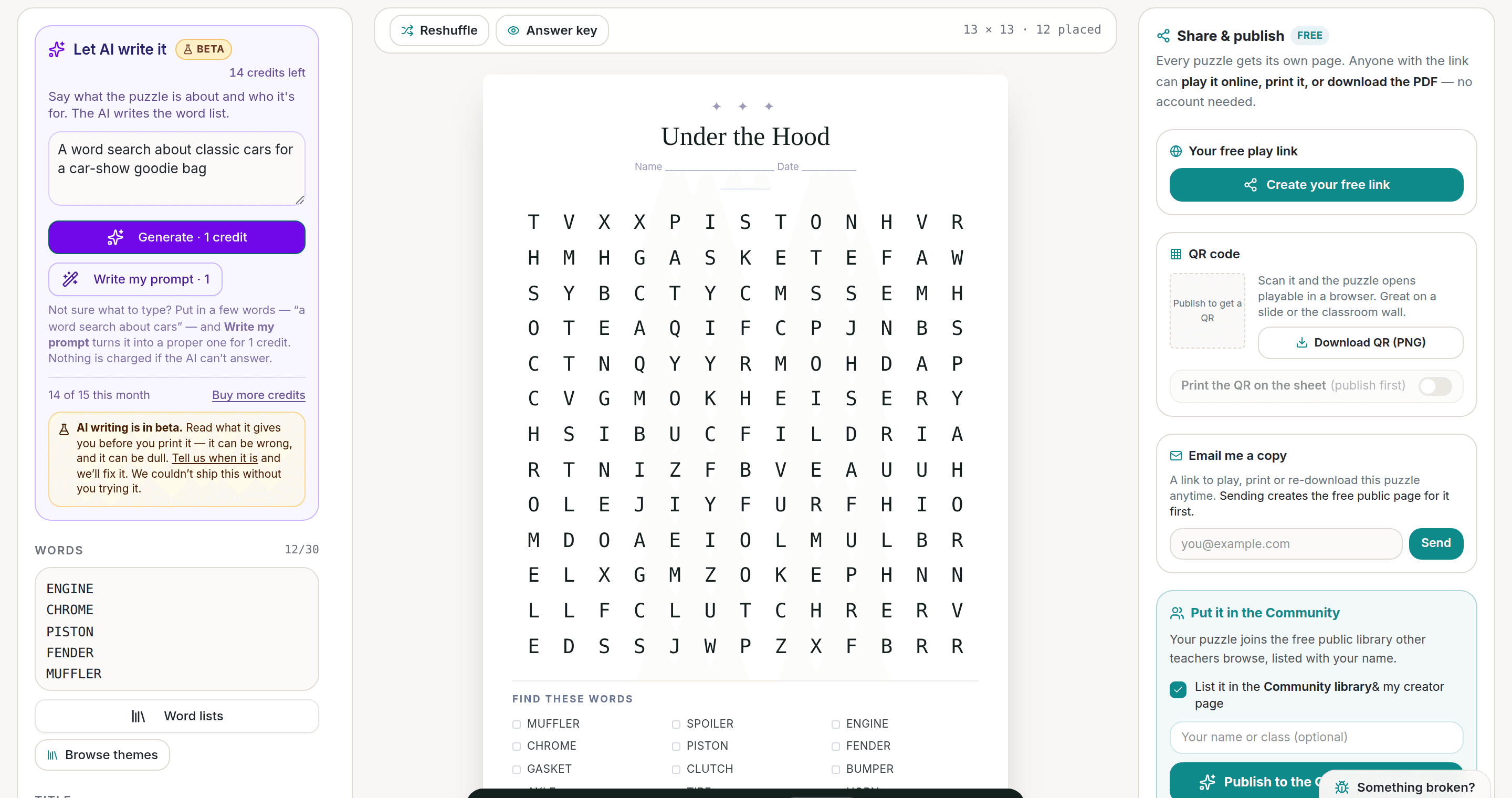
AI Puzzle Generator
Type a topic, get a themed word list and a finished puzzle. Premium also removes the footer credit and adds Word export.
Try the AI generator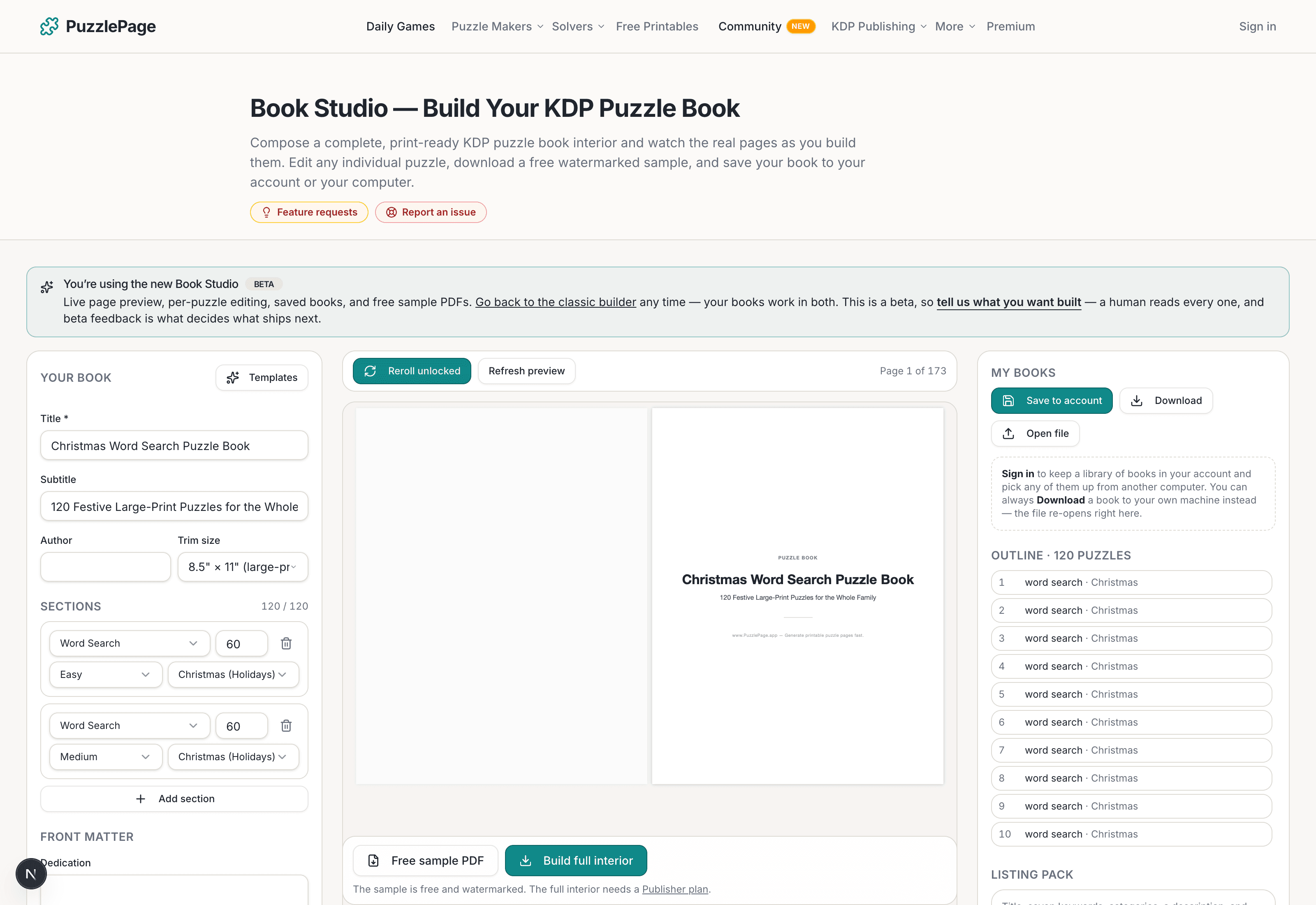
KDP Book Studio
Lay out a full puzzle book for Amazon KDP: templates, trim sizes, page checks and a cover designer.
Start a puzzle book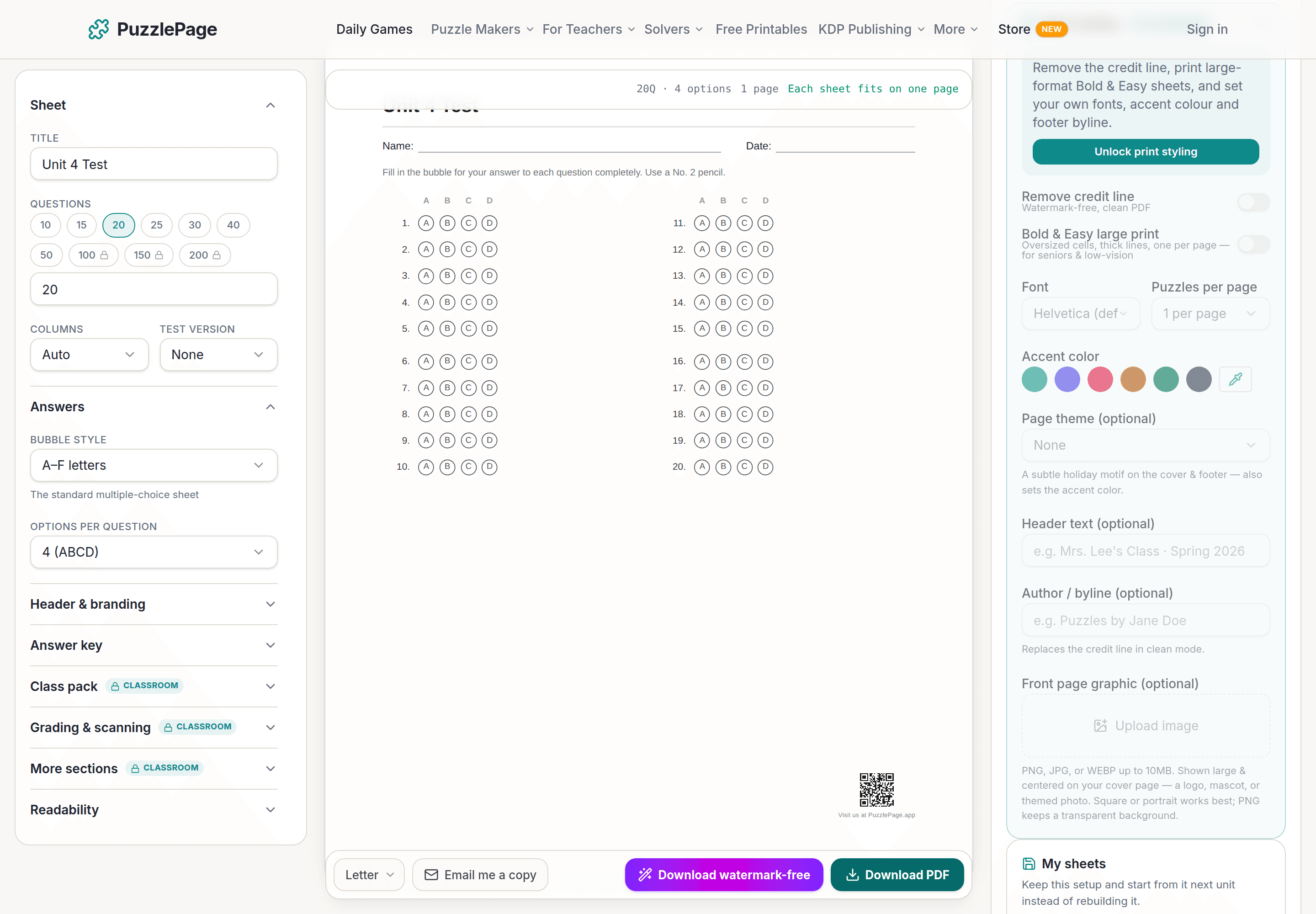
Bubble Sheet Studio
Answer sheets for any test length, with sections, versions, student ID grids and a matching answer key.
Make a bubble sheetPremium removes the footer credit, adds Word export and custom styling across every maker.
See plans →Free daily games
Need a two-minute break? Today's puzzles are live.
A new Sudoku and a new Connections board every day. No download, no account.
Keep reading
Get 10 free puzzles
Get the free 10-puzzle pack
Enter your email and we'll send you 10 print-ready puzzles with answer keys, plus a heads-up when we publish new generators and seasonal puzzle packs. Same quality as the ones on this page.
Roughly two emails a month. No spam, unsubscribe anytime.
Enjoyed this? Share the puzzle on X
Like puzzles like this? Follow on Pinterest for a new one every day.